Game review
Rita Review
8.5 / 10
- Developer
- SporkTank
- Publisher
- SporkTank
- Released
- 30 July 2026
- Platforms
- ["Windows", "Mac"]
- Genre
- Puzzle Platformer
A Chicken, A Crossword, And A Grandmother
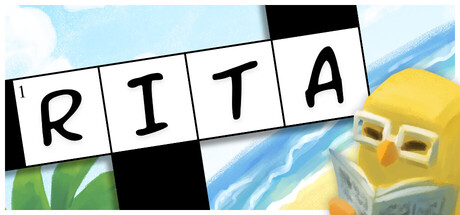
Rita, a cozy puzzle-platformer from solo studio SporkTank, released in full on Steam on July 30, 2026 after nearly a year of demos, festival showings, and a Steam Next Fest appearance, priced at $14.99. Its premise sounds almost too whimsical to take seriously on paper: a chicken named Rita explores a small seaside town, collecting scattered letters and using them to solve newspaper-style word puzzles, crosswords, word searches, anagrams, cryptics, that physically reshape the world around her, opening bridges, unlocking paths, and helping her neighbors along the way. What that premise doesn't convey is that Rita is also, unmistakably, a game about grief, memory, and the specific ritual of doing puzzles with a grandparent, and the 153-review pool backing its "Very Positive" 99% Steam score is dominated by players who say the game caught them completely off guard with how much it made them feel.
The Puzzle Mechanic Reviewers Keep Calling Unique
The core loop, collecting letters scattered through a 3D platforming space and then spending them on word puzzles that alter the environment, draws consistent praise for how it avoids the single-mechanic fatigue that sinks a lot of puzzle games. One reviewer summed it up cleanly: "It jumps between crosswords, word searches, anagrams, and other word puzzles, so you are not solving the exact same thing over and over," while another called the world-altering feedback loop "the really cool element of the game design," giving the concrete example of solving for the word "bridge" and watching one appear in the world moments later. A reviewer who logged nearly sixteen hours on the game, having first seen it at PAX years earlier, praised "a really nice mix of exploration, a range of word puzzles, and some really funny jokes whenever I least expect them," while another compared the collectathon structure favorably to Banjo-Kazooie, complete with island hub worlds and sports-day-style side challenges for each area's cast of denizens.
Difficulty That Splits Along Language Lines
Not every reviewer finds the puzzles equally approachable, and the fault line that emerges most clearly is language fluency rather than puzzle-solving skill. One reviewer, self-identifying as a non-native English speaker, wrote candidly: "I don't know words, which is the main part of feeling happy from word puzzles. Unlike non-word puzzles, I am presented rules and I can logic it out, if I just don't know words, I have to look them up to continue," ultimately concluding they still liked the game despite the friction. Another non-native speaker took a more resigned but positive tone: "Had to cheat only 2 times as a non-native speaker," while a third suggested it could double as an English-learning tool, "kids learning english would love this too." A reviewer with a background as a puzzle enthusiast flagged the opposite complaint, that some of the numeric puzzles have answers that felt arbitrary: "I know how hard it is to make good puzzle so I'd say they did an incredible job... except the numbers one I didn't like that one, 2 of the answers were bs." Between these two poles, easy for puzzle veterans but occasionally opaque for non-native speakers, and occasionally unfair even for puzzle veterans on specific puzzle types, Rita's difficulty curve reads as generally well-tuned but not universally frictionless.
A Story That Blindsides Almost Everyone
If there's one throughline uniting nearly the entire review pool, positive or mixed, it's that Rita's emotional narrative lands far harder than its cute chicken aesthetic prepares players for. The pool's single most striking review describes a player who lost a grandmother a decade ago and never got to say goodbye, writing through what they describe as tear-filled eyes about how the game reminded them to cherish time with their one remaining living grandparent before an upcoming visit. That's an extreme, deeply personal reaction, but it's echoed in more measured language across dozens of other reviews: "the personal message at the end was endearing, I admire the developers bravery," "I really liked the message and personal connection to the dev," and "the story throughout reminded me of my nana and how the little things that you grew up with from them stick around." One reviewer, aiming for a more clinical assessment, still landed on: "The surprisingly poignant story and characters work together with the charming chicken puzzle gameplay to create a touching emotional journey which deeply affected me." For a game built around a silly premise and blocky, deliberately simple graphics, that consistency of emotional impact across dozens of independent reviewers is a genuinely rare achievement.
Rough Edges: Camera, Performance, And Accessibility
The criticism that does surface in this pool tends to be specific and technical rather than structural. Several reviewers flag the fixed or semi-fixed camera as a recurring annoyance, one calling "the sudden camera movements" a source of mild frustration during platforming, another describing the "semi-fixed camera" as "annoying at times" even while otherwise recommending the game. A reviewer running a high-end 3090 graphics card reported the game capping at roughly 20 frames per second with no obvious settings to fix it, a legitimate performance red flag for a game with relatively simple, blocky visuals that shouldn't tax modern hardware. Most pointedly, one reviewer flagged a specific accessibility gap: "some race achievements may be not obtainable for persons with disabilities, that's kinda sad for such a cozy puzzle game," a criticism that lands with extra weight precisely because Rita otherwise goes out of its way to be a low-stress, welcoming experience. A separate reviewer noted that demo save data does not transfer into the full game, a minor but avoidable friction point for anyone who invested time in the earlier demo build expecting continuity.
Short, Replayable Once, And Built For Sharing
Most reviewers converge on a completion time between four and seven hours to fully finish and 100% the game, short by the standards of most $14.99 releases but consistently described as the right length for what Rita is trying to do rather than a shortfall. Multiple reviewers specifically highlight playing it with family, a non-gamer spouse, or kids as young as seven, one parent reporting that their two children ended up solving puzzles faster than they could once they got past being amused by the blocky graphics. That family-friendly, low-stakes framing extends to its Steam Deck compatibility, praised by several reviewers, and to its broad difficulty accessibility for English learners of all ages, even where that same accessibility occasionally produces the language-fluency friction noted above. It's a game clearly built to be handed to someone who doesn't normally play games, and the review pool's repeated stories of shared playthroughs with partners, kids, and Twitch chat suggest that design goal is landing.
Verdict
Rita is a small, quietly extraordinary puzzle-platformer that uses newspaper-style word games as a surprisingly effective delivery mechanism for a story about memory, loss, and generational connection, and its 153-review pool's near-unanimous "Very Positive" score reflects a genuine, rare consensus rather than hype. The puzzle variety keeps the four-to-seven-hour runtime from ever feeling repetitive, the difficulty curve is well-judged for puzzle veterans even if non-native English speakers will hit real friction on word-dependent clues, and the handful of technical complaints, camera jitter, an unexplained frame-rate cap on powerful hardware, and a real accessibility gap on some timed race achievements, are specific and fixable rather than fundamental. At $14.99 for an experience multiple reviewers describe crying through, and that families report bonding over, Rita earns its glowing reception: a cozy, unassuming little game that turns out to be about something much bigger than its premise lets on.
Screenshots
-
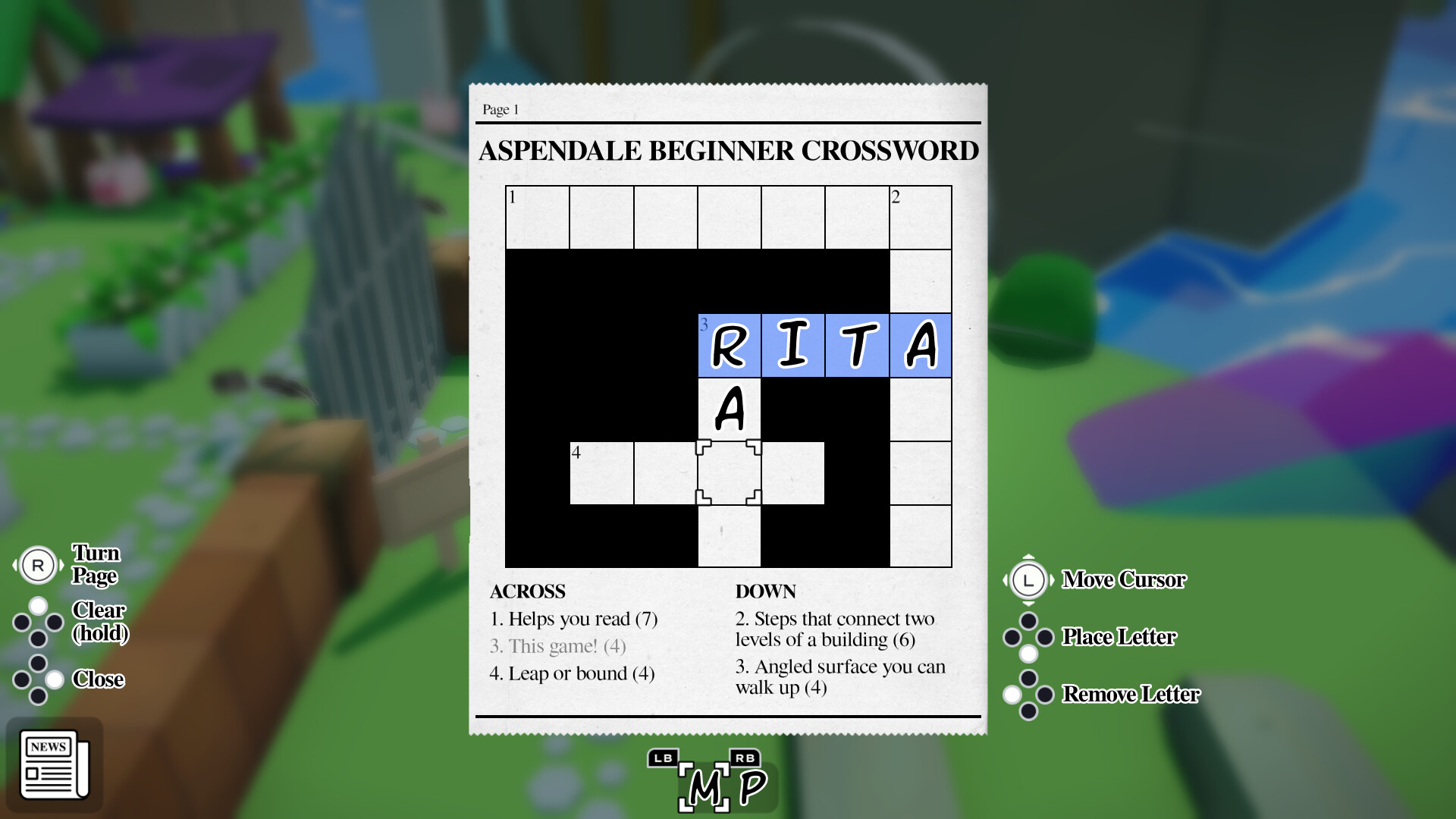
The 'Aspendale Beginner Crossword,' one of many newspaper-style puzzle pages layered directly over the 3D world.Image: SporkTank via Steam -
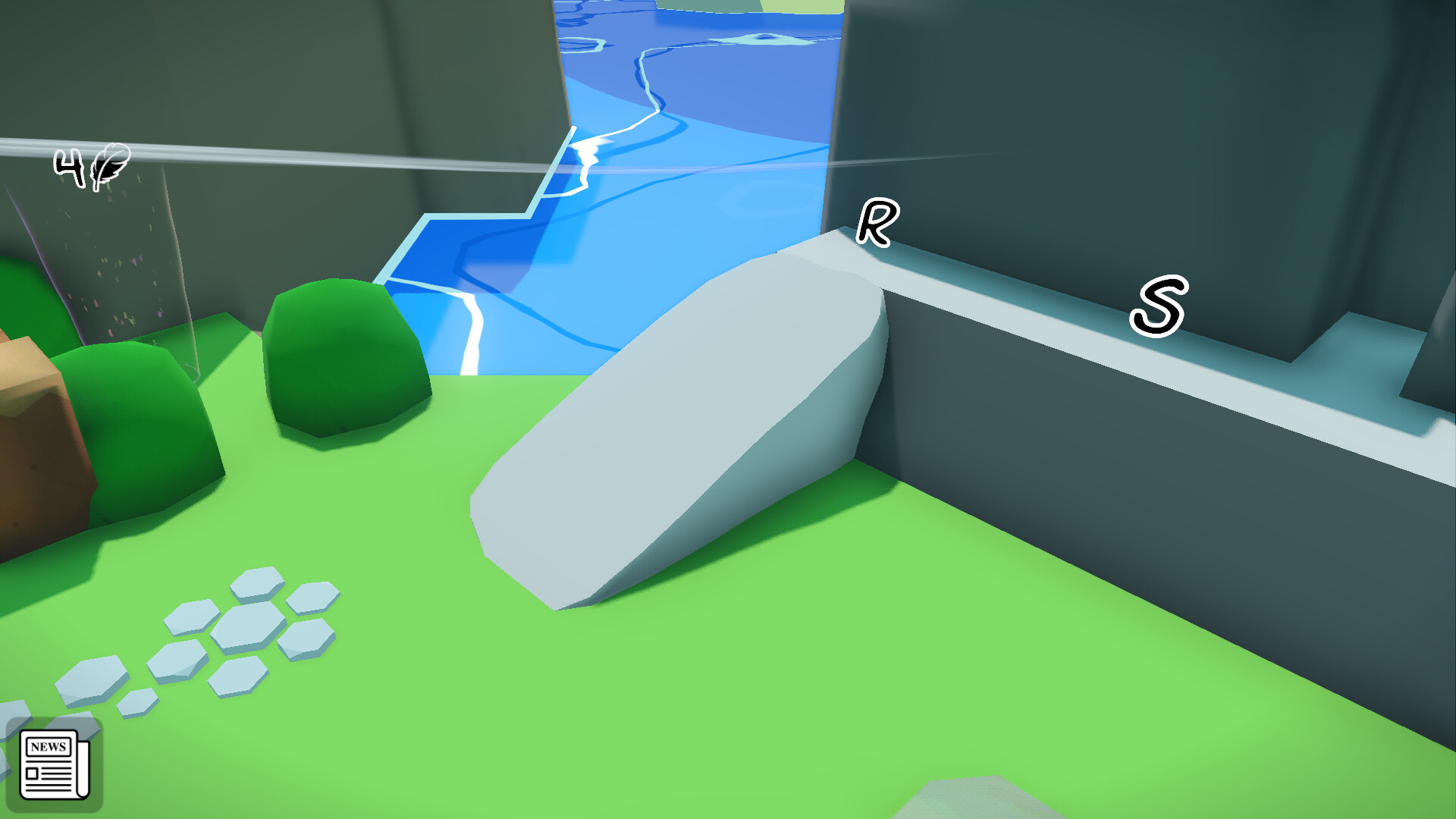
Letters like this floating 'R' and 'S' are scattered through the environment, waiting to be collected for the next puzzle.Image: SporkTank via Steam -
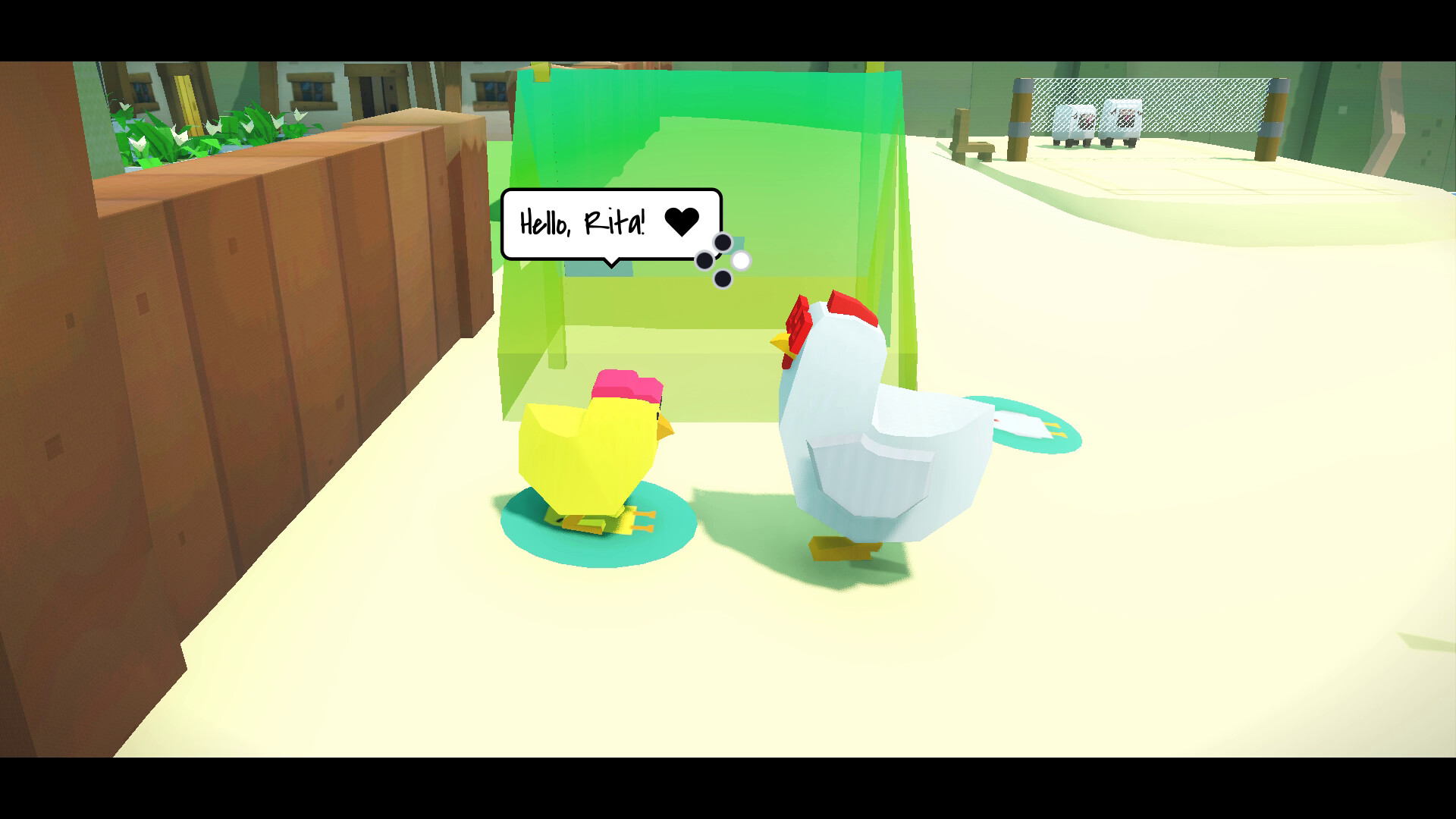
A warm farmyard greeting hints at the generational story running underneath the puzzles.Image: SporkTank via Steam