
Game review
Doki Doki Literature Club!
7.5 / 10
- Developer
- Team Salvato
- Publisher
- Team Salvato
- Released
- 6 October 2017
- Platforms
- Windows, macOS, Linux
- Genre
- Psychological horror visual novel
- Monetisation
- Completely free, with an optional paid "Plus" edition released separately in 2021 adding new content, voice acting, and merchandise support; the original free version reviewed here has never carried ads or in-game purchases
- Players
- None; single-player only
The short version
Doki Doki Literature Club! is built entirely around a bait-and-switch, and the honesty of its own marketing is part of the trick: the store page plays its dating-sim premise completely straight while ending with a blunt content warning that this "is not suitable for children or those who are easily disturbed." Reviewers who go in cold consistently describe the same experience — charmed by the opening hours, then unsettled by how deliberately and specifically the game subverts the genre's own comforting conventions from within. That subversion touches serious, real subject matter, including self-harm, suicide, and manipulative relationships, handled with a level of directness that a small but real minority of the review sample finds gratuitous or poorly earned rather than meaningful. What's not disputed is the craft: a genuinely novel use of the visual novel format's own file structure as a storytelling device, deployed with a specificity that still impresses reviewers writing years after the initial shock had already become common knowledge.
Biggest strengths
- A genuinely inventive use of the visual novel format itself as a storytelling and horror device, going beyond dialogue and branching choices into territory few games have replicated since
- The opening hours function as a legitimately well-written, charming dating sim in their own right, not just a thin setup for what follows
- Reviewers consistently describe the tonal and narrative turns as landing with real craftsmanship rather than shock for its own sake, even years after the surprise stopped being a surprise to most new players
Biggest weaknesses
- A small but real minority of reviewers find the handling of self-harm and suicide themes gratuitous or insufficiently earned relative to the shock value it generates, a fair critique given how serious the subject matter is
- Player choices are reported by more than one reviewer as having little to no effect on the eventual outcome, undercutting the sense of agency the dating-sim framing initially promises
- The pacing of the opening act is described by some reviewers as slow enough to test patience before the game's actual intentions become clear
Who it's for: Fans of horror and meta-narrative games who want a genre subversion built with real technical craft, and anyone curious about a genuinely influential piece of 2010s indie game history. Not suitable for anyone sensitive to depictions of self-harm, suicide, or manipulative relationship dynamics — the content warning on the store page is not a marketing gimmick.
Our recommendation: Worth experiencing for free, ideally with as little prior knowledge of the specific turns it takes as possible, and with a clear personal read on whether its subject matter is something you're currently in a good place to engage with.
7.5 / 10
Doki Doki Literature Club!'s own store page tells you almost everything and nothing at once: "The Literature Club is full of cute girls! Will you write your way into their heart?" followed immediately by "This game is not suitable for children or those who are easily disturbed." That juxtaposition is the entire design philosophy in two sentences. Released for free in October 2017 by Team Salvato, it became one of the most discussed independent games of its decade, spreading largely through word of mouth and video coverage rather than its own thin Steam review count — a reminder that a game's cultural reach and its Steam review numbers don't always track together. Its 223 English reviews are few for a game this influential, but they're consistently detailed, and reading them closely reveals a small, real disagreement about whether the specific way this game handles serious subject matter is a genuine achievement or a step too far.
A dating sim that plays itself completely straight
The opening hours commit fully to their genre. Reviewers describe real, unforced charm in the club's four members and the daily rhythm of writing poems to court them, and more than one notes this isn't a hollow setup — it works as a dating sim on its own terms before it becomes anything else. One reviewer's account captures how convincingly the misdirection lands: "Looks like a cute dating sim. It is not a cute dating sim. Go in blind, trust me. One of those games you can only truly experience once." That's the throughline across nearly every positive review in the sample — not praise for a twist itself, but for how completely and patiently the game earns the right to deliver one.
Serious subject matter, handled with real specificity
Where the game moves from horror-adjacent to something more direct, it engages with self-harm, suicide, and controlling, manipulative relationship dynamics — not as vague horror-genre texture, but as specific, named topics the narrative confronts directly. Several reviewers describe this as genuinely affecting rather than merely shocking: one writes that the game "changed my perspective on topics like obsession and suicide," while another, describing a difficult period in their own life, says the game "was there for me when I was at one of my lowest points." That's a meaningfully different register of praise than most horror games earn, and it's worth taking seriously as evidence the writing reaches for something more than a jump-scare.
It's also worth reporting the other side of that same coin plainly: a minority of reviewers push back specifically on how this content is deployed, with one detailed, more critical account describing frustration that serious self-harm imagery is used for shock value the reviewer felt wasn't fully earned by the writing around it. This isn't a case of one side being simply right — depicting mental illness and self-harm directly is a real creative choice with real stakes, and reasonable readers land in different places on whether this specific game's execution justifies it. The store page's own explicit warning suggests the developers were aware of exactly this tension rather than blind to it.
A genuinely novel trick, still impressive years later
Beyond the narrative content, reviewers single out a specific structural device: the game interacts with elements outside its own dialogue box, using the visual novel format's own underlying files as part of the storytelling in a way that was, at the time, genuinely without much precedent. One reviewer highlights this directly as a highlight: "it's also really cool that you can access the files and delete certain things/characters." That kind of mechanic has been imitated since, but reviewers writing recently still describe encountering it as a genuine surprise rather than a dated gimmick — a sign the specific craft involved, not just the shock of a first-time discovery, is doing real work.
The fair, more ordinary criticisms
Beyond the content debate, more conventional complaints appear too. More than one reviewer notes that player choices ultimately have little bearing on where the story ends up, undercutting the dating-sim illusion of agency the opening hours build up. Pacing draws some criticism as well — one reviewer admits the majority of the game "bored me to death" before what follows justified the patience required to get there, a fair warning for anyone expecting constant momentum rather than a slow-building setup.
A gap between cultural reach and its own Steam page
One detail worth stating plainly: a game this widely referenced, discussed, and imitated carries a surprisingly small Steam review count for its stature, and that gap is itself informative rather than a red flag. Doki Doki Literature Club! built its reputation substantially through free direct downloads, YouTube and streaming coverage, and years of cultural conversation that predate and extend well beyond its own storefront page — a reminder, consistent with lessons learned elsewhere in this research, that Steam review volume measures Steam engagement specifically, not a game's actual cultural footprint. The reviews that do exist here are unusually detailed and considered relative to their number, which this review reads as a sign of a genuinely engaged, if smaller-than-expected, Steam-specific audience rather than a thin or unremarkable one.
Verdict
Doki Doki Literature Club! remains a genuinely well-crafted, influential piece of interactive fiction — its opening hours work as an earnest dating sim, its structural tricks still land with real specificity years after they stopped being a secret, and its handling of serious subject matter clearly meant something real and personal to a meaningful share of the people who played it. It's also handling that subject matter directly enough that a fair-minded minority finds the execution more shock than substance, and the store page's own warning should be taken at face value rather than treated as horror-marketing boilerplate. Free, short, and still worth experiencing carefully.
Sources: Steam store page and appdetails API (release date, pricing, platform data, content descriptors, the store's own content warning text); Steam's aggregate review data (query_summary totals, English-language sample); individually read user reviews, both positive and negative, sorted by helpfulness and recency; Steam's global achievement statistics API (confirmed no achievement schema exists for this title).
Pros and cons
Pros
- A genuinely inventive use of the visual novel format itself as a storytelling and horror device, going beyond dialogue and branching choices into territory few games have replicated since
- The opening hours function as a legitimately well-written, charming dating sim in their own right, not just a thin setup for what follows
- Reviewers consistently describe the tonal and narrative turns as landing with real craftsmanship rather than shock for its own sake, even years after the surprise stopped being a surprise to most new players
- Being completely free removes any financial risk from trying a piece of genuinely influential game history
- The game addresses serious mental health subject matter directly rather than glancingly, which a meaningful share of reviewers describe as personally affecting in a way few games attempt
Cons
- A small but real minority of reviewers find the handling of self-harm and suicide themes gratuitous or insufficiently earned relative to the shock value it generates, a fair critique given how serious the subject matter is
- Player choices are reported by more than one reviewer as having little to no effect on the eventual outcome, undercutting the sense of agency the dating-sim framing initially promises
- The pacing of the opening act is described by some reviewers as slow enough to test patience before the game's actual intentions become clear
- Almost no replayability in the conventional sense once its central surprises are known, since the format depends heavily on a first-time experience
- The serious content warning is easy to dismiss as generic horror-game marketing until experienced directly, and at least one reviewer reports genuine, lasting emotional impact they weren't prepared for going in
Screenshots
-

Doki Doki Literature Club!Image: Team Salvato via Steam -

Doki Doki Literature Club!Image: Team Salvato via Steam -

Doki Doki Literature Club!Image: Team Salvato via Steam -
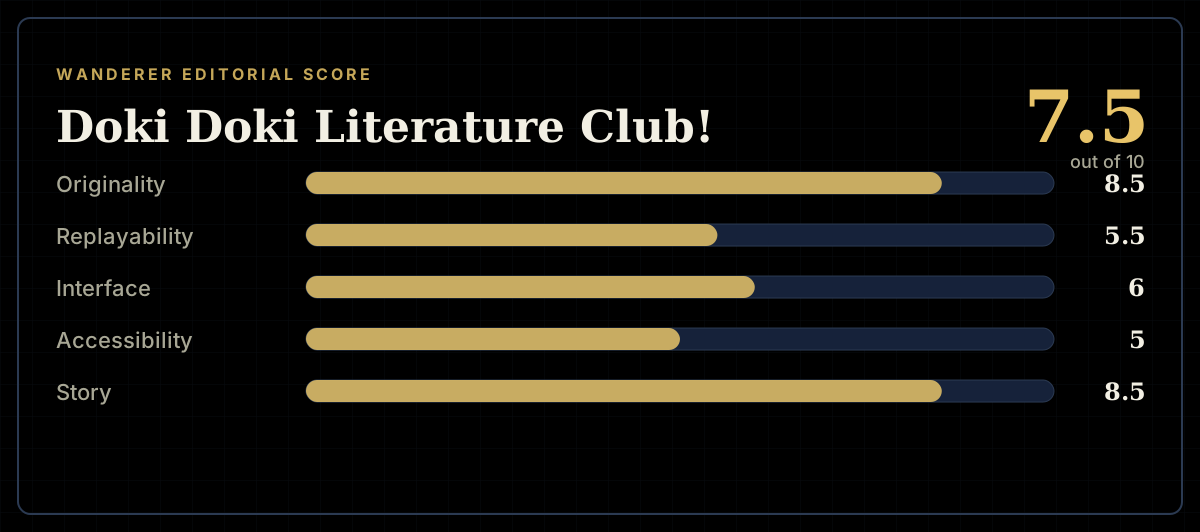
How the review scores each part of the gameWanderer Editorial -
The short versionWanderer Editorial