
Game review
Desperate Place
4.5 / 10
- Developer
- BruceGalaxy
- Publisher
- BruceGalaxy
- Released
- 21 April 2025
- Platforms
- Windows
- Genre
- Indie, Strategy
- Players
- Single-player
The short version
Biggest strengths
- A distinctive sci-fi crash-landing setup, gathering resources and repairing a damaged starship between waves, that several reviewers say hooked them immediately via the pre-release demo
- Genuinely well-made art direction and a wide roster of towers, units, heroes, and enemies that reviewers credit even when otherwise disappointed
- Attempts real narrative framing with dialogue and characters, an unusual and appreciated touch for a genre that rarely bothers
Biggest weaknesses
- Consistently and specifically compared to Thronefall as a close structural copy that reviewers say lacks that game's polish and player freedom
- Tower and building placement is locked to fixed, pre-selected slots with no free placement and no ability to sell or relocate structures once built, removing the strategic core the genre depends on
- Widely reported balance problems, including specialized towers that reviewers say frequently fail to counter the threats they're supposedly built for
4.5 / 10
Stranded, scripted, and compared to a much better game
Desperate Place puts you in the boots of a crew member waking up on a damaged colonization starship, stranded on a hostile alien planet, tasked with gathering resources, repairing the ship, and defending against waves of monsters to survive and eventually escape. That premise gives the game a genuine narrative hook most tower-defense titles skip entirely, and the pre-release demo clearly built real anticipation: "Absolutely love games like this and can't wait to sink hours upon hours into this. Playing the Demo really set the hook and now the game is finally out," one reviewer writes. But based on the available English-language review sample of 55 reviews — 29 positive, 26 negative, landing at an overall Mixed rating — that anticipation collided hard with a shipped game reviewers describe, again and again, in terms of one specific comparison.
"A reskin of Thronefall, but without the polish," one reviewer states in a review whose title alone functions as a complete verdict. That comparison to Thronefall, a well-regarded, tightly designed tower-defense hit, recurs across the negative sample as the central lens through which reviewers evaluate everything Desperate Place does differently, and every comparison lands unfavourably. A separate, more measured reviewer arrives at a similar conclusion while crediting real ambition: "I'm going to get ahead of the curb on this and say a game that at first glance seems to be inspired by Thronefall at least in terms of gameplay, having played for a little - there is story, characters with dialogue, the developer has really taken that gameplay and made it spark," though even this more generous reviewer frames the game's foundation as directly borrowed rather than original.
Fixed towers, no free placement, no selling
The single most consistent, most specific structural complaint concerns building placement, and it's the complaint that most directly explains why so many reviewers feel the game lacks real strategic depth. "Buildings were slotted into prelocations. You can't free build things in this game which is a huge let down. You can not sell buildings once built. Some maps the power is very limited and if you build too much well sorry that means you gotta start over now," one detailed reviewer writes, laying out precisely how restrictive the system is in practice. A separate reviewer makes the same point even more bluntly, describing the entire premise as false advertising: "there is no exploration, maps are tiny, you see the entire map as soon as you load into the game, there is almost no strategy - you can only pick the order you upgrade buildings, and you can max every building very quickly. It's barely a tower defence - defences are pre-selected and pre-placed, you can't move them."
The most heavily upvoted single review in the sample (93 votes, negative) frames the same rigidity as a deliberate design choice the reviewer simply disagrees with rather than a bug: "The design of the whole game being scripted and on rails... it's fine if the same waves come from the same locations every time you play a map and aren't random, and resource fields are static per playthrough," before going on to detail further specific frustrations with how little agency that design leaves the player once the initial layout is learned.
Balance problems and a targeting system reviewers call unfair
A second, distinct cluster of complaints concerns balance and combat mechanics rather than placement freedom. "There are huge balance issues with this game. Usually specialized towers deal with specific threats but in this game they just don't do what they're supposed to," one reviewer writes after reporting seven hours of genuinely enjoyed play before landing on a negative recommendation regardless — a pattern, enjoying real hours before concluding the game doesn't hold up, that recurs across several of the more detailed critical reviews. A separate reviewer's specific mechanical complaint about enemy targeting is worth quoting directly for how concretely it's stated: "my real gripe is with enemy fire being completely target locked, once an enemy fires at you, there is absolutely no way of avoiding the damage. Which is terrible, I can't stand it, its such a bad mechanic." That's a specific, structural complaint about player agency during combat, distinct from ordinary difficulty tuning, and it recurs in substance across multiple reviews even where the exact framing differs.
The achievement data corroborates the broad shape of these complaints. Across 33 total achievements, an early milestone sits at 94.4% completion, but the very next tier drops sharply to 47.1%, and the curve continues falling steeply from there down into single digits and fractions of a percent for late-game goals. That's a much steeper, earlier drop-off than this lane typically sees in games with a smoother difficulty curve, consistent with a playerbase that engages with the opening content in large numbers and then abandons the game in equally large numbers shortly after, rather than gradually thinning out across a well-paced mid-game.
Presentation gaps: translation, missing audio
Beyond the mechanical complaints, several reviewers flag more straightforward production issues. "It feels like cutscenes should have sound, while it does not. Grammar mistakes, most common is misplaced commas here and there," one reviewer notes, adding generously that the developers are likely not native English speakers before still flagging the issue as a real proofreading gap. A separate reviewer identifies the same translation problem independently: "the English translation still needs a lot of work which is annoying and can lead to confusion." These are more easily fixable issues than the structural placement and targeting complaints, but they compound the overall impression of a game that shipped before its rougher edges were sanded down.
What still works
It would be inaccurate to say nothing works here. Even the most detailed negative reviews consistently credit the art direction and content variety: "Game has a lot of well-made content. Towers, units, heroes, enemies and bosses. All with nice art style and diverse mission setups," one reviewer writes, immediately following it with "but everything feels like unfinished beta" — a pattern echoed across several reviews that separate genuine appreciation for the visual and content scope from disappointment in how that content actually plays. A smaller but real minority of the sample reports straightforward enjoyment without major reservations, including one reviewer who specifically wished only for more building placement freedom while otherwise finding the game fun.
Where this leaves it
Desperate Place arrives with a genuinely appealing sci-fi premise, real narrative ambition, and content variety that draws praise even from its harshest critics, but it's consistently measured against Thronefall by its own review base and comes up short on nearly every point of comparison: rigid, pre-placed towers with no free building or selling, balance issues that undercut specialized strategies, an unforgiving fully target-locked combat system, and rough English localization throughout. The achievement data's steep early drop-off supports the broader pattern of reviewers bouncing off the game once its initial hook wears thin. Worth a look only for genre completionists specifically curious about the sci-fi setting and willing to tolerate real structural rigidity; fans of Thronefall specifically looking for more of that game's freedom and polish should look elsewhere.
Pros and cons
Pros
- A distinctive sci-fi crash-landing setup, gathering resources and repairing a damaged starship between waves, that several reviewers say hooked them immediately via the pre-release demo
- Genuinely well-made art direction and a wide roster of towers, units, heroes, and enemies that reviewers credit even when otherwise disappointed
- Attempts real narrative framing with dialogue and characters, an unusual and appreciated touch for a genre that rarely bothers
- A short, low-commitment structure that several reviewers say delivers a few genuinely fun hours before its limitations become apparent
Cons
- Consistently and specifically compared to Thronefall as a close structural copy that reviewers say lacks that game's polish and player freedom
- Tower and building placement is locked to fixed, pre-selected slots with no free placement and no ability to sell or relocate structures once built, removing the strategic core the genre depends on
- Widely reported balance problems, including specialized towers that reviewers say frequently fail to counter the threats they're supposedly built for
- Enemy fire is fully target-locked with no dodge or avoidance mechanic once targeted, a specific mechanical complaint several reviewers call unfair rather than merely difficult
- Rough English translation and grammar throughout, plus reported missing audio during story cutscenes
Screenshots
-

Desperate PlaceImage: BruceGalaxy via Steam -

Desperate PlaceImage: BruceGalaxy via Steam -

Desperate PlaceImage: BruceGalaxy via Steam -
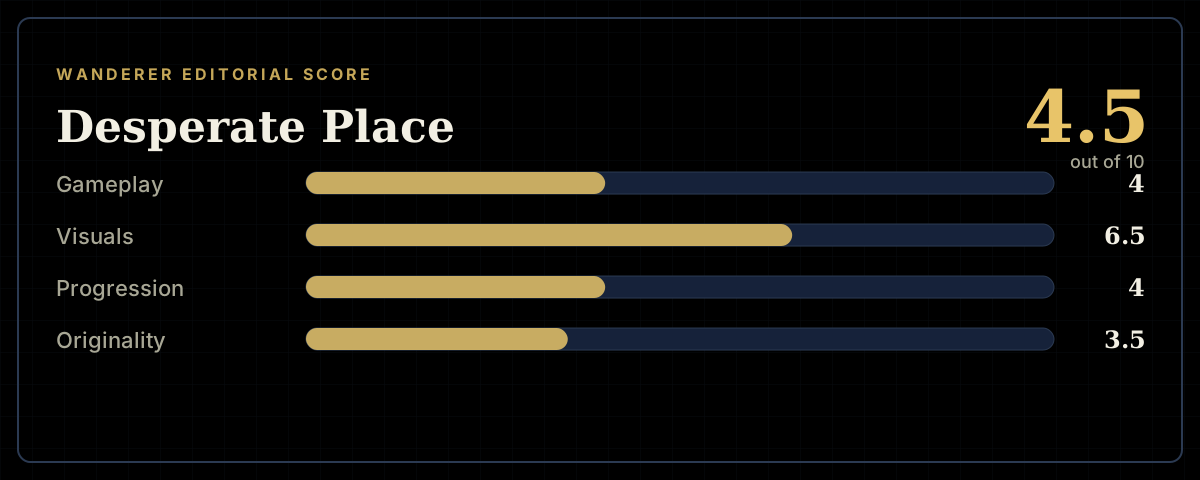
How the review scores each part of the gameWanderer Editorial -
The short versionWanderer Editorial