
Game review
Cradle of the Dark Brood Review
6.5 / 10
- Developer
- RyuseGames
- Publisher
- RyuseGames
- Released
- 12 June 2026
- Platforms
- ["Windows"]
- Genre
- Simulation
A Dark Fantasy Idler About Breeding Your Own Army
Cradle of the Dark Brood drops you in a "hostile corpse-world" with two starter critters and asks you to build an empire through selective breeding rather than direct combat control. One reviewer summarized the core loop cleanly: "You start with 2 critters and breed them. Then decide if a child is stronger or weaker and promote him to become one of the new parents. After multiple selective breedings your units become stronger and you start conquering the world." As creatures evolve, they mutate into new forms, "birds, amphibians, carnivors and so on," one reviewer wrote, each stage adding passive stats on top of the last. It's from RyuseGames, whose earlier release Idle Reincarnator is referenced by several reviewers as a spiritual sibling with a similar structural DNA, run-length prestige loops wrapped around a slow-building automation curve.
The Prestige Loop Clicks, Eventually
Reviewers who stuck with the opening hours consistently described a game that starts slow and then finds its rhythm once automation unlocks. "It starts a bit slow, but as you explore, the things get sped up," one wrote, while another put a number on the turning point: "once you reach the 4th stage/level and unlock prestige it starts escalating and getting faster and faster." A more experienced incremental-genre reviewer offered the strongest praise the game earned: "when I tell you that this one feels good to play, it should be an indicator... I could best describe the game as a shorter spiritual succession to a game like Trimps." Completion times clustered in the 14-to-34-hour range depending on playstyle, short by incremental-genre standards, which multiple reviewers treated as a genuine positive rather than a lack of content.
A Breeding System That Doesn't Reward Specialization
The most detailed critique aimed at the core mechanic itself came from a reviewer who dug into exactly how the five breeding stats interact: "you breed your creatures, selecting them based on 5 different stats that improve with each generation... but any thoughts of specializing on certain roles as a gameplay mechanic is immediately undercut by the fact that you kinda need all five equally for independent requirements." Other reviewers flagged a related balance issue where a single well-timed upgrade trivializes entire branches of the tech tree, one detailed a case where an early upgrade "will automatically produce enough Divine essence... to immediately reset and upgrade the ENTIRE RIGHT HALF OF THE PROGRESSION SYSTEM," undermining the sense that later choices matter. A different reviewer summed up the endgame disappointment: mid-to-late game, "you just find yourself leaving the housing side of the game alone," because prestige resets make earlier investments obsolete.
No Offline Progress Is the Genre's Cardinal Sin, and This Game Commits It
For a game built entirely around idle waiting, the single most damaging complaint is structural: progress only accrues while the game window is actually open. "NO OFFLINE PROGRESS, THE GAME MUST BE OPEN TO ADVANCE AT ALL," one frustrated reviewer wrote in full caps, treating it as the decisive flaw in an otherwise interesting game. Another reviewer, more measured but reaching a similar conclusion, said the idle stretches could get so long that "of course a lot of the idle time can be avoided if you figure out the systems and just abuse very poor prestige mechanics but then your 'play' time is not really worthwhile." For a genre whose whole appeal is checking in periodically while life happens elsewhere, an idler that punishes you for closing the window is a fundamental design mismatch, not a minor missing feature.
Reviewers Flag Undisclosed AI-Generated Writing
A specific and recurring accusation surfaces across multiple reviews: that the game's lore and story text were written using an LLM without being disclosed on the store page. One reviewer wrote, "the more text I read, the more I suspect most or the entirety of the game's lore was written by a LLM. If that is the case it hasn't been disclosed on the store page." Another was more direct: "Use of LLM AI. Most of the text in the game feels like it was written by AI. Low effort with no soul behind it." A third reviewer combined the complaint with a broader accusation about the developer's marketing conduct: "This dev uses shady tactics to promote this game and I got deceived by him as well. Generative AI slop that was not self-reported to Steam page, he hides this fact about AI, which can be acknowledged only from other players' comments." Not every reviewer who noticed AI-flavored text treated it as disqualifying, one recommending reviewer wrote "there is a bit of AI generated story text in between, but its not bad either," but the accusation of non-disclosure specifically is a consistent thread worth flagging to anyone considering a purchase.
Solid Bones, Rough Execution
The reviewers who came away satisfied generally credit the game's core evolutionary conceit and its pacing rather than any single standout system. "Automation comes about when you need it to, and pretty much everything can be automated after enough time," one wrote, calling it "fairly short for an incremental" but adding that "I feel I got more than my money's worth." Another highlighted the tonal shift as creatures evolve deeper into the corpse-world: the game "is more creepy and sad then the other game the dev has made so far, but the vibes made me want to know more." Even critical reviewers tended to frame their complaints as disappointment in unrealized potential rather than outright dislike, "I was very impressed with the potential here living within a very clean UI but ultimately there are way too many stats and systems that exist for their own sake."
Verdict
Cradle of the Dark Brood has a genuinely interesting hook, selective creature breeding as the engine for an idle-incremental power fantasy, and reviewers who bought in for its 15-to-30-hour runtime mostly came away satisfied with the pacing and the escalating sense of evolution. But it ships with real, specific problems that go beyond typical genre rough edges: a breeding system that doesn't actually reward specialization, prestige math that can trivialize half the tech tree in one move, a baffling lack of offline progress for a game built around idle waiting, and a cluster of reviews specifically accusing the developer of using undisclosed AI-generated writing. At $4.99 it's a reasonable gamble for incremental-genre fans who don't mind some jank, but the AI-disclosure complaints and the no-offline-progress design choice are worth weighing seriously before buying in.
Screenshots
-
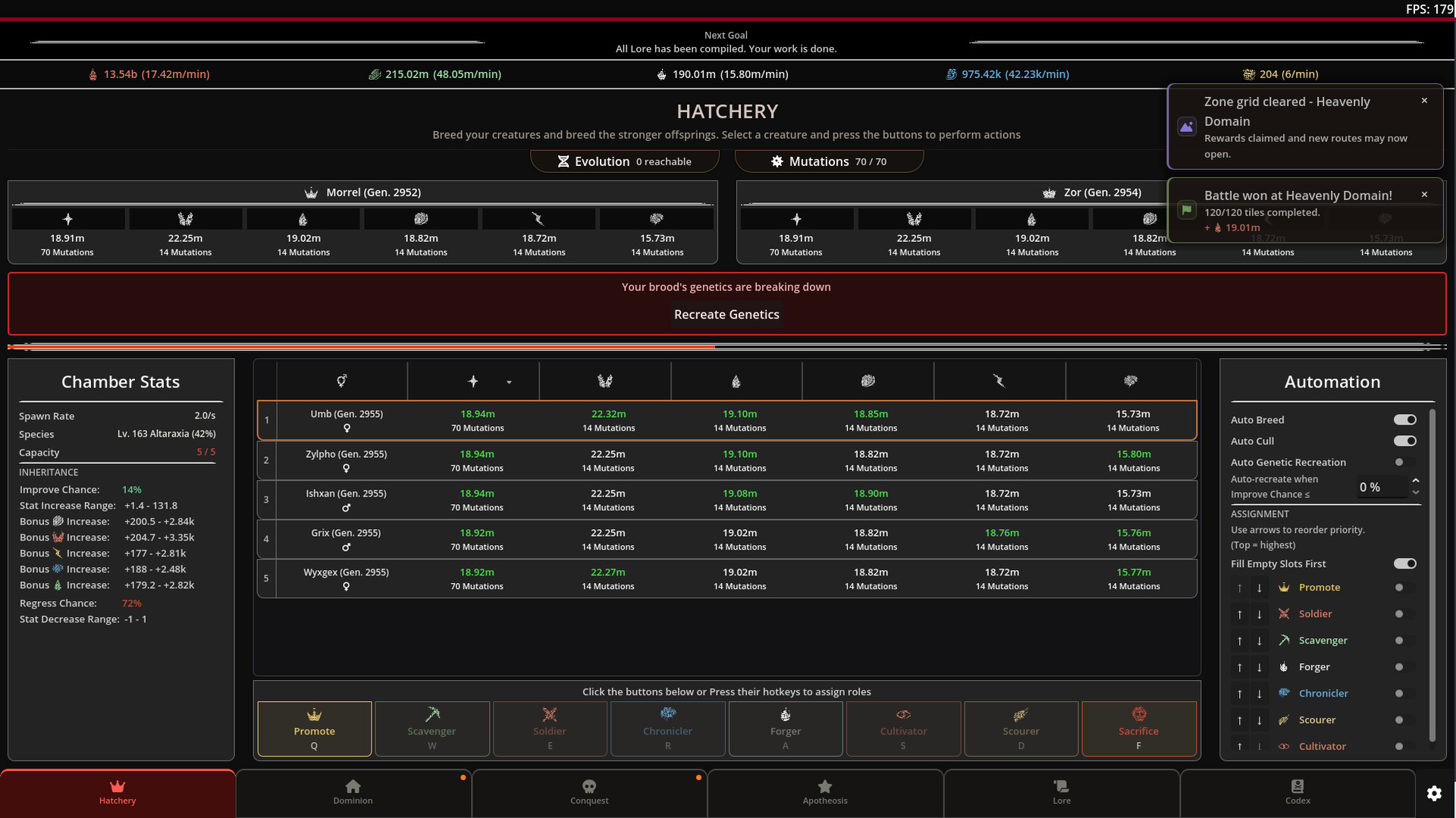
The Hatchery, where generations of creatures are bred, culled, and promoted, with Auto Breed and Auto Cull toggles for automating the grind reviewers described.Image: RyuseGames via Steam -
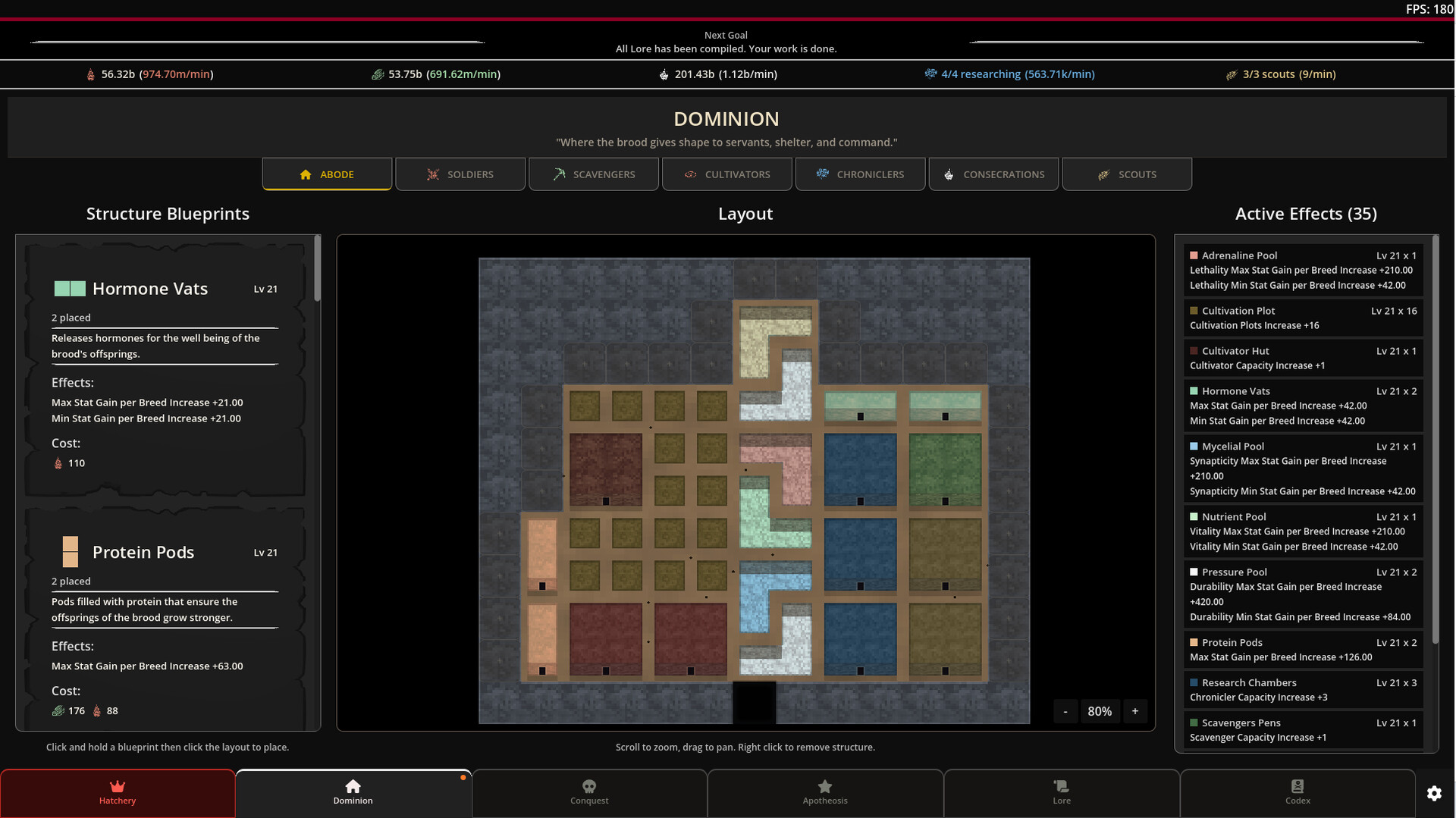
The Dominion base layout, where structures like Hormone Vats and Protein Pods stack breeding bonuses, part of the automation depth reviewers praised despite late-game balance complaints.Image: RyuseGames via Steam -
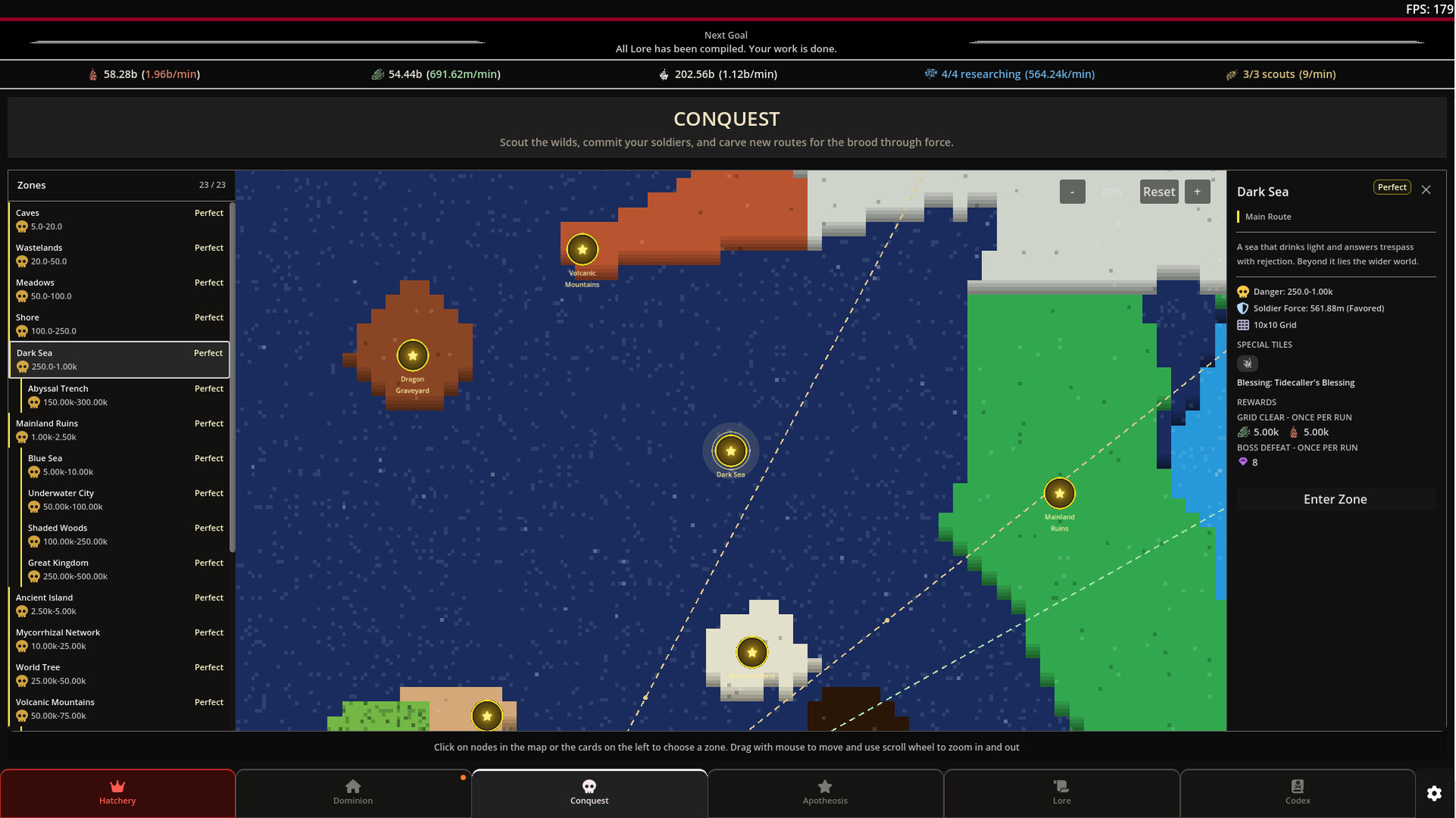
The Conquest map, sending the bred brood out to claim zones of escalating danger, from the starting Caves out to the Dark Sea and beyond.Image: RyuseGames via Steam