
Game review
Car Mechanic Simulator 2018
7 / 10
- Developer
- Red Dot Games
- Publisher
- PlayWay S.A.
- Released
- 28 July 2017
- Platforms
- Windows
- Genre
- Vehicle repair simulation
- Monetisation
- One-off purchase, with several licensed-car and content DLC packs released across its support life; no in-game currency or gameplay-affecting purchases
- Players
- None; single-player only
The short version
Car Mechanic Simulator 2018 built a genuinely huge, devoted audience — over 21,600 English reviews, 90% positive — on a straightforward promise it delivers well: strip a car apart bolt by bolt, diagnose what's actually wrong with it, and put it back together, across more than 40 vehicles and over 1,000 individual parts. Reviewers repeatedly describe real educational value beyond entertainment, several specifically crediting the game with teaching them genuine automotive knowledge they've since applied to real cars. Getting to that satisfaction requires surviving an onboarding experience an unusually large and consistent share of the same review sample describes as close to non-existent — multiple independent reviewers use nearly identical language to describe being dropped into diagnostic and repair tasks with no clear explanation of what's expected, and a separate, specific complaint about the in-game notepad's clunky part- buying workflow recurs often enough to treat as a real, unaddressed usability gap rather than isolated frustration. It's a game whose core loop earned real, lasting love from a huge audience despite, not because of, how it explains itself.
Biggest strengths
- A satisfying, detail-rich core loop — diagnosing, disassembling, repairing, and reassembling real vehicle systems — that a huge number of reviewers describe as genuinely relaxing and addictive
- Real, credible educational value beyond entertainment, with multiple reviewers specifically crediting the game with teaching them practical automotive knowledge
- A large scope for a budget sim: over 40 vehicles, 1,000-plus individual parts, and infinite randomly generated repair missions of varying difficulty
Biggest weaknesses
- Tutorial and onboarding draw unusually consistent, harsh criticism across independent reviewers, several using nearly identical language ("thrown in," "no explanation," "tutorial is non-existent") to describe the same specific gap
- A repeated, specific complaint about the in-game notepad's part-shopping workflow being "clunky" and time-consuming is common enough to treat as a real, unaddressed usability issue
- Reviewers with no prior car knowledge report a genuine divide in how accessible the game actually is despite marketing itself as approachable to newcomers
Who it's for: Car enthusiasts and anyone curious about basic automotive mechanics who wants a relaxing, detail-oriented repair sandbox, plus fans of "satisfying repetitive task" genres generally. Less suited to anyone who needs a game to teach its own systems clearly before expecting mastery, or players hoping for deep narrative or progression beyond the repair loop itself.
Our recommendation: Worth it at its typical low price for the core repair loop alone, which holds up well on its own merits; budget extra patience (or an outside guide) for the first hour, since the game's own tutorial won't carry you through it.
7 / 10
Car Mechanic Simulator 2018 hands players a garage, a growing collection of tools, and an endless supply of broken cars, then gets out of the way. Diagnose what's wrong, order the right parts, strip down whatever needs replacing, and put it all back together well enough to pass inspection and turn a profit. Released in July 2017 as the latest entry in an already-established franchise, it went on to become one of the biggest word-of-mouth successes in this research window — over 21,600 English reviews and a 90% Very Positive standing, a scale usually reserved for the AAA titles this lane rarely turns up unclaimed. What makes it worth examining closely isn't whether the core idea works — it plainly does, for an enormous number of people — but how consistently its own fans describe getting into that core idea as the hardest part of the experience.
A loop that genuinely teaches something
The single most distinctive praise running through the review sample isn't about fun in the usual sense — it's about function. One reviewer states it directly: "Very fun and useful for learning the basics of working on cars... It is basically a great start for learning. Also, the gameplay loop is pretty good. It's not just a good learning tool. It's an actually good game." Another, more practically minded, goes further: "for someone who wants to be a mechanic IRL this is a PERFECT practice method, no joke." Multiple independent reviewers report they specifically picked up real automotive knowledge from playing — part names, common failure points, general diagnostic logic — that they've since carried over to actual car ownership. That's an unusually concrete, checkable form of value for a simulation game to deliver, and it's corroborated across enough independent accounts to treat as a real, meaningful strength rather than marketing framing.
A tutorial its own players describe the same specific way
Set against that genuine strength is a complaint that appears with striking, near-identical consistency across independent reviews. One puts it bluntly: "Honestly never seen a tutorial so bad," describing hover-tooltips that explain individual tools well enough but a broader onboarding process that never actually explains what the player is supposed to do or how to complete the opening test track. Another reviewer uses almost the same framing from a different angle: "it throws you into an ocean and expects you to swim to a beach without knowing how to." A third: "don't recommend this game if you don't have experience with cars. The tutorial is non existent." Three independent reviewers, describing the same specific onboarding failure in strikingly similar terms, is strong enough convergence to treat as an accurate account of the shipped experience rather than three unrelated complaints about difficulty. It's also worth noting directly what this means in practice: the game's real educational value, described above, seems to emerge mostly despite this gap rather than because of any structured teaching the game itself provides.
A specific, recurring interface complaint
Beyond onboarding, one detailed and heavily-upvoted review raises a narrower but real usability issue: the in-game notepad used to track needed parts and shopping is described as "very clunky" and requiring far more effort to use than it should, given how much of the actual play time is spent referencing it while shopping for parts. That's a specific, actionable UI complaint distinct from the broader tutorial gap, and its prominence in the review sample (thousands of helpfulness votes on that single review) suggests it's a widely shared frustration rather than one player's pet peeve.
An honest note about franchise iteration
Worth stating plainly for anyone comparing options within the same series: at least one reviewer recommends skipping this specific entry in favor of a newer installment, noting plainly that "this is really old" relative to how much the franchise has evolved since. This review didn't research the later entries directly, so it can't independently confirm how much better a newer game in the series is, but it's a fair, practical note worth passing along rather than omitting — a reader choosing between multiple Car Mechanic Simulator years should know this specific one predates several later, likely more refined releases in the same series.
A dense first year of real support
The developer's own partner-events history confirms this wasn't a launch-and-forget release: the year following launch saw a steady cadence of numbered patches (racing through version 1.1 into 1.4 within its first four months alone) alongside real content additions — a new race track and car salon, dozens of new liveries, an in-game achievements system added post-launch, and a licensed Jeep DLC pack. That's a genuinely active first year, addressing bugs and adding scope rather than sitting static, even though none of the patch notes reviewed for this piece specifically targeted either the tutorial gap or the notepad complaint raised above. The scale of ongoing DLC support (additional licensed vehicles sold separately over the following years) also explains part of the game's long-tail value: buyers willing to add a pack or two get meaningfully more content than the base game alone provides, on top of an already generous starting roster.
Verdict
Car Mechanic Simulator 2018 earned its massive, devoted audience through a genuinely satisfying, detail-rich repair loop that a striking number of players credit with real educational value beyond entertainment. What keeps it from a stronger score is how consistently its own fans describe the exact same onboarding failure — a tutorial that explains individual tools well and the actual goal not at all — compounded by a specific, widely-flagged notepad usability gap that never seems to have been addressed. Push through the confusing opening hour, ideally with an outside guide in hand, and there's a genuinely rewarding sandbox underneath.
Sources: Steam store page and appdetails API (release date, pricing, platform data); Steam's aggregate review data (query_summary totals, English-language sample); individually read user reviews, both positive and negative, sorted by helpfulness and recency; Steam's global achievement statistics API; Red Dot Games/PlayWay S.A.'s own partner-events patch and DLC history, dense through the game's first year following its July 2017 release.
Pros and cons
Pros
- A satisfying, detail-rich core loop — diagnosing, disassembling, repairing, and reassembling real vehicle systems — that a huge number of reviewers describe as genuinely relaxing and addictive
- Real, credible educational value beyond entertainment, with multiple reviewers specifically crediting the game with teaching them practical automotive knowledge
- A large scope for a budget sim: over 40 vehicles, 1,000-plus individual parts, and infinite randomly generated repair missions of varying difficulty
- Photorealistic visual presentation of vehicles and parts draws consistent praise, including a dedicated photo mode for showing off finished work
- An extremely low typical price relative to the amount of content on offer, especially years after launch
Cons
- Tutorial and onboarding draw unusually consistent, harsh criticism across independent reviewers, several using nearly identical language ("thrown in," "no explanation," "tutorial is non-existent") to describe the same specific gap
- A repeated, specific complaint about the in-game notepad's part-shopping workflow being "clunky" and time-consuming is common enough to treat as a real, unaddressed usability issue
- Reviewers with no prior car knowledge report a genuine divide in how accessible the game actually is despite marketing itself as approachable to newcomers
- At least one detailed reviewer reports a game-breaking black-screen crash on launch
- The franchise has iterated since, and at least one reviewer recommends buying a newer entry in the series instead given how much has changed in later releases
Screenshots
-

Car Mechanic Simulator 2018Image: PlayWay S.A. via Steam -

Car Mechanic Simulator 2018Image: PlayWay S.A. via Steam -

Car Mechanic Simulator 2018Image: PlayWay S.A. via Steam -
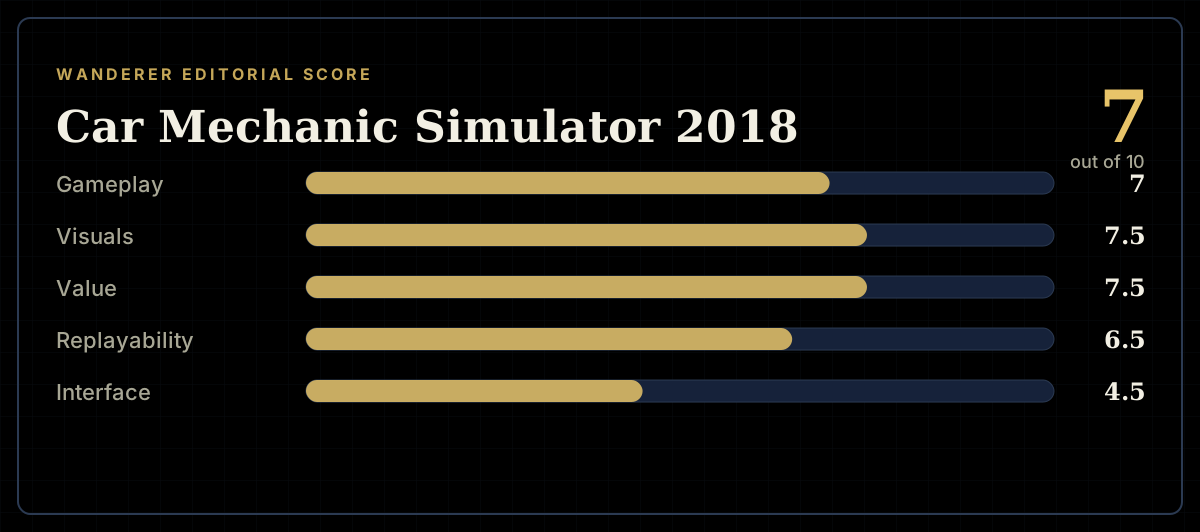
How the review scores each part of the gameWanderer Editorial -
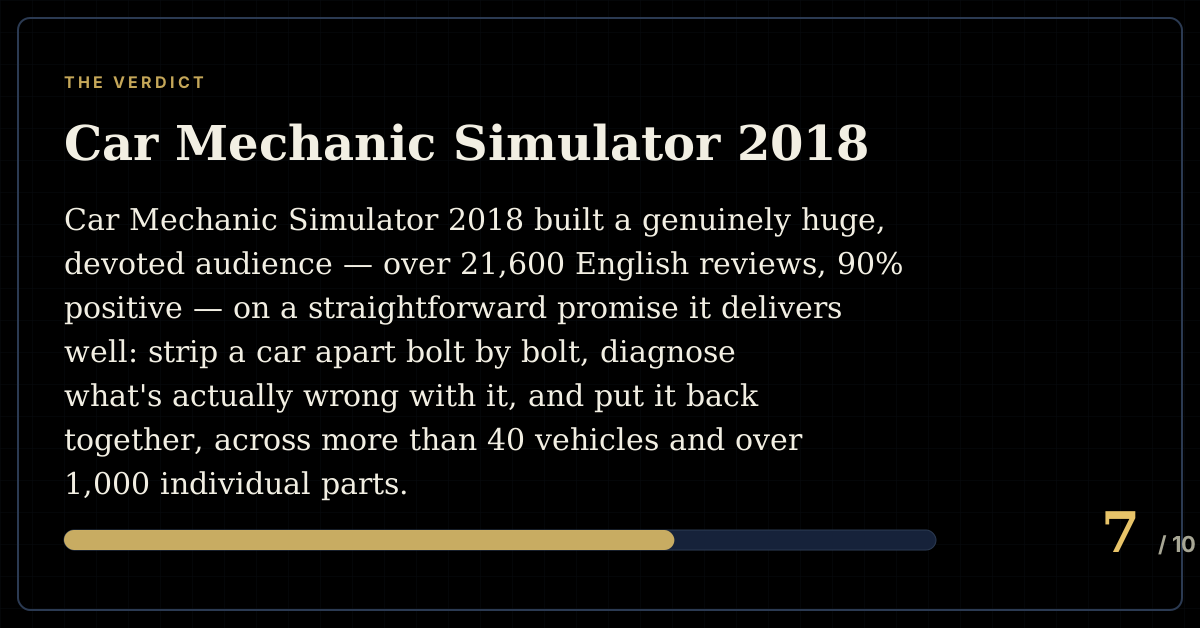
The short versionWanderer Editorial