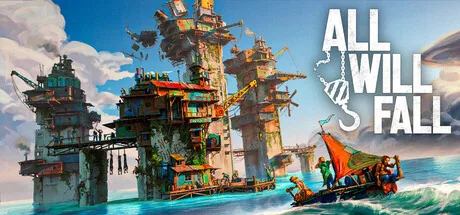
Game review
All Will Fall
7 / 10
- Developer
- All Parts Connected
- Publisher
- tinyBuild
- Released
- 3 April 2026
- Platforms
- Windows
- Genre
- Physics-based survival city builder and colony sim
- Monetisation
- Premium, one-off purchase. An optional soundtrack DLC exists alongside it and changes nothing about play
- Players
- Single-player only
The short version
All Will Fall's central idea is a good one and mostly delivers: your city is a physical structure that has to actually hold itself up, and the tide that rises and falls beneath it is both your exploration clock and a standing threat to every support beam you didn't quite finish. Three factions with competing needs and eight handcrafted scenarios give that idea real legs, and the sandbox and Workshop tools extend it further still.
It's also a rougher build than a NZ$43.59 premium release should be. Optimisation lags well behind the ambition of the simulation, the interface buckles once a city sprawls across several tiers, and reception is split on whether the physics genuinely constrains you or just asks for enough diagonal braces. None of that erases a genuinely distinctive city builder — it just keeps this one out of the top tier.
Biggest strengths
- The tide mechanic doubles as an exploration clock and a structural threat, so the same receding water that opens new scavenging ground can strip the buoyancy out from under a district you built on it
- Workers, Sailors and Engineers each unlock distinct capabilities and demands, and favouring one faction over another visibly changes which plans become easy or difficult
- Eight handcrafted scenarios cover very different pressures — an oil rig, a moving tanker, a tornado countdown — rather than reskinning the same map with a new backdrop
Biggest weaknesses
- Performance drops noticeably once a city grows tall and the tide's water simulation has a lot of geometry to interact with, even on hardware well above the stated minimum spec
- Reception is genuinely split on how much the physics actually constrains you — some players and reviewers find that enough diagonal supports let you brute-force past the tension and weight math the game advertises as its core challenge
- Interface and menu overload sets in during the late game, when faction happiness, rations, loyalty and structural stress all compete for the same small set of overlapping panels
Who it's for: Colony-sim and city-builder players who want their structures to be a real engineering problem rather than a snapping grid, and who don't mind a system that still has some rough edges. Less suited to anyone who wants a relaxing builder or a game that runs smoothly on a mid-range PC out of the box.
Our recommendation: Worth buying if physics-driven construction and faction management genuinely appeal to you — there's a real game here and a demo to try first. Wait for a patch or two, or a sale, if your PC is more than a couple of years old.
7 / 10
Most city builders treat your skyline as a list of buildings connected by logic — place a house, place a road, watch a happiness number tick upward. All Will Fall treats it as an actual structure that has to hold itself up, made of beams that bend, platforms that need support, and a tide underneath the whole thing that can strip out a foundation while you're busy managing something else entirely. That single decision — the city is a physics object before it's a spreadsheet — is what separates this from the survival-colony-sim crowd it otherwise resembles, and it's both the best and the shakiest part of what All Parts Connected has built.
A city that has to actually stand up
The pitch is straightforward on paper: a drowned Earth, a small settlement clinging to whatever dry ground and salvage is left, and a goal of growing that into a sprawling vertical city built up rather than out, because out is mostly ocean. What makes it distinct is the construction system underneath that goal. Every beam, platform and support you place carries real weight, tension and material strength, and the game genuinely wants you to think about load paths the way an actual structural engineer would — where the stress travels, what's holding the weight above it, and what happens if you remove a piece further down the chain. Get it wrong and a tower doesn't just fail with a message box; it visibly buckles and collapses, often taking neighbouring structures down with it. Getting that failure state to actually look and feel like a physical event, rather than a scripted animation, is a genuinely hard thing to pull off, and when it lands it's the best few seconds the game has to offer.
The tide is the real antagonist
The smartest system in the whole build is the water. All Will Fall's ocean rises and falls on its own schedule, and receding tides are how you get access to new scavenging ground — resource nodes, wreckage, and buildable land that simply isn't there when the water's high. That's a clever way to pace exploration without gating it behind a tech tree. The trade-off is that the same tide can quietly undercut buoyancy and support you were relying on, so a structure that was stable at low tide can start groaning at high tide, and a district you built to take advantage of a temporary exposed seabed can end up stranded, flooded, or structurally compromised once the water comes back in. It turns the tide into a genuine clock you're always racing against, on both the exploration side and the engineering side, and it's the one mechanic in the game that nobody seems to have a bad word for.
Three factions, one set of headaches
Population management runs through three factions — Workers, Sailors and Engineers — each with distinct traits and access: Sailors bring boats and are the ones who can actually reach receding-tide scavenging grounds by water, Engineers bring cranes and heavier construction capability, and each faction has its own housing, food, water and leisure demands that don't line up neatly with the other two. Favouring one faction's needs over another's has a real, visible cost — a city run entirely for Engineers' convenience will have Sailors and Workers quietly souring on you, with consequences for output and stability. It's a meaningfully different management layer from the single population-happiness bar a lot of colony sims settle for, and the choice between governing as a "kind shepherd" or a "strong-hand tyrant" gives the political side of the game a shape, rather than treating governance as flavour text.
Eight scenarios that actually change the problem
The campaign is split across eight handcrafted scenarios, and to the game's credit they don't just reskin the same flat map with a new colour palette. An abandoned oil rig, a tanker you build on top of and sail across the ocean in search of land, and a race to fortify a city before an incoming tornado are genuinely different design problems, each testing a different part of the construction and survival systems rather than just raising the same numbers. Add a robust level editor and Steam Workshop support, and the scripted content stops being the ceiling — players who want to keep building past the eight scenarios have real tools to design their own maps, weather conditions and resource layouts, and a growing community doing exactly that. For a genre where replayability often means "start the same map again," that's a substantial amount of actual variety on offer.
Does the physics really hold you to account?
Here's where the reviews genuinely diverge, and it's worth being upfront about it rather than picking a side that isn't earned. Some coverage treats the structural system as the game's one real triumph — a source of tension where every addition to a tall build is a live risk calculation, not a formality. Other coverage, including a widely shared critical take, argues the opposite: that once you understand the pattern, the "simulation" mostly comes down to adding enough diagonal supports, and the promised weight-and-tension puzzle rarely produces the kind of hard trade-offs the marketing implies. Both readings can be true at once. Early and mid-game builds, where materials and cranes are limited, do seem to force real engineering decisions. Once a player has unlocked enough support types and enough Engineer-faction construction capacity, brute-forcing past the physics with over-engineering becomes a viable, if inelegant, strategy — which blunts the exact tension the system is built to create. Whether that reads as "the physics isn't deep enough" or "the physics rewards mastery" probably says as much about the player as the game, but the marketing promises the former problem stays interesting throughout, and for a meaningful slice of players it doesn't.
Where the frame rate goes to argue back
The more consistent complaint, across both critics and the Steam community, is performance. Water is one of the most graphically demanding things the engine renders, and a tall, mature city sitting on top of an actively simulated tide asks a lot of hardware that the stated minimum spec — a GTX 1660 Super and a Ryzen 5 3600 or i5 12400 — doesn't obviously deliver. Reports describe stutter and short freezes appearing specifically in the late game, when population, structure count and physics calculations are all at their highest simultaneously, and the developers have publicly acknowledged multithreading and late-game lag as an ongoing problem rather than a rumour. There has been real, measurable improvement since the game's pre-launch demo period, and patches since April have kept chipping away at it, but a premium release in 2026 shouldn't need "we're aware and working on it" as a standing line in its patch notes, and as of this writing it still does.
An interface that gets crowded exactly when you need it clearest
Menu management is the other place the ambition outruns the polish. Early on, tracking faction needs, resource flow and structural integrity across a handful of panels is manageable. Once a city sprawls across several vertical tiers with three factions all demanding attention at once, those same panels start competing for the same screen space, and checking whether a beam is about to fail means digging through the same overlapping UI you're also using to manage rations and loyalty. Citizen pathfinding compounds the problem — workers and sailors visibly struggle to navigate tall, branching, ladder-heavy structures efficiently, which is a genuine liability in scenarios that run on a countdown, where a citizen taking the long way round can be the difference between hitting a deadline and not.
Presentation and value
Visually and sonically, All Will Fall is competent without being memorable. The setting — a dying, flooded world, rusty favelas next to concrete towers, three factions scavenging a drowned civilisation — is a strong premise on paper, and the writing around random events leans into some genuinely difficult calls, like whether to take in starving newcomers or trust a sudden windfall of meat with an origin nobody wants to ask about. The audiovisual execution just doesn't do quite enough to make that atmosphere distinctive on screen; it does the job without leaving much of an impression. At NZ$43.59, the base game is priced like a serious mid- size premium release, and against roughly a hundred hours of scenario, sandbox and Workshop content for a player who wants to see all eight campaigns through, that's a defensible price even before you factor in ongoing patches. The only additional purchase is a NZ$7.39 soundtrack DLC that changes nothing about play — there's no second content tier being sold separately from an unfinished base game, which is a genuinely clean way to handle monetisation for a premium single-player release.
Players who like watching a system keep working while they step away from micromanaging every decision might find a distant echo of that appeal in Wanderer's own gathering loop, on a much smaller scale and without the risk of a collapsing tower.
Verdict
All Will Fall backs up its central pitch more often than it doesn't: a city that's genuinely a structure rather than a grid, a tide that turns exploration and engineering into the same clock, and three factions whose competing demands give the political side of colony management real teeth. Eight distinct scenarios plus a proper level editor and Workshop support mean the premise gets to stretch across a lot of different problems rather than one repeated map.
It arrives with real rough edges attached, though. Performance strain in the late game is a documented, acknowledged issue rather than an isolated complaint, the interface gets crowded exactly when a tall, multi-faction city most needs clarity, and there's a legitimate, unresolved argument over whether the structural physics is a genuine constraint or something experienced players can simply out-engineer. None of that undoes what's distinctive here. It does mean you're buying a strong idea that's still finishing its execution, not a fully polished one — worth it for the right audience, patchy enough that everyone else should try the demo first.
Price and platform details checked 31 July 2026.
Pros and cons
Pros
- The tide mechanic doubles as an exploration clock and a structural threat, so the same receding water that opens new scavenging ground can strip the buoyancy out from under a district you built on it
- Workers, Sailors and Engineers each unlock distinct capabilities and demands, and favouring one faction over another visibly changes which plans become easy or difficult
- Eight handcrafted scenarios cover very different pressures — an oil rig, a moving tanker, a tornado countdown — rather than reskinning the same map with a new backdrop
- The level editor and Steam Workshop support turn the campaign into a starting point rather than the whole game, for players who want to keep building past the scripted content
- A single structural miscalculation can visibly, satisfyingly bring down a tower you spent hours on, which is exactly the risk the marketing promises
Cons
- Performance drops noticeably once a city grows tall and the tide's water simulation has a lot of geometry to interact with, even on hardware well above the stated minimum spec
- Reception is genuinely split on how much the physics actually constrains you — some players and reviewers find that enough diagonal supports let you brute-force past the tension and weight math the game advertises as its core challenge
- Interface and menu overload sets in during the late game, when faction happiness, rations, loyalty and structural stress all compete for the same small set of overlapping panels
- Citizen pathfinding struggles across tall, branching, ladder-heavy structures, which matters when a scenario's timer is running
- Visual presentation is functional rather than distinctive, and doesn't fully sell the bleak, flooded setting the writing and scenario design promise
Screenshots
-
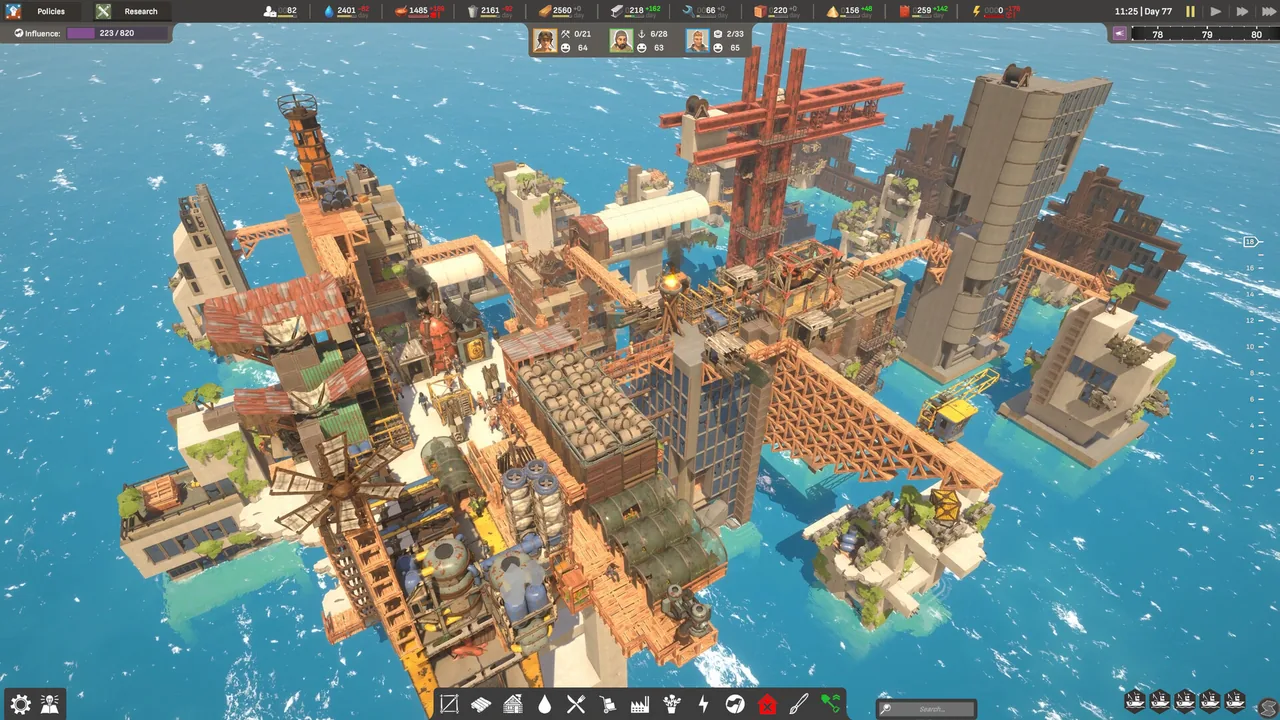
ALL WILL FALLImage: tinyBuild via Steam -
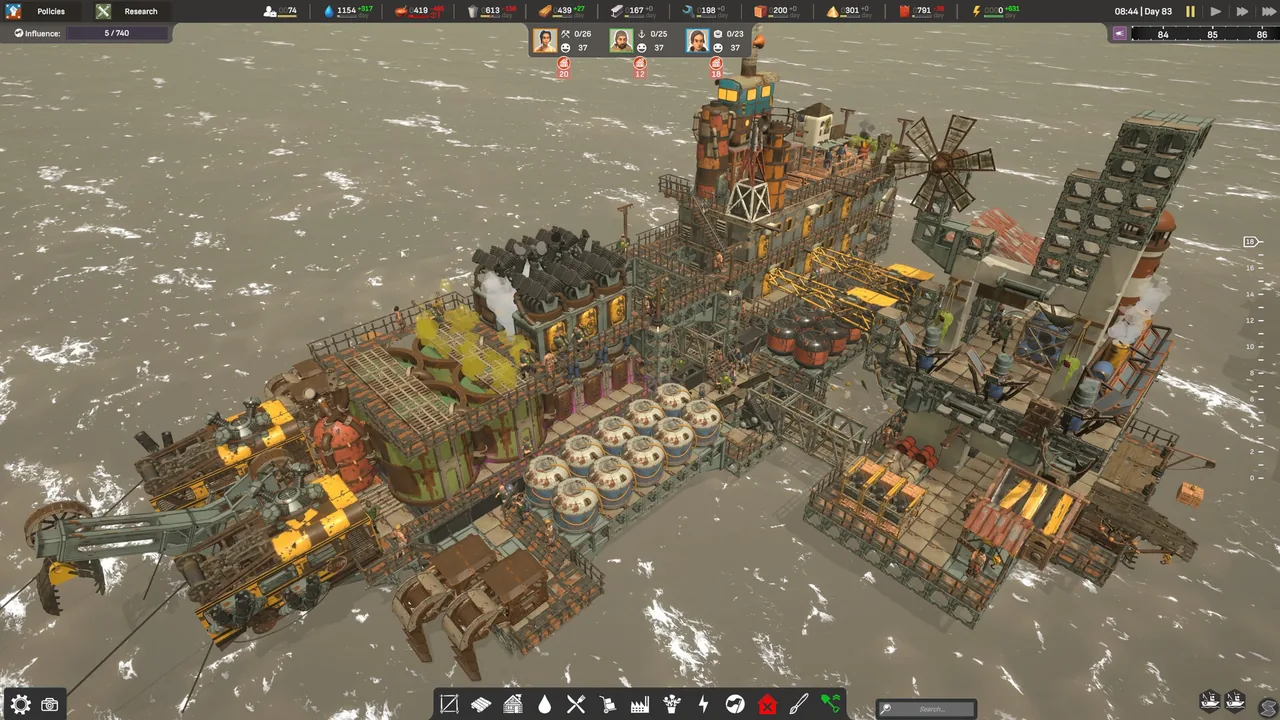
ALL WILL FALLImage: tinyBuild via Steam -
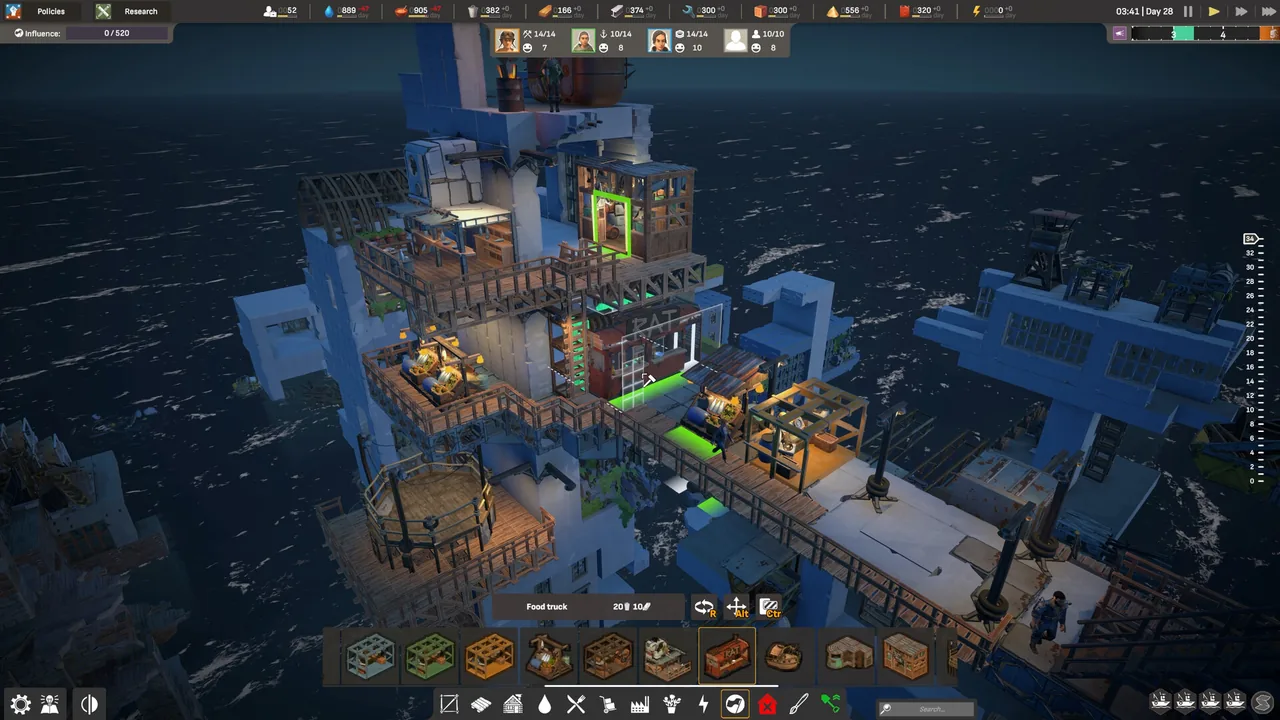
ALL WILL FALLImage: tinyBuild via Steam -
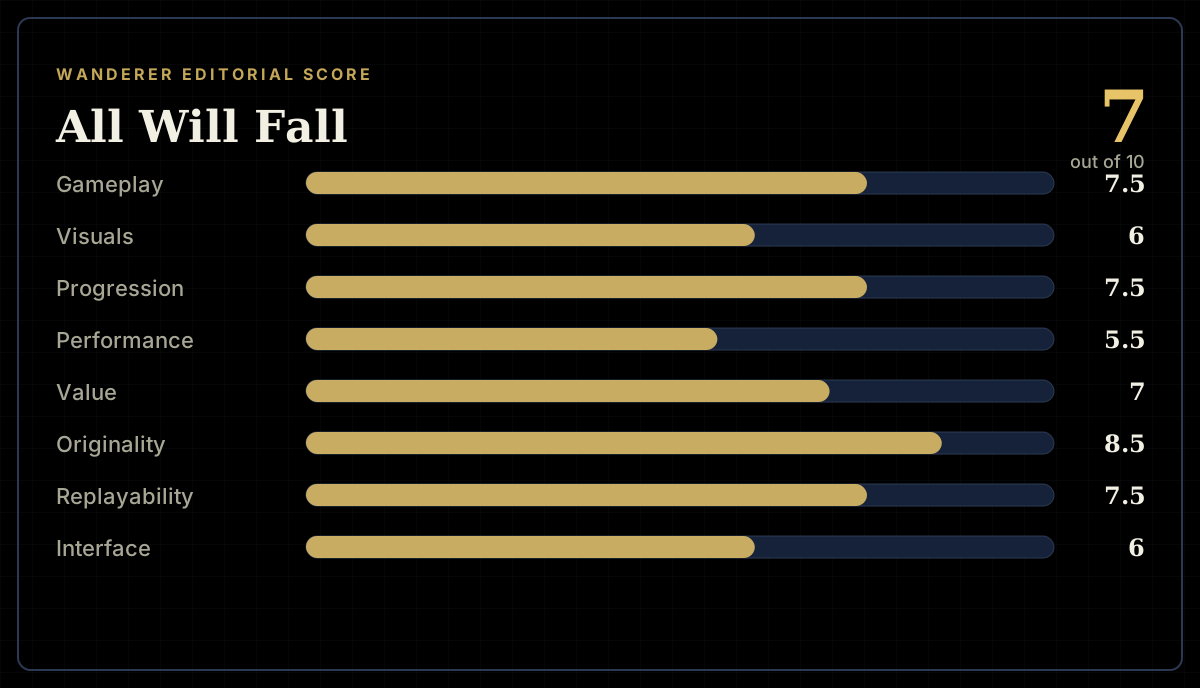
How the review scores each part of the gameWanderer Editorial -
The short versionWanderer Editorial