Game review
A Thousand Bees
6.2 / 10
- Developer
- Make it a Triple
- Publisher
- Make it a Triple
- Released
- 8 April 2026
- Platforms
- [Windows, Linux]
- Genre
- Casual
- Monetisation
- Paid
- Players
- Single-player only
The short version
A Thousand Bees is exactly what its title promises: find a thousand hand-drawn bees hidden across a dozen beautifully illustrated scenes, set to a soft, whimsical soundtrack. It's a short, low-stress way to spend an afternoon, and reviewers are near-unanimous that the art and mood are the reason to play. Just don't expect much of a game underneath the picture book — the "search a scene, click what you find" loop barely evolves across its runtime, and the last few stragglers in each level can turn relaxing into frustrating without a hint system to fall back on.
Biggest strengths
- Hand-illustrated art direction that reviewers repeatedly single out as the game's biggest draw, with a distinct "honeycore" cozy aesthetic
- A soft, well-matched soundtrack that several reviewers credit with the game's calming, meditative feel
- Accessible design: mouse-only and touch-only play options, adjustable difficulty, and a self-paced structure with no timers
Biggest weaknesses
- A thin, repetitive core loop — scan a scene, click the bees, move to the next scene — that several reviewers say wears out its welcome once the initial art appreciation fades
- No in-game hint system, which reviewers say turns the last handful of especially well-hidden bees in each level from a fun challenge into a frustrating slog
- A short overall runtime that leaves at least one reviewer recommending a sale purchase rather than full price
Who it's for: Fans of cozy, low-pressure hidden-object games who want something to unwind with over an afternoon rather than a game with mechanical depth or challenge.
Our recommendation: Worth it on sale, or at full price if you specifically want a short, gorgeous, no-stakes hidden-object game — go in expecting a picture book you interact with, not a game with systems.
6.2 / 10
A Picture Book You Click Through
A Thousand Bees is a hidden-object game built around a single, literal premise: somewhere across a dozen scenes of gardens, meadows, and pastoral summer settings, a thousand bees are hiding, and the job is to find them all. Developed and published by Make it a Triple, it leans hard into a "honeycore" cozy aesthetic — hand-drawn, warmly coloured illustrations packed with detail, populated by cats, farm animals, and everyday objects that double as camouflage for its buzzing quarry. There's no combat, no failure state, and no timer pressuring the search; players simply scan each scene at their own pace, clicking bees as they're spotted, with a level clearing once every last one has been found.
The presentation is, by a wide margin, the thing reviewers talk about first. One review called it "a little work of art," praising the hand-drawn visuals as "beautiful and incredibly atmospheric," while another wrote that it's "worth having a go just to enjoy the beautiful art and pastoral mood of the various scenes," adding that it was "clearly made with a lot of love." A more structured review scoring the game across several categories gave its "Mood" a perfect five out of five, calling it simply "Lovely!" That same reviewer praised the game as "a little work of art" in its own right, a phrase that recurs independently across multiple reviews without any apparent coordination — a good sign that the art direction is landing consistently rather than only with a vocal few.
The soundtrack draws almost as much consistent praise as the visuals. Reviewers repeatedly describe the music as "comfy," "whimsical," and "well suited" to the mood of each scene, and more than one credits the combination of music and art with putting them into what one reviewer called "a calm+flow state where you just tick off bees one by one." Small sound design touches — ambient noises that play when interacting with objects and the game's various animals — get called out specifically as a nice bit of extra craft layered onto the core search mechanic.
The Search Itself Doesn't Hold Up as Well
Strip away the art and music, though, and reviewers are considerably more mixed on whether there's a satisfying game underneath. One of the more detailed reviews put it plainly: "on the other hand, it's not much to write home about as a game. It's mostly a bee counting game, with the vast majority of them in plain sight." That's a fair summary of the core tension running through the review sample — the searching itself is straightforward for the bulk of each level, with the genuine challenge concentrated almost entirely in a handful of especially well-camouflaged stragglers at the very end.
That design choice is also the single most common specific complaint. A reviewer who reported finding 998 of the game's 1,000 bees put it directly: "only thing i wish the game had is a hint system, those last two bees will haunt me for ever." Without any kind of assist for the final holdouts in each scene, what starts as a relaxing, meditative search can turn into a frustrating standstill, particularly for players who want to fully clear every level rather than move on once most of a scene is done. It's a small missing feature, but it sits right at the point where the game's mood — calm, unhurried, low-stakes — collides hardest with its actual difficulty curve.
A second, more muted thread of criticism touches on control options. One reviewer specifically asked for an alternative to zooming with the mouse wheel, noting the game is functionally "mouse recommended, maybe even required" for precise clicking on smaller hidden bees — a reasonable ask for a game that otherwise supports touch-only and mouse-only play modes as accessibility options. And at least one negative review, while brief, pointed to a lack of lasting value and recommended waiting for a sale rather than paying full price, a sentiment echoed indirectly by the game's short overall length; most reviewers describe clearing all twelve levels as an afternoon's activity rather than anything approaching a substantial time investment.
Small Scale, Small Review Sample, Genuine Charm
It's worth being upfront that A Thousand Bees has a modest review base — a small enough sample that broad conclusions about its reception should be read as directional rather than exhaustive. What is consistent across nearly every review available, though, is the split described above: the art and mood are close to universally loved, and the actual hidden-object mechanic is seen as functional but thin, with a specific and repeated ask for a hint system to smooth out its hardest moments. Nobody in the sample reports bugs or technical issues; one reviewer specifically called out a clean, trouble-free run on Steam Deck, a small but useful data point for anyone considering it as a handheld pick-up-and-play title.
Price, Length, and Who It's Actually For
At NZ$14.75, the price sits in line with its scope — a short, focused, single-mechanic game rather than anything trying to be a long-form experience. Most reviewers describe clearing all twelve levels as an afternoon's activity, and at least one reviewer explicitly recommended waiting for a sale rather than paying full price given how quickly the core loop is exhausted. Achievements are tied to fully clearing each scene, which gives completionists a reason to go back for stragglers, but there's no meaningfully different second playthrough on offer once every bee has been found.
For players who specifically want a short, low-stakes, visually driven session — something closer to flipping through an illustrated picture book than playing a game with systems — the reception here suggests it delivers cleanly on that narrow promise. For players expecting a hidden-object game with escalating puzzle design, varied mechanics, or much replay value beyond a second look for missed bees, the sample suggests tempering expectations accordingly; this is a game to relax with for an hour or two, not one built to be revisited or mastered.
Verdict
A Thousand Bees succeeds almost entirely on the strength of its hand-illustrated art and soft, whimsical soundtrack, both of which draw consistent, specific praise across its review base. As a game, though, it's thin by design — a straightforward "spot the bee" loop that doesn't meaningfully evolve across its dozen levels, and whose hardest, most frustrating moments come from a handful of especially hidden bees with no hint system to fall back on. It's a pleasant, well-crafted way to spend an afternoon rather than a game with much mechanical depth, and it's best approached with that expectation set from the start — as a short, cozy picture book you happen to click through, not a puzzle game with real teeth.
Pros and cons
Pros
- Hand-illustrated art direction that reviewers repeatedly single out as the game's biggest draw, with a distinct "honeycore" cozy aesthetic
- A soft, well-matched soundtrack that several reviewers credit with the game's calming, meditative feel
- Accessible design: mouse-only and touch-only play options, adjustable difficulty, and a self-paced structure with no timers
- Small environmental touches — ambient sounds when interacting with objects and animals — that reviewers call a nice bit of extra polish
- Reports of a stable, bug-free experience across platforms, including one reviewer specifically noting zero issues on Steam Deck
Cons
- A thin, repetitive core loop — scan a scene, click the bees, move to the next scene — that several reviewers say wears out its welcome once the initial art appreciation fades
- No in-game hint system, which reviewers say turns the last handful of especially well-hidden bees in each level from a fun challenge into a frustrating slog
- A short overall runtime that leaves at least one reviewer recommending a sale purchase rather than full price
- Reliant almost entirely on mouse input for precise clicking, which one reviewer flagged as a control limitation they'd like an alternative for
Screenshots
-
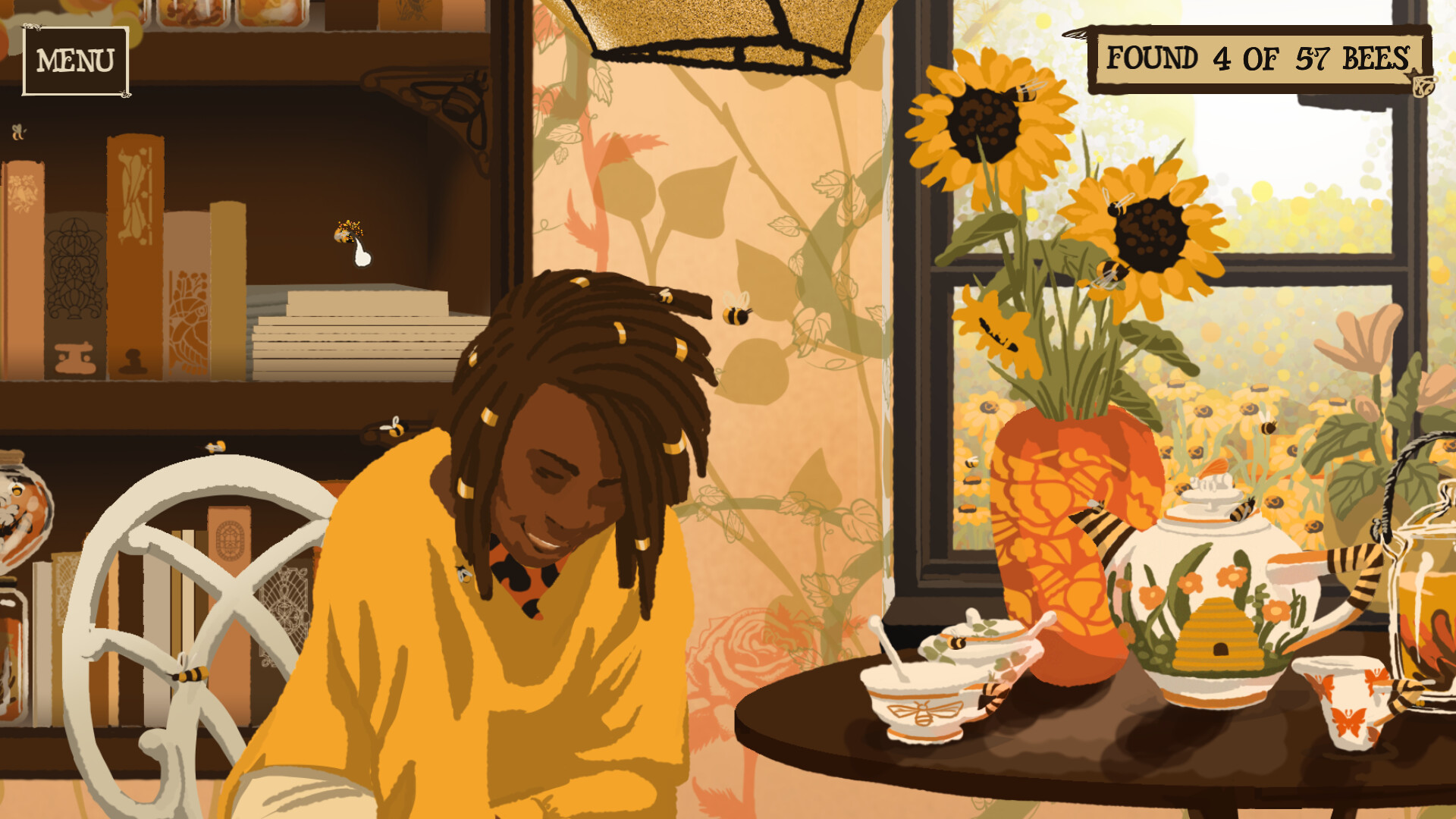
A typical hidden-object scene, with most bees in plain sight and a few tucked into finer detailMake it a Triple -
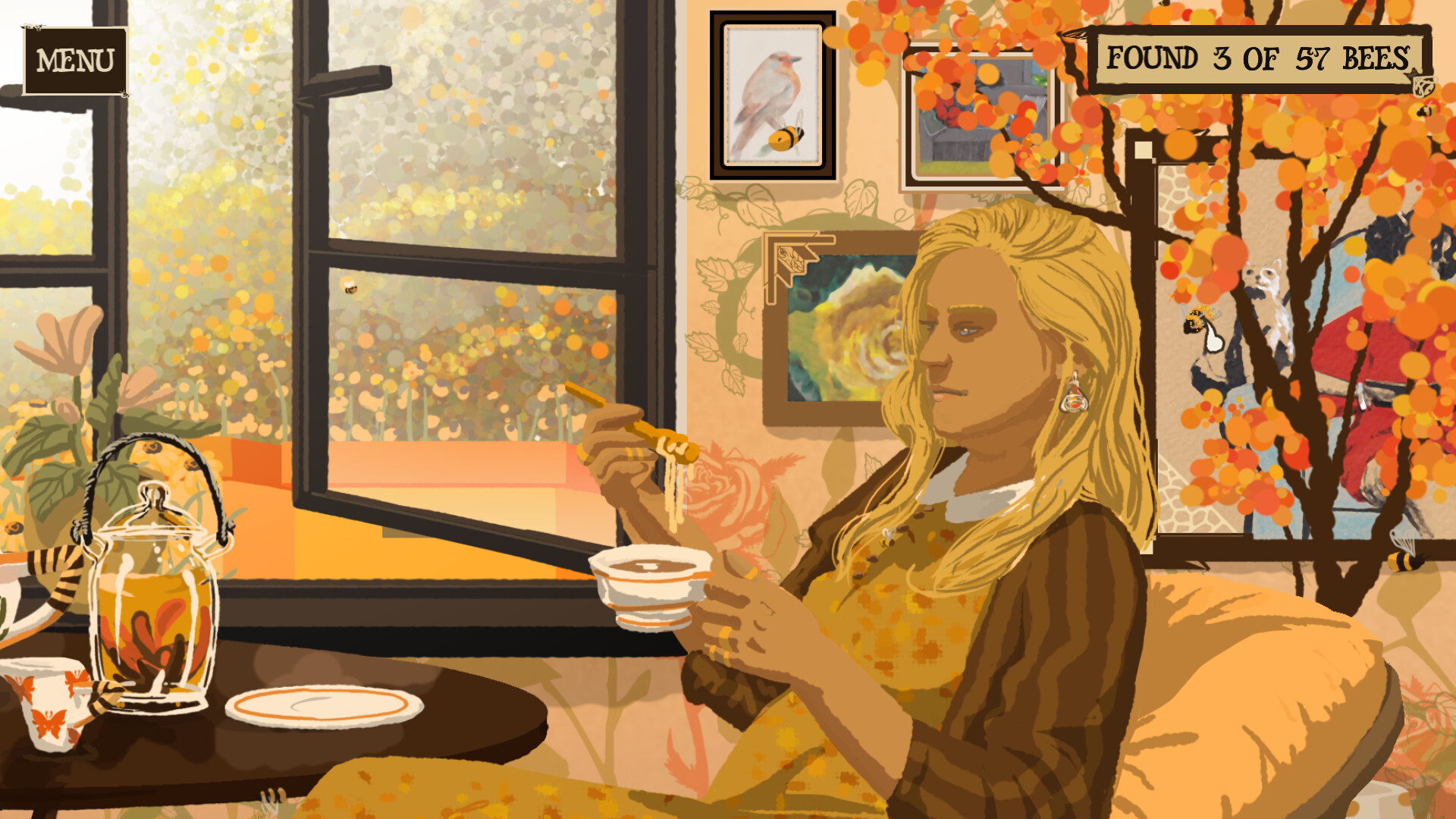
The game's warm, hand-drawn art style draws near-unanimous praise across its reviewsMake it a Triple -
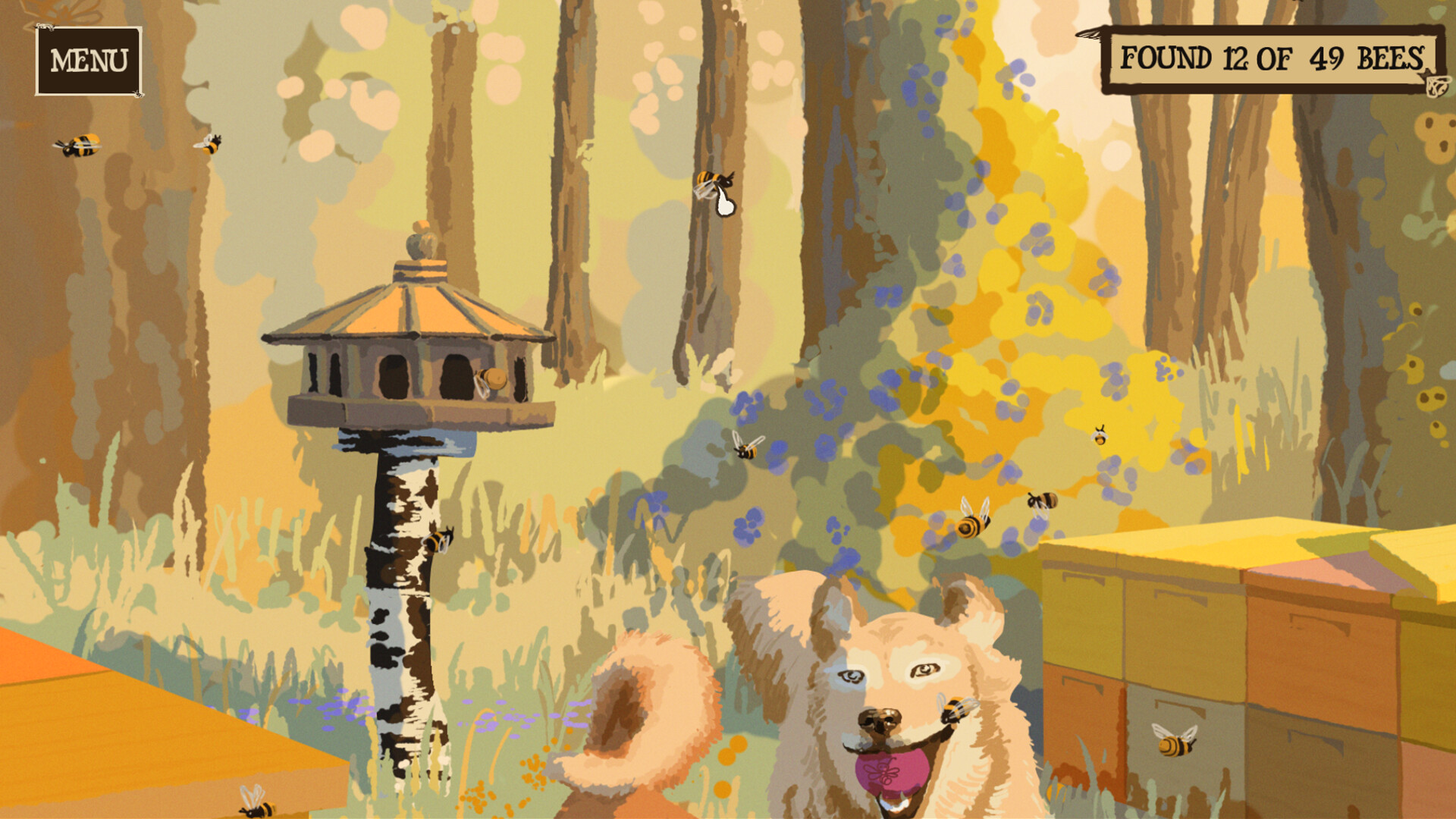
A woodland level with beehives and a dog companion, one of the dozen scenes to fully clearMake it a Triple -
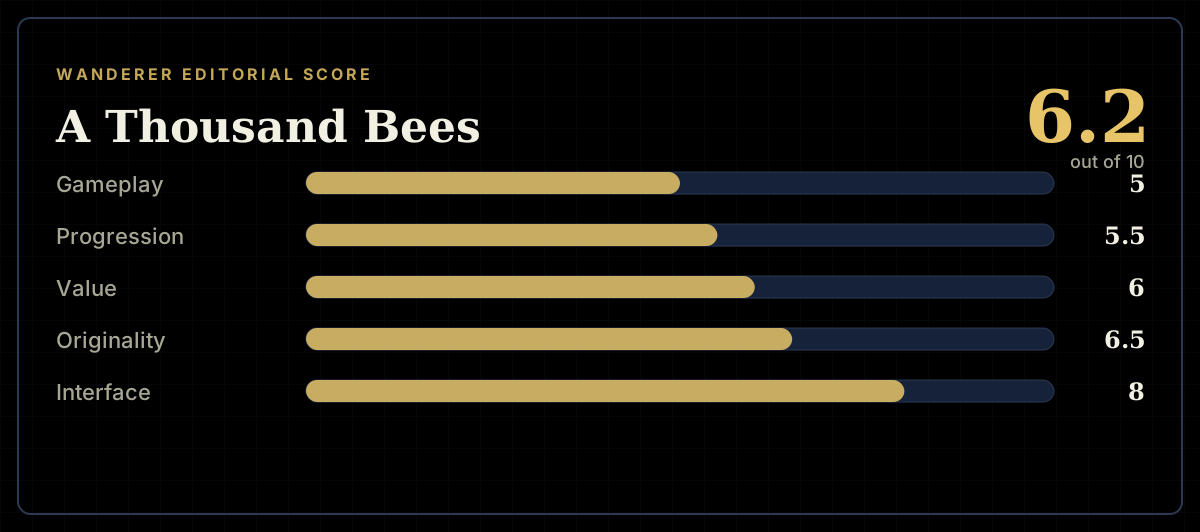
How the review scores each part of the gameWanderer Editorial -
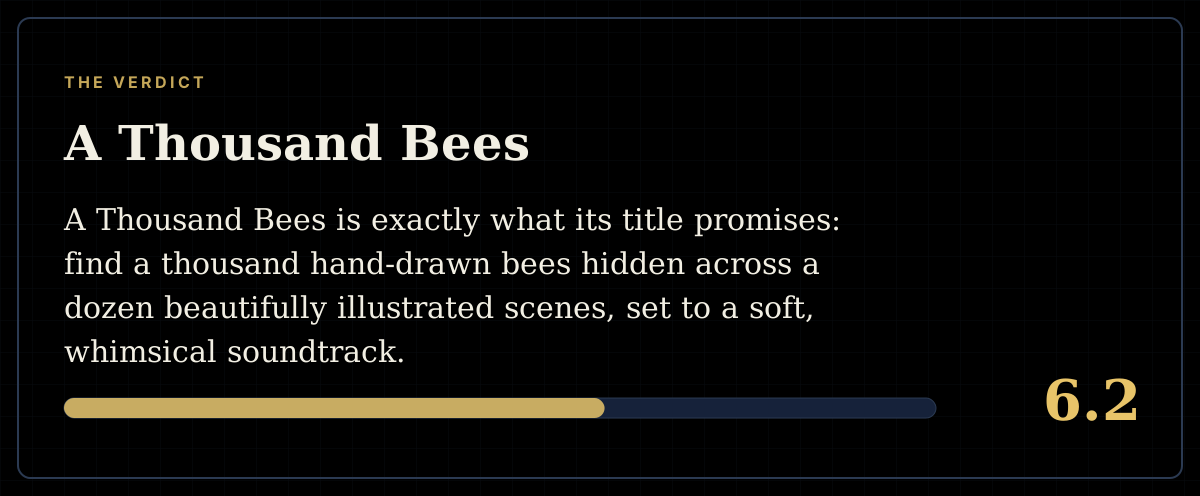
The short versionWanderer Editorial