
Game review
Zoominoes Review
7.5 / 10
- Developer
- Starlight Games inc.
- Publisher
- Starlight Games inc.
- Released
- 30 July 2026
- Platforms
- ["Windows"]
- Genre
- Roguelike Deckbuilder
Balatro, But It's Dominoes With Animals
Zoominoes released on Steam on July 30, 2026, from developer and publisher Starlight Games inc., for $14.99, after a lengthy public demo period that reviewers reference constantly. Its core loop is instantly recognizable to anyone who's played Balatro: reach an escalating point goal within a limited number of plays, shop for permanent upgrades between rounds, and chase the moment your build clicks into an out-of-control scoring chain. What's different is the board itself, a domino-style grid where each animal tile must match the color or habitat type of its neighbor to be legally placed, layering a genuine spatial puzzle on top of the familiar deckbuilding shell. With 462 positive reviews against 39 negative across a 501-review sample, the response lands solidly in Very Positive territory, and the sheer number of reviewers who mention having logged dozens or even hundreds of hours in the pre-release demo says a lot about how quickly the hook took hold.
Twenty Zookeepers and a Genuinely Deep Synergy Web
Reviewers consistently praise the amount of content on offer: 20-plus playable "zookeepers," each with a distinct starting deck and passive ability, alongside a wide roster of animals whose abilities interact with color, habitat, board position, and each other in ways multiple reviewers call more thoughtfully designed than they expected. One especially detailed review highlights specific interaction chains, like a frog that jumps into a mirror tile and duplicates itself, working exactly as a player would hope without needing to second-guess whether the developer actually implemented the interaction they were hoping for. Several reviewers who put well over a hundred demo hours in before buying describe the full release as adding meaningfully more content rather than just re-skinning what they'd already played, and the presence of daily challenges, run-specific modifiers, and an endless "work overtime" mode gives the loop somewhere to go once a standard run is won.
Mythic Animals and Difficulty Scaling Are the Real Fault Line
The most substantial and consistent criticism across the sample is that the game's rarest "mythical" animals scale so far past everything else that they collapse strategic variety, particularly at the highest difficulties and in endless mode. Multiple detailed reviews describe successful runs converging on the same handful of efficient builds once a mythical animal appears, with one reviewer noting that drafting the right one can effectively win a run outright regardless of the choices made earlier, and another arguing that roughly 80 percent of the animal roster becomes irrelevant by the late game as a result. A related, equally common complaint is that starting decks are stuffed with several low-value "filler" animals that exist mainly to be removed, forcing an opening strategy built around deck-thinning rather than genuine experimentation. Several reviewers frame the higher difficulties as tipping too far into pure randomness, where a bad early seed can make a run unwinnable no matter how well it's played, though just as many reviewers report beating the hardest difficulty and call the challenge fair once its patterns are learned. The developer's post-launch balance patches get specifically acknowledged by more than one reviewer as moving in the right direction, even from otherwise critical reviews.
Bugs and Rough Edges Show Up in a Meaningful Minority of Reviews
A recurring thread among the negative reviews, and a handful of otherwise positive ones, is technical rough edges: reports of restarted runs failing to fully reset game state, soft locks after selecting a reward, animals duplicating into a hand slot without being playable, and achievements unlocking incorrectly. One detailed negative review specifically calls out the 1.0 launch patch notes claiming all zookeepers received unique selection dialogue, while testing showed the original three pre-launch zookeepers still lacked it, reading as either an oversight or a lingering quality-control gap from the demo period. None of this is described as universal, and the large majority of reviewers, including several with 40-plus hours logged since launch, report no bugs at all, but it's frequent enough across the sample to be a real caveat rather than a fluke for a paid 1.0 release.
Charm, Sound Design, and a Genre That's Gotten Crowded
Presentation is close to universally praised: reviewers repeatedly single out the art direction, the personality given to individual animals and zookeepers, and small per-animal sound cues as elevating what could have been a generic "number go up" game into something with real identity. That charm matters because the genre itself is acknowledged by several reviewers as increasingly saturated with Balatro-inspired roguelike deckbuilders, and Zoominoes is repeatedly credited with standing out from that crowd specifically because its domino-placement mechanic and zoo theming give it a distinct feel rather than a reskin. A few reviewers do note the gameplay loop can feel repetitive between the same handful of encounter types once the systems are learned, wishing for more run-altering random events to break up the pattern.
Verdict
Zoominoes takes a genre that's become genuinely crowded and finds a real point of differentiation in its domino-grid placement puzzle, backed by a deep and mostly well-considered web of animal synergies that reviewers who put in dozens of demo hours are still discovering new things about. Its biggest problem is one shared by plenty of games in this space: a handful of top-tier picks that outclass most of the roster once difficulty ramps up, alongside enough launch-week bugs to be a genuine, if inconsistent, annoyance. Neither issue is severe enough to undercut what's clearly a well-loved, actively updated release, and for $14.99, Zoominoes earns its comparisons to the genre's biggest name rather than just riding on them.
Screenshots
-
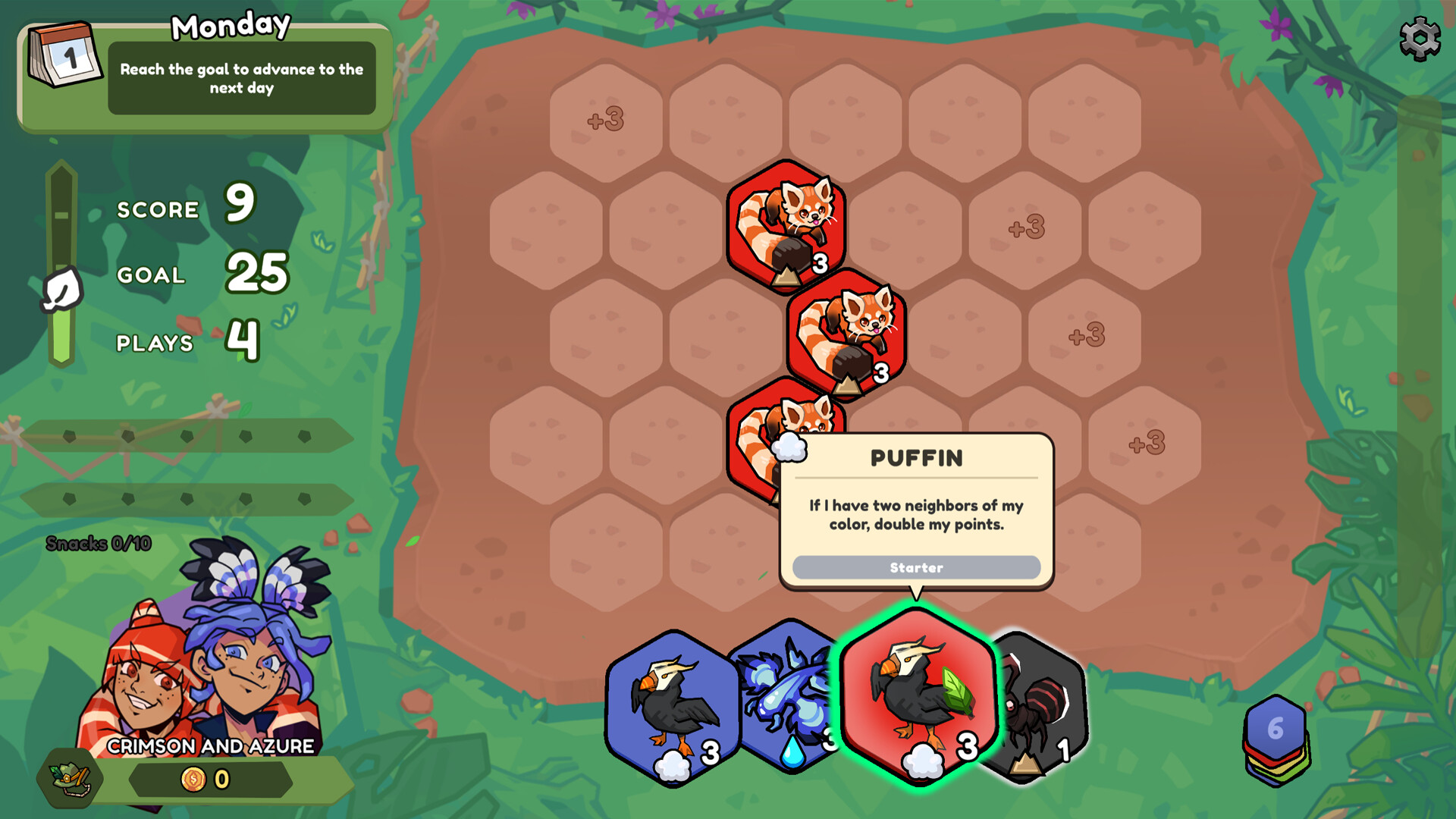
The domino-style hex grid on day one, where matching an animal's color or habitat to its neighbors is the whole puzzle.Image: Starlight Games inc. via Steam -
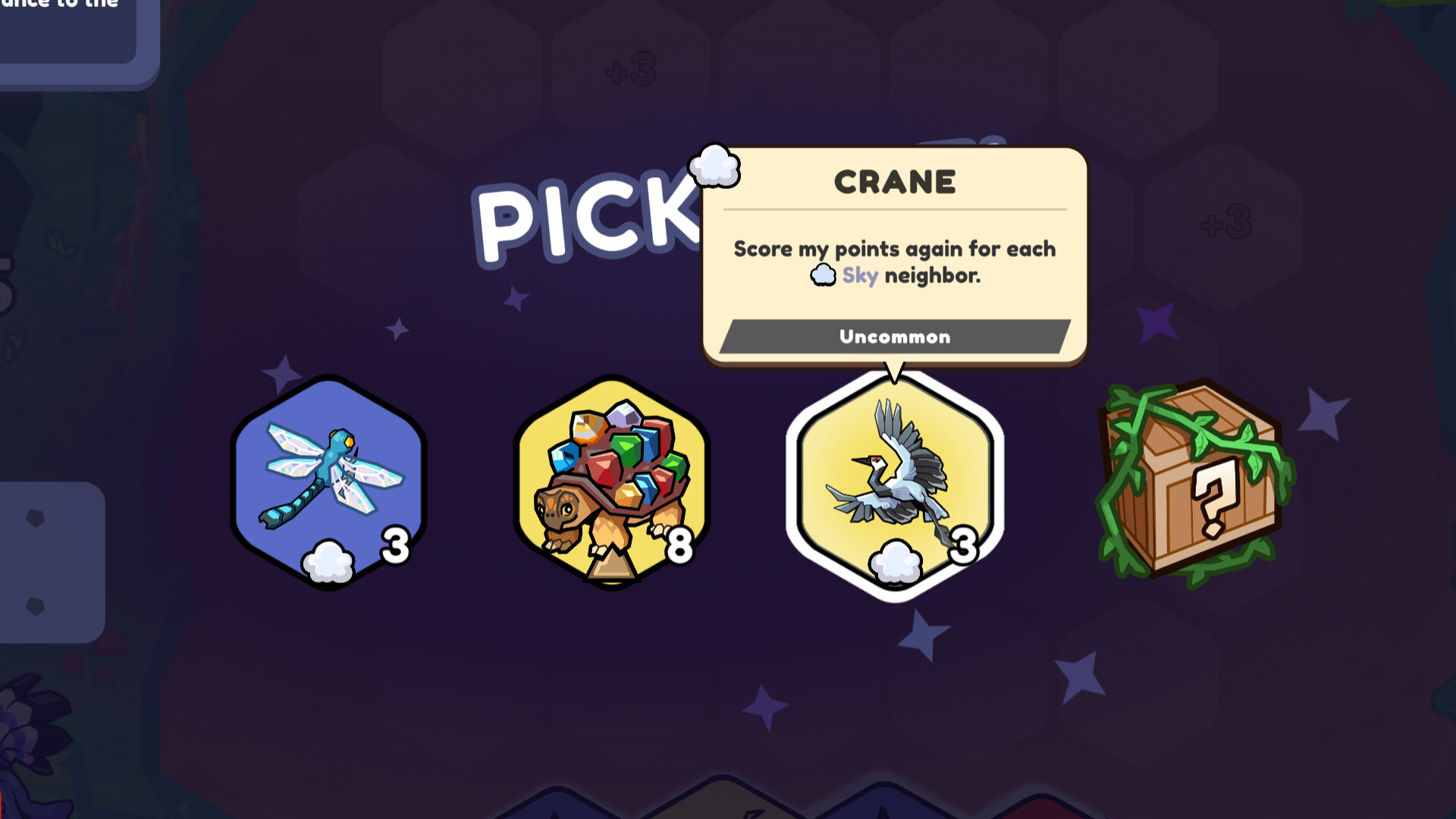
One of the run's reward picks, the kind of choice reviewers say is where deck-thinning strategy actually starts.Image: Starlight Games inc. via Steam -
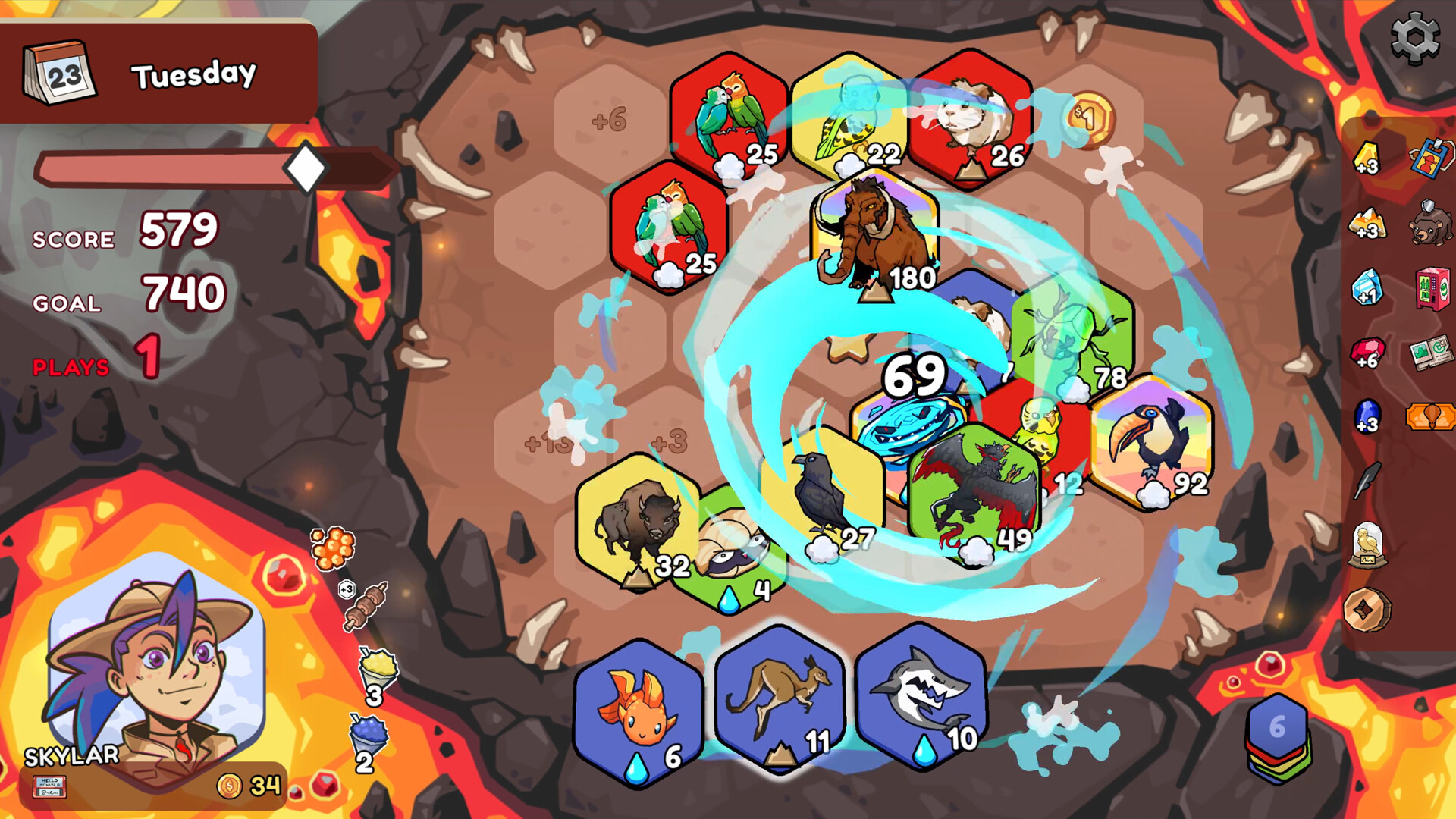
The kind of late-run combo explosion reviewers compare directly to Balatro's biggest scoring chains.Image: Starlight Games inc. via Steam