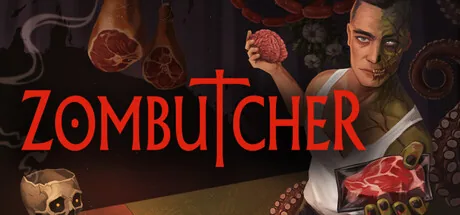
Game review
ZOMBUTCHER: Monster Business Simulator
6 / 10
- Developer
- ODIUS
- Publisher
- Loopr Partners
- Released
- 11 June 2026
- Platforms
- Windows
- Genre
- Action, Indie, Simulation
- Monetisation
- paid
- Players
- false
The short version
Biggest strengths
- A genuinely unique hook, running a legitimate butcher shop by day and stealth-hunting victims for meat by night, that reviewers consistently call addictive
- Real tension from the zombification-hunger clock forcing players to balance shopkeeping, resource management, and staying fed without drawing police attention
- A varied, if underused, roster of meat types and crafting options with room to specialize
Biggest weaknesses
- Slicing, packaging, and crafting mini-games are widely described as finicky and unreliable, with actions frequently failing to register correctly
- Multiple independent reviewers report visibly AI-generated art and text, specifically in the in-game guidebook and NPC expression icons
- Thin mid-to-late content: once core upgrades are unlocked, several reviewers say there's little left to do beyond finishing remaining missions and achievements
Who it's for: Fans of shopkeeper sims who want a dark, stealth-horror twist on the genre and can tolerate finicky mini-games and a short, thin mid-to-late-game loop
Our recommendation: recommended with caveats
6 / 10
Two games in one shopkeeper's apron
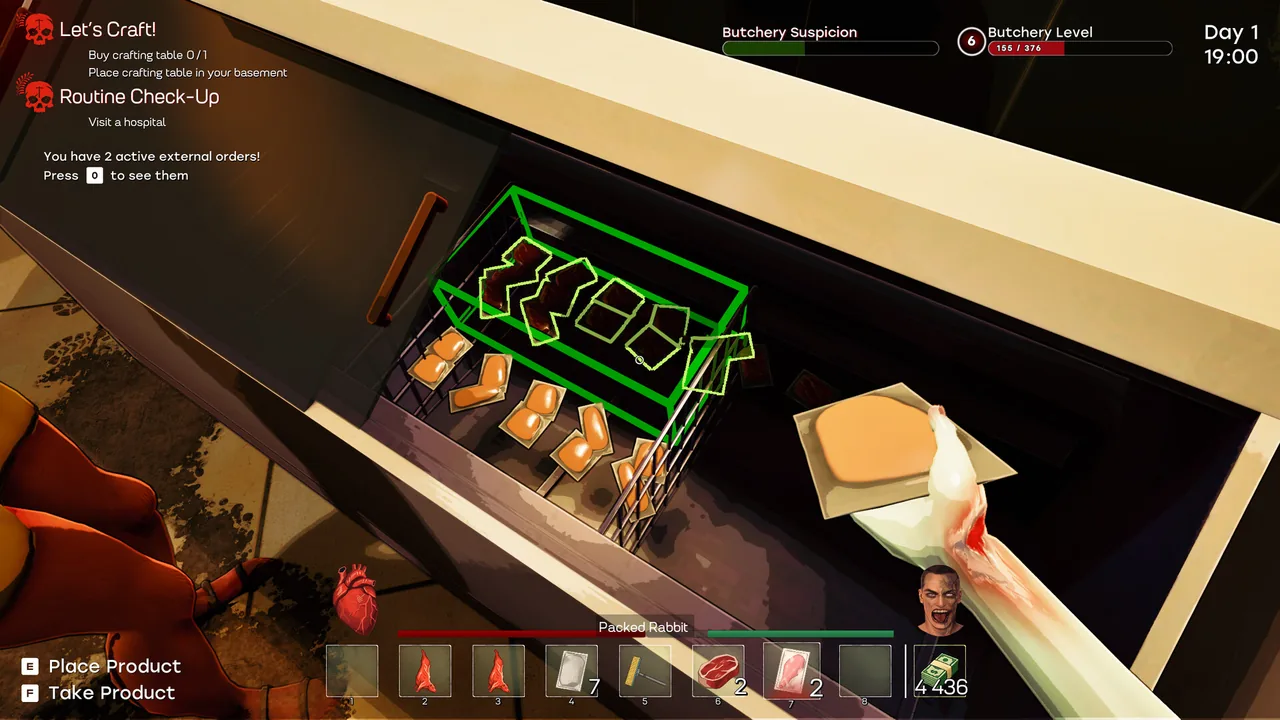
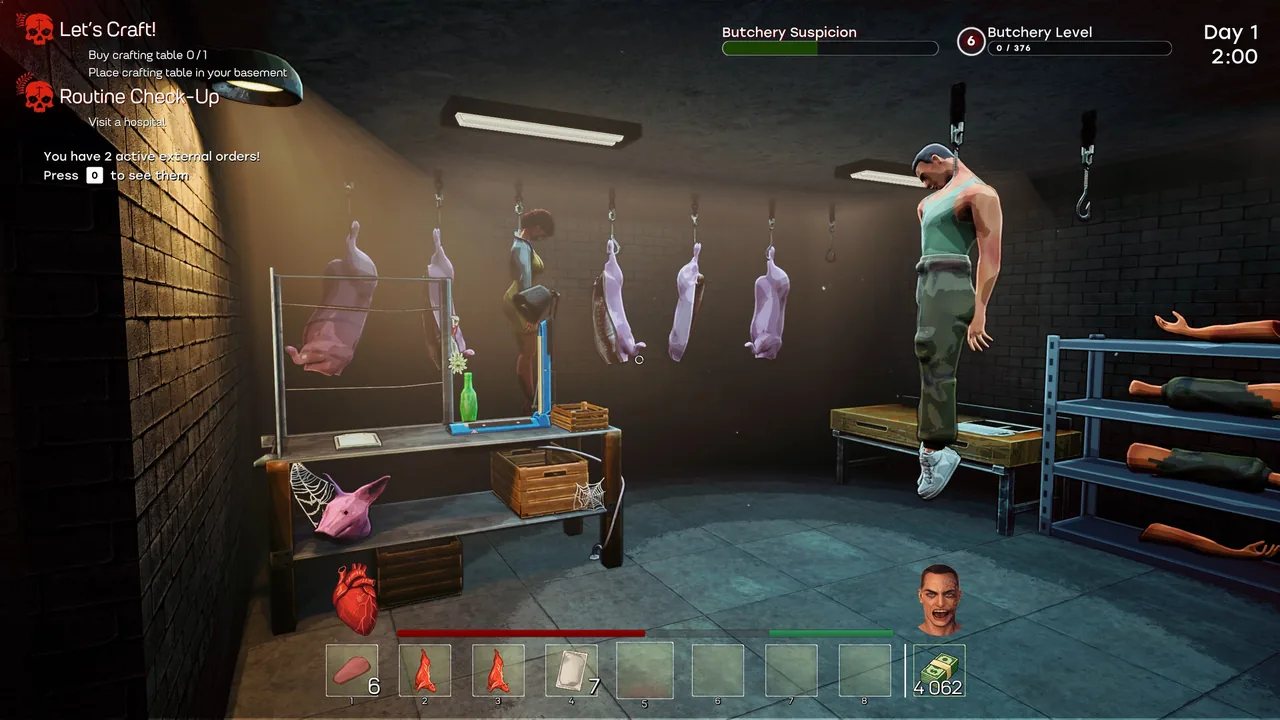
ZOMBUTCHER's pitch is disarmingly simple and, by most reviewer accounts, exactly as fun as it sounds: run a meat shop by day, selling cuts to human customers, then spend the night stalking, subduing, and butchering victims to restock the shelves, all while managing your own hunger for brains before you slip into full zombification and draw police attention. One reviewer summed up the appeal directly: "a very fun twist on the shopkeeper sim type of game that adds another spinning plate to your pile of plates by making it so that you're a zombie who must eat brains every so often or else it's game over." Another described it as "way more addictive than I expected," praising how "there's a constant pressure to stay on top of things" that keeps the day and night halves of the loop genuinely in tension with each other rather than feeling like two separate games stitched together.
A real management-stealth hybrid, not just a reskin
What keeps the premise from feeling like a gimmick is how seriously the game treats both halves of the loop. The daytime shopkeeping runs on familiar simulation-genre rhythms, stocking shelves, pricing goods, and serving customers, while the nighttime stealth sections require genuine caution: getting spotted mid-hunt risks the police catching on, and letting the hunger clock run out triggers visible zombification that threatens the whole operation. Reviewers who leaned into that duality found it a satisfying reason to keep playing past the novelty of the premise, with one calling the balance between "management, strategy and chaos" the game's core strength.
Mini-games that fight the player
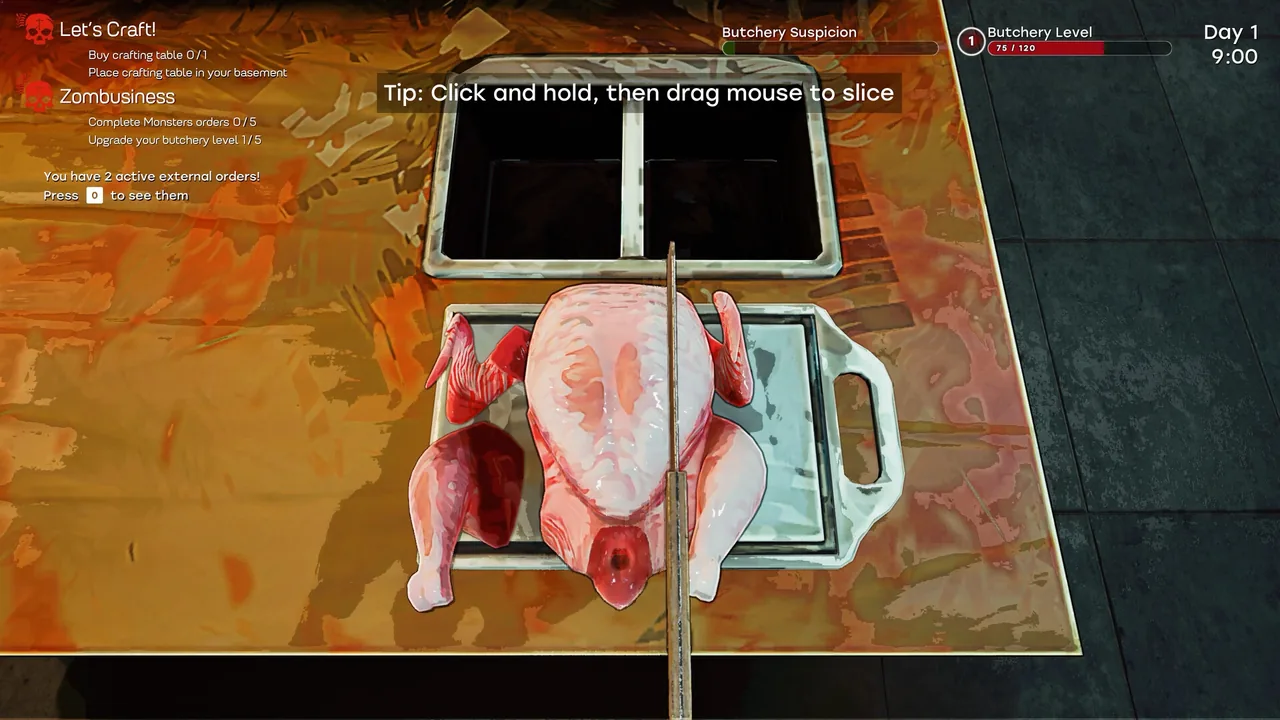
The most consistent, corroborated complaint concerns basic input reliability during the game's core interactions. One detailed reviewer put it plainly: "everything felt really clunky and cumbersome to do. Half the time your actions aren't registering properly until you run your mouse over the screen several times, cutting meat, grinding meat, putting together trinkets, etc." Multiple other reviewers echoed the same frustration with the slicing mechanic specifically, one noting "the slicing mechanics can be a little finicky and I'd struggle to cut the meats with the knife," though that same reviewer found the sawblade upgrade largely resolved it later on. A more critical reviewer described the auto-snapping in crafting and packaging as "so glitchy" that it made "constantly fighting to package, cut, and craft" more frustrating than the difficulty ever intended, and another reported the game outright breaking during leveling, unable to craft or sell items due to what they described as bugs.
Reviewers flag AI-generated art and text
A recurring, independently sourced concern across multiple negative reviews is that portions of the game's visual and written content were produced with generative AI rather than hand-made. One reviewer wrote that "things like the guidebook and the expressions above NPCs' heads are very obviously AI-generated," and said they "could've easily used stock imagery or something simpler" instead. A separate reviewer raised the same concern independently, writing that "the text in the game feels very akin to it, and I've seen others mention it has AI images," while flagging separately that core mechanics "feel janky" and under-tested. A third reviewer went further, estimating that "90% of images, if not all of them, are entirely AI generated." None of these reports come with an official developer disclosure on the store page confirming AI-generated content, so we can't state it as verified fact, but the consistency and specificity of these independent claims, pointing at the same specific assets (the guidebook and NPC expression icons) across separate reviewers, makes this worth flagging clearly to prospective buyers who care about that distinction, rather than treating it as one player's unsubstantiated gripe.
Content that thins out once the upgrades are unlocked
Several reviewers who otherwise enjoyed the core loop flagged a familiar simulation-genre problem: a strong opening hours that tapers off once the upgrade tree is exhausted. One wrote that after unlocking everything, "there really isn't much left to do outside of fin[ishing]" remaining objectives, noting the main goals amount to hitting a few money thresholds followed by a single low-stakes ending choice. Another echoed that the campaign and store missions felt "just too short," adding that neither "gave me a reason to keep playing beyond finishing all the missions and achievements." That's consistent with a detailed positive review's own playtime accounting, finishing the game in under six hours, which that same reviewer flagged as "a little short for the price" even while standing by their overall recommendation.
UI friction and a fast difficulty curve
Beyond the mini-games, reviewers reported rougher edges in how the game communicates its own systems. One wrote that the UI is "horrible and amateurish," describing a twenty-minute search for a crafting table that turned out to be gated behind an unflagged level requirement, and separately noted a time-of-day bug where the game told them it was morning moments after nearly being caught at night. The same reviewer flagged pacing as "really too fast," with dirt and mess accumulating faster than feels fair for a management sim still teaching its systems. These are the kind of rough-edges complaints that a post-launch patch pass could meaningfully address, and the developer's shipped patch history shows exactly that kind of ongoing attention, including localization fixes, an overhauled save/load system, inventory and quest fixes, and a newly added Endless Mode.
An active developer working through the launch bugs
To the developer's credit, ODIUS has kept up a visibly steady post-launch cadence: a first patch landed within days of release, followed by a major patch, inventory and quest-specific fixes, a new save/load system, and a localization pass, with an Endless Mode update announced as a further expansion beyond the base campaign shortly after. That's a meaningfully different picture from a studio that ships once and disappears, and it directly addresses at least some of the specific bug reports, around crafting, saving, and inventory, that show up in critical reviews. Buyers frustrated by the mini-game jank at launch have a reasonable basis to expect continued attention, even if the deeper concerns around content depth and asset originality aren't the kind of thing a patch alone resolves.
Verdict
ZOMBUTCHER: Monster Business Simulator has a hook few other shopkeeper sims can claim, and when its day/night tension is working, reviewers describe it as genuinely addictive. It's held back by finicky, unreliable mini-game execution, a mid-to-late game that thins out faster than its six-hour-plus runtime should allow, and a cluster of independent, specific reviewer reports pointing at AI-generated art and text in its guidebook and NPC expressions, a concern the storefront doesn't currently address either way. Worth a look for simulation fans drawn to its stealth-horror twist who can tolerate rough mini-game feel and a short back half; those bothered by unreliable input handling or unresolved questions about how its assets were made should wait and watch the patch notes before buying in.
Pros and cons
Pros
- A genuinely unique hook, running a legitimate butcher shop by day and stealth-hunting victims for meat by night, that reviewers consistently call addictive
- Real tension from the zombification-hunger clock forcing players to balance shopkeeping, resource management, and staying fed without drawing police attention
- A varied, if underused, roster of meat types and crafting options with room to specialize
- Works well on Steam Deck with light control remapping, according to multiple reviewers
Cons
- Slicing, packaging, and crafting mini-games are widely described as finicky and unreliable, with actions frequently failing to register correctly
- Multiple independent reviewers report visibly AI-generated art and text, specifically in the in-game guidebook and NPC expression icons
- Thin mid-to-late content: once core upgrades are unlocked, several reviewers say there's little left to do beyond finishing remaining missions and achievements
- A short campaign, roughly six hours for one detailed reviewer, that several buyers feel doesn't fully justify the asking price
Screenshots
-
ZOMBUTCHER: Monster Business SimulatorImage: Loopr Partners via Steam -
ZOMBUTCHER: Monster Business SimulatorImage: Loopr Partners via Steam -
ZOMBUTCHER: Monster Business SimulatorImage: Loopr Partners via Steam