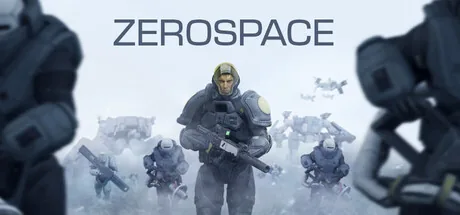
Game review
ZeroSpace
7 / 10
- Developer
- Starlance Studios and Ironward
- Publisher
- Starlance Studios and Gamersky Games
- Released
- 20 July 2026
- Platforms
- Windows
- Genre
- Sci-fi RTS with RPG commander progression
- Monetisation
- One-off premium purchase for Early Access. No battle pass or premium currency at launch; the seasonal Galactic War metagame hands out cosmetic and in-game rewards for participation rather than selling them
- Players
- Ranked 1v1 and 2v2, 3v3 skirmish and free-for-all, PvE co-op missions, and a seasonal cross-server "Galactic War" metagame led by RTS streamers, alongside a single-player campaign
The short version
ZeroSpace is the first RTS in a long time that plays like it was designed by people who actually miss StarCraft, rather than people who read a wiki summary of it. Four factions and six mercenary pools mix into genuine tactical identities, base-building keeps its teeth, and the commander layer bolted on top mostly behaves — heroes support the army instead of replacing it, which is the one decision that could have sunk the whole hybrid.
It is also, honestly, an early access build with one campaign act, one faction still unbalanced for ranked play, and a launch strategy built heavily around streamers and their personal alliances rather than a quieter on-ramp for anyone who hasn't touched an RTS ladder since Legacy of the Void. The bones are excellent. Whether they're worth full price yet depends entirely on how much you already know about macro.
Biggest strengths
- Four factions and six mercenary pools combine into genuinely distinct tactical identities rather than reskinned symmetry
- Heroes level up and unlock passive buffs and calldown abilities but stay support pieces, keeping the RTS decision-making about army composition rather than babysitting one power-fantasy unit
- Campaign dialogue choices visibly shape Commander Aster's relationships and leadership style, an actual attempt at branching narrative in a genre that rarely bothers
Biggest weaknesses
- Early Access ships one act of the campaign; the "cinematic saga" pitch is currently a prologue, not the story being sold on the box
- The Xol faction is explicitly unbalanced for ranked play at launch, which pushes early competitive players toward three factions instead of four
- Player feedback across the launch window consistently flags rough edges and missing polish, exactly what you'd expect from a young Early Access build but still a real cost at full price
Who it's for: Lapsed StarCraft and Command & Conquer players who miss base-building and want a reason to come back, plus anyone curious about RPG-flavoured strategy games with real stakes attached to hero units. A rough entry point for someone who has never played a real-time strategy game before and doesn't already know what "macro" means.
Our recommendation: Worth buying now if you already know the genre and want to support active development, or if you specifically want co-op and campaign content and can live with Act 1 being the whole story so far. Everyone else should wait for a later Early Access build, or at least a deeper discount, before spending full price on one act and an unfinished ladder.
7 / 10
Every real-time strategy game released since 2015 has been measured against a ghost. ZeroSpace is the first one in years where that comparison feels like a compliment the developers are chasing on purpose rather than a burden they're stuck carrying. Built with Starlance Studios' own team alongside Ironward — the Red Solstice studio — and stacked with StarCraft-scene names like Sasha "Scarlett" Hostyn and Paulo "CatZ" Vizcarra as design consultants, it plays like a genre revival written by people with a very specific, very personal idea of what went wrong with RTS design over the last decade. Then it welds an RPG commander layer on top, with branching dialogue, hero progression, and a story campaign styled after Mass Effect. That combination is the whole review: does the hybrid work, and who is it actually for.
Macro that still bites
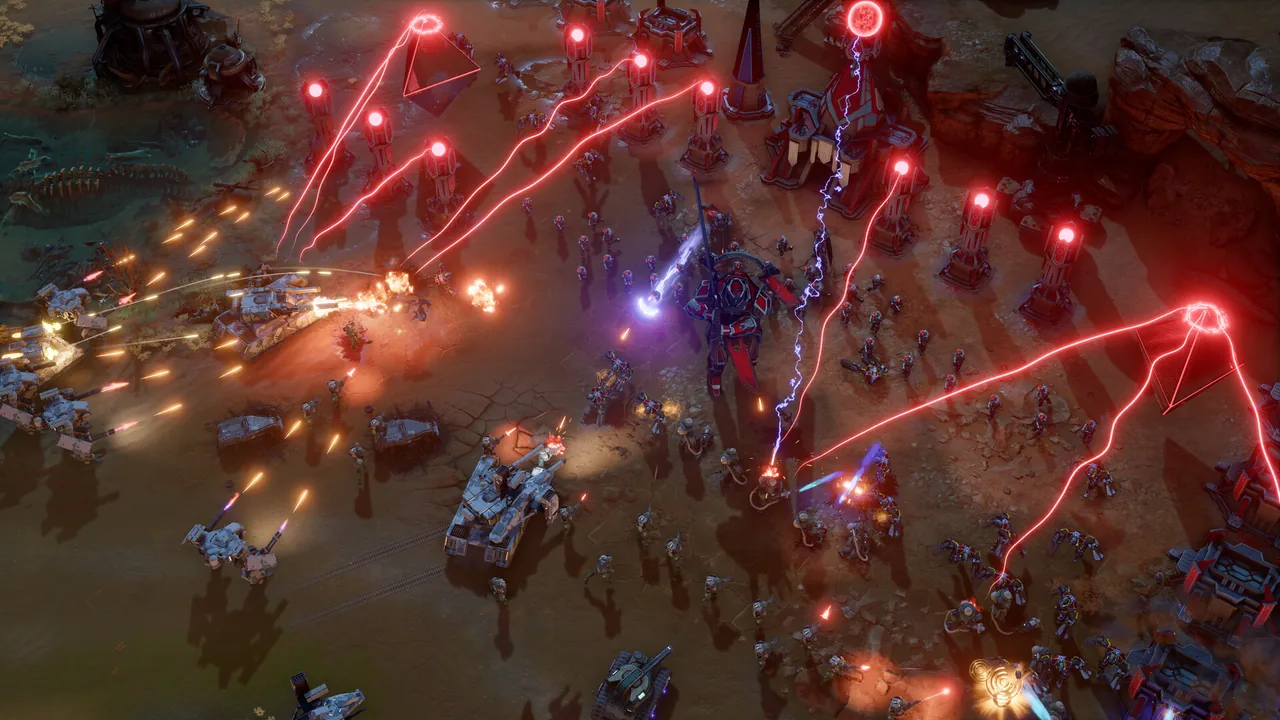
Strip away the hero units and the cutscenes and ZeroSpace's foundation is unmistakably classic-mould RTS — base construction, resource economy, tech-gated unit tiers, and army composition decisions that matter round to round. Four playable civilizations anchor the roster: the Protectorate (humanity's own faction), the plant-derived Grell, the overwhelming-numbers Legion, and the synthetic Xol, with six additional mercenary factions available to hire into any army rather than locked behind a fixed race pick. That mercenary layer is the smarter of the two ideas — instead of choosing one of four fixed toolkits and living with its gaps all game, you're assembling a composite identity match to match, closer to how a Command & Conquer generals mod handles subfactions than how StarCraft's three races work. It rewards exactly the kind of match-to-match adaptation that made the genre's best players fun to watch, and it gives newer players room to specialise into a playstyle without first mastering an entire race's full unit roster.
The catch, and it's a real one this early in Early Access: the Xol faction isn't balanced for ranked play yet. That's an honest admission from a young build rather than a scandal, but it means the "four factions" pitch is currently closer to three-and-a-half for anyone who wants their ladder games to mean something, and it's the first sign that this is a product still being built in public.
Heroes that know their place
The riskiest design decision in any RTS-RPG hybrid is what happens to hero units once you give them levels, gear, or abilities — the genre's history is full of games where a beefed-up commander either trivialises early engagements or turns matches into a single unit's highlight reel while the actual army stands around waiting. ZeroSpace makes the correct call here: heroes level through an in-match faction progression track that unlocks passive upgrades and calldown abilities, but they're built and balanced as support pieces, not solo win conditions. That's a genre-respectful choice rather than an obvious one, and it's the single biggest reason the RPG layer reinforces the strategy game instead of diluting it. You're still winning or losing on economy, positioning, and composition; the hero is a lever you pull inside that framework, not a replacement for playing the RTS underneath it.
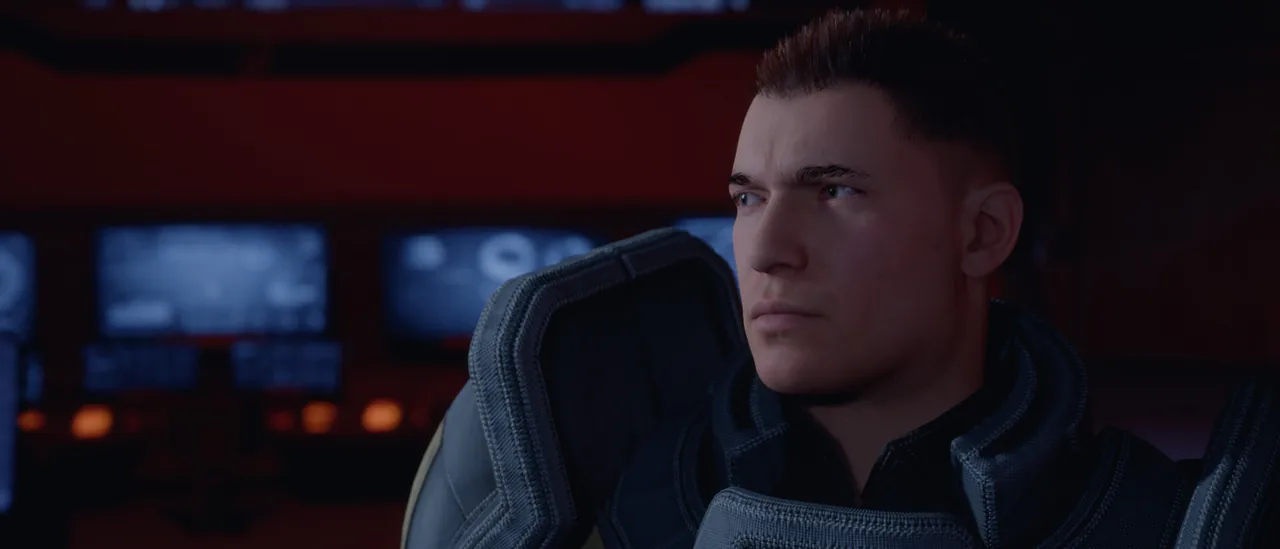
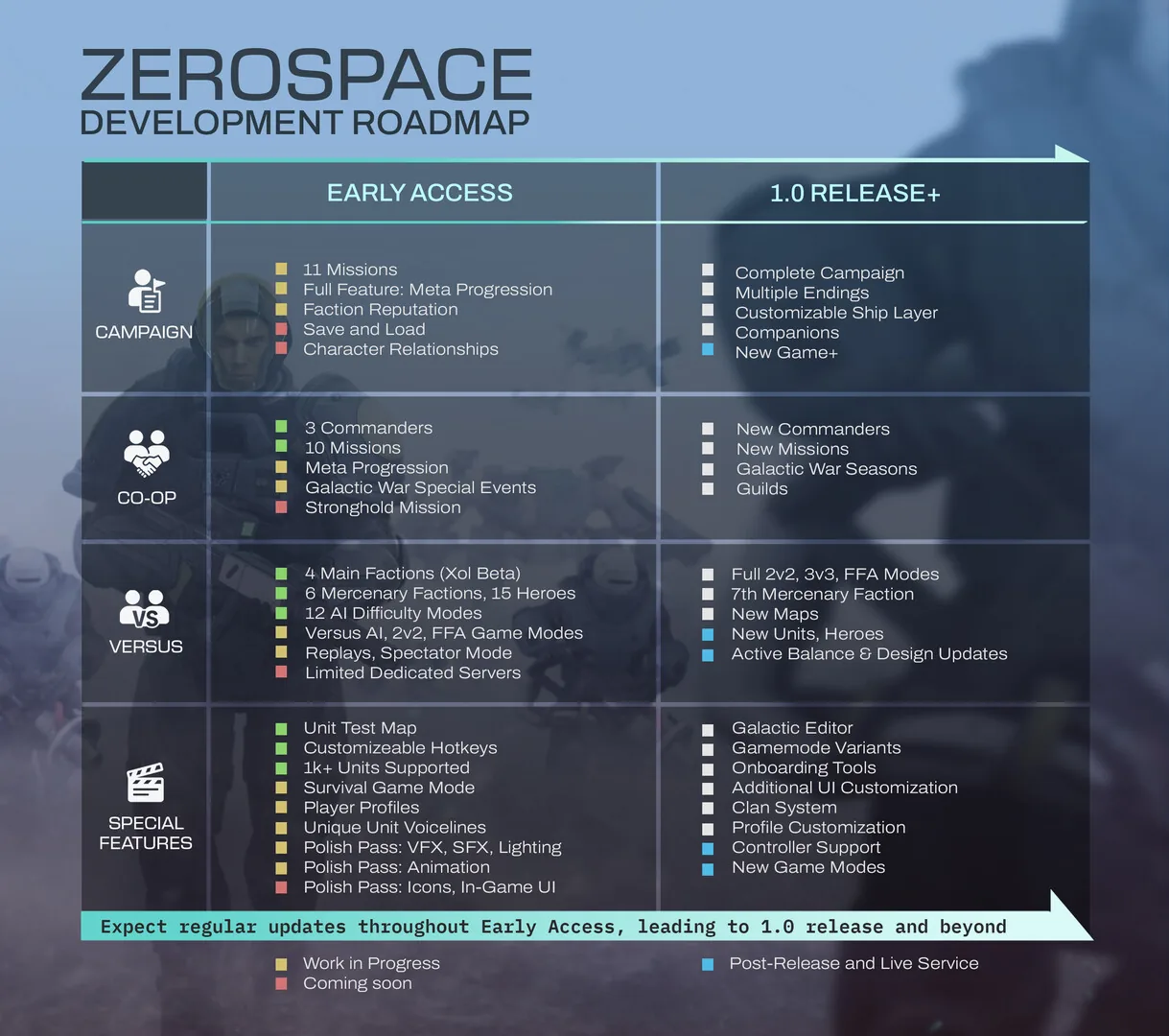
Where the hybrid gets more interesting — and more divisive — is the campaign, where Commander Aster's story leans hard into dialogue trees and relationship-shaping choices that wouldn't be out of place in a BioWare game. Early Access ships Act 1: twelve missions establishing the Protectorate's political situation and Aster's command style through player choice. It's a genuinely rare ambition for the genre, and the writing has enough weight to make the choices feel like they cost something rather than existing purely for flavour text. But twelve missions is a prologue, not the "epic, cinematic saga spanning the galaxy" the marketing promises, and anyone buying specifically for the RPG story is buying into an act, with no confirmed date for the rest.
Co-op, ranked, and the Galactic War
Multiplayer breadth is where ZeroSpace makes its strongest case for being worth the asking price today rather than later. Ranked 1v1 and 2v2 sit alongside 3v3 skirmish and free-for-all, PvE co-op missions built as their own mode rather than a campaign reused with bots, and a seasonal metagame called the Galactic War layered over the top of all of it. Season Zero ran as a two-week event tying every co-op match played to a persistent galactic map, where influence earned by three player-led alliances captured planets and territory until a winner was crowned. It's a clever structural idea — borrowing the "your individual matches feed a shared, visible outcome" hook that made Helldivers 2's Major Orders land, and applying it to an RTS where that kind of shared stakes system barely exists.
The problem is who those three alliances were led by: RTS streamers Winter, Neo, and uThermal, each commanding their own faction of players. That's not a bad idea in isolation — pro-scene names lending structure to a launch event is a reasonable marketing beat — but building the headline feature of your Early Access launch entirely around three creators and their existing communities sends a specific signal about who this game currently expects to show up. It's not unwelcoming exactly, but it reads like a launch event for people who already follow competitive RTS content, not an on-ramp for someone who quit StarCraft II a decade ago and just wants to see what modern base-building feels like again.
The barrier-to-entry problem
That's the real tension running through ZeroSpace, and it's bigger than any single system. The developers have built something that plays like the RTS genre's most faithful students made it — and that's exactly why it's a hard sell to anyone who isn't already fluent in the genre's language. Macro-heavy base-building with real APM stakes was always the thing that pushed casual players toward MOBAs and looter shooters in the first place; ZeroSpace hasn't softened that curve so much as dressed it in RPG clothing and hoped the story missions would ease people in. They might, for players patient enough to treat Act 1 as an extended tutorial. But the game's most visible feature at launch — a ranked ladder with one unbalanced faction, wrapped in a streamer-led seasonal event — is aimed squarely at people who already know what they're doing, not the "lapsed RTS fan looking for a reason to come back" audience the pitch keeps invoking.
None of that makes the hybrid a failure. The hero layer earns its place by staying disciplined; the mercenary system genuinely deepens army-building decisions instead of just adding cosmetic variety; and Kickstarter backing plus a full four-faction skeleton at Early Access launch is a stronger starting position than most strategy games get. It just means the RPG half and the RTS half currently reinforce each other mechanically while the marketing and structure around them work against the very audience most likely to appreciate that mechanical care.
Polish, performance, and where the money is going
Player sentiment through the launch window is genuinely encouraging for a young Early Access build — recent English-language reviews sit at 81% positive, ahead of the 76% all-time, all-language figure, which usually means a rocky international or early-adopter tail rather than a game getting worse over time. The recurring, honest theme in that feedback is exactly what you'd expect this early: real enthusiasm for the core game paired with consistent notes that it needs more polish and attention before it's the finished product being promised. That's not damning on its own — it's what Early Access is for — but it does mean the current NZ$54.89 asking price is buying into a build players themselves are still calling unpolished, not a discounted preview of something already complete.
Accessibility is a genuine bright spot worth calling out specifically, because strategy games rarely bother: adjustable difficulty, mouse-only and touch-only control schemes, subtitle options, and camera-comfort settings are all present from launch, well ahead of genre norms. It's a small thing that suggests a team thinking about who else might want in, even while the marketing around Season Zero was pulling in the opposite direction.
Verdict
ZeroSpace deserves the "most credible StarCraft successor in years" tag on mechanical merit alone — the base-building has teeth, the mercenary system rewards real tactical thinking, and the hero layer was built by people who understood exactly how easily that idea goes wrong and avoided the trap. That's a genuinely rare combination this early in a project's life, and it's why the enthusiasm from the RTS scene isn't hype for its own sake.
But this is still one campaign act, one faction not yet fit for ranked play, and a launch event built for an audience that already knows the genre's grammar, all sitting behind a full-price Early Access tag that players themselves are calling unpolished. If you already speak RTS fluently and want to back a project with real design conviction behind it, this is an easy recommendation today. If you're the lapsed player the marketing keeps talking to — someone who hasn't opened a build order in ten years and wants a gentle way back in — the current build asks you to relearn the genre from scratch before any of its better ideas get a chance to land. Wait for more acts, a settled Xol, and a quieter on-ramp, or come in now knowing exactly what kind of player this version was built for.
Strategy fans who like the idea of a system that keeps rewarding planning and long-term thinking rather than twitch reflexes alone will find a distant, much gentler cousin of that appeal in Wanderer's own gathering and progression loop.
Price and platform details checked 31 July 2026.
Pros and cons
Pros
- Four factions and six mercenary pools combine into genuinely distinct tactical identities rather than reskinned symmetry
- Heroes level up and unlock passive buffs and calldown abilities but stay support pieces, keeping the RTS decision-making about army composition rather than babysitting one power-fantasy unit
- Campaign dialogue choices visibly shape Commander Aster's relationships and leadership style, an actual attempt at branching narrative in a genre that rarely bothers
- PvE co-op, ranked ladders, and free-for-all skirmish are all present at launch instead of promised for later, so solo and social players both have something to do immediately
- Accessibility options — adjustable difficulty, mouse-only and touch-only control schemes, subtitle and camera-comfort settings — go further than most strategy games bother to offer
Cons
- Early Access ships one act of the campaign; the "cinematic saga" pitch is currently a prologue, not the story being sold on the box
- The Xol faction is explicitly unbalanced for ranked play at launch, which pushes early competitive players toward three factions instead of four
- Player feedback across the launch window consistently flags rough edges and missing polish, exactly what you'd expect from a young Early Access build but still a real cost at full price
- The headline seasonal event was built entirely around three streamer-led alliances, which reads as marketing aimed at an audience that already knows who those streamers are, not a welcome mat for a lapsed player coming back cold
- No confirmed roadmap date for later campaign acts or full faction balance, so buying in means betting on a timeline the developers haven't committed to publicly
Screenshots
-
ZeroSpaceImage: Starlance Studios via Steam -
ZeroSpaceImage: Starlance Studios via Steam -
ZeroSpaceImage: Starlance Studios via Steam -
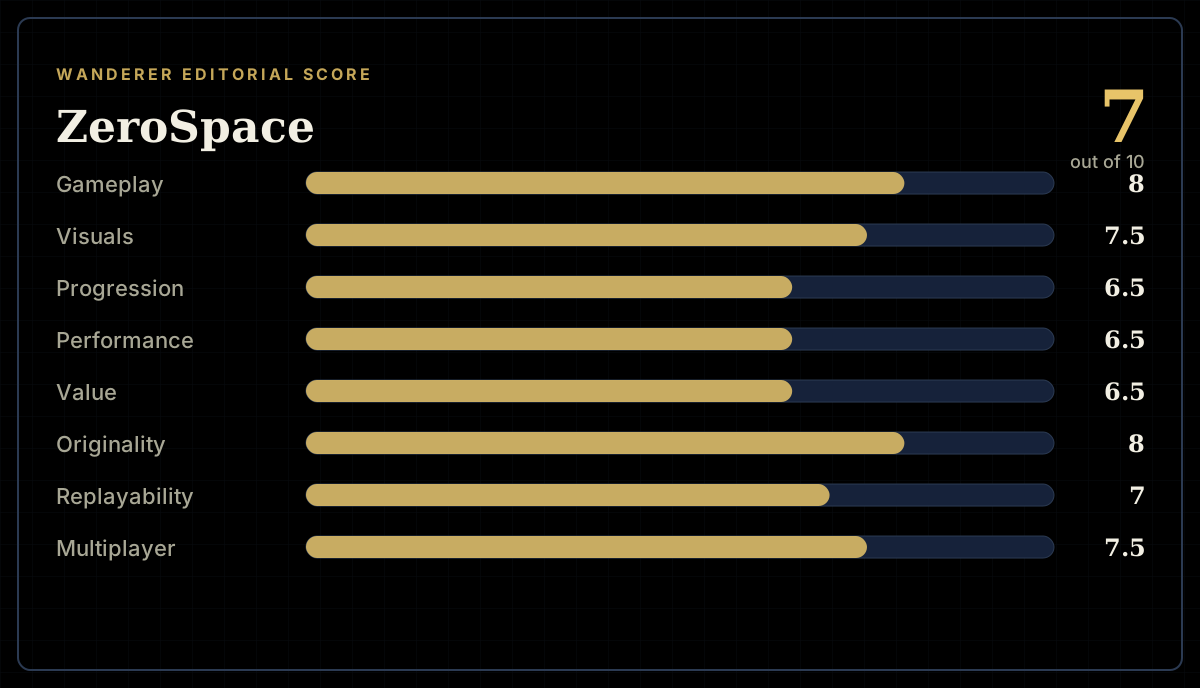
How the review scores each part of the gameWanderer Editorial -
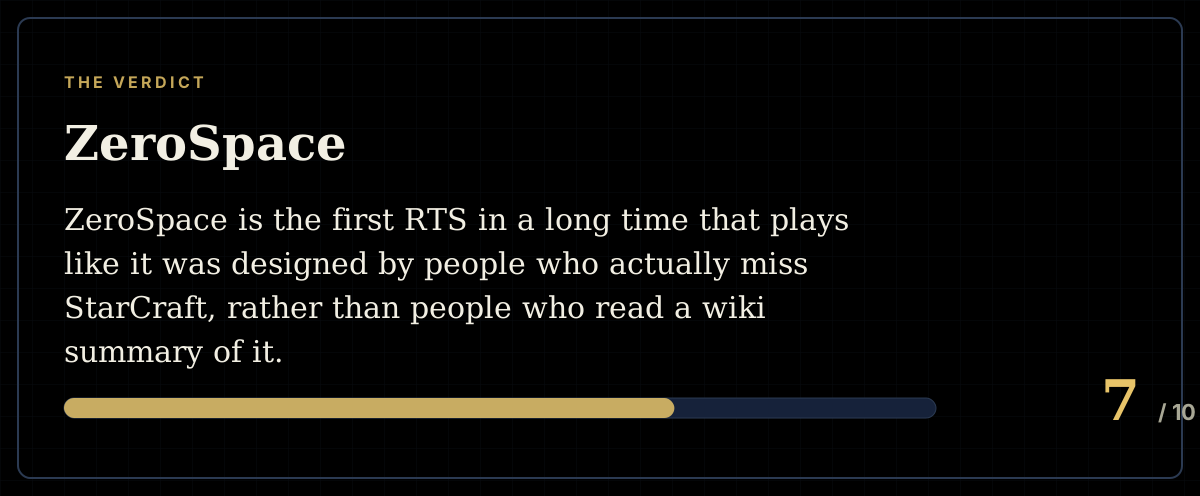
The short versionWanderer Editorial