Game review
War Room: Tactical Sandbox
5 / 10
- Developer
- Lado B Studios
- Publisher
- Lado B da História
- Released
- 29 June 2026
- Platforms
- Windows
- Genre
- Indie, Simulation, Early Access
- Monetisation
- paid
- Players
- false
The short version
Biggest strengths
- A genuinely distinctive sandbox editor letting players import custom PNG sprites, build historical or original maps, and stage battles with pause and adjustable time-scale controls
- Movie, pixel, and CRT filter options aimed squarely at players making historical video content rather than playing a conventional game
- A developer reviewers credited with quickly acting on community feedback, such as adding middle-mouse map panning after a single forum request
Biggest weaknesses
- A dense, unfriendly interface that multiple reviewers said lacks real guidance, with the in-game guide described as more of a control summary than a tutorial
- A Battle Mode reviewers described as an unrealistic abstraction, with units failing to recognize terrain, breaking pathfinding, and simply colliding without coherent combat behavior
- Reported severe framerate drops, described by one reviewer as turning into "a slide show," during battles with heavy AI unit counts
Who it's for: Hobbyist historians, Kriegsspiel enthusiasts, and educational content creators who want a lightweight tool for staging and animating historical scenes, more than players seeking an actual battle simulator
Our recommendation: recommended with caveats
5 / 10
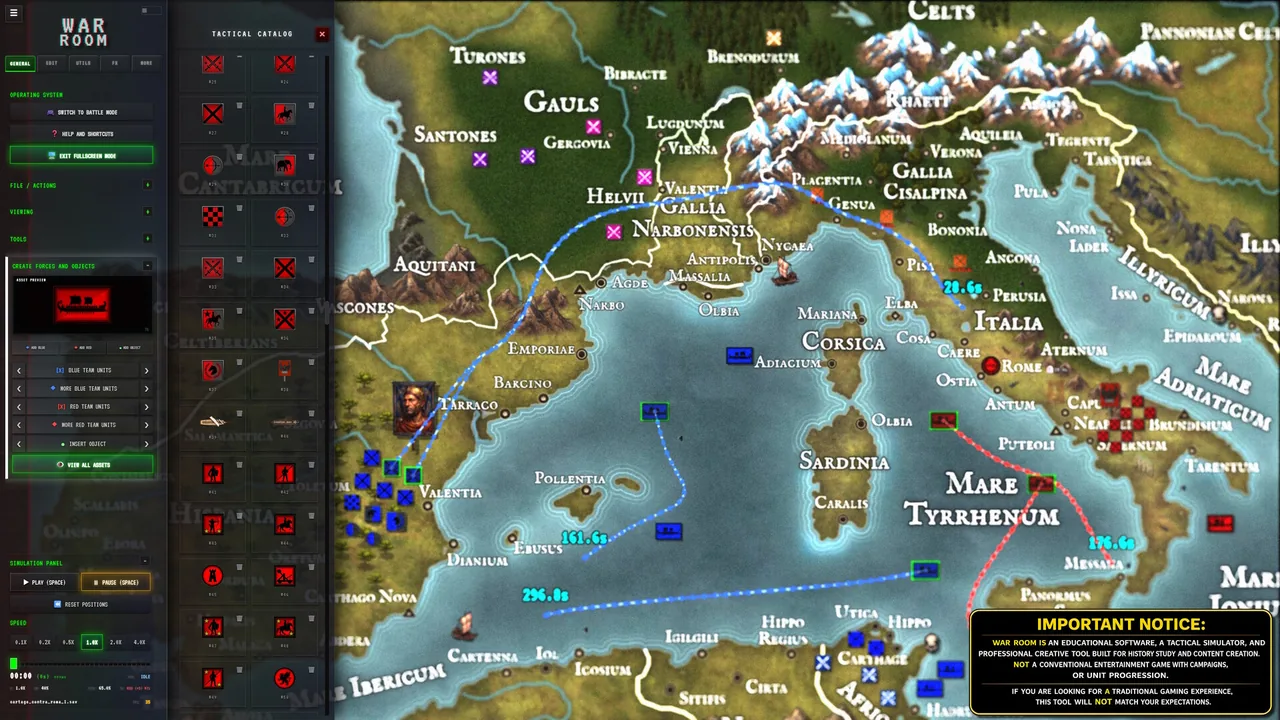
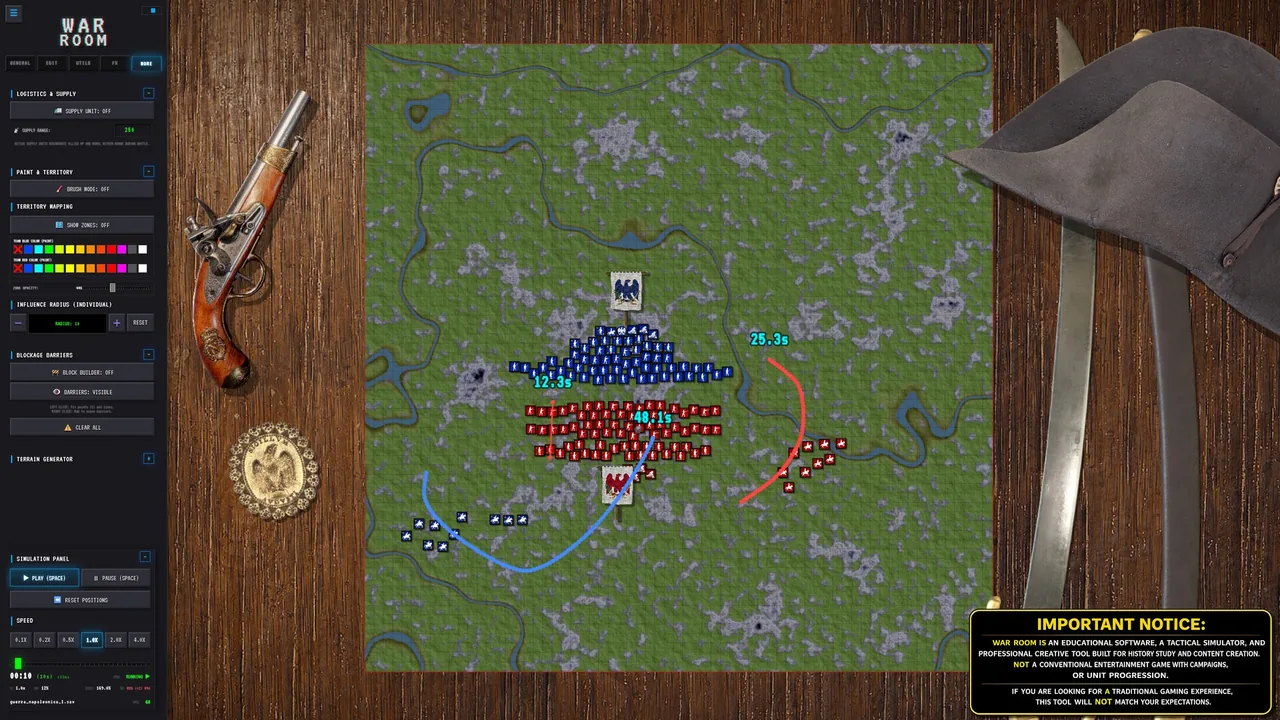
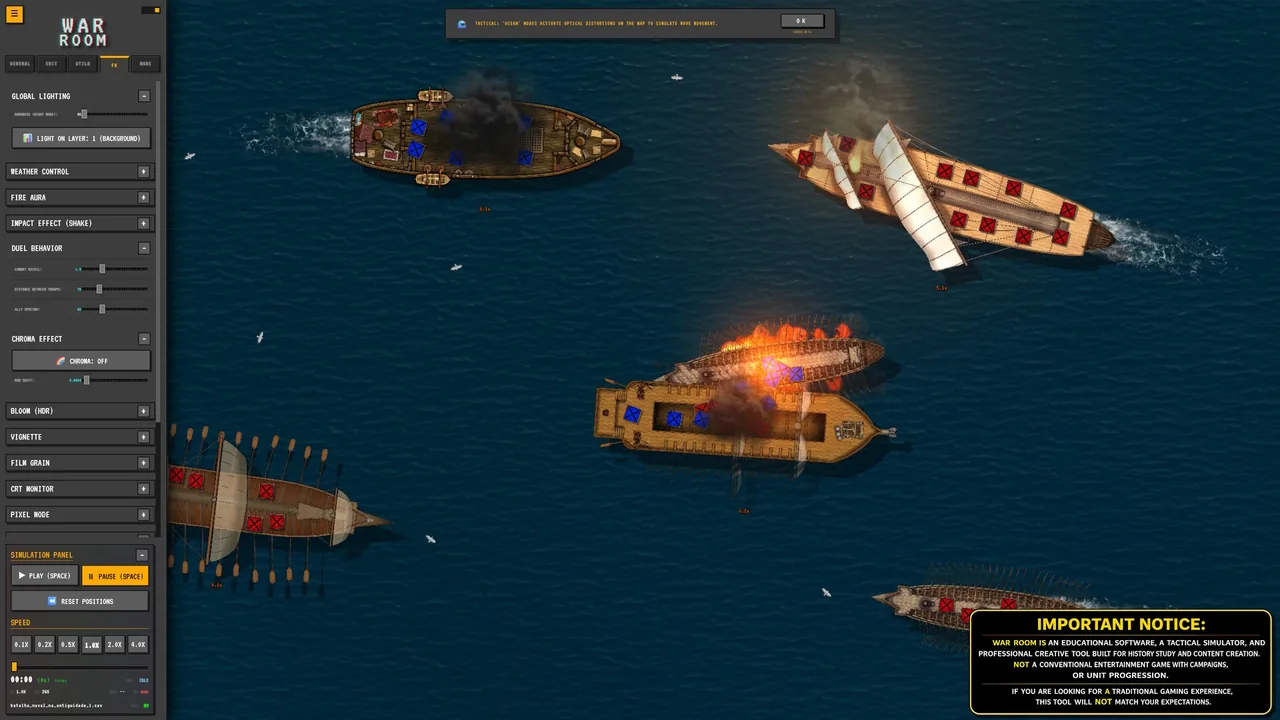
War Room: Tactical Sandbox entered Early Access on June 29, 2026, and its pitch is unusual enough to stand out in a genre choked with grand-strategy clones: it isn't really trying to be a game at all. The developer describes it as "a 2D tactical sandbox tool built for historical study, content creation, and Kriegsspiel enthusiasts," and that framing matters, because judging it as a battle simulator versus judging it as an animation tool produces two very different reviews. Import your own PNG sprites, drop them onto a historical or custom map, assign sides, and either hand control to a simple AI or issue orders yourself in a real-time mode that can be paused and rewound in speed. Movie, pixel, and CRT filters sit alongside the editor for players who want their finished battles to look like archival footage rather than a live simulation.
For the audience it's actually built for — hobbyist historians, Kriegsspiel players, and people making educational war-history videos who don't want to learn full animation software — that pitch has real appeal. One Positive reviewer who set out to make historical videos called it "a place to start," and specifically praised the pause-and-time-scale system for staging shots, the option to cut battle sound entirely, and a responsive developer who added middle-mouse panning after a single forum request. Another described testing a self-made small map against a simple AI opponent and came away impressed that, even in Early Access, "the game has already all the function and key to play and create good maps." The core toolset — sprite import, map creation, time control, filter stacking — is genuinely there and genuinely functional for the narrow use case of staging and animating a historical scenario.
Where the picture gets messier is everything layered on top of that toolset, starting with the interface. Reviewers across both camps agree the UI is dense and unfriendly to newcomers: one Positive reviewer conceded it's "a little complex to understand at the begin," and a detailed Negative review went further, describing the in-game guide as "more like a summary of the controls" than an actual tutorial, offering no real guidance on how to build or assign units. That same reviewer flagged that most controls rely on unconfigurable key binds rather than clickable buttons, that the guide itself is hard to read on small screens, and that the default presets ship without a proper world map or a NATO-symbology unit library — meaning anyone hoping to start making content immediately has real setup work ahead of them first.
Battle Mode is the software's most contested feature, and it's the part that undercuts the "not a simulation" framing the developer has leaned on. Multiple reviewers describe units that don't recognize terrain and simply bump into each other without meaningful feedback, pathfinding that breaks down under complexity, and behavior that reads as arbitrary rather than tactical — one Negative reviewer summarized it as units engaging in "no coherent form of combat." Performance is a separate complaint: a Positive reviewer who otherwise likes the tool noted that heavy AI battles turn the game "into a slide show," and the same review flags inconsistent unit movement speeds. None of this sinks the sandbox-and-editor half of the package, but it does mean the "living battlefields" half of the marketing promises more than the current build delivers.
The most serious allegations in the review pool go beyond bugs and UI friction. The longest Negative review, titled "Do not spend your money on this developer," alleges that War Room's assets are AI-generated — calling it "total AI SLOP" and claiming "the developer cannot even generate a single response without using AI to formulate" — and separately claims the developer "personally attacked people" in the review's own comment section and on the forums, adding that those comments have since been deleted. A second, independent Negative review states flatly that "this game has undisclosed AI usage." Wanderer has not independently verified either the asset-origin claim or the account of the developer's conduct, and reports them here only as reviewer allegations rather than established fact — but two unconnected reviewers raising undisclosed AI usage as their central complaint, alongside a specific and detailed account of hostile developer behavior toward reviewers, is the kind of pattern buyers researching the game deserve to know about before purchasing. The same Negative review also alleges the developer altered the store page's marketing description after launch, softening claims about "simulating" tactical confrontations once early buyers pushed back on how abstracted the actual combat turned out to be.
Value for money is another split question depending on which audience you fall into. At $9.99, several reviewers framed the purchase as cheap relative to what they'd otherwise pay for full animation or editing software just to storyboard a battle sequence, and one specifically called it a fair price for "a tool that has most of what I think I'll need" despite having never made a video before. But a Negative reviewer who came in hoping to shortcut educational-content production found the opposite: default presets shipping without a proper world map or a comprehensive NATO-symbology unit library, meaning the advertised time savings evaporate once you factor in the setup work required before you can actually start staging anything. Free alternatives exist for the illustration side of the workflow, that reviewer noted, which makes War Room's specific value proposition rest almost entirely on the sandbox and battle tools rather than anything else it offers.
Taken as a whole, War Room: Tactical Sandbox is a real, working sandbox editor wrapped around a combat simulation that doesn't hold up to its own marketing, sitting inside a review pool carrying unusually serious and specific allegations about both the game's asset pipeline and its developer's conduct toward critics. If you want a lightweight tool for staging historical scenes and cutting slow, filtered footage for a video project, several reviewers found genuine value here despite the rough UI. If you're expecting the "tactical confrontations" and "morale and logistics" the store page still advertises, the Battle Mode as it exists in Early Access — bumping, pathless units and slideshow framerates under load — falls well short, and the unresolved AI-sourcing and developer-conduct allegations are reason enough to wait and watch before buying in.
Pros and cons
Pros
- A genuinely distinctive sandbox editor letting players import custom PNG sprites, build historical or original maps, and stage battles with pause and adjustable time-scale controls
- Movie, pixel, and CRT filter options aimed squarely at players making historical video content rather than playing a conventional game
- A developer reviewers credited with quickly acting on community feedback, such as adding middle-mouse map panning after a single forum request
- Real, if narrow, appeal already demonstrated by reviewers using it to storyboard and animate historical scenarios
Cons
- A dense, unfriendly interface that multiple reviewers said lacks real guidance, with the in-game guide described as more of a control summary than a tutorial
- A Battle Mode reviewers described as an unrealistic abstraction, with units failing to recognize terrain, breaking pathfinding, and simply colliding without coherent combat behavior
- Reported severe framerate drops, described by one reviewer as turning into "a slide show," during battles with heavy AI unit counts
- Multiple independent reviewers alleging undisclosed AI-generated assets, and one detailed account alleging hostile developer conduct toward reviewers in comments and forums since deleted, none of which Wanderer has independently verified
Screenshots
-
War Room: Tactical SandboxImage: Lado B da História via Steam -
War Room: Tactical SandboxImage: Lado B da História via Steam -
War Room: Tactical SandboxImage: Lado B da História via Steam