Game review
National Transit
6.5 / 10
- Developer
- NationQ Studio
- Publisher
- NationQ Studio
- Released
- 23 June 2026
- Platforms
- Windows
- Genre
- Simulation, Strategy, Early Access
- Monetisation
- paid
- Players
- false
The short version
Biggest strengths
- A genuinely distinctive premise within the transport-sim genre, developing an entire nation's infrastructure and economy rather than managing a single city, that reviewers called one of the game's strongest aspects
- Cities tracked across multiple statistics (education, healthcare, GDP, HDI) that reviewers say make the simulation feel meaningfully reactive to policy and infrastructure choices, not purely decorative
- Satisfying, open-ended network design, watching a procedurally generated map fill in with roads, railways, ports, and airports, that multiple reviewers singled out as the game's best moment-to-moment hook
Biggest weaknesses
- An economy reviewers described as poorly balanced, letting players accumulate money quickly enough that meaningful strategic decisions largely disappear after the first few hours
- Many policies, buildings, and systems that reviewers say don't clearly communicate their actual effect, leaving players uncertain whether their choices matter
- Traffic and rail systems reviewers found underdeveloped, with even ten-lane highways becoming congested and railways not meaningfully relieving the bottlenecks they were expected to solve
Who it's for: Transport and infrastructure sim fans who enjoy Transport Fever or OpenTTD but have wished for a nation-scale, state-development angle, and who don't mind Early Access rough edges around economic balance and UI clarity
Our recommendation: recommended with caveats
6.5 / 10
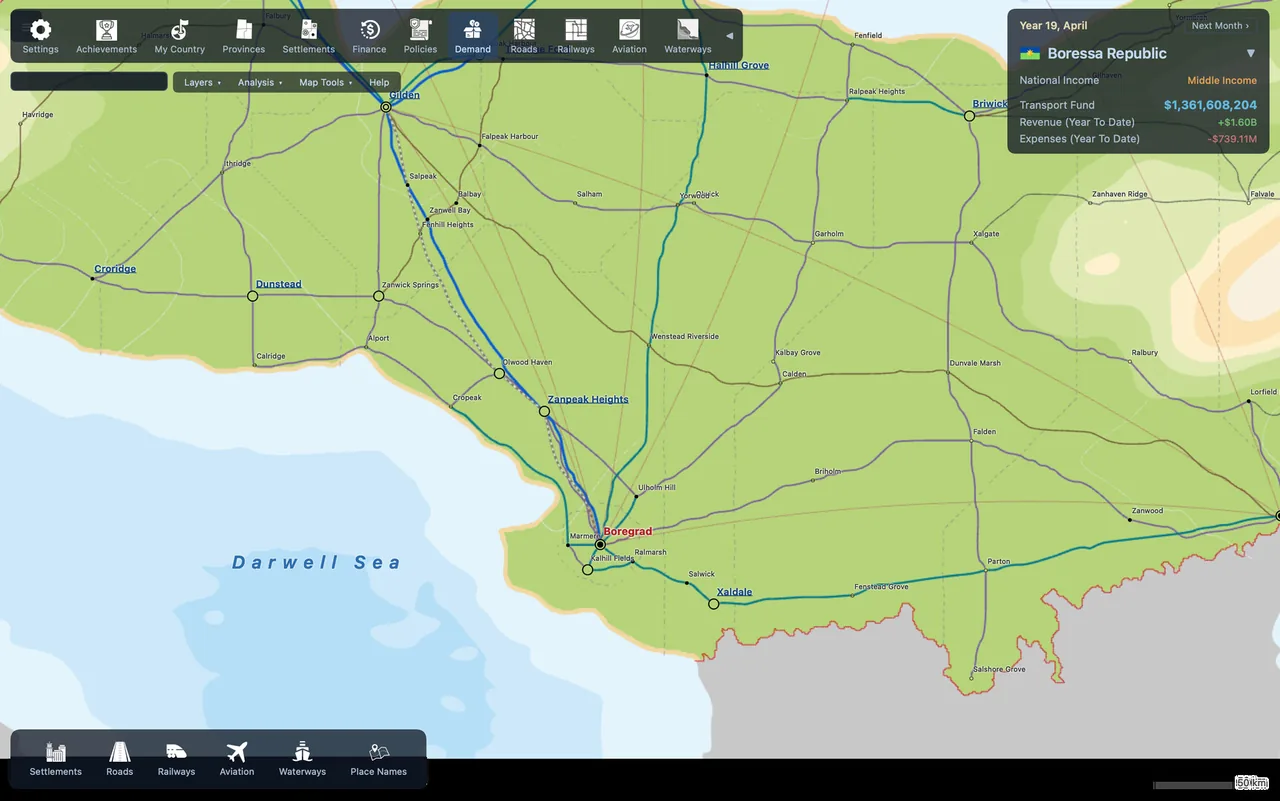
National Transit entered Early Access on June 23, 2026 with a premise that manages to feel fresh inside one of strategy gaming's most well-worn genres. Where Transport Fever, OpenTTD, and their many descendants task players with running a private transit company inside a fixed world, National Transit hands players an entire, largely undeveloped nation and asks them to build the roads, railways, ports, airports, and public transit that turn it into a functioning country. It's a small conceptual shift with a big effect on how the game plays, and it's the single thing nearly every reviewer in its overwhelmingly Positive review pool (31 of 32 English reviews recommend it) singles out as the game's strongest asset.
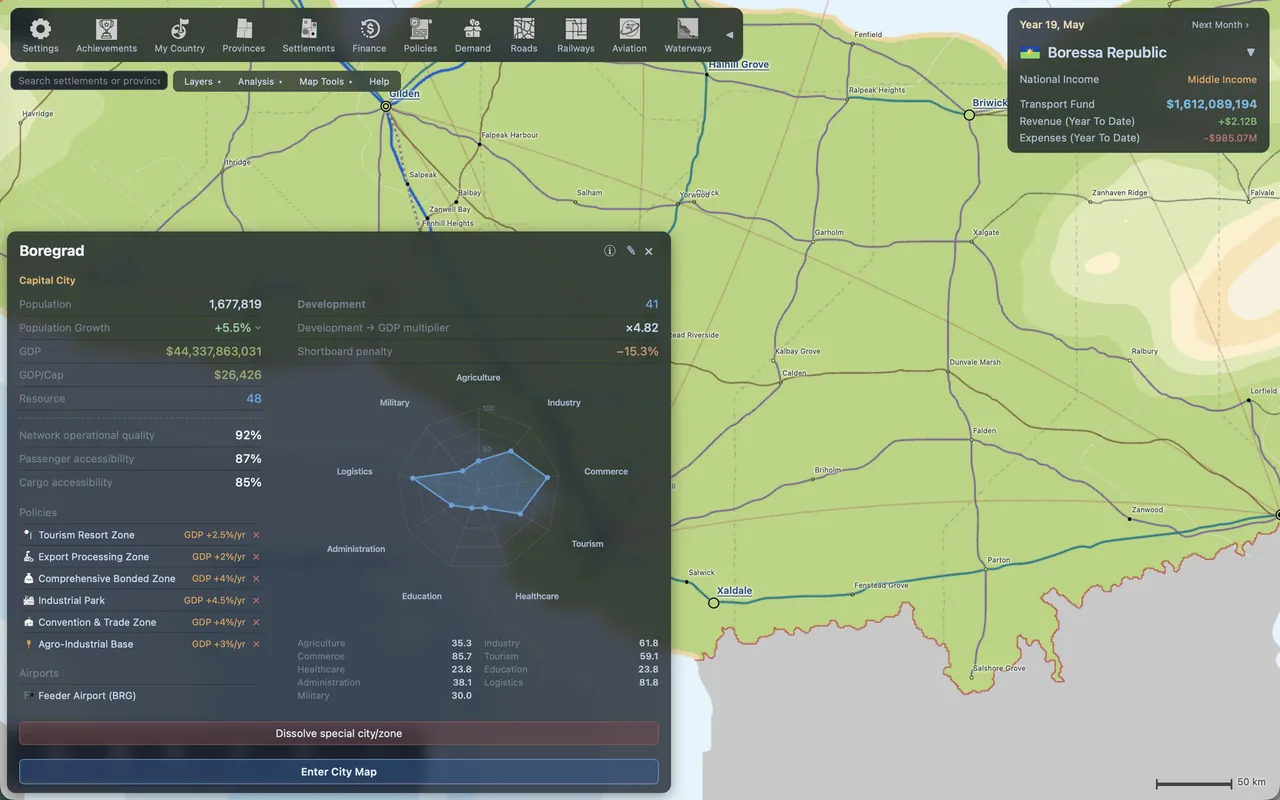
The scope of that ambition shows up in the details. Cities in National Transit track statistics well beyond simple population and money — education, healthcare, GDP, GDP per capita, and Human Development Index all factor in, and reviewers say cities visibly respond to infrastructure and policy decisions rather than sitting as static decoration on the map. One of the pool's longest and most detailed reviews, a 5,600-character breakdown after four hours of play, called this simulation depth one of the game's strongest aspects, alongside procedural world generation that lets players choose between island nations, coastlines, and landlocked countries for genuinely different starting conditions each run. That same reviewer described watching a map "slowly transform into something that looks like a real country," comparing the finished result to studying a real map and imagining the history behind it — high praise for a genre where the appeal often lives entirely in that kind of emergent, self-authored narrative.
Where the reviews consistently turn critical is what happens after the opening hours. Several reviewers describe an economy that isn't well balanced yet, with money accumulating fast enough that the game's central tension, deciding what infrastructure to prioritize under real budget constraints, evaporates within the first several hours of play. Because time progression is manually controlled, players can also accelerate their own income by skipping ahead aggressively, compounding the problem. Once money stops being scarce, reviewers say the game shifts from a series of meaningful decisions to simply building whatever comes to mind, and several specifically flagged underexplained policies and building effects as making it hard to tell whether any given choice is actually working as intended. One reviewer summarized the late-game feeling bluntly: "Okay… what should I do now?"
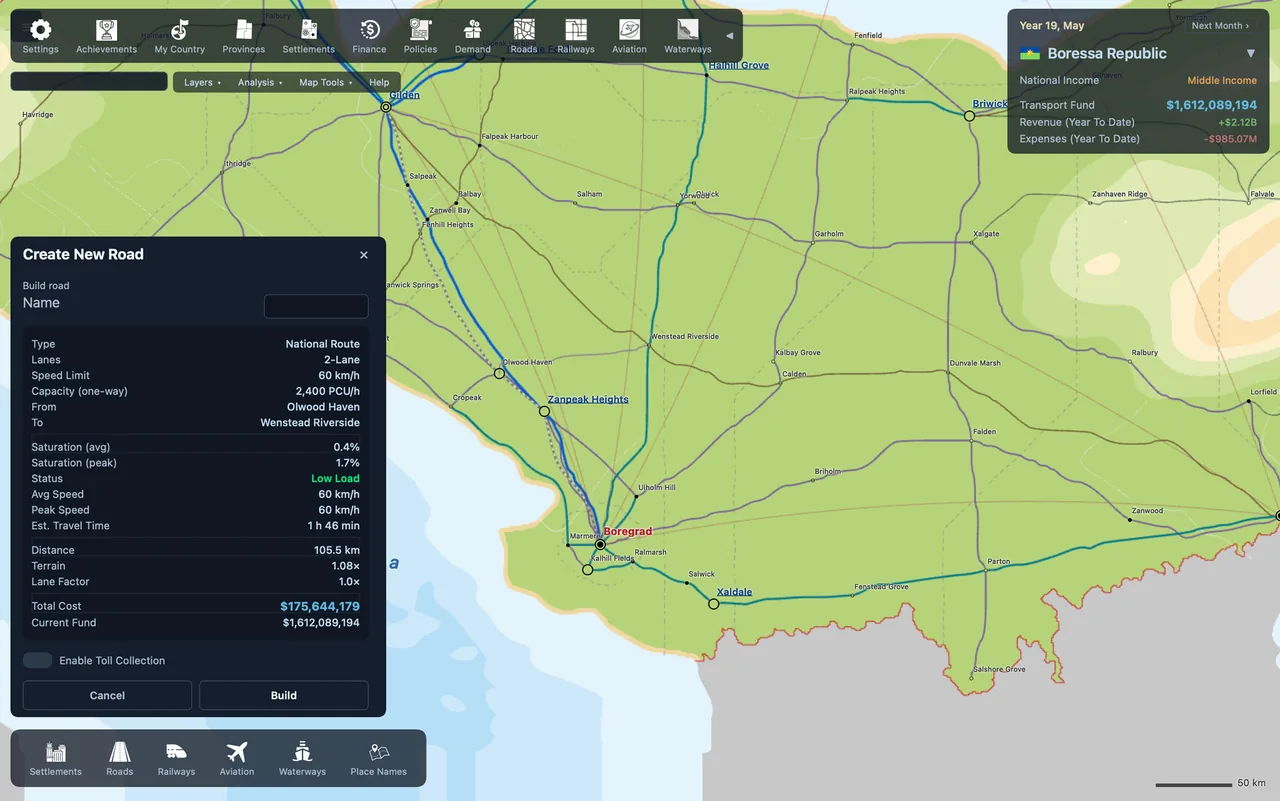
Traffic and rail systems draw similarly specific complaints. Multiple reviewers reported building enormous highways, in one case ten lanes wide, that still became congested, while railways — which several expected to be the natural long-term solution to exactly that problem — didn't meaningfully relieve the bottlenecks. Road construction itself was called smooth and enjoyable, but one detailed review flagged a real workflow annoyance: new roads can currently only branch from existing cities rather than from other roads, forcing players to found entirely new settlements just to build a highway interchange.
Performance is the pool's most serious and least resolved concern. One long, technically detailed negative review described the game as the first title the reviewer couldn't get running properly through Proton on Linux, eventually working around the issue via Protontricks and WebView2, only to still encounter severe freezes when building roads on larger maps — in one case a 25-second freeze simply to see route options between two cities, with further multi-second stalls on road upgrades and basic map navigation. That reviewer noted the same freezing also occurred on a Windows 11 partition on the identical hardware, suggesting it isn't purely a Linux/Proton compatibility issue, though they acknowledged not seeing similar reports elsewhere in the review pool. The same review also flagged that the game currently uses AI-generated music, a detail echoed independently by other reviewers speculating that some UI elements, icons, and presentation assets may also be AI-assisted; one of the pool's most positive reviews raised the same suspicion about the UI and writing and said explicitly they didn't mind if true, so long as development time goes toward gameplay depth rather than replacing placeholder art. Wanderer has not independently verified any AI-authorship claims and reports them here only as reviewer-sourced observations about the game itself.
The review pool is unusually specific about what would fix these problems, which is itself a good sign for a young Early Access project. Reviewers converged on a fairly consistent wishlist: better economic balancing so money stays scarce longer, policies that clearly state their effects rather than leaving players guessing, more reasons to actually diversify between road, rail, and other transport types instead of highways dominating every solution, and long-term objectives or dynamic events, one reviewer suggested economic crises or elections, to give the sandbox a reason to keep testing players once the map is mostly built out. A separate reviewer, twenty-four hours in during the version 0.1 build, graded the game like a report card and gave it a C+ for learning curve and a C for fun, explicitly tying both marks to the same root issue: a mini-tutorial covers the basics, but several systems' actual in-game impact is never explained, leaving depth that has to be inferred rather than discovered.
None of these complaints read as reviewers souring on the underlying idea — quite the opposite. The reviewer who wrote the pool's longest and most critical breakdown still closed by recommending the game, calling the core concept "genuinely excellent" and specifically wishing the developer well. That pattern, real structural problems paired with genuine enthusiasm for what the game could become, runs through nearly the entire review pool. National Transit's foundation, watching an underdeveloped nation grow into a functioning transit network under your own decisions, is distinctive enough to be worth the price of admission for genre fans willing to accept Early Access roughness. Whether it becomes something more than an interesting foundation will depend on NationQ Studio tightening the economic balance, explaining its own systems more clearly, and chasing down the performance issues at least one buyer found severe enough to make the game genuinely difficult to play.
Pros and cons
Pros
- A genuinely distinctive premise within the transport-sim genre, developing an entire nation's infrastructure and economy rather than managing a single city, that reviewers called one of the game's strongest aspects
- Cities tracked across multiple statistics (education, healthcare, GDP, HDI) that reviewers say make the simulation feel meaningfully reactive to policy and infrastructure choices, not purely decorative
- Satisfying, open-ended network design, watching a procedurally generated map fill in with roads, railways, ports, and airports, that multiple reviewers singled out as the game's best moment-to-moment hook
- Strong value at its current price point, with reviewers repeatedly calling it worth trying even in its current early state
Cons
- An economy reviewers described as poorly balanced, letting players accumulate money quickly enough that meaningful strategic decisions largely disappear after the first few hours
- Many policies, buildings, and systems that reviewers say don't clearly communicate their actual effect, leaving players uncertain whether their choices matter
- Traffic and rail systems reviewers found underdeveloped, with even ten-lane highways becoming congested and railways not meaningfully relieving the bottlenecks they were expected to solve
- At least one detailed report of severe performance freezes when building or upgrading roads on larger maps, alongside a separate reviewer's mention of AI-generated music and multiple reviewers independently speculating some UI and presentation elements may be AI-assisted
Screenshots
-
National TransitImage: NationQ Studio via Steam -
National TransitImage: NationQ Studio via Steam -
National TransitImage: NationQ Studio via Steam