Game review
Tyranny
7 / 10
- Developer
- Obsidian Entertainment
- Publisher
- Paradox Interactive
- Released
- 10 November 2016
- Platforms
- Windows, macOS, Linux
- Genre
- Isometric RPG
- Monetisation
- One-time purchase plus 5 DLC packs (two are substantial story expansions); no in-app purchases
- Players
- Single-player only
The short version
Tyranny asks a question few isometric RPGs bother with: what if the evil overlord already won, years ago, and you're one of their enforcers? Reviewers consistently credit the premise and the character-creation "Conquest" system — which lets players shape the history of that conquest before the story even begins — as some of the most original work in the genre. What drags this game's reputation down is what happens by the end: "Tyranny does not 'end': it stops. The story arc does not reach any sort of logical or aesthetically pleasing conclusion," reads a 182-vote review, a complaint echoed by 27 of the 100 most-helpful negative reviews discussing the ending specifically, and 22 describing the overall game as too short. Several reviewers trace this directly to Tyranny's commercial reception — a "cult following" but a "buggy launch" that, unlike Obsidian's own Pillars of Eternity, never earned a sequel or the additional expansions that might have resolved its unfinished plot threads. Recent sentiment (80%) sits a little below the 85.7% lifetime score, consistent with a smaller, more mixed recent sample for an eight-year-old release rather than any new issue.
Biggest strengths
- A genuinely original premise — playing as an enforcer for an evil power that already won its war — that reviewers consistently single out as one of the freshest ideas in the CRPG genre
- The "Conquest" character-creation system, letting players shape the game's backstory through choices made before the story even begins, draws specific, repeated praise
- Four distinct major story paths encourage genuine replayability, a rarity many reviewers contrast favourably with more linear RPGs
Biggest weaknesses
- The single most common serious complaint: the game's ending is widely described as abrupt and unresolved rather than a genuine conclusion, cited by 27 of the 100 most-helpful negative reviews discussing the ending specifically
- 22 of the 100 most-helpful negative reviews describe the overall game as too short, with several reviewers explicitly recommending the two main DLC expansions as close to mandatory rather than optional
- AI pathfinding and combat companion behaviour draw recurring, specific criticism
Who it's for: CRPG fans who want a genuinely different premise and don't mind an ending that several longtime fans describe as abrupt — buy the two main story DLCs alongside the base game.
Our recommendation: Buy, with the Bastard's Wound and Tales from the Tiers DLC — several reviewers specifically warn the base game alone feels incomplete.
7 / 10
The pitch
Tyranny is Obsidian Entertainment's isometric RPG built around an unusual premise: the game's "evil overlord" figure, Kyros, already conquered the world years before the story begins, and the player is one of Kyros's fatebound enforcers, sent to pacify the last resisting territory. Choices made during character creation retroactively shape how that conquest unfolded.
A premise reviewers keep calling genuinely original
Across positive and negative reviews alike, the setup is treated as a real point of distinction in a crowded genre. "It's everything you love about the Infinity Engine games, but in a grimdark world that culls out all the high fantasy nonsense. There are no inhuman orc hordes on rampages," reads one detailed positive review. Another asks directly: "I don't understand how Pillars of Eternity got 2 games and several DLCs but no one even mentions this game. Story is amazing, lore is amazing, even the magic system on its own should make this game GOTY." The Conquest character-creation system — letting players determine the history of the war through a series of choices before the main game even starts — is one of the most-praised individual features in this corpus, regardless of how a reviewer felt about the rest of the game.
"It does not end: it stops"
What consistently undercuts that goodwill is the game's conclusion. "Tyranny does not 'end': it stops. The story arc does not reach any sort of logical or aesthetically pleasing conclusion. Plot points mentioned early in the game go nowhere," reads a 182-vote review — one of 27 among the 100 most-helpful negative reviews that discuss the ending specifically as unresolved rather than simply disappointing. A separate but related complaint concerns overall length: 22 of the 100 most-helpful negative reviews describe the base game as too short. "The maps are small, side-quest scarce and the story is short," reads one, while a 914-vote review states it more sharply: "I liked this game a lot until I started paying attention... [the ending] feels like the game was cut short." Several reviewers connect this directly to the game's commercial reception: "A CRPG that bombed due to lack of marketing... a buggy launch, which is an Obsidian tradition, basically paved the way for obscurity," reads one review, framing the truncated story as a consequence of Tyranny never getting the sequel or full expansion suite that resolved similar growing pains in Obsidian's other RPGs.
The DLC as a partial fix
A meaningful number of reviewers treat the two main story DLC packs — Bastard's Wound and Tales from the Tiers — as closer to essential than optional. "Don't play Tyranny without the two main-DLCs! Unless you haven't played any RPG after Baldurs Gate I," reads a direct 79-vote recommendation, describing the base game alone as noticeably incomplete-feeling without them. This is a specific, actionable piece of guidance that recurs often enough in this corpus to be worth following rather than treating as one reviewer's opinion.
Checked against Obsidian's other CRPG
This library has also reviewed Pillars of Eternity II: Deadfire, a useful point of comparison since several Tyranny reviewers raise it directly, usually to lament that Tyranny never received similar ongoing support.
| Lifetime English score | |
|---|---|
| Tyranny | 85.7% (Very Positive) |
| Pillars of Eternity II: Deadfire | 88.5% (Very Positive) |
The two games sit close together on raw sentiment despite very different post-launch histories — Tyranny's score holds up well considering the ending complaints, suggesting the strength of its opening hours and premise carries real weight even for reviewers who mark it down.
Where sentiment sits now
Recent English review sentiment — the 100 most recent reviews, spanning April to August 2026 due to this older title's lower review volume — runs 80% positive, a little below the 85.7% lifetime score. That gap likely reflects normal noise in a smaller recent sample for an eight-year-old release rather than a new issue; the ending and length complaints found in this window match the game's established pattern rather than introducing anything new. Achievement data shows a very steep completion curve: the median across 70 achievements is just 4.2%, consistent with a branching-path RPG where most players see only one of several major story routes.
Value
At NZ$47.99, the base game alone is reasonably priced but, per this corpus's consistent advice, is best purchased alongside its two main story DLC packs for a more complete experience; monetisation itself draws no complaints beyond that completeness concern.
Verdict
Tyranny offers one of the more genuinely original premises in modern isometric RPGs, backed by a character-creation system reviewers single out as a real innovation, and combat and writing that hold up well against Obsidian's other work. Its consistent, well-documented weakness is a conclusion a large share of its own audience calls abrupt rather than resolved — a limitation this corpus links to a troubled launch that never earned the sequel or expansions that might have fixed it. Buy it for the premise and the opening acts; pair it with the main DLC, and go in knowing the ending is the one thing this game's fans agree it doesn't fully deliver on.
Pros and cons
Pros
- A genuinely original premise — playing as an enforcer for an evil power that already won its war — that reviewers consistently single out as one of the freshest ideas in the CRPG genre
- The "Conquest" character-creation system, letting players shape the game's backstory through choices made before the story even begins, draws specific, repeated praise
- Four distinct major story paths encourage genuine replayability, a rarity many reviewers contrast favourably with more linear RPGs
- Strong voice acting and dialogue writing throughout, consistent with Obsidian's other work in the genre
Cons
- The single most common serious complaint: the game's ending is widely described as abrupt and unresolved rather than a genuine conclusion, cited by 27 of the 100 most-helpful negative reviews discussing the ending specifically
- 22 of the 100 most-helpful negative reviews describe the overall game as too short, with several reviewers explicitly recommending the two main DLC expansions as close to mandatory rather than optional
- AI pathfinding and combat companion behaviour draw recurring, specific criticism
- A steep achievement completion curve (median 4.2% across 70 achievements) reflects a branching-path RPG where most players see only one route through
Screenshots
-
TyrannyImage: Paradox Interactive via Steam -
TyrannyImage: Paradox Interactive via Steam -
TyrannyImage: Paradox Interactive via Steam -
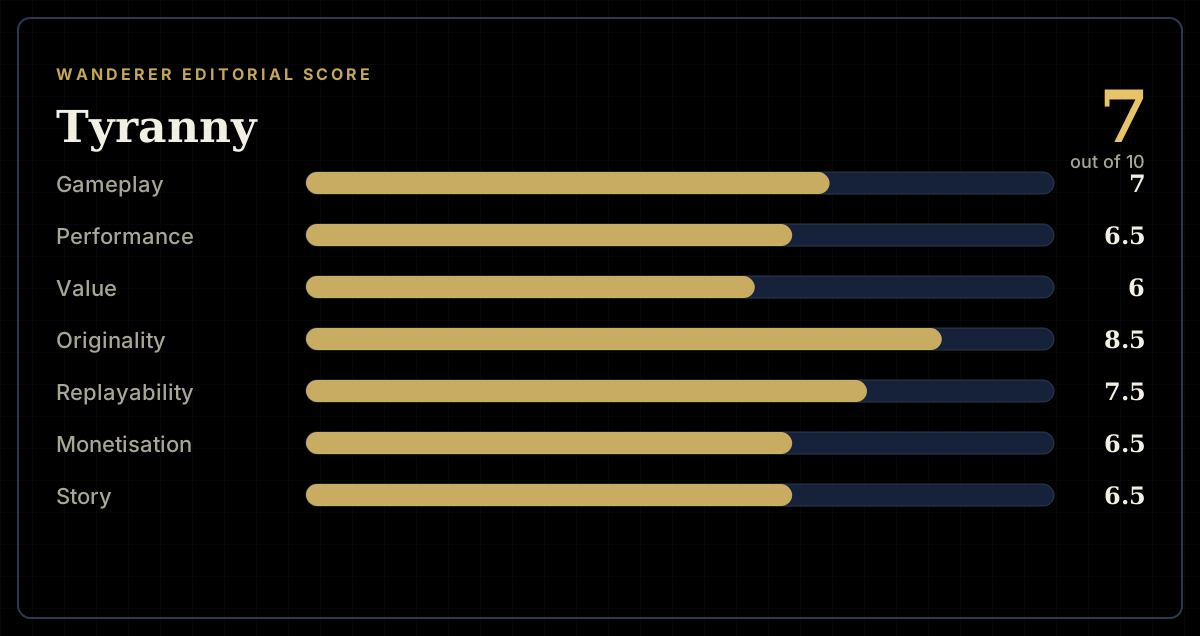
How the review scores each part of the gameWanderer Editorial -
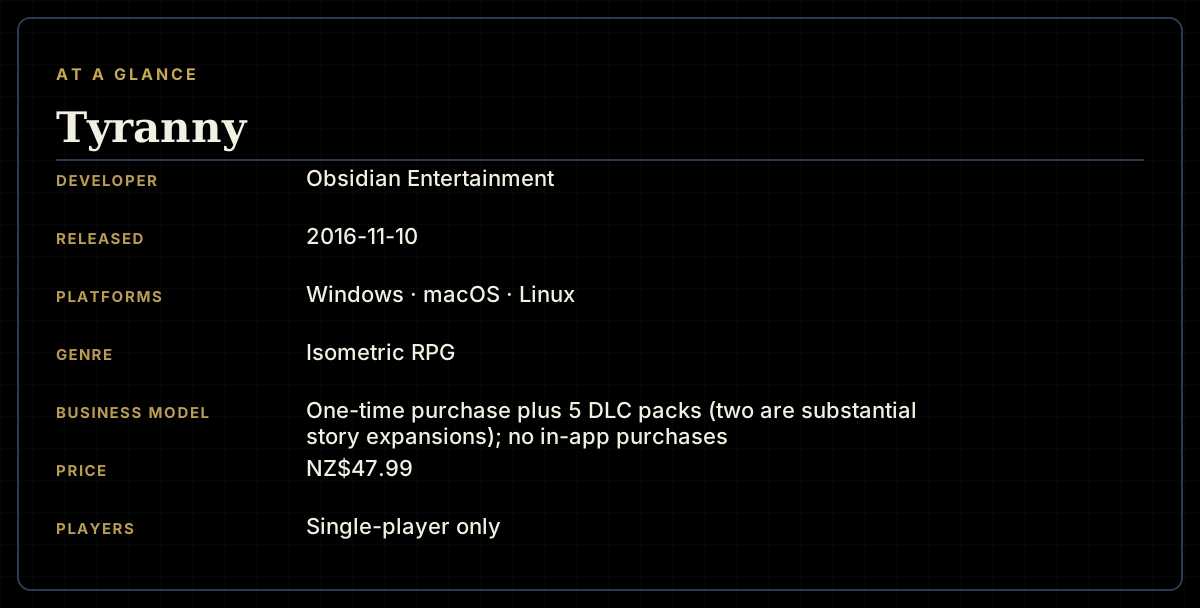
The game at a glanceWanderer Editorial -
The short versionWanderer Editorial