
Game review
Trading Card Inspector
7.5 / 10
- Developer
- Daydream Gallery
- Publisher
- Catoptric Games
- Released
- 6 June 2026
- Platforms
- Windows
- Genre
- Indie, Simulation, Puzzle
- Monetisation
- paid
- Players
- false
The short version
Biggest strengths
- A genuinely funny script, with reviewers repeatedly calling it one of the funniest indie games they've played, built around a memo-driven corporate satire of Habubis Corporation
- A satisfying escalating-difficulty structure, where short levels each introduce new stat modifiers and grading rules that keep the core loop from ever feeling repetitive
- A well-regarded endless mode praised as addictive and well-tuned, extending replay value well past the main story
Biggest weaknesses
- Some cosmetic unlocks and random screen-affecting events can make card text genuinely hard to read, a specific and avoidable friction point flagged by at least one detailed reviewer
- A short main campaign, with one player clocking full completion at around 5-7 hours, that leaves some wanting more content for their money
- The core loop, verifying stats and doing quick mental math under criteria, isn't for everyone; at least one reviewer found it felt more like a school exercise than entertainment despite praising its fair price
Who it's for: Fans of Papers, Please-style inspection sims and mental-math puzzle games who want a short, genuinely funny corporate-satire wrapper around an escalating grading challenge
Our recommendation: recommended
7.5 / 10
A Papers, Please premise that goes its own way
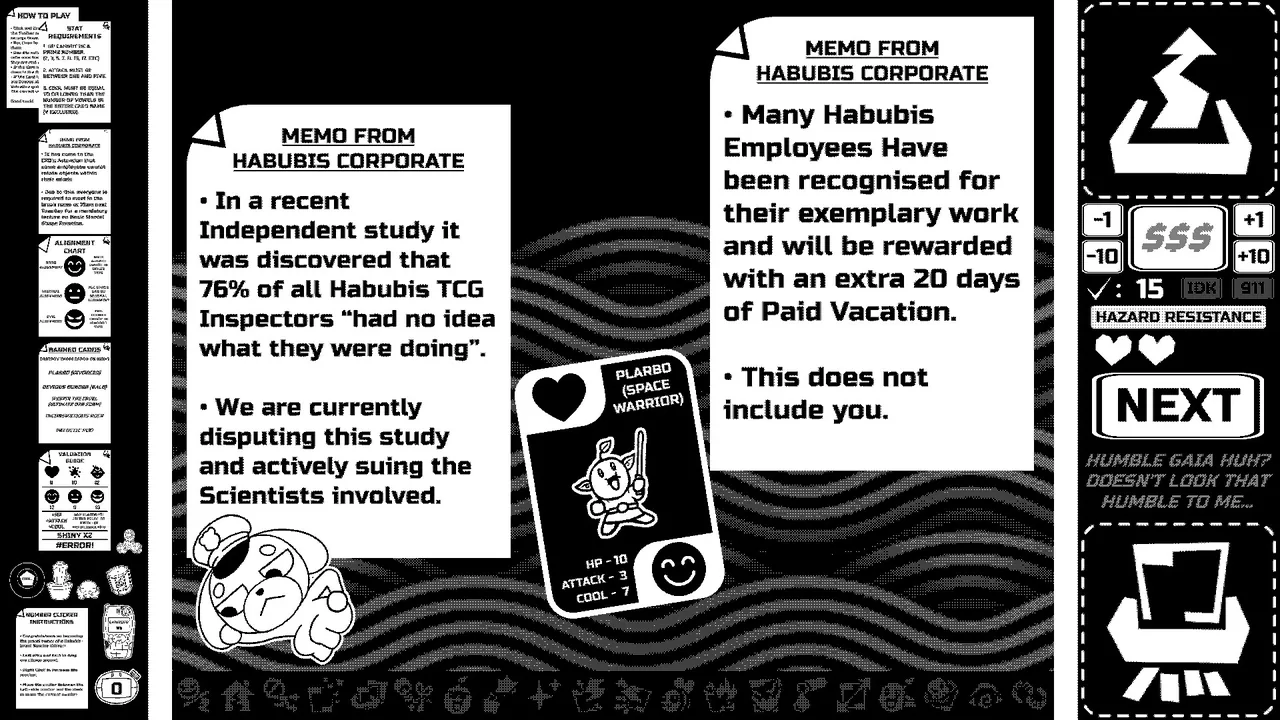
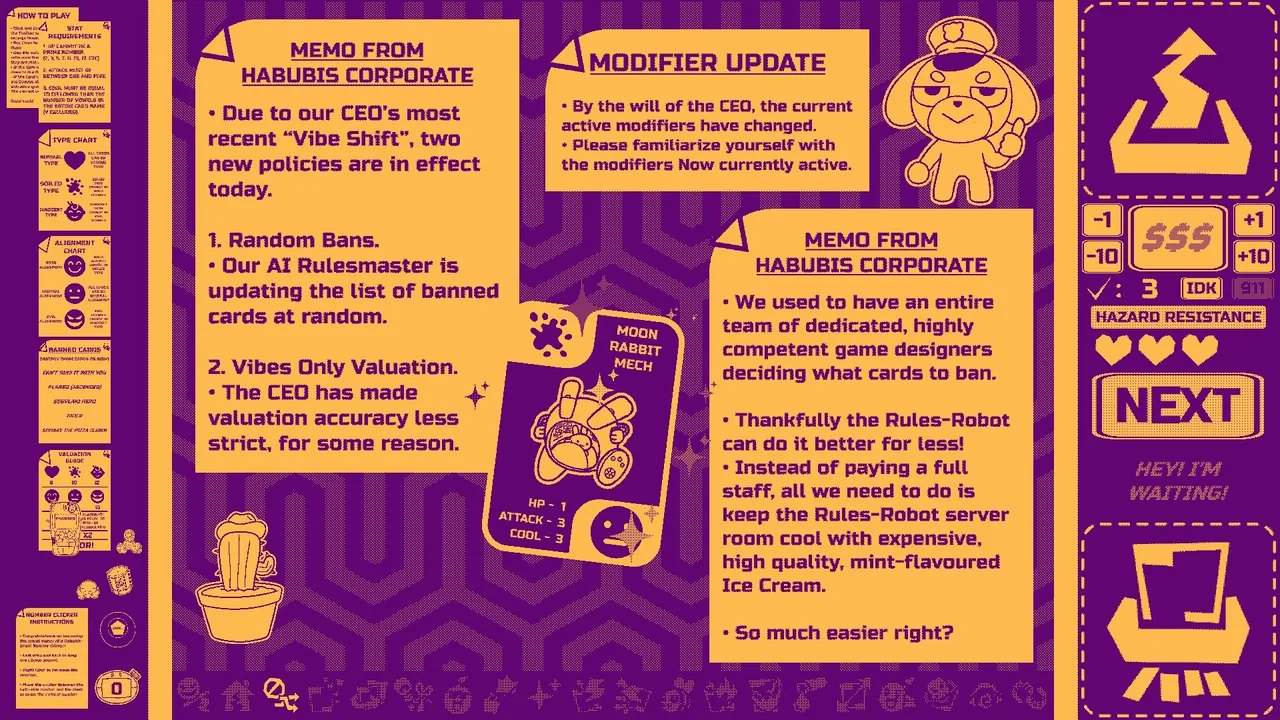
Trading Card Inspector puts players behind the desk of a professional card examiner for Habubis Corporation, the fictional company behind "The World's Most Coolest TCG," tasked with verifying the authenticity, stats, and legality of a steady stream of cards and shredding anything that doesn't check out. The comparison to Papers, Please is obvious and inevitable, and several reviewers went in expecting a close cousin. One found the reality a little different: "I went into Trading Card Inspector expecting a comedic spin on Papers, Please. It is… not quite that. What it is, under all the booster packs, quirky challenges, and corporate villainy, is a delightful little math simulator that broke me out of a two-month gaming funk." That distinction matters for setting expectations: this is less about time-pressured moral compromise and more about a relaxed, escalating exercise in pattern recognition and mental arithmetic, dressed up in a distinctive comic setting.
Genuinely, repeatedly funny
The single most consistent point of praise across the review pool is the writing. One reviewer didn't hedge at all: "I really want it to be at the forefront of my review that this is hands down one of the funniest games I've ever played. I was absolutely roaring my head off at some of these memos and cards. There's a perfect blend of wit and irreverence throughout the game and it's a style of humour I feel like you don't see much." Another reviewer echoed the same reaction from a different angle, praising "an incredibly (and frustratingly) well-made endless mode" alongside a story that "tickles that 'papers, please' perfectionism in my brain while also having a super engaging and funny storyline." For a small-scale indie sim built around a fairly dry-sounding core mechanic, that level of consistent comedic praise is a genuine differentiator.
A grading loop that escalates instead of repeating
Reviewers were specific about why the core inspection mechanic holds up over a full playthrough rather than growing stale. One wrote, "Choose the right value for the cards based on their stats and shred the fakes... each level has unique stat modifiers as you progress, keeping the gameplay fresh but also ramping up the difficulty." Another reviewer framed the same design choice as central to the game's pacing: "I think the main standout of this game is how the gameplay, in paper (ha) quite simplistic, gets dressed up in such a way that it never drags or feels repetitive; this is also in part because it doesn't overstay its welcome as it is a relatively short game and so every other level manages to stand out due to its unique interactions between different modifiers." That combination, a short runtime paired with constantly shifting rules, is a deliberate design decision that reviewers credit as working well.
Where's Waldo meets basic arithmetic
Multiple reviewers reached for the same kind of comparison to describe the actual moment-to-moment gameplay: cross-referencing reference sheets against a card's printed stats to spot what's fake, out of spec, or otherwise invalid. One described the core loop directly: "TCGI does exactly what it proposes on the tin perfectly. You clock into your shift, you shuffle your reference sheets on your desk," while another called the grading process "where's waldo meets basic arithmetic" once its mechanics click. A separate reviewer who came to the genre specifically for the math hook confirmed the learning curve works as intended: "I wanted to play a game based around mental math to assuage my former gifted kid ego. But what you'll find is that the grading mechanics will soon get intuitive. Right when you thought you had a handle on it, you'll be given surprise after surprise with fun modifiers and even plot twists."
Cosmetics and chaos can hurt readability
The pool's clearest concrete criticism concerns a specific, avoidable friction point: certain cosmetic unlocks and random screen-affecting events can make the cards themselves harder to actually read. One reviewer explained, "At it's base the game is a simple math game with card collecting mechanics. With the different mechanics coming in to increase difficulty. Money exists just to unlock more cards and in game cosmetics. Some of the cosmetics can make the text hard to read so you'll need to play around with which ones work for you. The random events that affect the screen can also make this difficult." That's a fixable, specific complaint rather than a fundamental design problem, but it's a real one for a game whose entire challenge depends on being able to clearly read and cross-reference small amounts of card text under time and modifier pressure.
Not everyone wants a math test, even a good one
The game's small negative-review pool is thin, but it points at a real limitation rather than a dismissible complaint. The lone negative review found in the pool read: "Fun concept with a fair price for what it offers. I just didn't find it fun. You have to use criteria you're provided and have to do low level math. I think the game would do better in schools than in my game library." Notably, even this critical reviewer didn't take issue with the price or the underlying concept, only with whether "verify criteria against printed numbers" is something they personally find entertaining as a game rather than an exercise. It's a useful reminder that the core hook, however well executed, is fundamentally a math-verification puzzle, and that won't land for every player regardless of how funny the wrapper around it is.
A short but well-paced runtime, priced to match
Length came up as a mild, rather than serious, concern. One reviewer who fully completed the game estimated the total experience at "about 5-7 hours to 100%. Short (about 5-7 hours to 100%) but well worth the money," while another more terse review simply called it "Short but sweet" while praising the improvement to their own mental math along the way. At $6.99, reviewers were broadly consistent that the price matched the scope on offer, even the game's one clearly negative reviewer explicitly conceded the price was fair, which suggests any dissatisfaction in the pool is about the core concept rather than value for money.
Verdict
Trading Card Inspector takes a fairly dry-sounding premise, verifying trading card stats against printed criteria, and turns it into a genuinely funny, well-paced puzzle game that escalates its own rules often enough to avoid ever feeling repetitive. Its comic writing and corporate-satire setting draw some of the strongest praise in the review pool, and its endless mode gives it real replay value beyond a short main campaign. The main rough edges are minor: a few cosmetic and screen-effect combinations that can hurt on-screen readability, and a core loop that, however well executed, is still fundamentally a mental-math exercise that won't appeal to everyone. For fans of inspection sims and puzzle games willing to embrace that hook, it's an easy recommendation at its price point.
Pros and cons
Pros
- A genuinely funny script, with reviewers repeatedly calling it one of the funniest indie games they've played, built around a memo-driven corporate satire of Habubis Corporation
- A satisfying escalating-difficulty structure, where short levels each introduce new stat modifiers and grading rules that keep the core loop from ever feeling repetitive
- A well-regarded endless mode praised as addictive and well-tuned, extending replay value well past the main story
- A fair price point that most reviewers, even critical ones, agreed matched the amount of content on offer
Cons
- Some cosmetic unlocks and random screen-affecting events can make card text genuinely hard to read, a specific and avoidable friction point flagged by at least one detailed reviewer
- A short main campaign, with one player clocking full completion at around 5-7 hours, that leaves some wanting more content for their money
- The core loop, verifying stats and doing quick mental math under criteria, isn't for everyone; at least one reviewer found it felt more like a school exercise than entertainment despite praising its fair price
- Minimal time pressure in most levels means the game leans more toward relaxed pattern recognition than the tense, high-stakes feel some Papers, Please comparisons might imply
Screenshots
-
Trading Card InspectorImage: Catoptric Games via Steam -

Trading Card InspectorImage: Catoptric Games via Steam -
Trading Card InspectorImage: Catoptric Games via Steam