
Game review
Tiny Circuits Review
7.5 / 10
- Developer
- Cromware LLC
- Publisher
- Cromware LLC
- Released
- 16 July 2026
- Platforms
- ["Windows"]
- Genre
- Puzzle
Wire Routing With a Twist: You're Standing on the Board
Tiny Circuits casts you as the newest, tiniest hire at a circuit factory, and the only way to climb from Unpaid Intern to Employee of the Month is to solve your way through more than 70 handcrafted circuit-board puzzles. On paper it's a familiar genre: route a signal from an input to an output by rotating and placing tiles. What sets it apart, and what the game itself leads with, is that your little robot isn't just a cursor floating above the grid — it physically occupies a cell on the board, and it has to move out of the way of its own solution. Plan a route that needs to pass through your own square, and you've created a problem you now have to solve around.
No Solution to Memorize
The other structural hook is that your starting position on each board randomizes every attempt. In a genre where puzzle games can become a matter of memorizing a known-good sequence of moves, Tiny Circuits builds in a small but effective safeguard against that: because you don't know exactly where you'll start, you have to actually understand how each component redirects a signal rather than recalling a fixed solution path. It's a modest design decision, but it's the kind of thing that keeps a 70-puzzle collection from turning into rote repetition for players who've already seen a level once.
A Small Toolbox That Builds on Itself
The game spreads its mechanical variety across six main worlds, each introducing one new component and asking you to combine it with everything you've already learned. One-way diodes force a signal to travel in a single direction, undoing the two-way assumptions a player builds up early on. Signal inverters flip a signal's type mid-route so it can reach components that would otherwise reject it. Logic gates combine two separate inputs into a single controlled output. Teleporters let a signal jump across the board entirely, opening up routes the physical grid can't otherwise support. None of these are individually complicated, but the game leans on stacking them together in later levels, and reviewers specifically call out one interaction — diagonal wire pieces that can freely connect and split into multiple paths at their corners — as a mechanic they hadn't quite seen handled this way in other path-connection puzzle games.
Optional Challenge for Players Who Want More
Clearing all six main worlds with a three-spark rating unlocks a seventh, harder world built entirely around challenge puzzles for players who want more than the base campaign offers. That structure gives Tiny Circuits a soft difficulty ceiling above its main content without forcing every player through it, which fits a game that's otherwise clearly aiming for a relaxed, non-punishing pace: any level can be restarted without penalty, and a dedicated Free Play mode unlocks every level from the start with progression and achievements turned off, for players who just want to tinker with the mechanics rather than complete a checklist.
Reviewers Agree: It's Cute, Calm, and Steadily Escalating
The review sample is tiny, but it's also completely unanimous — six reviews, all positive, and every one of them landing on roughly the same handful of compliments. More than one reviewer describes the game as "cute," with one specifically noting the puzzle-set-per-desk framing as a nice small touch that ties the level structure back into the office-promotion premise. The soundtrack draws consistent praise too, described as smooth and calming, with one reviewer comparing it directly to a lo-fi study-radio playlist — a fitting match for a game explicitly built around a cozy, low-stress pace. On difficulty, the sample agrees the game ramps up steadily rather than throwing a wall at the player: one reviewer specifically notes new ways to connect power points are introduced gradually as the difficulty increases, and another, with under an hour played, flags that the puzzles can already be "harder than it looks" despite the low-key presentation.
A Genuinely Thin Sample Worth Being Honest About
It would be dishonest to treat six short reviews, several only a sentence or two long, as the same kind of evidence a hundred-review sample would provide. The longest and most substantive reviews in the sample cap out well under two hours of playtime, and one review is nothing more than three lightning-bolt emoji. There's no dissenting voice in the sample at all, which is worth noting rather than treating as proof of a flawless game — it may simply reflect a small, self-selecting audience of players who already knew this genre was for them before buying. The developer's own post-launch patch notes mention fixing an issue where Steam achievements weren't being awarded promptly, which suggests at least one real technical rough edge existed shortly after release, even though no reviewer in the sample mentions running into it directly.
Presentation Matches the Premise
Beyond what reviewers explicitly praise, the game's own materials back up the cozy framing consistently: a stylized, colorful art style, a robot protagonist small and simple enough to read clearly against busy circuit boards, and full controller support alongside the expected mouse-and-keyboard control scheme. Steam Cloud saves, leaderboards, and achievement support round out a feature list that's modest but complete for a puzzle game at this price point, and nothing in the sample or the store materials suggests the game is missing anything its genre peers would be expected to have.
Verdict
Tiny Circuits doesn't reinvent the signal-routing puzzle genre, but it finds two or three small, well-considered ways to make a familiar formula feel fresh — turning the player's own position into part of the puzzle, randomizing starting spots so there's nothing to memorize, and layering diodes, inverters, gates, and teleporters into combinations that keep 70-plus levels from feeling repetitive. Its review sample is far too small to call a verdict definitive, and the unanimous positivity should be read with that caveat in mind rather than as proof of a flawless release. But everything in that small sample, and everything in the game's own design choices, points toward a competently built, genuinely cozy puzzle game that's honest about what it is and delivers on it. At $9.99 for a 70-puzzle campaign plus a harder unlockable seventh world, it's a reasonable, low-risk pickup for anyone who likes calm logic puzzles with a bit of mechanical bite.
Screenshots
-
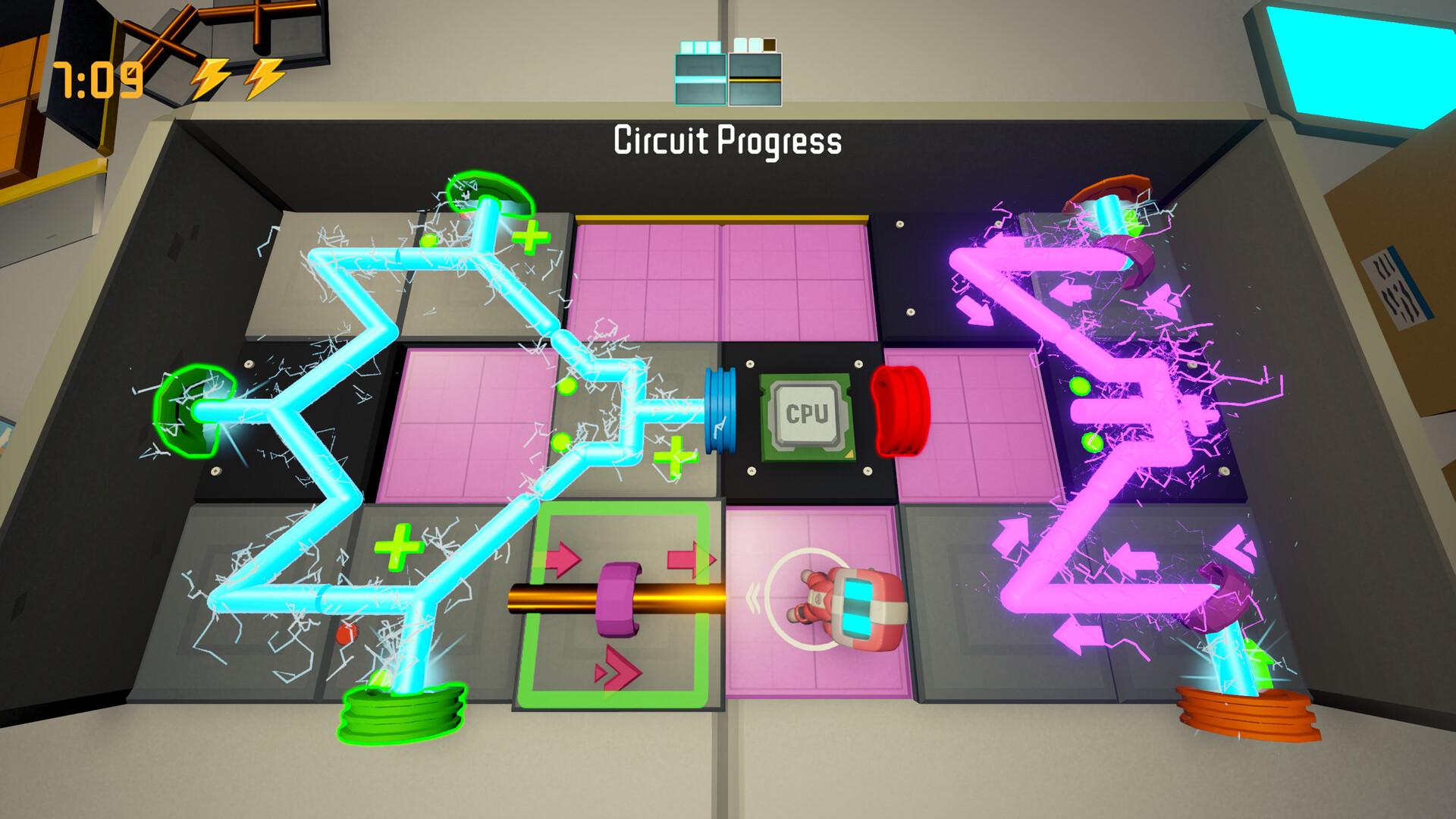
The spark rating in the top corner rewards a clean, efficient route, not just any working solution.Image: Cromware LLC via Steam -
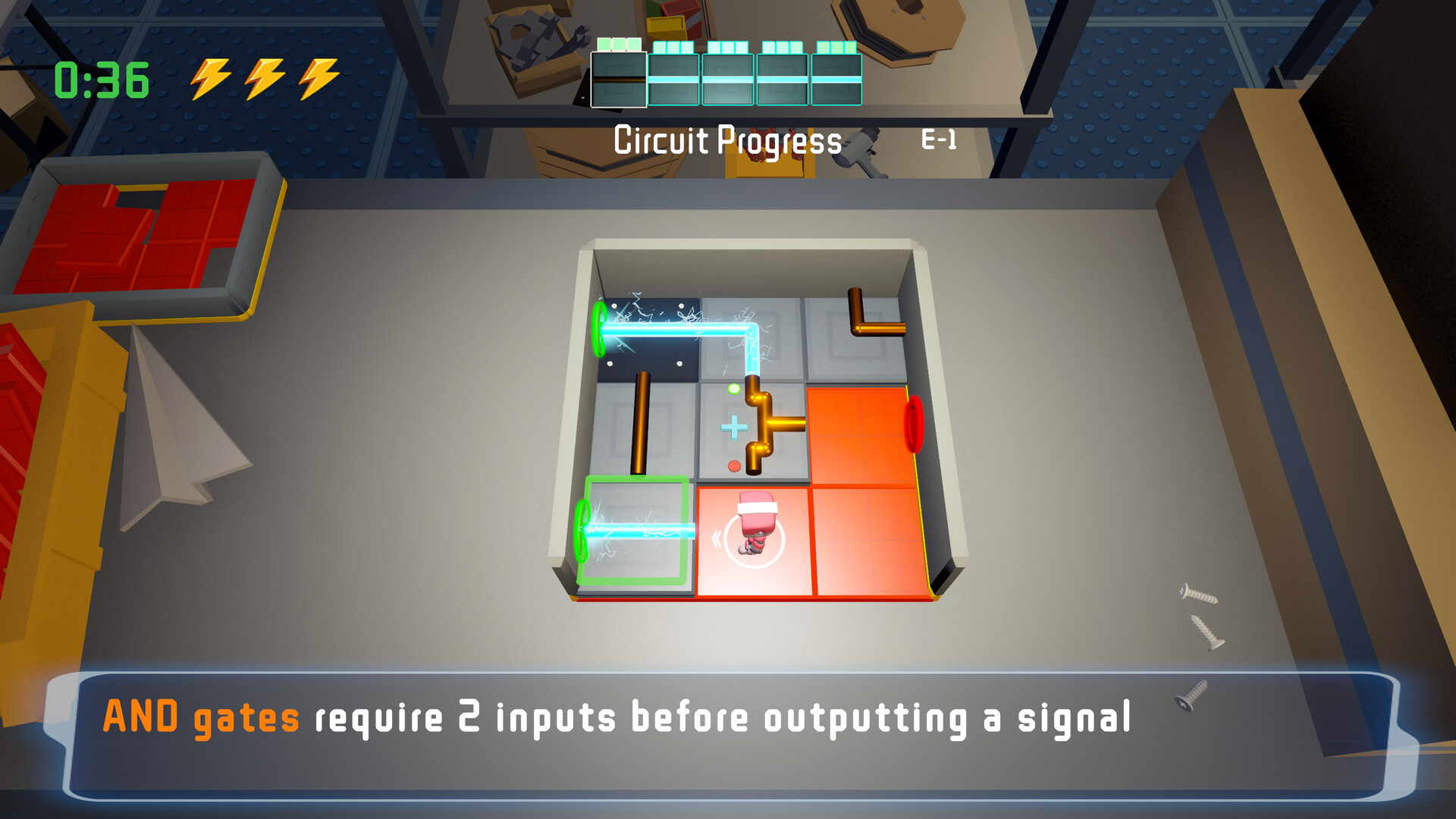
New components like AND gates get a plain-language tutorial prompt the first time they show up.Image: Cromware LLC via Steam -
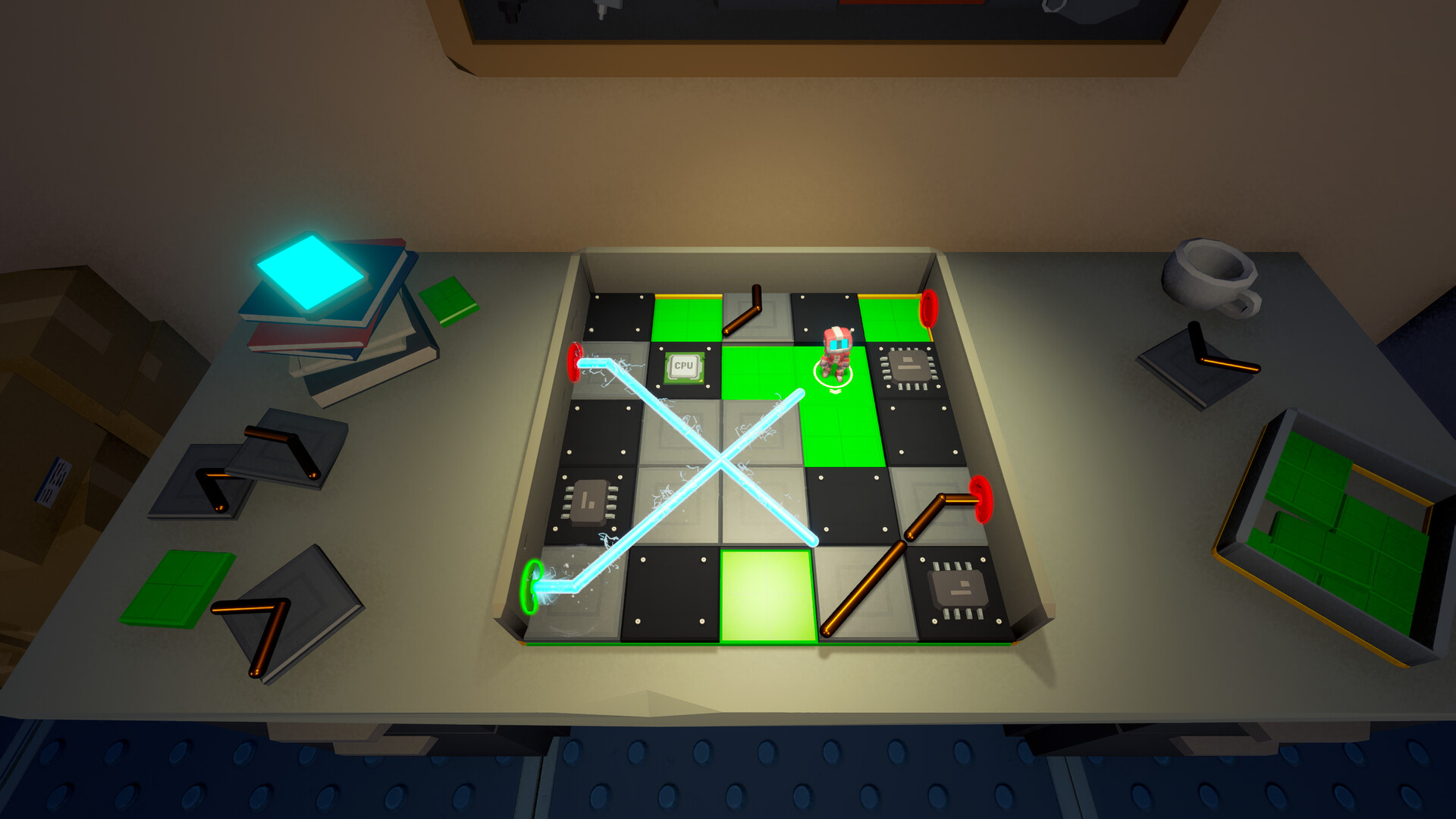
Every puzzle box sits on a lived-in desk, and this one shows off the diagonal wire crossings reviewers called out as unusually clever.Image: Cromware LLC via Steam