Game review
Thousand Floors
5.5 / 10
- Developer
- 琥珀塔 ("Amber Tower")
- Publisher
- 琥珀塔 ("Amber Tower")
- Released
- 18 June 2026
- Platforms
- Windows
- Genre
- Idle tower-climber
- Monetisation
- One-time purchase on Steam, plus an in-game peer-to-peer marketplace where cosmetic unit skins — several of which also carry stat bonuses — trade for real money
- Players
- Single-player; Steam Leaderboards provide asynchronous score comparison only
The short version
Thousand Floors gets the hook right: tap a floor of its endless pagoda, watch a Tower Climber burst out and collide with whatever's waiting, and let a growing roster of allies join the fight on their own timers while relics and mystic arts stack in the background. That loop is legitimately satisfying for a while. What keeps pulling players back out of it is a marketplace that sells performance-affecting cosmetics for real money and a game that never quite explains its own systems — reincarnation, chests, keys and skill windows all arrive with almost no onboarding, so a fair number of players bounce off in the first hour wondering what they just paid for.
Biggest strengths
- The tap-a-floor summon system genuinely rewards spatial thinking — walkway space and on-screen unit caps mean Floor Lockdown and target-floor choice matter, rather than tapping being a pure formality
- A dozen distinct ally types with no roster cap give the mid-game a real reason to diversify instead of stacking one unit endlessly
- The widget/compact display mode lets the tower run minimised in a corner of the screen while you do something else, which several long-time players cite as the reason they keep it open for hundreds of hours
Biggest weaknesses
- A real-money marketplace sells unit skins that also grant stat bonuses, which multiple reviewers flag as pay-to-win dressed up as a cosmetic store, with individual skins priced well above what the base game costs
- Core systems — reincarnation rewards, chest-and-key gating, skill activation from the upgrade menu — go essentially unexplained, and several players who refunded cite not understanding what they were doing or why
- Interface polish lags behind the concept: reviewers describe stretched, blurry or distorted icons and art assets, including the gold counter that's visible on screen at all times
Who it's for: Idle-game regulars who don't mind digging through an under-explained system to find the loop underneath, and anyone drawn to Eastern-mythology pixel art over the usual fantasy-dungeon idle template.
Our recommendation: Worth a look for genre veterans who already know how to parse a poorly tutorialised idle game and can shrug off an optional marketplace. Newer players, or anyone allergic to real-money cosmetics that double as stat sticks, should wait for a patch pass or a deep sale.
5.5 / 10
Most idle tower-climbers treat the tower as a number to watch increase. Thousand Floors treats it as a piece of architecture you actively manage — walkways only hold so many bodies, floors you haven't locked down keep pulling summons away from the ones that matter, and the tower itself is rendered as a real, climbable Eastern pagoda rather than a progress bar wearing a skin. That's a smart foundation for the genre. What sits on top of it is less consistent: a loop that a meaningful slice of its own players describe as addictive enough to run for hundreds of hours, next to a tutorial that barely exists and a monetisation model that crosses a line most idle games are careful to avoid.
Tap a floor, watch the collision
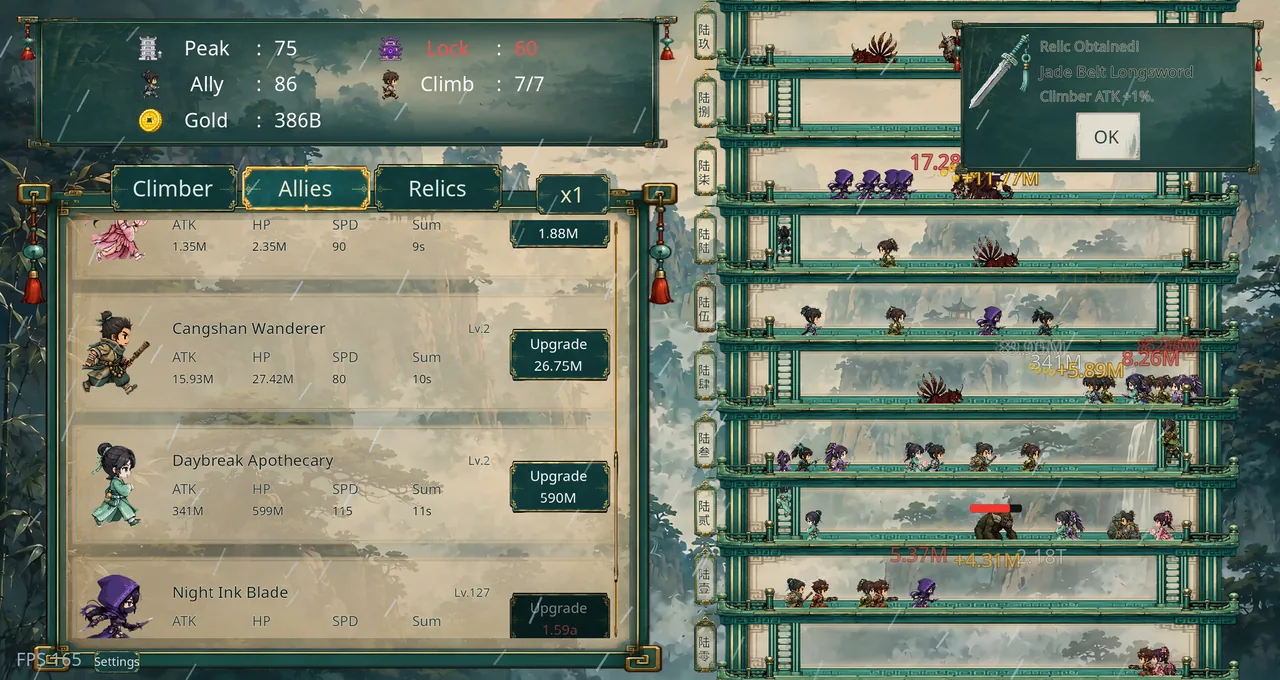
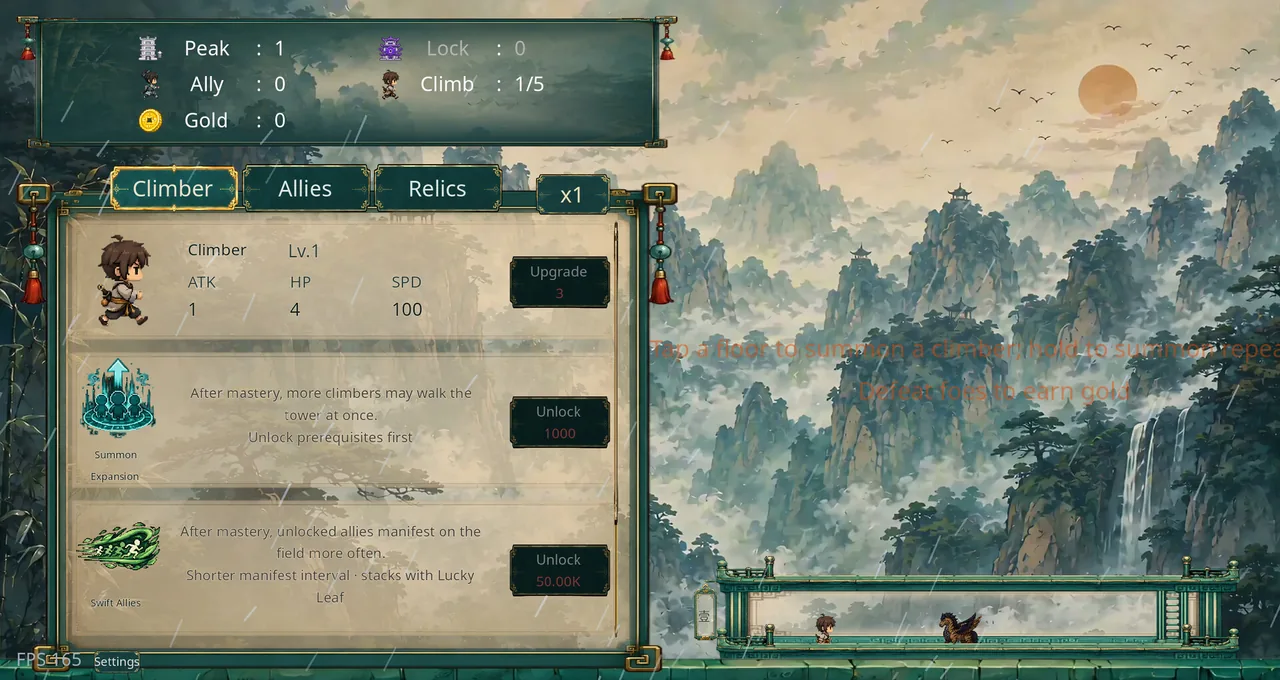
The core interaction is simple to describe and more interesting to actually run. Tap or hold a floor of the tower and a Tower Climber spawns there; unlocked allies join automatically on their own timers, and everyone on a given walkway collides, trades hits, and either holds ground or gets pushed back. Higher floors carry tougher enemies and better gold and chest drops, but the tower only has so much physical space — you can't just spam every floor at once and expect the best return. Floor Lockdown, which seals off the base of the tower so summons concentrate on floors that are actually paying out, turns the tap into a real allocation decision rather than a reflex.
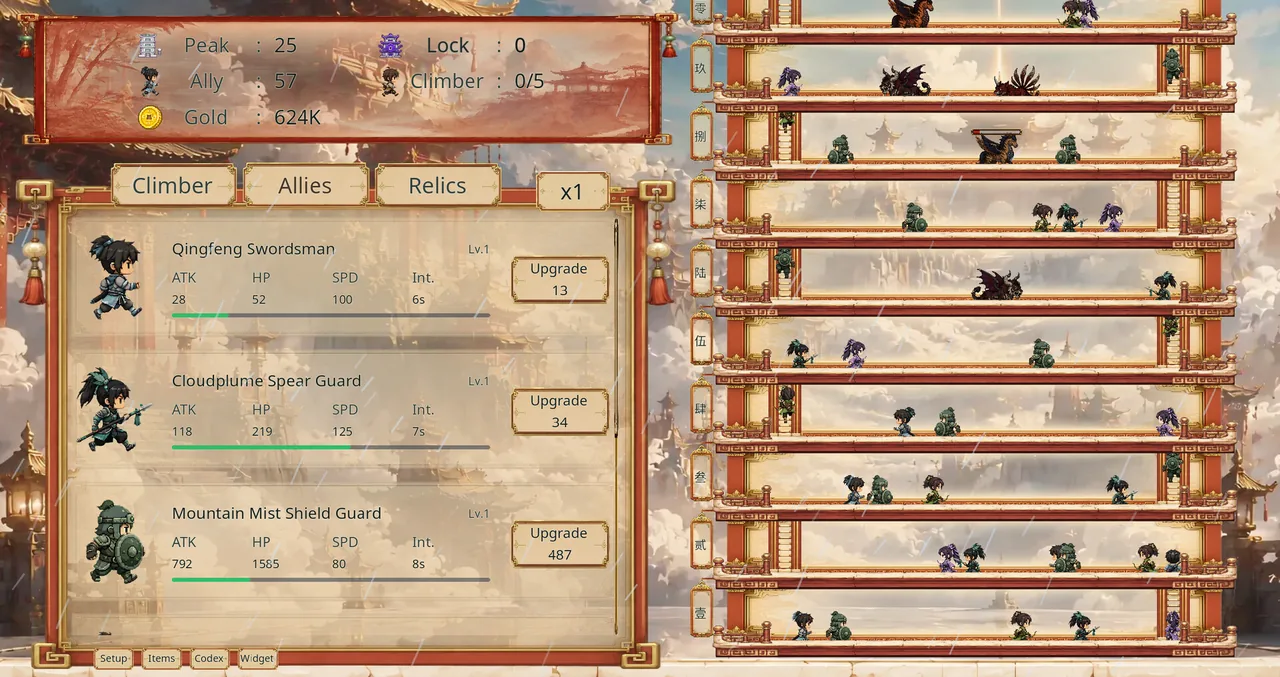
It's a clever twist on the genre's usual "click the thing that makes numbers go up" default, and it's the strongest evidence that there's a good design team somewhere in this project. A dozen ally archetypes — sword cultivators, spear guards, shield bearers, archers, talismanists, dancers, monks, apothecaries, assassins, artificers — carry no roster cap, so the mid-game rewards figuring out which combination actually clears a given floor rather than brute-forcing one overpowered unit type into everything.
Mystic arts, relics, and a rebirth loop that doesn't explain itself
Underneath the summoning sits a fairly standard incremental spine: mystic arts branch out into passive and active abilities, milestone floors and chests drop permanently stacking relics — attack, HP, move speed, gold find, chest odds — and once a run has gone far enough, Rebirth resets the climb back to floor one while banking every relic earned, with a Wish-Lamp Talisman system layered on top for re-rolling rewards on the next attempt. On paper it's a conventional prestige loop, the kind that's carried plenty of good idle games before it.
The problem is how little the game does to explain any of it. More than one player who requested a refund inside the first hour points to the same complaint: no clear sense of what reincarnating actually does, what the accumulating chests are for once keys run out, or how the skill-casting menu is meant to be used mid-fight. One long-session player put it bluntly after finally triggering a rebirth — no idea what it unlocked, no clear reason to do it again. For a system that's supposed to be the entire long-term hook, sending players into it without so much as a tooltip is a real design failure, not a minor rough edge.
The marketplace is the real problem
Thousand Floors ships with a peer-to-peer Steam marketplace where players can buy and sell in-game items for real money, and that alone wouldn't be unusual — plenty of idle games run cosmetic economies through the Steam Community Market without controversy. What's drawn consistent criticism is that several of the tradeable unit skins aren't purely cosmetic; they carry stat bonuses on top of their new look, and they're priced well above impulse-buy territory, with individual skins reportedly running into double-digit euros or dollars apiece. Money spent there also doesn't go to the developer the way a Steam DLC purchase would — it flows through the marketplace between players — which compounds the frustration for anyone who assumed they were supporting further development.
Calling a system "pay-to-win" fairly requires being specific about what it actually buys, and here the answer is concrete: a small, permanent stat edge attached to an optional cosmetic, sold at prices several multiples of the base game's own asking price. It doesn't lock content behind a paywall, and the core loop is fully playable without ever touching the marketplace. But for an idle game that otherwise earns its progression through relic drops and floor clearing, a shop selling permanent power alongside its skins sits awkwardly next to a genre built on the promise that time, not money, is what buys strength.
Presentation and polish
The pixel art commits to its premise — layered pavilions, monsters pulled from the Classic of Mountains and Seas, screen-filling combat once enough allies are unlocked — and it's a genuine change of scenery from the Western-fantasy dungeon crawl most idle RPGs default to. Several players single out the art style and the sense of scale once dozens of units are fighting across a floor at once as the game's best moment-to-moment payoff.
The execution doesn't always match the ambition, though. Recurring complaints describe stretched, squeezed or blurry scaling on individual graphics, right down to the gold-count icon that sits permanently on screen, and units that spawn half-outside the tower's visible bounds on newly unlocked floors. None of it is game-breaking, but it's the kind of visible rough edge that undercuts a game asking players to stare at the same screen for hundreds of hours.
On the language question specifically: Thousand Floors ships with an official English translation among eleven supported languages, and the actual sentences hold together — this isn't a game garbled by machine translation. The store page itself can't settle on whether the title is "Thousand Floors" or "Thousands Floors," using both inconsistently in its own description, which is a small tell of the same underlying polish gap that shows up everywhere else. But the substance of player frustration isn't bad grammar. It's an absence of explanation — systems that exist and function but were never taught to the player, in any language.
Value and who it's for
At NZ$15.75 with no subscription, no energy system and no ads, the base purchase is a fair ask for an idle game with this much genre ambition, and the widget mode that shrinks the whole tower into a draggable corner window is a real, well-executed feature for anyone who wants idle progression running alongside other work. The number of players logging thousands of minutes suggests the loop holds up for the audience it clicks with.
It's the marketplace and the missing tutorial, not the core price, that explain the 52% Mixed standing across roughly 250 Steam reviews — a total still small enough that the picture could shift meaningfully with more data, but consistent enough in what it says that it's not a fluke. Refund-worthy confusion in the opening hour and a monetisation model that sells power alongside cosmetics are exactly the kind of first impression that keeps an idle game from building the audience its actual combat loop deserves.
Final verdict
Thousand Floors has a better core idea than its reception suggests: tap-to-summon combat with real spatial constraints is a genuinely fresh spin on the idle tower-climber, and its Eastern mythology setting gives it a visual identity the genre badly needed. But a tutorial that explains almost nothing, visible polish issues in the art pipeline, and a real-money marketplace that sells stat-affecting skins are three separate, avoidable problems stacked on top of a good foundation. Fix any one of them and this is a comfortably Good idle game; right now it's a Mixed one that asks new players to do the tutorial's job for it.
Genre veterans who can push past the first confusing hour and ignore the marketplace entirely will find a loop worth keeping open in a corner of the screen. Everyone else should wait to see whether the missing explanations get patched in.
Players who'd rather have a persistent world explain its own systems as it goes, without an optional marketplace attached to power, might also want to look at Wanderer.
Pros and cons
Pros
- The tap-a-floor summon system genuinely rewards spatial thinking — walkway space and on-screen unit caps mean Floor Lockdown and target-floor choice matter, rather than tapping being a pure formality
- A dozen distinct ally types with no roster cap give the mid-game a real reason to diversify instead of stacking one unit endlessly
- The widget/compact display mode lets the tower run minimised in a corner of the screen while you do something else, which several long-time players cite as the reason they keep it open for hundreds of hours
- Eastern pixel-pagoda art direction and the Classic of Mountains and Seas monster roster give it a visual identity distinct from the usual Western-fantasy idle-RPG wallpaper
Cons
- A real-money marketplace sells unit skins that also grant stat bonuses, which multiple reviewers flag as pay-to-win dressed up as a cosmetic store, with individual skins priced well above what the base game costs
- Core systems — reincarnation rewards, chest-and-key gating, skill activation from the upgrade menu — go essentially unexplained, and several players who refunded cite not understanding what they were doing or why
- Interface polish lags behind the concept: reviewers describe stretched, blurry or distorted icons and art assets, including the gold counter that's visible on screen at all times
- The rebirth loop that's supposed to be the long-term hook reads as an obligation rather than a reward to at least one experienced player, who couldn't identify any concrete benefit after reincarnating
Screenshots
-
Thousand FloorsImage: 琥珀塔 via Steam -
Thousand FloorsImage: 琥珀塔 via Steam -
Thousand FloorsImage: 琥珀塔 via Steam -
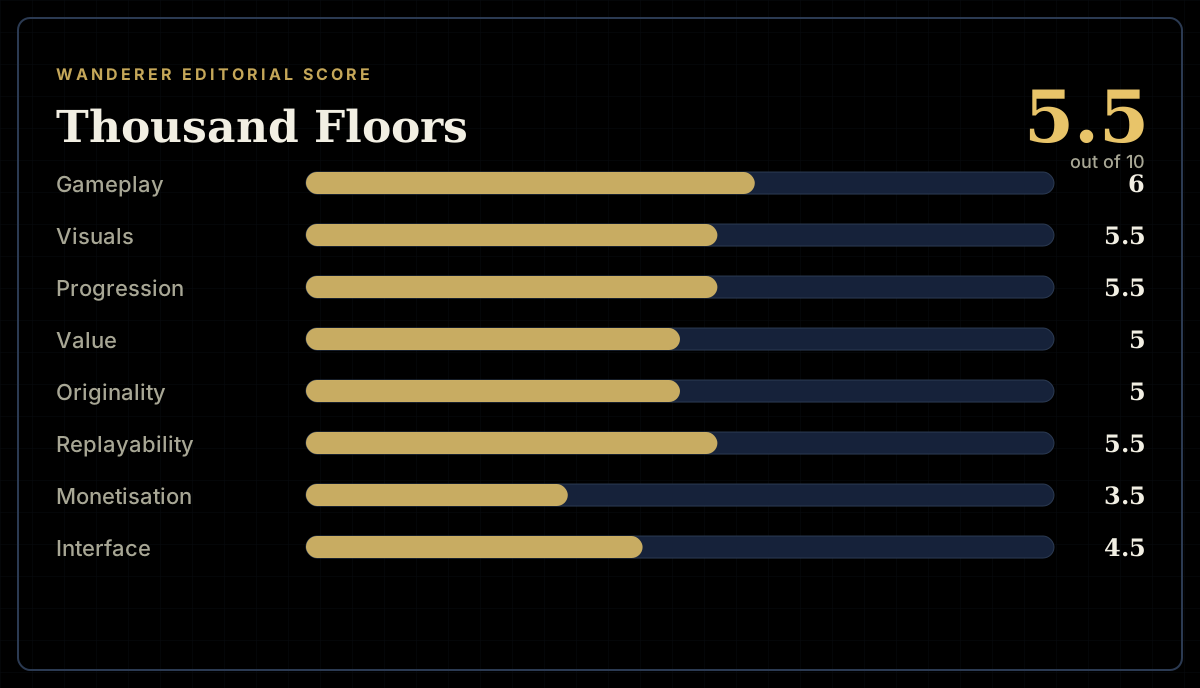
How the review scores each part of the gameWanderer Editorial -
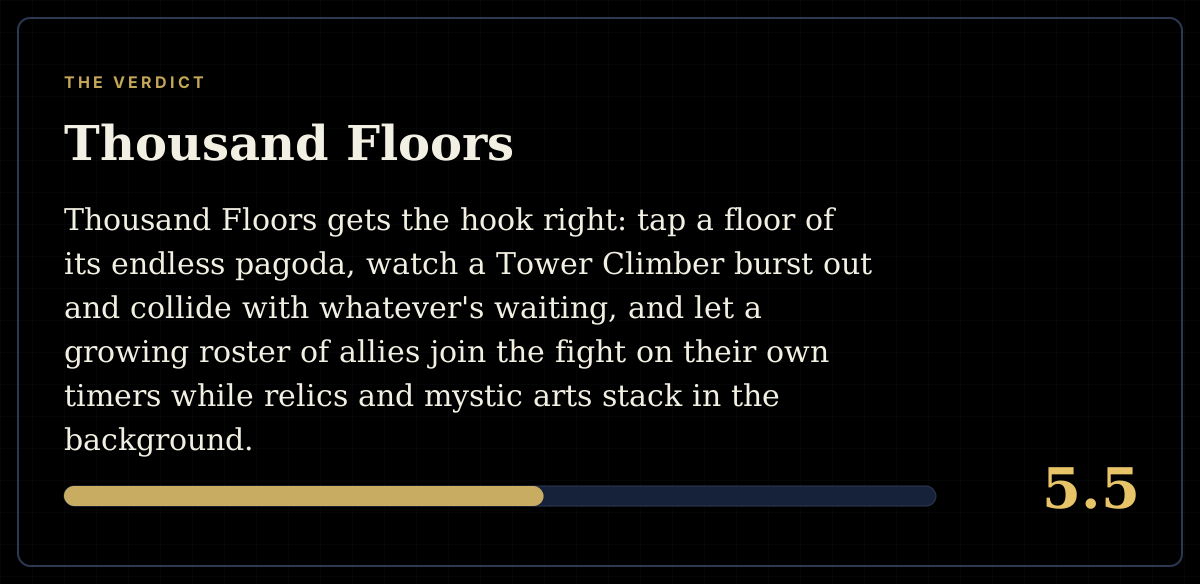
The short versionWanderer Editorial