
Game review
The Textorcist: The Story of Ray Bibbia
6.5 / 10
- Developer
- Morbidware
- Publisher
- Headup
- Released
- 14 February 2019
- Platforms
- Windows
- Genre
- Action
- Monetisation
- Paid, with DLC boss content
- Players
- false
The short version
The Textorcist casts players as Ray Bibbia, a private exorcist who fights demonic bosses by dodging bullet-hell projectiles with one hand while typing Latin exorcism verses and English phrases with the other. Its concept is genuinely unlike anything else on Steam, and its style, music and sheer difficulty draw enthusiastic praise from a wide range of players, including some very fast typists surprised to find themselves struggling. But a real, detailed contingent argues the dual-input premise itself doesn't work as designed — that dodging and typing simultaneously creates frustration rather than flow — and a separate, specific set of bugs (including reported save-file loss and unresolved crashes) undercuts an otherwise distinctive package.
Biggest strengths
- A genuinely unique concept unlike almost anything else in the genre, fusing bullet-hell dodging with real-time typing combat, including actual Latin exorcism verses
- Widely and specifically praised art direction, music and irreverent B-movie horror tone that reviewers enjoy independent of the difficulty debate
- A real, substantial challenge that surprises even highly skilled typists (100+ WPM) who report genuinely struggling, giving the game credibility as more than a novelty gimmick
Biggest weaknesses
- A real, detailed critical contingent argues the core dual-input premise doesn't work as intended — dodging bullet-hell patterns and typing accurately at the same time is described as creating frustration rather than the intended flow state, especially once fast-paced Latin text is introduced
- Reported serious technical bugs: at least one reviewer describes save files disappearing after reinstalling the game, and a separate reviewer reports unresolved game-breaking bugs still present more than a year after launch
- Unskippable interactive cutscenes before every boss attempt, which one detailed reviewer specifically asks the developer to let players bypass after repeated retries
Who it's for: Fans of extreme-difficulty bullet-hell shmups who also type quickly and are curious about a genuinely novel genre mashup unlike anything else available.
Our recommendation: Worth it for the novelty, style and soundtrack if you're a confident, fast typist looking for a real challenge — skip it if you're not comfortable typing under pressure, since a real share of players report the dual-input concept simply isn't fun for them regardless of skill.
6.5 / 10
What it is
The Textorcist casts players as Ray Bibbia, a hard-boiled private exorcist who battles demonic bosses through a genuinely unusual dual-input system: dodging dense bullet-hell projectile patterns with one hand on the movement keys while typing exorcism verses — English phrases and, later, actual Latin prayers — with the other to damage enemies. Developed by Morbidware and published by Headup, it released on 14 February 2019 at NZD 21.99, wrapped in a stylish, deliberately campy B-movie horror aesthetic with a "mid-90s anime plot," in one reviewer's words.
Its review corpus, 664 in English, sits at a strong Very Positive 82.7% (549 to 115), and reading through it in depth reveals a game whose core concept is genuinely novel enough to earn its own place in the genre — while also generating real, specific disagreement about whether that concept actually succeeds as gameplay.
A concept that surprises even confident typists
This corpus consistently frames the game's central hook with real enthusiasm and, often, genuine surprise at its difficulty. "It's terrific. It's hard as heck," writes one reviewer, describing the experience of moving with one hand and typing with the other as something that "might even make it harder" for good typists specifically, since it breaks the usual two-handed typing rhythm. A separate reviewer states this more starkly: "I say this as a person who types 125 WPM and has never broken a sweat playing a typing game before... it breaks my brain," describing genuinely hitting a difficulty wall for the first time in years. Another reviewer sums up the appeal bluntly: "no one asked for this game. No one needed a typing game that combines bullet-hell mechanics, a god-awful mid-90's anime plot, and actual Latin. But, damn. It's fun as hell."
A real, detailed case that the dual-input concept doesn't work
Set against that enthusiasm, a substantial and specific critical thread argues the fusion at the game's core is fundamentally at odds with itself. "Bullet hell shmups are too high octane to involve dodging AND typing, making Textorcist more frustrating than fun," writes one detailed reviewer, noting the early levels work fine before the endgame's faster patterns break the balance entirely. Another reviewer, a proficient touch typist, makes a specific, counterintuitive point: "if you're a proficient touch typist, you'll actually probably have an even harder time with the game" than someone who hunts and pecks, because of how awkwardly the shift-key movement scheme interacts with typing muscle memory. A separate reviewer states plainly: "it's a good concept but there just isn't a good way to have a fluid movement scheme mixed in with the typing combat. Too annoying trying to manage both at the same time." That's a specific, mechanically grounded critique distinct from ordinary "this game is too hard" complaints — several critics here explicitly separate the concept's novelty from its actual moment-to-moment execution.
Real, specific technical problems
Beyond the core-design debate, this corpus documents concrete technical issues worth flagging directly. "Every time the game is redownloaded, the save files disappear," writes one detailed reviewer, calling this "such a disaster due to it's difficulty" given how much progress a single playthrough represents. A separate, more pointed review states: "game-breaking bugs that have not been fixed over a year after release? That's pretty bad," arguing that a punishing, precision-based game carries a higher obligation for technical stability than a more forgiving one. A third reviewer raises a narrower but genuinely frustrating issue: being forced to sit through "tedious interactive cutscenes EVERY TIME you want to challenge a boss," with no way to skip straight to a retry after the first viewing.
The Latin-text fairness debate
A specific, recurring complaint concerns the game's use of actual Latin prayers as typing targets for non-native English speakers. "Extremely hard if you're non-native (in particular if you rarely type in latin alphabet)," writes one reviewer, while another states the Latin content specifically "made me stop," arguing that longer or more familiar English words would have preserved the challenge without adding an additional, arguably unintended language barrier. That's a fair, specific point distinct from the broader difficulty debate — the game's core challenge is clearly by design, but the added friction from unfamiliar Latin vocabulary lands differently depending on a player's own linguistic background in a way the difficulty curve doesn't fully account for.
What the achievement data confirms about the difficulty
The Textorcist's achievement curve is among the steepest this lane has documented: 72.2% for defeating the first boss, dropping to 41.1% by the third, and falling into single digits by the seventh boss and beyond. Hardcore-difficulty and full-completion achievements sit at 1-2% across the board. That's a genuinely brutal attrition curve, strongly corroborating both the "even fast typists struggle" praise and the "the back half breaks the concept" criticism — very few players who start this game see it through to the end, regardless of which side of the design debate they land on.
Verdict
The Textorcist delivers something genuinely rare: a fully realized, stylish fusion of two genres that have never been combined this way before, and its difficulty is real rather than manufactured. Whether that fusion is actually fun rather than merely difficult remains a fair, unresolved question within its own fanbase, and real technical bugs — particularly reported save-file loss — add unnecessary risk to an already unforgiving experience. Recommended for confident typists specifically seeking a genuine challenge unlike anything else in the genre; approach with caution otherwise.
Pros and cons
Pros
- A genuinely unique concept unlike almost anything else in the genre, fusing bullet-hell dodging with real-time typing combat, including actual Latin exorcism verses
- Widely and specifically praised art direction, music and irreverent B-movie horror tone that reviewers enjoy independent of the difficulty debate
- A real, substantial challenge that surprises even highly skilled typists (100+ WPM) who report genuinely struggling, giving the game credibility as more than a novelty gimmick
- Rebindable movement controls (shifting from WASD to ESDF) that let dedicated players optimize for faster typing without sacrificing movement, a thoughtful accessibility option for its core demographic
Cons
- A real, detailed critical contingent argues the core dual-input premise doesn't work as intended — dodging bullet-hell patterns and typing accurately at the same time is described as creating frustration rather than the intended flow state, especially once fast-paced Latin text is introduced
- Reported serious technical bugs: at least one reviewer describes save files disappearing after reinstalling the game, and a separate reviewer reports unresolved game-breaking bugs still present more than a year after launch
- Unskippable interactive cutscenes before every boss attempt, which one detailed reviewer specifically asks the developer to let players bypass after repeated retries
- A specific complaint that the game's non-negotiable design (no adjustable difficulty, no lives system) means dying deep into a long, difficult boss fight forces a full restart from the beginning of that fight
- Multiple non-native English speakers report the mix of English and Latin text makes an already difficult game considerably harder in ways that feel unintentional rather than a deliberate design choice
Screenshots
-

The Textorcist: The Story of Ray BibbiaImage: Headup via Steam -

The Textorcist: The Story of Ray BibbiaImage: Headup via Steam -

The Textorcist: The Story of Ray BibbiaImage: Headup via Steam -
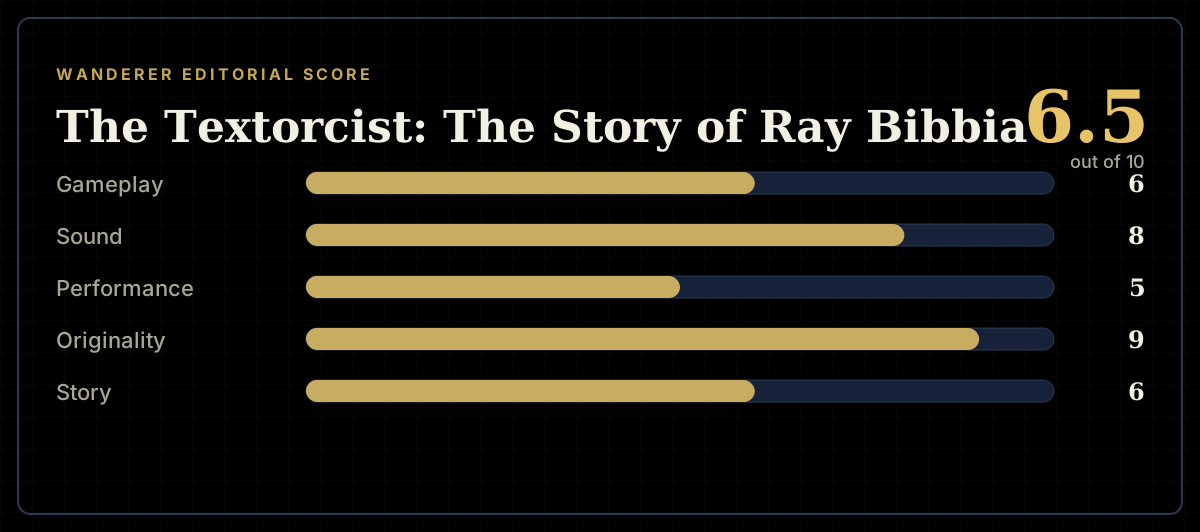
How the review scores each part of the gameWanderer Editorial -
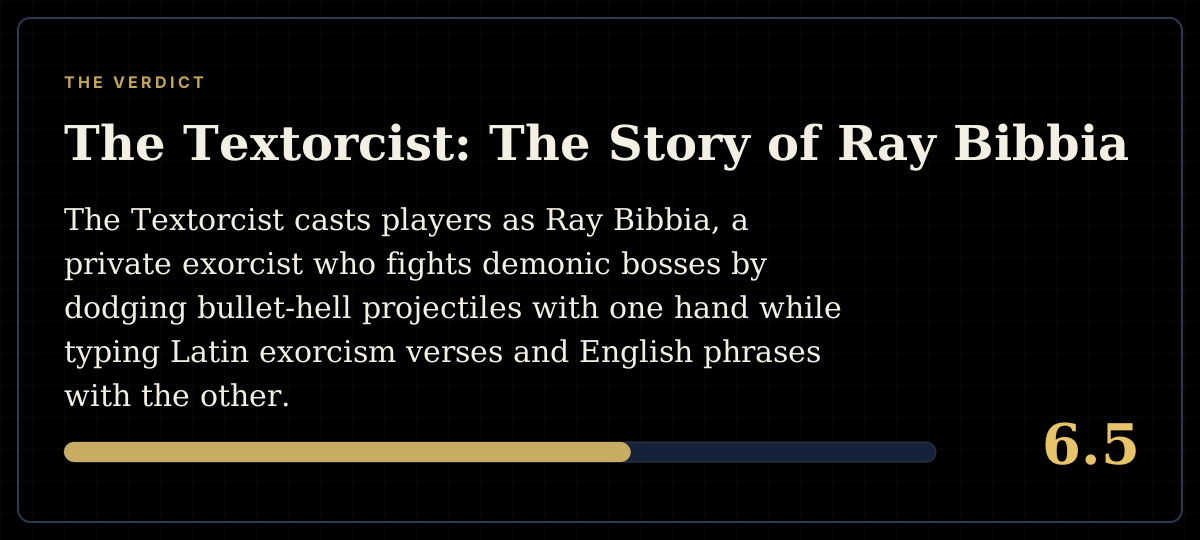
The short versionWanderer Editorial