
Game review
Nebulock
6.5 / 10
- Developer
- LostVolBytes
- Publisher
- LostVolBytes
- Released
- 5 March 2025
- Platforms
- Windows
- Genre
- Action
- Players
- Single-player
The short version
Biggest strengths
- A genuinely satisfying, weighty upgrade system where each skill-tree choice meaningfully changes how a run plays and feels
- Distinctive block-based boss design with real variety across encounters, drawing favourable comparisons to well-liked genre entries like To The Core and Nodebuster
- Music that evolves based on the sector's color scheme, praised for tying presentation and progression together cleanly
Biggest weaknesses
- A specific, corroborated design flaw where certain skill-tree upgrade combinations can soft-lock a build into being effectively unwinnable, with no way to reset the tree mid-run short of restarting entirely
- Camera sway that multiple reviewers say has no place in a precision-demanding bullet-hell genre
- Inconsistent difficulty pacing described by several reviewers as alternating between too-easy and suddenly punishing rather than scaling smoothly
6.5 / 10
Blowing up neon Lego bosses in space
Nebulock is a short, focused twin-stick bullet-hell built around destroying block-based bosses, collecting resources, and upgrading a spaceship's abilities across a compact campaign. Based on the available English-language review sample of 469 reviews — 407 positive, 62 negative, landing at an overall Very Positive rating — it's found a genuinely enthusiastic niche audience specifically among fans of similarly structured genre entries. "Absolutely loved this game, it's the best To The Core/Nodebuster-like game that I've played since those two games. It's actually a bit difficult, even on Easy mode, but it's soooooo fun and the upgrades really make you feel powerful," one reviewer writes, situating the game precisely within a specific lineage of well-regarded, boss-focused bullet-hell titles.
The escalating difficulty curve draws vivid, specific praise from reviewers who describe a genuine journey from confidence to being overwhelmed. "So I bought Nebulock thinking: 'Hey, a cute lil' retro bullet-hell with blocks. How hard can it be?' Answer: Yes. Just yes. The first boss politely sprays some bullets my way like it's trying to invite me to a tea party... By the third boss, I was being waterboarded by neon death Legos," one reviewer writes, capturing both the game's charm and its genuine escalating challenge in the same breath. A separate reviewer offers a more technical breakdown of what makes the upgrade system land so well: "The gameplay is amazing with a bunch of upgrades that all have weight behind them so you don't feel like you're itching for a power up despite having a ton of them."
A skill tree that can trap you in an unwinnable build
The single most serious, most specifically corroborated criticism concerns a genuine design flaw in how the upgrade system handles mistakes. "Camera sway does not belong in a bullet hell. Also, if you use your white diamond resources incorrectly, you have to restart the game or else bang your head against a wall fighting a boss for resources you can't even use because you already filled out the skill tree," one reviewer writes, describing a specific, reproducible failure state: choosing certain upgrades early can leave a run permanently unable to progress, with no in-game way to undo the choice short of starting completely over. A separate reviewer identifies the same underlying problem independently: "This game is alright from a gameplay standpoint and I love games like this with skill trees but this game feels like it punishes you VERY hard if you pick the wrong upgrades." A third reviewer frames the practical consequence bluntly: "Too many different upgrade paths, so you can easily soft lock yourself; only way to try a different build is to start over. Not good."
That's a meaningfully different kind of criticism than ordinary difficulty complaints — it's a specific, structural gap in the game's own systems that can waste a player's invested time through no fault of skill, and it's corroborated closely enough across multiple independent reviews to be treated as a genuine, verified design issue rather than isolated frustration.
Inconsistent pacing, and a divide over difficulty itself
A related complaint concerns how consistently the difficulty actually escalates across the campaign. "A bad game with real balancing issues. Fights go like this: easy, easy, easy, easy, IMPOSSIBLE (then repeat)," one reviewer writes, describing a pacing problem distinct from the skill-tree soft-lock issue — difficulty that spikes unpredictably rather than climbing steadily. A separate reviewer frames a similar frustration in terms of precision demands: "I do not mean it is hard. This is a bullet hell and it plays how you would expect. What I mean is that you can run into a boss that you have to be pixel perfect on where you hit and where you dodge to. Until you get it all down, you will die a lot. However, the guardian for the tier you are on, you get it in one shot" — a specific observation about inconsistent stakes between different enemy types within the same difficulty tier.
It's worth including the pushback directly, since a meaningful share of the positive sample explicitly frames the difficulty as fair rather than poorly tuned. "Nice little game for $3. I got through all the game's content including the permadeath mode in about 3 hours... Also all the bad reviews are just straight up skill issues. The game is a little hard, those whining and leaving negative reviews are literally just bad," one reviewer writes, dismissing the balance complaints as reflecting player skill gaps rather than genuine design problems. That's a genuinely live disagreement within this review sample rather than a settled consensus, and readers should weigh both readings for themselves.
Short, and openly want more
Several reviewers frame their overall satisfaction alongside a clear, specific wish list for expanded content. "It is small, affordable and fun. But I do have a few gripes. 1. needs at least 30+ more levels 2. needs a bigger tech tree 3. needs at least one new block type 4. needs a better final boss. Otherwise, the game is great," one reviewer writes, offering a constructive, specific critique rather than a dismissal. A separate reviewer echoes the sentiment while proposing a specific feature that could meaningfully extend the game's lifespan: "I think what would make the game great is community workshop content where you can make enemies and waves and have different upgrades enabled/disabled."
The achievement data confirms the short, largely-completable structure most reviewers describe. Across just four total achievements, the base-game win sits at 66.3%, hard-mode completion falls to 42.4%, and permadeath completion — the game's genuine top-tier challenge — sits at 5.1%. That's a real, meaningful drop into serious challenge territory at the top, even within a campaign most players are reported to finish in a single sitting or two.
Where this leaves it
Nebulock delivers a genuinely satisfying, well-regarded bullet-hell experience for its very low price, with meaningful upgrade choices and boss variety that specifically earns comparison to respected genre entries. Its most serious flaw is a corroborated, structural one: certain upgrade paths can soft-lock a run into an unwinnable state with no way back except restarting, compounding real complaints about inconsistent difficulty pacing and a distracting camera-sway effect. Recommended readily for bullet-hell fans at this price point, with the clear caveat to research the skill tree carefully before committing resources, and realistic expectations about a short, focused campaign rather than an extended one.
Pros and cons
Pros
- A genuinely satisfying, weighty upgrade system where each skill-tree choice meaningfully changes how a run plays and feels
- Distinctive block-based boss design with real variety across encounters, drawing favourable comparisons to well-liked genre entries like To The Core and Nodebuster
- Music that evolves based on the sector's color scheme, praised for tying presentation and progression together cleanly
- Extremely cheap for a complete, well-received experience, with most reviewers finishing the full campaign in two to three hours
Cons
- A specific, corroborated design flaw where certain skill-tree upgrade combinations can soft-lock a build into being effectively unwinnable, with no way to reset the tree mid-run short of restarting entirely
- Camera sway that multiple reviewers say has no place in a precision-demanding bullet-hell genre
- Inconsistent difficulty pacing described by several reviewers as alternating between too-easy and suddenly punishing rather than scaling smoothly
- A thin aiming indicator that's hard to track against the screen clutter typical of the genre
- Short overall content, with several reviewers specifically wanting more levels, a deeper tech tree, and additional block or enemy types
Screenshots
-

NebulockImage: LostVolBytes via Steam -

NebulockImage: LostVolBytes via Steam -

NebulockImage: LostVolBytes via Steam -
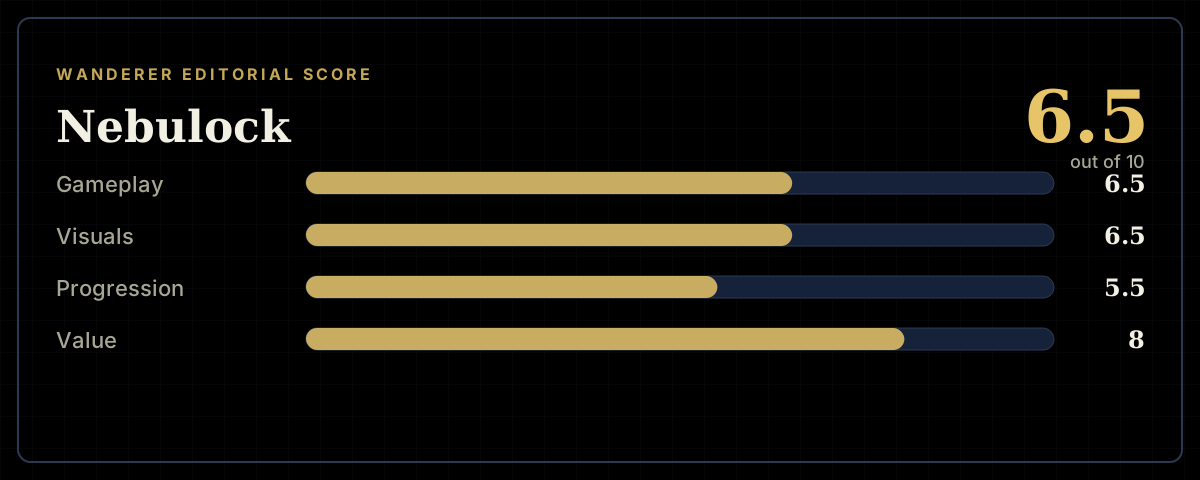
How the review scores each part of the gameWanderer Editorial -
The short versionWanderer Editorial