Game review
THE REF - Football Referee Simulator
6.5 / 10
- Developer
- HustleGrow AB
- Publisher
- HustleGrow AB
- Released
- 6 August 2026
- Platforms
- Windows
- Genre
- Indie, Simulation, Sports
- Monetisation
- One-time purchase, no in-game store, no DLC listed
- Players
- 1-4 player online co-op (center referee, two assistant referees, one match assessor); single-player career is fully playable solo
The short version
THE REF hands you the one job every football game has automated away: making the call. You stand in the middle of a full 3D match with no replay and a few seconds to decide whether that was a foul, a dive or a straight red, and the game marks you on it afterward — press reaction, club grudges and all, across a four-league career that runs for years. The genuinely new part is the 1-4 player online co-op, where two assistants flag their own uncertain offside calls and you decide whether to trust them, with the newspapers remembering who was wrong. It's a real idea with almost nobody else attempting it, shipped by a solo developer who put out a tutorial-and-voice-chat patch within three hours of release. It's also six days old, has one Steam review, and Early Access means the officiating engine underneath everything is exactly what's still being tuned.
Biggest strengths
- No other current Steam release puts the player in the referee's shoes for a full 3D match rather than a stat-driven abstraction, with fouls, dives, cards, penalties and VAR all judged in real time
- The 1-4 player online co-op splits distinct jobs across real people — center referee, two assistants and an assessor who marks everyone — with an "Overrule" mechanic that turns a teammate's offside flag into a genuine four-second trust decision
- A four-league career with 36 clubs, aging and retiring players, cup runs, press relationships across six newspapers and rival referees competing for the same big fixtures gives the core loop somewhere to go over dozens of hours, not just repeated one-off matches
Biggest weaknesses
- The one Steam review at time of writing, a recommend, still calls the core refereeing interaction "clunky" and says the game's cartoonish art style can make it genuinely hard to judge whether a tackle was a foul or a dive — a real problem for a game whose entire premise is judging exactly that
- English is the only supported language, with no partial localisation listed, on a genre (football) with a global, multilingual audience
- The developer's own FAQ frames online co-op as "the newest system and the main focus of Early Access hardening," meaning the headline four-player mode is explicitly the least-tested part of the build right now
Who it's for: Football fans who've ever shouted at a referee and management-sim players who like a system with real consequences attached to a judgment call, especially groups of three or four friends willing to be the officiating crew for each other's careers.
Our recommendation: A genuinely distinctive concept executed with more scope than a solo Early Access launch usually manages — worth the introductory price for anyone curious about refereeing as a game system, especially in a group. Anyone who wants a finished, widely-tested product, or who bounces off "clunky" as a description of the core interaction, should wait a few patches and let the review count grow past one.
6.5 / 10
Every football game ever made has been built around the same fantasy: you're the one who scores. THE REF throws that out and hands you the job nobody asks for growing up — the referee, standing in the middle of twenty-two players who don't answer to you so much as react to you, deciding in real time whether that was a professional foul or a soft red, with no replay button and a mark out of ten waiting at full time. It's a genuinely uncommon pitch for a Steam sports release, and it's shipped into Early Access by a single Swedish developer working under the studio name HustleGrow AB, six days before this review and with exactly one player review to judge it against.
Judgment as the core mechanic
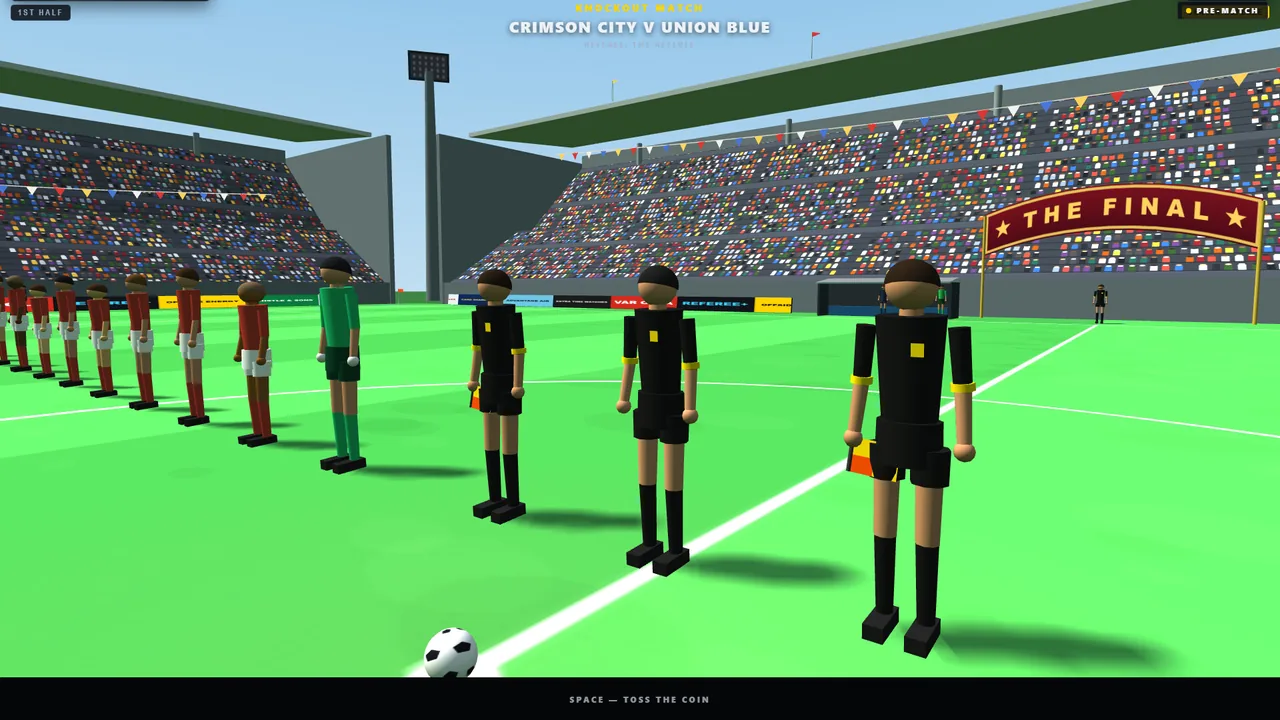
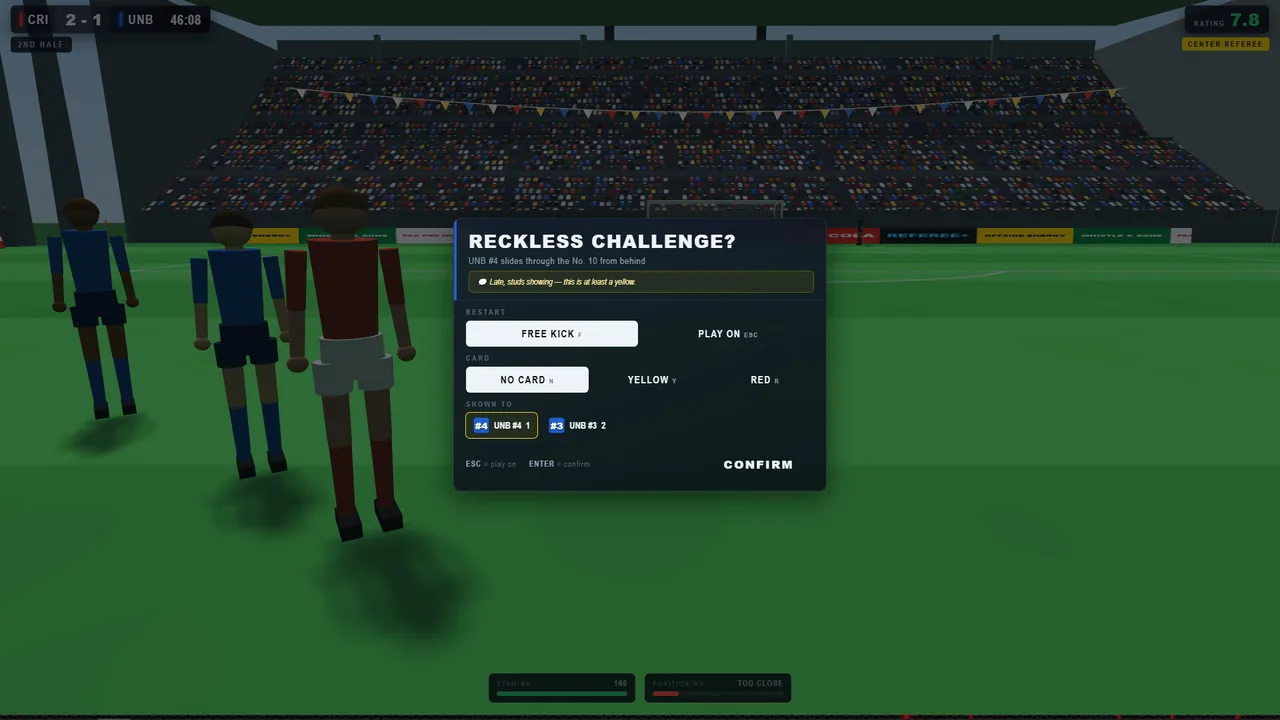
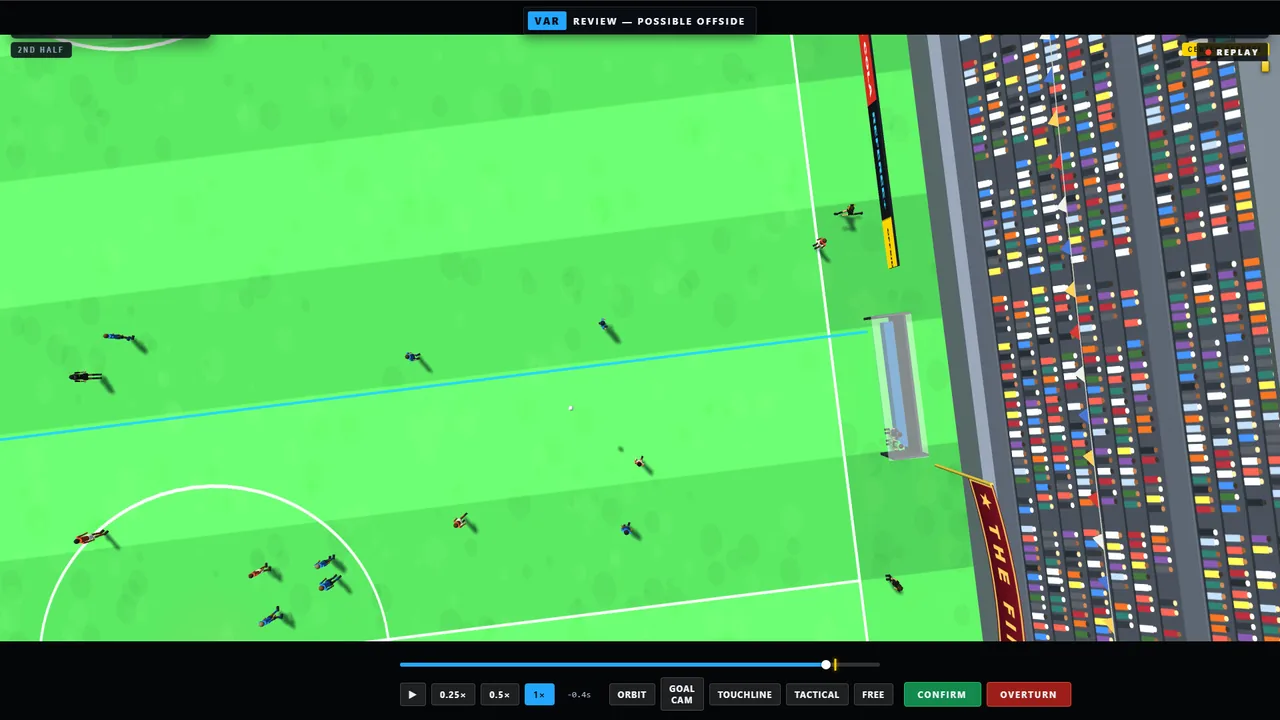
The entire game is built around a moment of doubt rather than a moment of skill. A tackle happens at match speed, you get a "gut feeling," and you act on it — whistle for the foul, wave play on, show a card, point to the spot. The verdict comes later: at full time, THE REF replays what actually happened, call by call, and scores your night. That delayed-judgment loop is the whole design in miniature, and it extends into a pitchside VAR review — five camera angles, slow motion, a manually drawn offside line — that lets you overturn your own decision at the cost of match time and, per the store page, a mark against you for how often you reach for it unnecessarily. Managers who lose their heads get sent to the stands. Time-wasters get booked. Weather changes what you can actually see. None of that is abstracted into a menu; it's staged as something you have to watch and rule on inside a full 3D match.
A career that keeps a grudge
Underneath the moment-to-moment officiating sits a genuinely long-form structure: four leagues to climb from Sunday-league mud to the top flight, 36 clubs whose rosters age, retire and refresh with new players over time, cup runs and an international tournament layered on top of weekly league fixtures. Six newspapers rate every match with distinct editorial personalities, and how you handle the press conference afterward — contrite or defensive — affects how forgiving the coverage is next time. Clubs remember you specifically; hand a team too many cards and penalties and the game tracks a file against your name. Fifteen rival referees are competing for the same big fixtures, so slipping in the rankings costs you the games that matter. It's a lot of interlocking reputation systems for a solo-developer Early Access launch to commit to on day one, and the scope is the single most impressive thing about the release regardless of how the refereeing itself plays.
The co-op is the actual pitch
Single-player is the whole game, playable start to finish according to the developer's own Early Access FAQ. But the four-player online co-op is what nothing else on Steam is currently attempting, and it's built around a genuinely sharp idea: your assistants don't just watch, they form their own uncertain read on a play, and the further they are from the ball the less confident that read gets. When a flag goes up for offside, you have about four seconds to trust it or wave it down, and the game shows the offside line down to the centimetre afterward — with your teammate's name attached to whether they called it right. A fourth player sits as the match assessor, grading everyone. Add "Crew VAR," where the whole group watches a replay and votes before the center referee makes the final call, and two separate press rooms where you can back a teammate's version of events or throw them under the bus before either of you knows the truth, and this stops being a referee sim you play alone and becomes something closer to a social deduction game wearing a whistle. It's the reason to watch this release rather than skip it — nothing else on the platform is doing a shared-judgment mechanic like this one.
The catch, stated plainly in the developer's own Early Access Q&A, is that online co-op is "the newest system and the main focus of Early Access hardening" — the headline feature is explicitly the least battle-tested part of the build, and the FAQ says as much rather than papering over it.
What the evidence actually says
There isn't much of it yet, and this review isn't going to pretend otherwise. THE REF has exactly one Steam review at time of writing: a recommend, from a player at 43 minutes, who calls the game "super promising" but flags the core interaction as "clunky" and specifically notes that the cartoonish art style can make it "difficult to call a fall from time to time" — which, for a game whose entire premise is calling exactly that, is the single most load-bearing complaint the corpus currently contains. The same reviewer wants more variety in how the AI players move and asks for fouls to be possible away from the ball, both reasonable requests for a launch build. Global achievement data backs up how early this all still is: the top unlock sits at 71.4%, a reasonable tutorial-adjacent milestone, but three of the fourteen achievements are still sitting at 0% six days in.
What does count in the game's favour is how the developer is responding. A patch titled "Referee School, Crew Voice Chat & The Laws Update" landed roughly two and a half hours after the release timestamp — not a hotfix, but a real content update: a guided five-minute onboarding tutorial that walks through the whistle, cards, advantage, the assistant's flag and a full VAR monitor run before letting a new player loose on a real match; built-in push-to-talk or open-mic voice chat for co-op crews; career fixtures that now properly host the whole group through repeated rematches; and VAR coverage extended to handballs in the build-up to goals, missed clear red cards and mistaken identity. Sixteen real national squads were added to the international tournament in the same update. That's a genuinely substantial same-day patch for a solo developer to ship, and it directly answers the kind of onboarding complaint a brand-new, systems-heavy game like this was always going to draw.
Early Access, honestly
HustleGrow's own FAQ is unusually specific for an Early Access page, and worth quoting rather than summarising. Asked why Early Access at all: "Tuning that fairness — when a flag is right, how harshly a wrong call is punished, how the crew rating blends — is exactly the kind of thing that needs thousands of real matches by real players, not just my own testing." Asked how long: "roughly 6 to 12 months," gated on milestones — stable co-op across real-world connections and a community-balanced career — rather than a fixed calendar date. Asked what's playable today: "a complete career mode... quick matches, knockout matches with extra time and penalty shootouts, VAR reviews with multiple camera angles, four venue tiers with weather, press conferences, gamepad support and Steam achievements," with single-player explicitly called "stable and can be finished end to end." The developer also states plainly that the price will rise moderately at full launch, so the current NZ$8.43 introductory rate (25% off NZ$11.25 until 20 August) is the cheapest this game will ever be, not a permanent value baseline.
That's a more forthcoming Early Access pitch than most: a solo developer naming the exact system that needs community testing (the fairness of the grading, not the whole game), naming what's already finishable, and backing the promise with a same-day patch instead of a launch-day announcement and silence.
Value and final verdict
Six and a half out of ten for a concept this original is a score about evidence, not ambition. Nothing else currently on Steam asks a player to be the referee rather than a player, and the co-op crew structure — assistants forming their own uncertain reads, an assessor grading everyone, newspapers remembering who was wrong — is a genuinely novel multiplayer hook built on top of a sport whose management sims have mostly ignored the officials entirely. The career scope, the same-day patch and the developer's specific, milestone-based Early Access roadmap all suggest someone building this seriously rather than testing the waters. Set against that: a single Steam review that calls the central mechanic clunky, an art style that reportedly makes the exact judgment calls you're being scored on harder to read, English-only support, and a headline co-op mode the developer themselves says is still being hardened. At an introductory price under nine dollars, curious football fans and groups of three or four friends have very little to lose by trying it now and watching it grow. Anyone who wants confirmation that the whistle actually feels good in hand should give the review count a few more weeks to catch up to the idea.
Pros and cons
Pros
- No other current Steam release puts the player in the referee's shoes for a full 3D match rather than a stat-driven abstraction, with fouls, dives, cards, penalties and VAR all judged in real time
- The 1-4 player online co-op splits distinct jobs across real people — center referee, two assistants and an assessor who marks everyone — with an "Overrule" mechanic that turns a teammate's offside flag into a genuine four-second trust decision
- A four-league career with 36 clubs, aging and retiring players, cup runs, press relationships across six newspapers and rival referees competing for the same big fixtures gives the core loop somewhere to go over dozens of hours, not just repeated one-off matches
- The developer's Early Access FAQ commits to specific exit milestones (co-op stability across real-world connections, a community-balanced career mode) rather than a vague date, and backed it up with a substantial patch — a guided "Referee School" tutorial and built-in crew voice chat — within about three hours of launch
- Clean one-time purchase with no in-game store, premium currency or DLC listed, at an introductory price that the developer states is the lowest it will ever be
Cons
- The one Steam review at time of writing, a recommend, still calls the core refereeing interaction "clunky" and says the game's cartoonish art style can make it genuinely hard to judge whether a tackle was a foul or a dive — a real problem for a game whose entire premise is judging exactly that
- English is the only supported language, with no partial localisation listed, on a genre (football) with a global, multilingual audience
- The developer's own FAQ frames online co-op as "the newest system and the main focus of Early Access hardening," meaning the headline four-player mode is explicitly the least-tested part of the build right now
- A single Steam review and a global achievement spread with several unlockables still sitting at 0% is nowhere near enough data to confirm how the officiating and grading systems hold up across dozens of hours or under co-op networking stress
- The developer states the price will rise moderately once the game leaves Early Access, so the NZ$8.43 entry point is explicitly temporary rather than a stable long-term value comparison
Screenshots
-
THE REF - Football Referee SimulatorImage: HustleGrow AB via Steam -
THE REF - Football Referee SimulatorImage: HustleGrow AB via Steam -
THE REF - Football Referee SimulatorImage: HustleGrow AB via Steam -
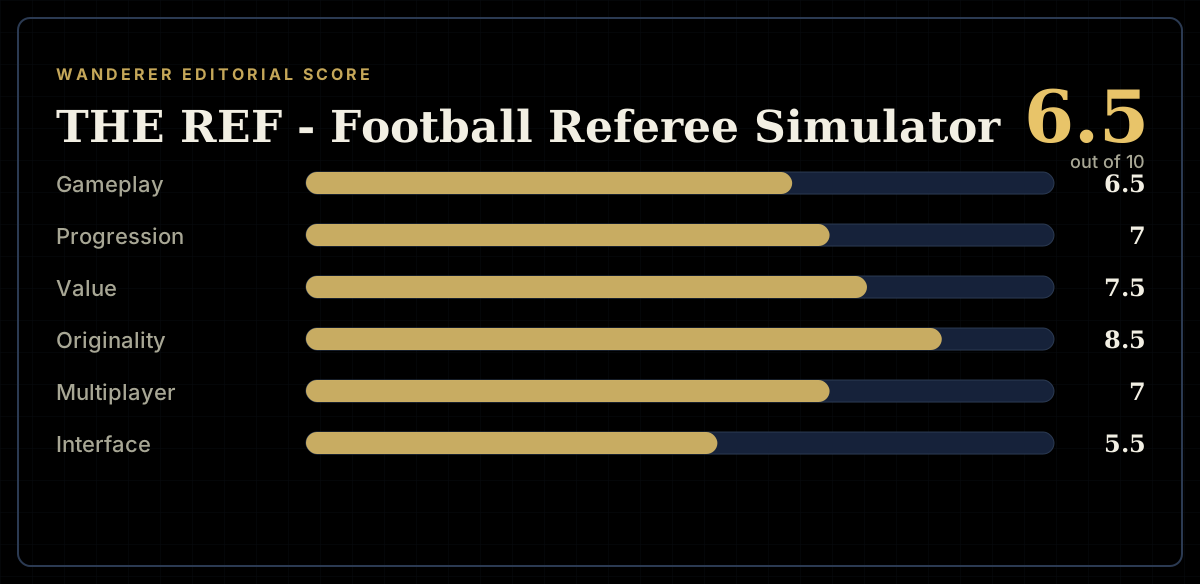
How the review scores each part of the gameWanderer Editorial -
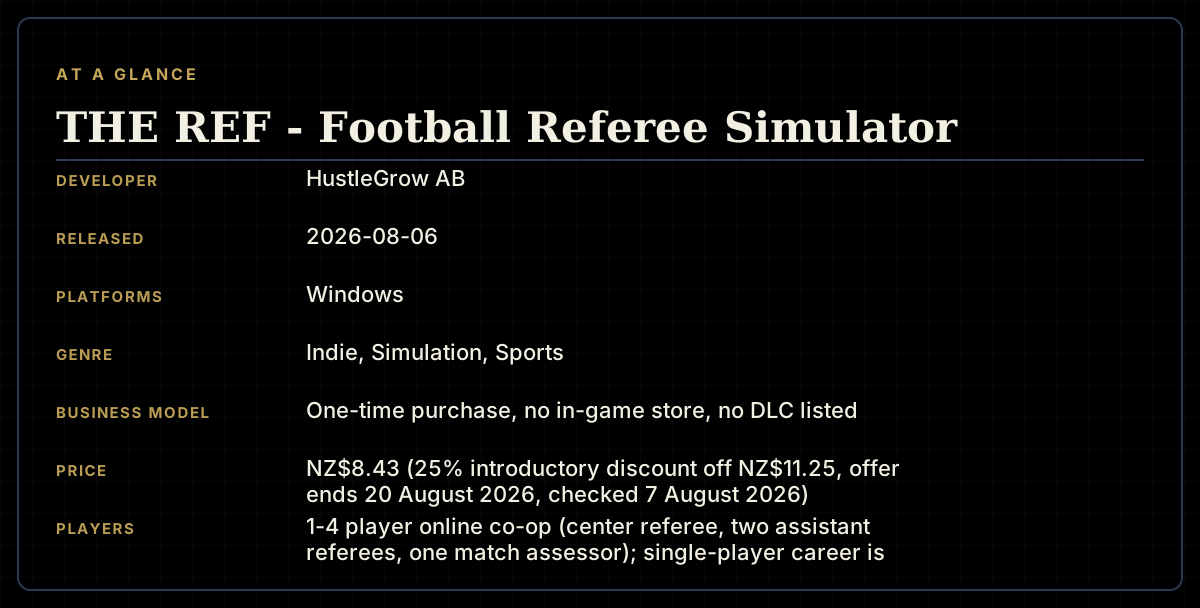
The game at a glanceWanderer Editorial -
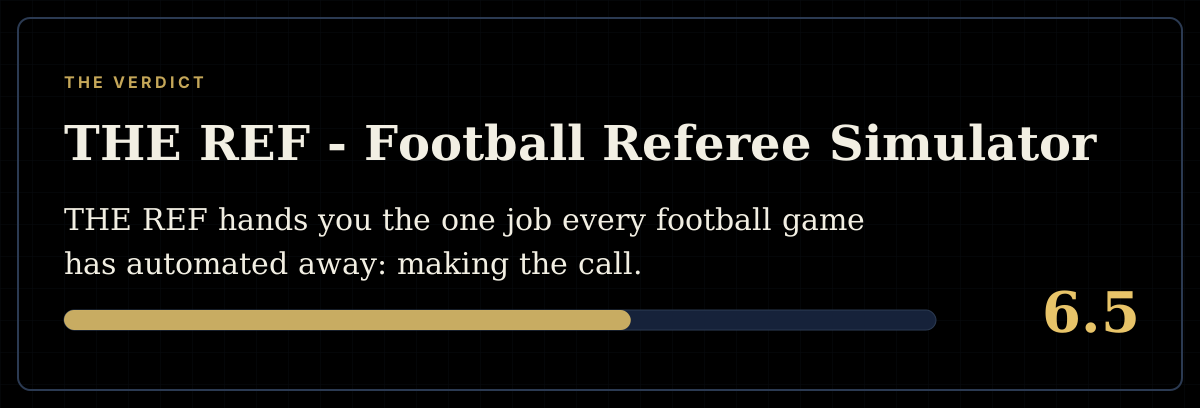
The short versionWanderer Editorial