
Game review
The Braves
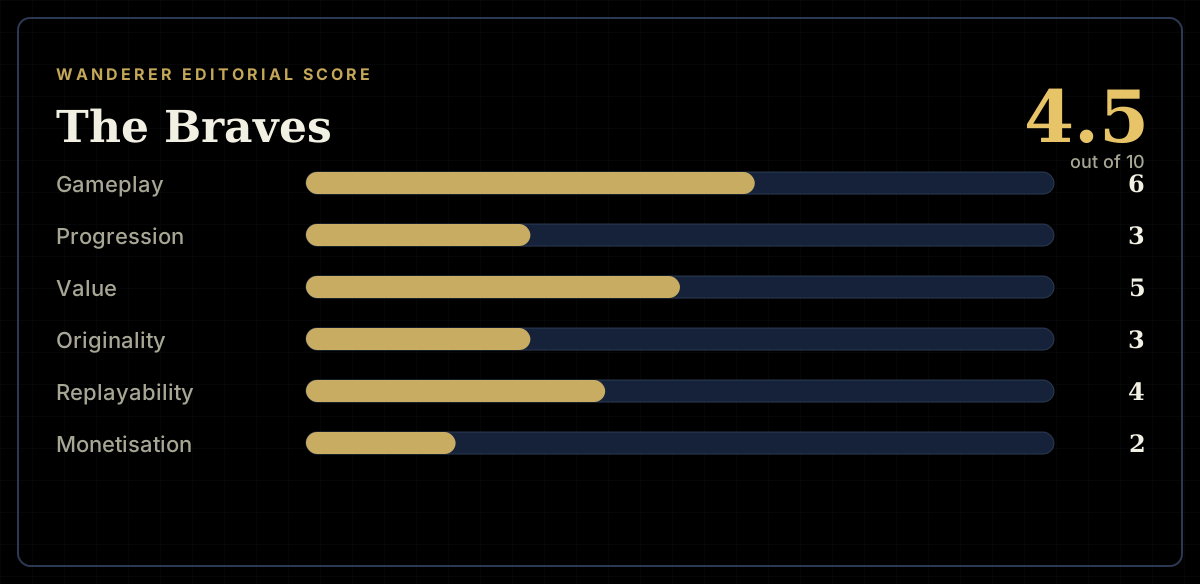
4.5 / 10
- Developer
- 101XP GAME STUDIOS
- Publisher
- 101XP
- Released
- 3 May 2024
- Platforms
- Windows
- Genre
- Free-to-play bullet-heaven roguelite
- Monetisation
- Free-to-play with gacha-style character/equipment summoning, up to roughly €100 per currency purchase
- Players
- Single-player only
The short version
The Braves takes the Vampire Survivors formula — survive endless waves while auto-attacking enemies and building an ever-stronger character — and wraps it in a free-to-play structure built around gacha-style character and equipment summoning. This review's sample confirms the core survival loop is genuinely fun for many players in its early hours, but a large, specific, and remarkably consistent negative-review theme describes a steep progression wall that pushes players toward real-money spending, directly corroborated by Steam's own partner-events feed for the game, which consists almost entirely of sale and summon-banner promotions rather than substantive content updates.
Biggest strengths
- The core bullet-heaven survival loop is repeatedly praised as genuinely fun and addictive in its early hours, with multiple reviewers specifically comparing it favourably to Vampire Survivors while enjoying the added spatial and hero-variety twists
- A wide roster of playable heroes and weapon evolutions gives free players real build variety to experiment with before progression walls set in, according to several reviewers
- The game is entirely free to download and play, and several reviewers report reaching a meaningful amount of content without spending money, at least in the earlier stages
Biggest weaknesses
- A large, specific, and remarkably consistent negative-review theme describes a punishing progression wall tied directly to gacha-style monetization, with multiple reviewers independently describing needing thousands of hours or significant real-money spending to progress past certain points
- This review's own achievement-data check corroborates the severity of that wall directly: the easiest achievements sit at 93.8% completion, falling to under 1% for the rarest, an extremely steep cliff even by the standards of grind-heavy live-service games
- Steam's own partner-events feed for the game is dominated almost entirely by sale and summon-banner promotional posts rather than substantive gameplay updates, a pattern that directly supports reviewer characterizations of the game as monetisation-first
Who it's for: Vampire Survivors fans specifically curious about a free, gacha-monetized take on the formula who are comfortable capping their investment at zero dollars and zero expectations of full completionism; not a fit for players sensitive to aggressive live-service monetization or wanting a fair, skill-based progression curve.
Our recommendation: Worth trying for free specifically as a short-session time-killer, with a firm mental line drawn against spending any money, since this review's sample suggests real money is the only reliable way past the game's later progression walls.
4.5 / 10
The Braves takes the now-familiar Vampire Survivors formula — auto-attacking your way through endless waves while building an ever-stronger character — and layers a free-to-play, gacha-style summoning system on top. This review's sample confirms the underlying survival loop is genuinely fun for many players early on, and identifies a large, specific, and unusually well-corroborated set of complaints about exactly what happens once that early-game honeymoon ends.
A genuinely fun opening, widely acknowledged
Even the harshest critics in this review's sample tend to concede the core gameplay works. "The gameplay itself is fun, it's disappointing to see players treated as nothing more than a source of money," one otherwise critical reviewer writes. Another compares it directly and favourably to its inspiration: "No secret, this feels like Vampire Survivors, but that's GOOD! Tons of variety, many heroes, lots of fun." A third simply states: "Amazing how fun this is, with such a simple gameplay loop. It really boils down to running around evading monsters and yet it manages to get you hooked." That consistency, across reviewers who ultimately land on opposite overall recommendations, suggests the fundamental combat design genuinely succeeds on its own terms.
A steep, specific, and widely corroborated progression wall
The single most repeated complaint in this review's sample describes what happens after that strong opening. "Unless you've got 3,000 hours to spare (and a mild addiction to suffering), or a bottomless wallet, just do yourself a favor and run. This game is basically a full-time job with microtransactions," one reviewer writes. Another quantifies the grind directly: "you have to either replay the same layouts at the same difficulty over and over for 15–20 minutes while gaining almost nothing—or pay to progress." This review's own check of Steam's achievement data supports the scale of that complaint precisely: the easiest achievements sit at 93.8% completion, but the rarest fall below 1%, an unusually steep cliff even among grind-forward live-service games.
What the game's own promotional feed reveals
Perhaps the most telling evidence in this review comes not from player reviews but from the developer's own communications. Steam's partner-events feed for The Braves contains 100 recent posts, and the overwhelming majority are variations on the same theme: "Legendary Weekend and Autumn Season!", "More Gold and Rare Packs!", "Enhanced Summon x50!", "Big Sale at the Marketplace!" Substantive gameplay or balance updates are rare by comparison. That pattern is a direct, verifiable confirmation of what reviewers describe qualitatively — this is a game whose ongoing development priorities are dominated by monetisation events rather than content or balance work, and it's difficult to read that feed and conclude otherwise.
A serious, specific, and unresolved account
One long-time player raises a particularly serious complaint distinct from the monetization debate: "I was just banned with no warning for 'cheating' and was given a screen that said 'you've been noticed!' This would be completely understandable if I had been cheating or altering the game in some way- but I hadn't. I've played the same base game as downloaded for about 600 hours. I'm giving a bad review since I was banned for something I didn't do and was not provided a way to appeal." This review's sample could not independently verify the circumstances of that specific ban, but the detail and the reviewer's substantial logged playtime make it a serious, specific account worth flagging directly rather than dismissing.
A concrete design flaw, not just a balance gripe
Beyond monetisation, multiple reviewers raise a specific, mechanical complaint about core controls. "Attack direction is tied with movement direction so any weapons/attacks that rely on directional timing become useless since you are generally running away from everything," one reviewer explains, arguing the developers "must release aim from movement and give an auto-aim feature or free aim, or this game will die a quick death." That's a concrete, fixable design issue distinct from the broader monetisation debate, and it recurs specifically enough to represent a genuine gameplay complaint rather than frustration displaced from the pay-wall issue.
A minority defense worth hearing fairly
Not every reviewer agrees the monetisation is unfair, and it's worth stating that view directly rather than treating it as an outlier. "I'm playing as f2p, so far everything is fine. At the time of writing this review, I had played ~70 hours. I have several legendary characters and equipment," one reviewer with over 9,000 minutes logged reports. Another echoes a similar experience: "There are payed elements to shortcut things but they're definitely not required to progress, I am progressing just fine without spending a dime so far." That these accounts come from reviewers with genuinely substantial playtime suggests the progression wall, while real and widely reported, may not be equally punishing for every player or playstyle — some combination of luck with the gacha system and patient grinding appears to let a meaningful minority avoid the worst of the pay-to-win pressure other reviewers describe.
Weighing genre comparison against the free price tag
Several reviewers frame their final judgment through a direct value comparison to the game's obvious inspiration. "For the price of microtransactions in this game you can easily afford the thing it is trying to copy," one reviewer notes, referring to Vampire Survivors' modest one-time purchase price. That comparison is worth taking seriously: for players willing to spend any real money at all to smooth out progression, the total cost here can easily exceed what a fully-featured, non-predatory alternative would ask for outright — a genuinely useful piece of context for anyone deciding whether The Braves' free download is actually the better deal it appears to be at first glance.
Final verdict
The Braves succeeds at delivering a genuinely fun, Vampire-Survivors-inspired early game, and this review's sample confirms real enjoyment from a broad range of players in those opening hours. But a large, specific, and unusually well-corroborated negative-review consensus — backed directly by the game's own achievement data and its overwhelmingly promotion-focused update feed — describes a progression structure built to push players toward real-money spending rather than to reward skill or patience. Free-to-play curiosity is a reasonable way to sample the genre here, provided players go in with zero intention of spending money and no expectation of reaching full completion.
Pros and cons
Pros
- The core bullet-heaven survival loop is repeatedly praised as genuinely fun and addictive in its early hours, with multiple reviewers specifically comparing it favourably to Vampire Survivors while enjoying the added spatial and hero-variety twists
- A wide roster of playable heroes and weapon evolutions gives free players real build variety to experiment with before progression walls set in, according to several reviewers
- The game is entirely free to download and play, and several reviewers report reaching a meaningful amount of content without spending money, at least in the earlier stages
- Steam's global achievement percentages confirm a huge, 244-entry content list, giving genre fans a great deal of surface-level material to engage with even if full completion proves difficult
- Boss encounters and later stages are described by several reviewers as visually striking and genuinely challenging, adding real tension beyond the genre's usual "outlast the clock" simplicity
Cons
- A large, specific, and remarkably consistent negative-review theme describes a punishing progression wall tied directly to gacha-style monetization, with multiple reviewers independently describing needing thousands of hours or significant real-money spending to progress past certain points
- This review's own achievement-data check corroborates the severity of that wall directly: the easiest achievements sit at 93.8% completion, falling to under 1% for the rarest, an extremely steep cliff even by the standards of grind-heavy live-service games
- Steam's own partner-events feed for the game is dominated almost entirely by sale and summon-banner promotional posts rather than substantive gameplay updates, a pattern that directly supports reviewer characterizations of the game as monetisation-first
- At least one reviewer with over 35,000 minutes logged reports being permanently banned for "cheating" with no explanation or appeal process, despite maintaining they never altered the game in any way; this review's sample could not independently verify the circumstances of that specific ban
- Multiple reviewers describe a core control-scheme flaw where attack direction is tied to movement direction, making many weapons that rely on aiming while standing still or retreating effectively unusable in practice
Screenshots
-

The BravesImage: 101XP via Steam -

The BravesImage: 101XP via Steam -

The BravesImage: 101XP via Steam -
How the review scores each part of the gameWanderer Editorial -
The short versionWanderer Editorial