Game review
The Banner Saga 2
7 / 10
- Developer
- Stoic
- Publisher
- Stoic
- Released
- 19 April 2016
- Platforms
- Windows, macOS
- Genre
- RPG
- Monetisation
- One-time purchase; a soundtrack DLC available separately
- Players
- Single-player only
The short version
The Banner Saga 2 is Stoic's middle chapter in its Viking-inspired tactical RPG trilogy, continuing directly from The Banner Saga with a save-carrying system that lets choices persist across games. It sits at 90% positive ("Very Positive") across 2,172 English-language Steam reviews — this review read essentially the full negative sample (100 of 215 total) alongside the 100 most recent English reviews.
Reviewers consistently frame this entry as a "sophomore slump." "I think The Banner Saga 2 will end up being regarded as the sophomore slump in the trilogy," reads one representative review, and 37 of the 100 negative reviews read make some direct comparison to the first game, mostly unfavourable. The specific, mechanically precise combat critique this outlet found dominating the negative sample of the original game recurs here largely unchanged: "the best strategy is to delay every fight as long as possible... so that weakened enemies waste turns in the meantime," reads one review, describing the same injure-don't-kill logic. The game's new mechanic, barricades, draws its own specific complaint as adding length without depth: "these pointless annoying barricades... only serve to make combat go longer." A separate, recurring complaint concerns the ending, which several reviewers who praised the first game's conclusion call unsatisfying and cliffhanger-heavy by comparison.
Biggest strengths
- Continues the trilogy's acclaimed art direction and score, with reviewers on both sides of the score still crediting the presentation
- A save-carrying system that lets choices and consequences from the first game persist, reviewers note as a genuine structural strength of the trilogy format
- New playable characters and enemy types expand the roster within the established systems
Biggest weaknesses
- Widely framed by reviewers as the trilogy's "sophomore slump," with 37 of the 100 negative reviews read making unfavourable direct comparisons to the first game
- The same mechanically specific combat critique found in this outlet's review of the original Banner Saga recurs largely unchanged: delaying kills to leave enemies weakened but alive is still frequently the optimal strategy
- The new barricade mechanic draws its own specific complaint, with reviewers describing it as adding turns and tedium to combat without adding meaningful depth
Who it's for: Existing Banner Saga fans continuing the story — newcomers should start with the first game, and go in expecting more of the same rather than a meaningfully evolved sequel.
Our recommendation: Worth playing to continue the story if you enjoyed the first game, though this review's own sample suggests tempering expectations — the core combat critique from the original persists here, and the new barricade mechanic adds friction more than depth.
7 / 10
Introduction
The Banner Saga 2 is Stoic's middle chapter in its Viking-inspired tactical RPG trilogy, released on 19 April 2016 at NZ$29.99. It continues directly from The Banner Saga, letting players import choices and consequences from the first game via a save-carrying system as the caravan's journey continues toward a besieged capital. It sits at 90% positive ("Very Positive") across 2,172 English-language Steam reviews — a small enough corpus that this review read essentially the entire negative sample, 100 of 215 total, plus a sample of the 100 most recent English reviews. This outlet reviewed the first game in the trilogy earlier the same day, giving this review a direct, same-day point of comparison.
"The sophomore slump"
The dominant framing across this review's negative sample is comparative, and mostly unfavourable: 37 of the 100 negative reviews read explicitly compare this entry to the first game. "I think The Banner Saga 2 will end up being regarded as the sophomore slump in the trilogy," reads one review, arguing the sequel struggles to feel as fresh as its predecessor's "unique style and spin on the traditional idea of a strategy RPG." Another, having played both back to back: "not only all issues existed in the Banner Saga 1 exist in the Banner Saga 2, all changes Stoic made in this sequel made things worse."
The same combat critique, largely unresolved
This review's earlier coverage of the original Banner Saga found a specific, mechanically precise complaint about its combat: because Strength serves as both damage and health, injuring rather than killing enemies is often the stronger play. That same critique recurs here almost verbatim. "The turn-based combat is a drawn-out slog where the best strategy is to delay every fight as long as possible to setup a full team kill, so that weakened enemies waste turns in the meantime," reads one review. The sequel's own new mechanic draws a related complaint: "The only new feature are these pointless annoying barricades, which only serve to make combat go longer as you spend 2-3 turns getting around the bloody things." Where the first game's negative sample debated whether the injure-don't-kill system was clever or frustrating, this entry's reviewers more often treat it as an unresolved problem the sequel had a chance to address and didn't.
An ending reviewers find less satisfying
A separate, specific complaint concerns pacing and resolution. "The previous game had a good ending with a satisfying final battle that paced itself well... but this game ends just short and leaves a bad taste in your mouth with a bunch of loose ends," reads one review. Another, more succinctly: "That cliffhanger ending, though... give me some clear, definite resolution." As the middle chapter of a trilogy, an unresolved ending is structurally expected — but several reviewers who specifically praised the first game's more complete arc find this entry's version of that trade-off less satisfying.
Verdict
The Banner Saga 2 continues its trilogy's celebrated art direction and narrative structure, and recent sentiment holding close to a strong 90% lifetime score shows most players remain satisfied. What this review's own negative sample makes clear, though, is that this entry is widely read as the weaker middle chapter — the same combat-design critique this outlet found in the original game persists largely unaddressed, the new barricade mechanic draws its own tedium complaint, and the ending lands less cleanly for reviewers who specifically compare it to the first game's. Worth continuing for existing fans invested in the story — go in with expectations calibrated to "more of the same" rather than meaningful evolution.
Pros and cons
Pros
- Continues the trilogy's acclaimed art direction and score, with reviewers on both sides of the score still crediting the presentation
- A save-carrying system that lets choices and consequences from the first game persist, reviewers note as a genuine structural strength of the trilogy format
- New playable characters and enemy types expand the roster within the established systems
- Recent sentiment (86% positive) remains close to the strong 90% lifetime figure, suggesting steady rather than declining reception
Cons
- Widely framed by reviewers as the trilogy's "sophomore slump," with 37 of the 100 negative reviews read making unfavourable direct comparisons to the first game
- The same mechanically specific combat critique found in this outlet's review of the original Banner Saga recurs largely unchanged: delaying kills to leave enemies weakened but alive is still frequently the optimal strategy
- The new barricade mechanic draws its own specific complaint, with reviewers describing it as adding turns and tedium to combat without adding meaningful depth
- Several reviewers who praised the first game's conclusion specifically call this entry's ending unsatisfying and overly reliant on cliffhangers and unresolved plot threads
Screenshots
-
The Banner Saga 2Image: Stoic via Steam -
The Banner Saga 2Image: Stoic via Steam -
The Banner Saga 2Image: Stoic via Steam -
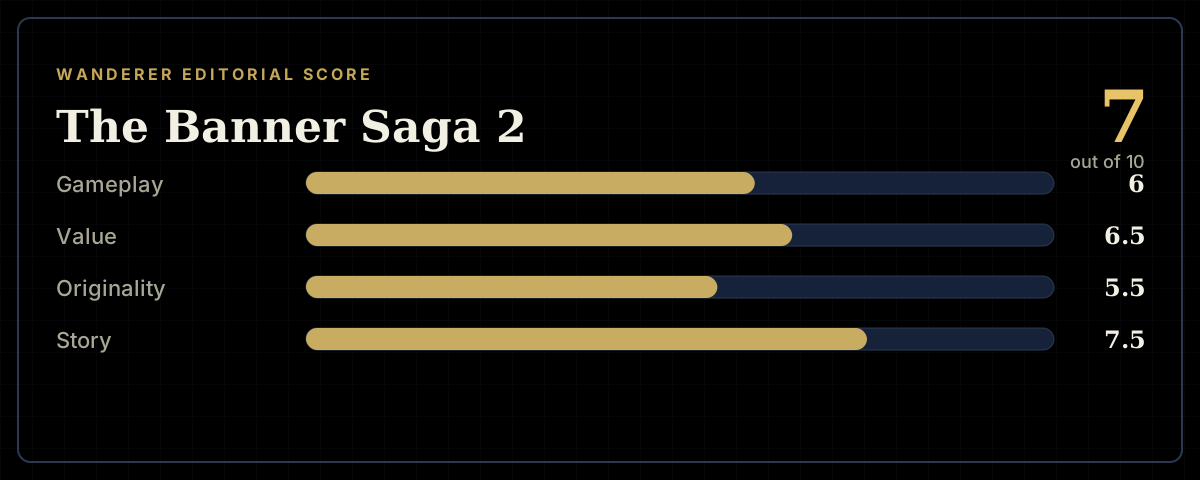
How the review scores each part of the gameWanderer Editorial -
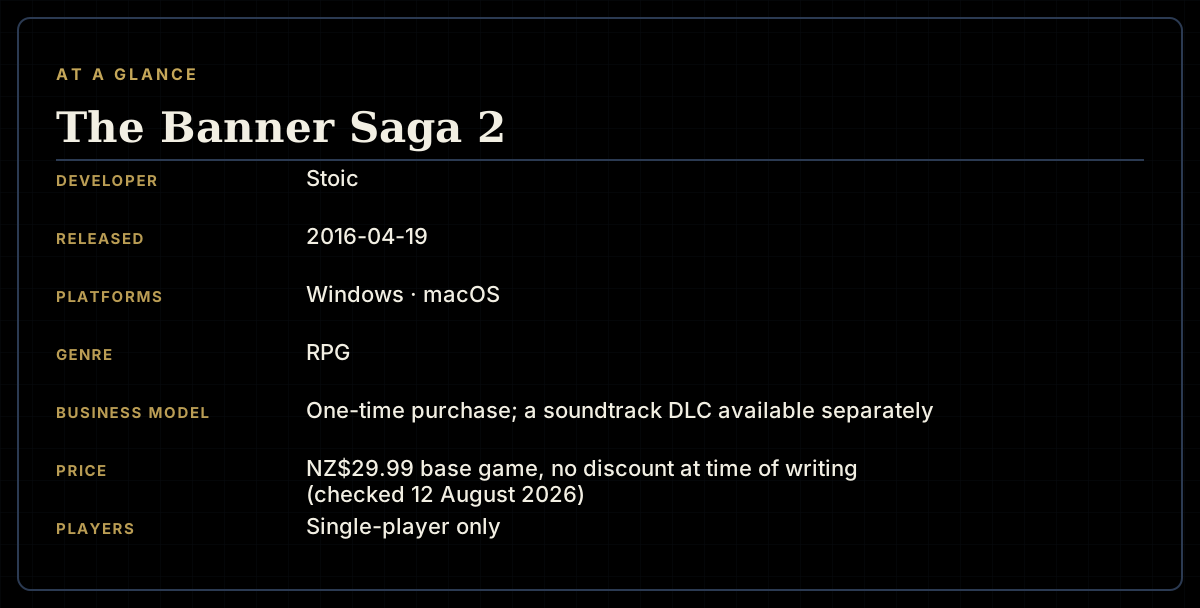
The essentials at a glanceWanderer Editorial -
The short versionWanderer Editorial