
Game review
Sweet Tea Tycoon
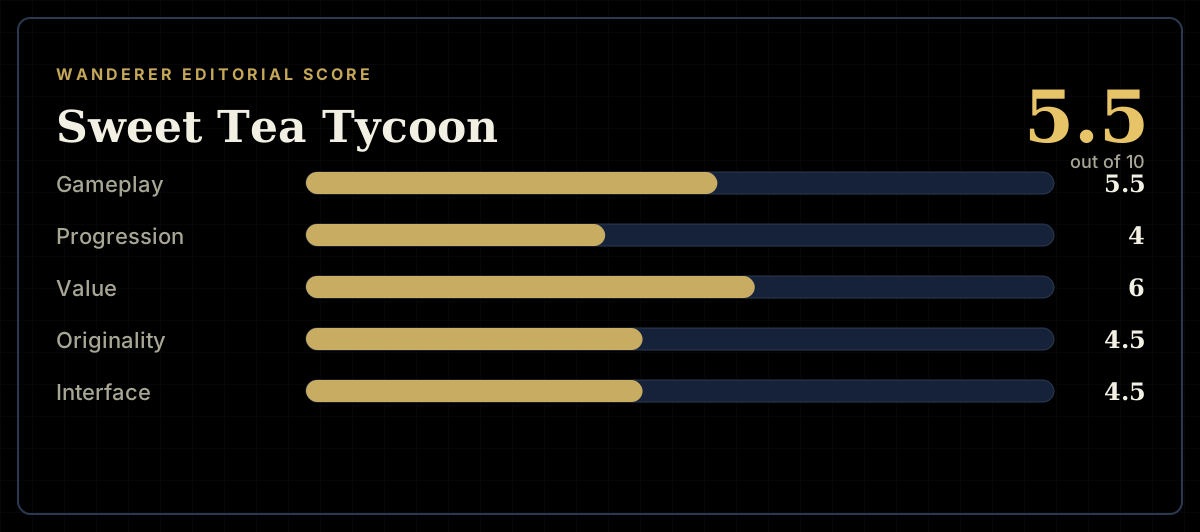
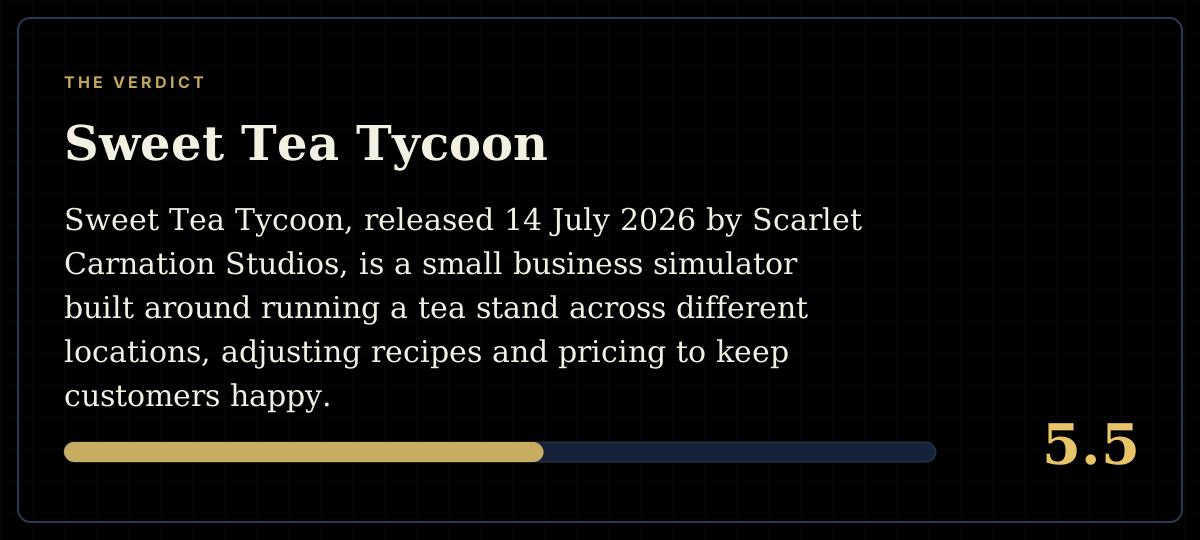
5.5 / 10
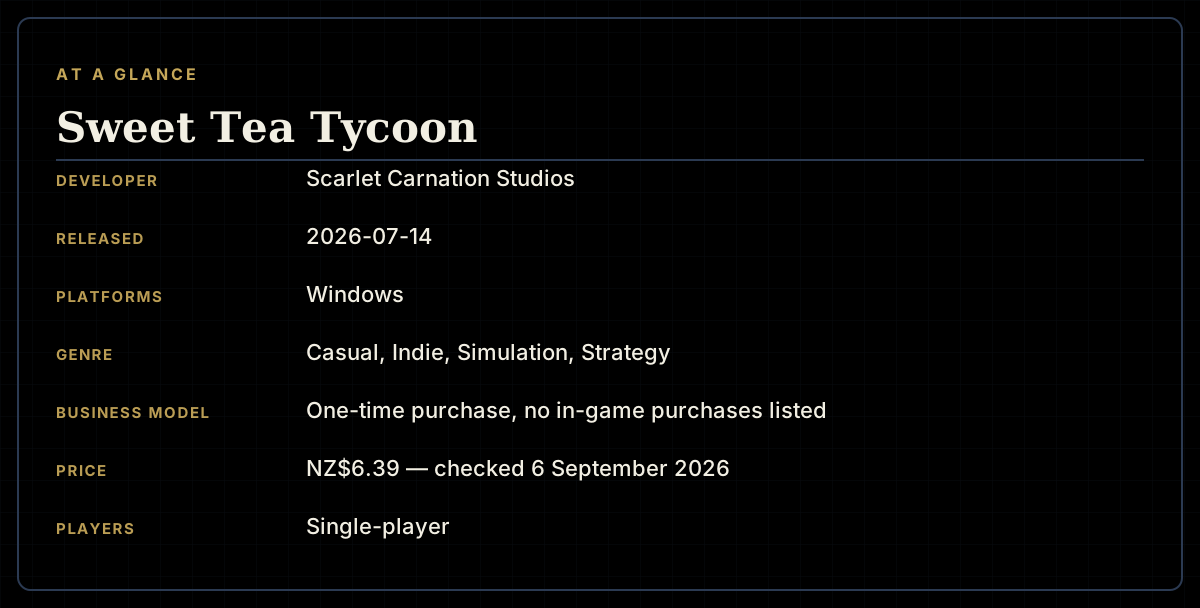
- Developer
- Scarlet Carnation Studios
- Publisher
- Scarlet Carnation Studios
- Released
- 14 July 2026
- Platforms
- Windows
- Genre
- Casual, Indie, Simulation, Strategy
- Monetisation
- One-time purchase, no in-game purchases listed
- Players
- Single-player
The short version
Sweet Tea Tycoon, released 14 July 2026 by Scarlet Carnation Studios, is a small business simulator built around running a tea stand across different locations, adjusting recipes and pricing to keep customers happy. It sits Positive with a small, entirely favourable sample of 7 reviews, and reading through all of them reveals a consistent, specific picture rather than uncritical praise: reviewers genuinely enjoy the game's nostalgic throwback to early-2000s browser tycoon titles like Lemonade Tycoon, but nearly every review independently arrives at the same practical limitation — the whole game can be completed in two to three hours, several systems including advertising and staff hiring are reported as functionally unnecessary to succeed, and more than one reviewer specifically wants more challenge and depth than what's currently on offer.
Biggest strengths
- Multiple reviewers specifically describe the game as strongly reminiscent of early-2000s browser-based tycoon games like Lemonade Tycoon, framing this nostalgia factor as the game's core appeal and specifically recommending it to fans of that era
- The very low asking price draws consistent, favourable comment, with several reviewers explicitly stating the game delivered a satisfying couple of hours for the cost even while noting they wouldn't want to pay more for what's currently on offer
- The core recipe and pricing management loop is described as cute and genuinely engaging for a short session, successfully scratching a specific nostalgic itch several reviewers named directly
Biggest weaknesses
- Every reviewer in this small sample who commented on length reports finishing the entire game in two to three hours, with more than one stating directly they wouldn't recommend paying more than the current low asking price given how little content that represents
- Multiple reviewers report the game is too easy once its systems are understood, with one detailed reviewer noting recipes barely need to vary between locations and that following general trend indicators for factors like bitterness and ice matters more than any deeper strategic decision-making
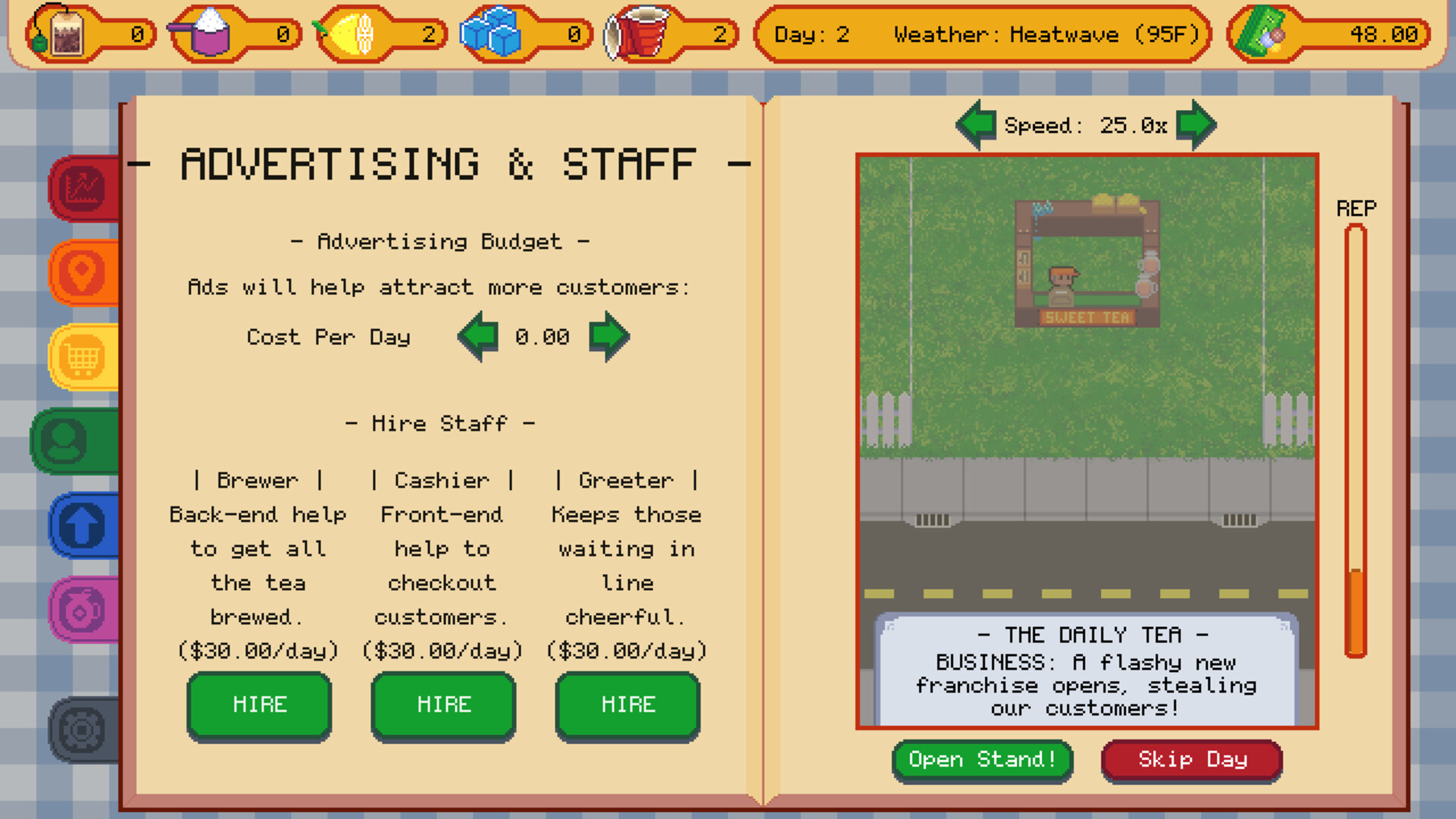
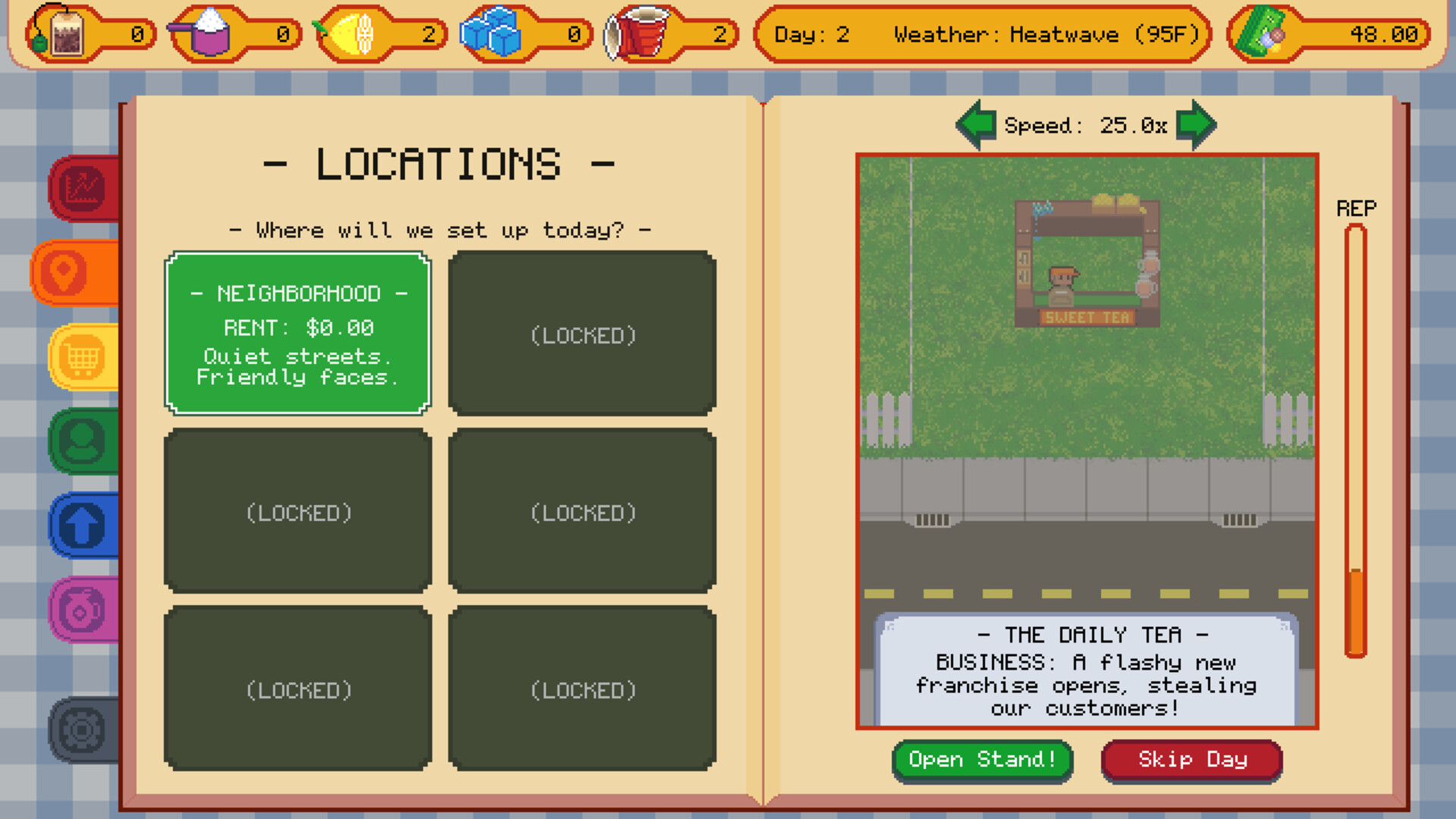
- Two specific systems — advertising and staff hiring — are reported by at least one detailed reviewer as functionally unnecessary, with a healthy business achievable in the game's most expensive location without using either system at all
Who it's for: Fans of nostalgic, low-stakes browser-tycoon throwbacks looking for a short, cheap, relaxing couple of hours rather than a deep, challenging business simulation.
Our recommendation: Worth its very low price for a short, pleasant nostalgia hit; go in expecting a brief, easy couple of hours rather than a substantial tycoon experience with real strategic depth.
5.5 / 10
Introduction
Sweet Tea Tycoon, released 14 July 2026 by Scarlet Carnation Studios, puts players in charge of a small tea stand: adjust recipes, set prices, and expand across different locations while keeping customers satisfied. It sits Positive with a small, entirely favourable sample of just 7 reviews, and reading through every single one of them reveals something more specific and useful than uncritical five-star praise: a consistent, repeated set of limitations that every reviewer independently arrives at, even while enjoying their time with the game overall.
A genuine, well-executed nostalgia hit
The clearest throughline across this small sample is nostalgia, and it's treated as a genuine strength rather than a crutch. Multiple reviewers specifically compare the game to early-2000s browser-based tycoon titles like Lemonade Tycoon, with one directly stating it recreates "the old simple days" of that era and recommending it on that basis alone. The core loop of adjusting recipes and pricing to match customer demand is described as cute and genuinely engaging for a short session, and the very low asking price draws consistent, specific praise, with several reviewers explicitly framing it as a fair trade for a couple of pleasant, relaxing hours rather than a substantial purchase.
A short, easy experience by every account
Set against that genuine praise, every reviewer in this sample who addresses length or difficulty lands on the same conclusion independently. Multiple reviewers report finishing the entire game in two to three hours, and more than one states directly they wouldn't want to pay more than the current asking price given how little content that represents. Difficulty draws its own specific, repeated complaint: one detailed reviewer notes that recipes barely need to vary between different locations, and that following general seasonal or news-driven demand trends for factors like bitterness or ice matters more than any deeper strategic decision the game asks players to make.
Systems that don't need to be used
A more specific, mechanically-minded complaint comes from a detailed reviewer who reports successfully running a healthy, profitable business in the game's most expensive location without ever using either the advertising or staff-hiring systems — two features presumably intended as meaningful strategic levers. That same reviewer separately flags unclear purchasing limits as needing rework, painting a picture of a game whose systems are present but not yet load-bearing enough to matter to a player's actual success or failure.
A specific storage bottleneck
Beyond the broader ease-and-length complaints, this review found one concrete, repeated mechanical issue: cup storage capacity. One detailed reviewer reports consistently exceeding 450 customers and running out of cups before midday despite an otherwise successful operation, framing it as the single limiting factor standing between their business and further growth. A separate reviewer echoes this more briefly, specifically asking for a storage capacity update. This reads as a small, fixable issue rather than a fundamental design problem, but it's specific and consistent enough across independent reports to be worth naming directly for anyone considering a purchase.
Reading a small, unanimous sample honestly
With only seven reviews and every one of them positive, this review is cautious about presenting too confident a picture of consensus — a sample this size can shift meaningfully with just a few more voices, and this score should be understood as a snapshot of early reception rather than a settled verdict. That caveat matters less here than it might elsewhere, though, because the specific limitations named above don't come from a lone dissenting voice buried in an otherwise uncritical sample — they're volunteered independently by reviewers who are, in every single case, still recommending the game overall. That's a genuinely different signal than a mixed sample where critics and fans are talking past each other: here, the same small group of people who enjoyed their time with Sweet Tea Tycoon are also the ones flagging, unprompted, exactly where it falls short. This review treats that kind of self-aware, specific praise as more informative than a simple thumbs-up count, even from a sample this size, and expects the broader pattern — a likeable, low-stakes nostalgia piece that doesn't yet reward repeat or extended play — to hold up as more reviews accumulate.
Where this fits in a busy micro-genre
It's worth placing Sweet Tea Tycoon briefly within the wider wave of small, nostalgic business-sim throwbacks this review has encountered across the current release year. Games explicitly chasing the Lemonade Tycoon and Game Dev Story era of simple, bite-sized management loops have become a recognisable, crowded micro-genre on Steam, and the reviewers here seem keenly aware of that context — several frame their comparisons and expectations explicitly against that older wave rather than against modern, systems-heavy tycoon games. Judged specifically against that narrower comparison set, rather than against the genre's more ambitious modern entries, Sweet Tea Tycoon's short runtime and light difficulty read less as a fundamental flaw and more as a faithful, if somewhat undercooked, continuation of exactly the format it's trying to evoke.
Final Verdict
Sweet Tea Tycoon succeeds at a narrow, specific goal: recreating the low-stakes, nostalgic feel of early-2000s browser tycoon games at a price that matches its modest scope, and every reviewer in this small sample found genuine enjoyment in that specific experience. What holds this score down is that the same reviewers who enjoyed it consistently and independently identify the same limitations — a two-to-three-hour runtime, systems like advertising and staff that don't need to be used to succeed, and a specific cup-storage bottleneck at higher customer volumes. Worth its very low price for a short, pleasant nostalgia hit; don't expect meaningful challenge or depth once you've learned its systems, which by every account here doesn't take long at all.
Pros and cons
Pros
- Multiple reviewers specifically describe the game as strongly reminiscent of early-2000s browser-based tycoon games like Lemonade Tycoon, framing this nostalgia factor as the game's core appeal and specifically recommending it to fans of that era
- The very low asking price draws consistent, favourable comment, with several reviewers explicitly stating the game delivered a satisfying couple of hours for the cost even while noting they wouldn't want to pay more for what's currently on offer
- The core recipe and pricing management loop is described as cute and genuinely engaging for a short session, successfully scratching a specific nostalgic itch several reviewers named directly
- At least one reviewer expresses direct interest in paying for additional locations or DLC content if the developer chooses to expand the game further, suggesting real underlying goodwill toward the core concept
Cons
- Every reviewer in this small sample who commented on length reports finishing the entire game in two to three hours, with more than one stating directly they wouldn't recommend paying more than the current low asking price given how little content that represents
- Multiple reviewers report the game is too easy once its systems are understood, with one detailed reviewer noting recipes barely need to vary between locations and that following general trend indicators for factors like bitterness and ice matters more than any deeper strategic decision-making
- Two specific systems — advertising and staff hiring — are reported by at least one detailed reviewer as functionally unnecessary, with a healthy business achievable in the game's most expensive location without using either system at all
- A specific capacity limitation draws repeated comment: cup storage is reported as too small to keep pace with higher customer volumes, with one reviewer describing consistently running out of cups before midday despite otherwise successful operations
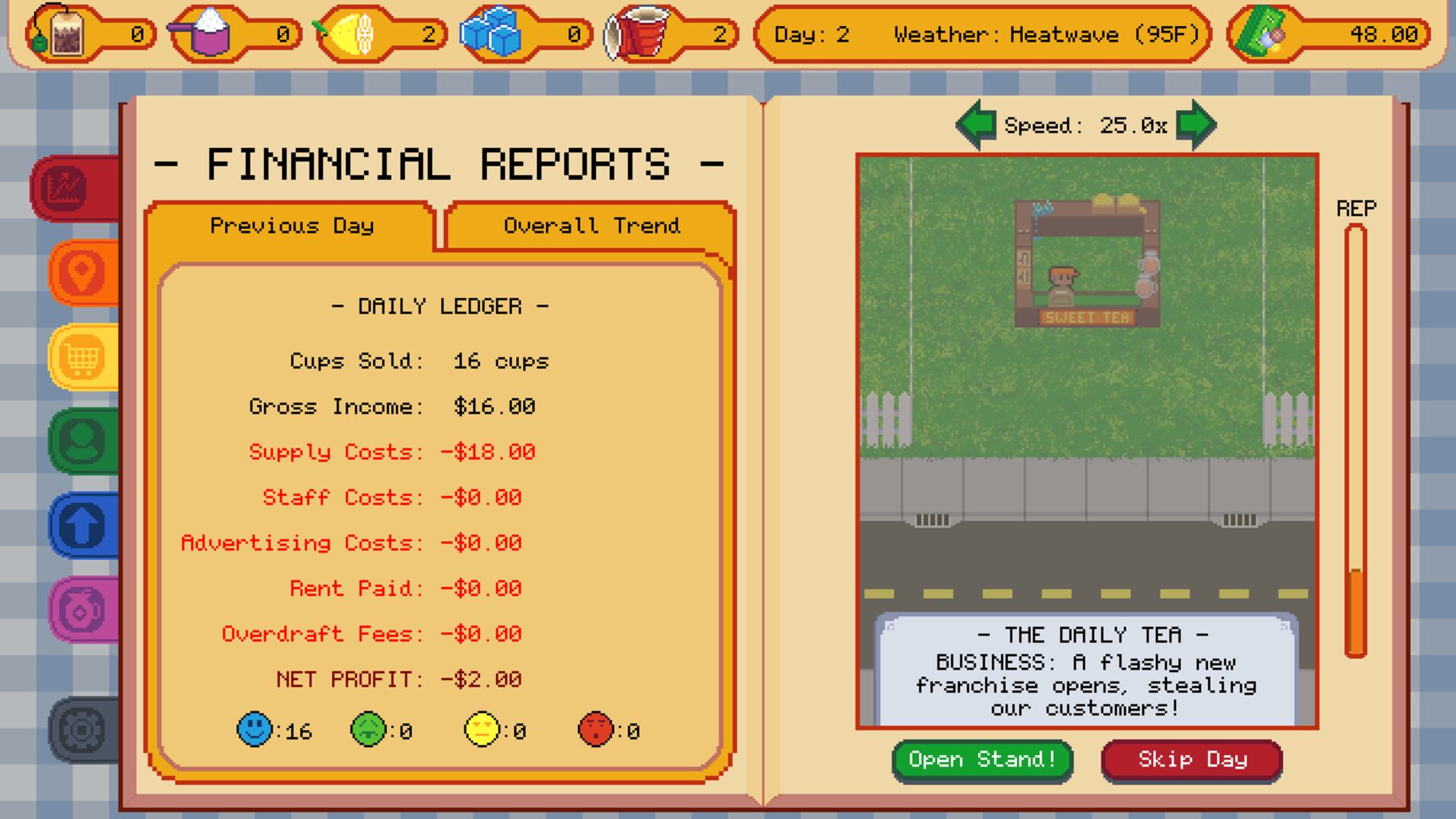
- At least one reviewer notes the game doesn't explain why a customer was dissatisfied with a given order, leaving players to guess at adjustments rather than responding to clear, specific feedback
Screenshots
-
Sweet Tea TycoonImage: Scarlet Carnation Studios via Steam -
Sweet Tea TycoonImage: Scarlet Carnation Studios via Steam -
Sweet Tea TycoonImage: Scarlet Carnation Studios via Steam -
How the review scores each part of the gameWanderer Editorial -
The essentials at a glanceWanderer Editorial -
The short versionWanderer Editorial