Game review
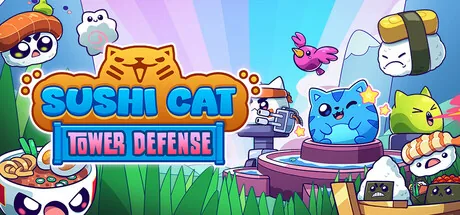
Sushi Cat - Tower Defense
6.5 / 10
- Developer
- OverPowered Team
- Publisher
- Armor Games Studios
- Released
- 5 March 2026
- Platforms
- Windows
- Genre
- Indie / Strategy
- Monetisation
- One-time purchase
- Players
- Single-player
The short version
Sushi Cat - Tower Defense revives Armor Games' long-dormant flash-game mascot, absent from a mainline release since 2015, as a maze-building roguelite tower defense, developed by OverPowered Team and published by Armor Games Studios, released 5 March 2026 at $9.99. Its 53-review, Very Positive sample praises a genuinely satisfying path-building hook and an unusually responsive launch-week patch cadence, while converging hard on real performance crashes at high wave counts and a midgame several reviewers describe as one strategy repeated endlessly.
Biggest strengths
- This review's sample repeatedly praises the core maze-building hook, with one detailed review calling out the ability to 'change the path the enemies take to create mazes, link paths and create all kinds of funnels,' and towers that get more expensive as you place them, actively encouraging build variety rather than one dominant strategy
- This review checked the developer's partner-events feed and found a genuinely fast, responsive post-launch cadence, a 'Concerning Difficulty' post one day after launch followed by 'New Difficulties Added!' six days later and a combined 'Difficulty, Performance and More' patch a week after that, directly matching multiple reviewers who specifically credit the developer for acting on feedback
- This review's sample includes strong, specific nostalgia for the Sushi Cat brand itself, with one reviewer noting this is 'the first game in 11 years since Sushi Cat-a-Pult in 2015' and expressing genuine surprise and delight that Armor Games revived the character at all
Biggest weaknesses
- This review's sample includes multiple, independently reported performance and stability bugs serious enough to read as a real technical problem, including a report that a game crash can permanently corrupt saved progress and require a full reset, plus repeated freezing and crashing once wave counts climb past 70 on otherwise capable hardware
- This review's sample includes a specific, structural complaint that despite being framed as a roguelike strategy game, the optimal approach converges on 'literally one strategy: you make a long path out of towers,' with one detailed reviewer calling the resulting play 'mindless' once the trick is learned, even while continuing to enjoy it out of nostalgia
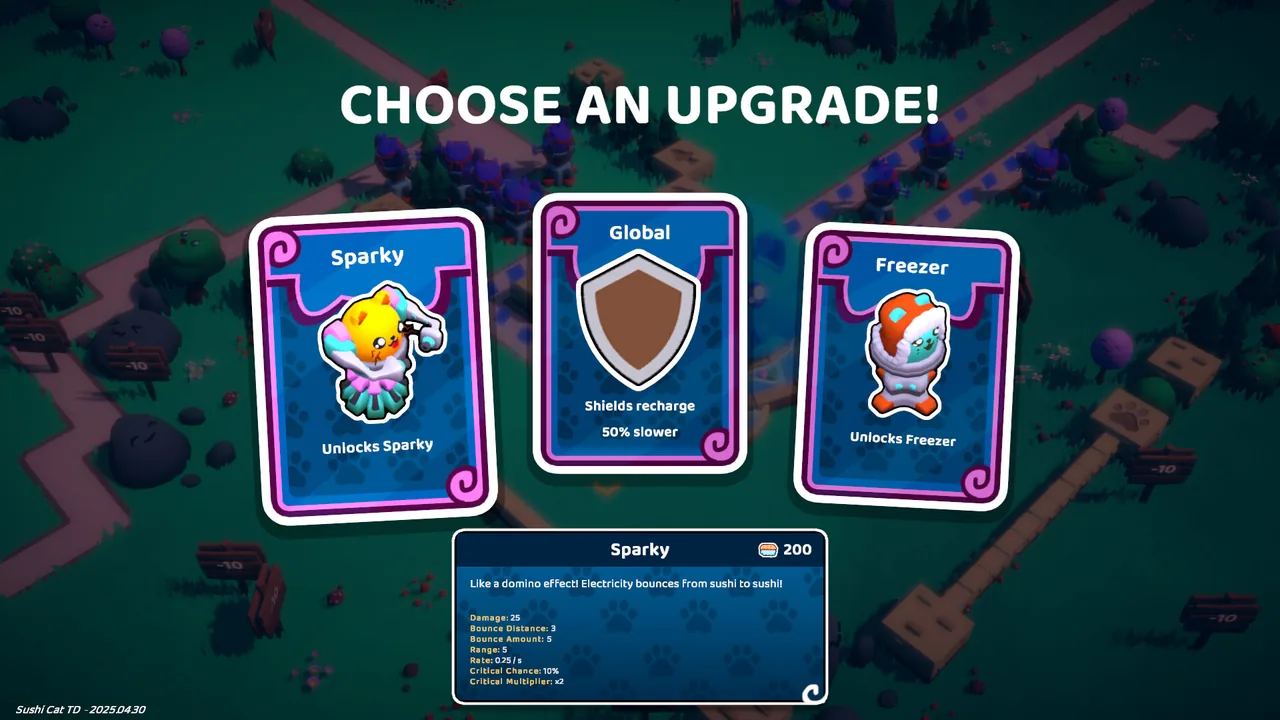
- This review's sample includes a detailed, specific UI complaint listing several standard tower-defense features the game lacks at launch, including no way to see which roguelike upgrades you've already selected mid-run and no way to click an enemy to check its health or active status effects
Who it's for: Tower defense fans who enjoy maze-building genre entries like Bloons TD, plus anyone with nostalgia for the original Sushi Cat flash games; a weaker fit for anyone on lower-end hardware, since this review's sample repeatedly reports freezes and crashes once wave counts climb past 70.
Our recommendation: A solid pickup for maze-building tower defense fans on capable hardware, best bought on sale given a single-map structure several reviewers feel doesn't yet justify full price.
6.5 / 10
Sushi Cat - Tower Defense pulls Armor Games' long-dormant flash-game mascot out of retirement, casting the beefy titular cat and his tower-building crew against waves of rogue sushi and the villainous Brocolini, in a maze-building roguelite tower defense. It's developed by OverPowered Team and published by Armor Games Studios, released 5 March 2026 at $9.99. This review draws on all 53 reviews in the game's full all-language total, spanning ten languages, alongside its global achievement data and the developer's post-launch patch history.
A maze-building hook this sample keeps coming back to
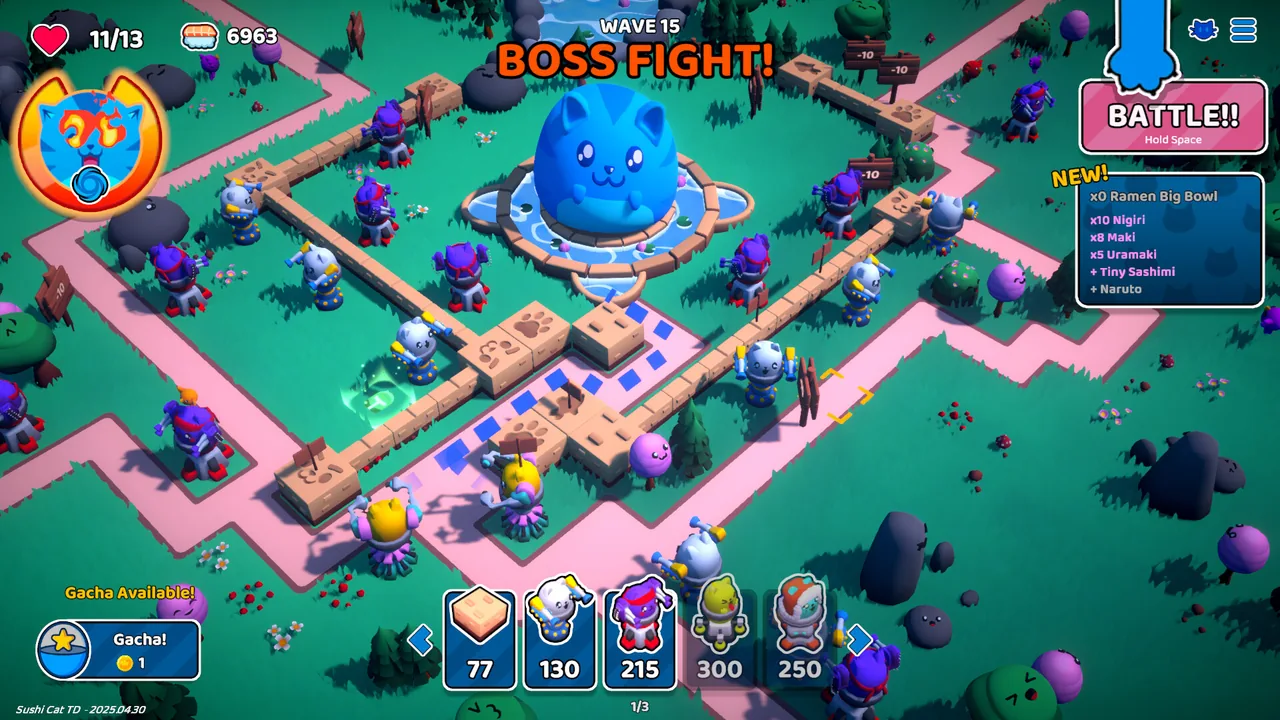
The strongest, most consistently praised mechanic in this sample is the freedom to physically reroute enemy paths. One detailed review highlights the ability to "change the path the enemies take to create mazes, link paths and create all kinds of funnels," while another notes that towers get progressively more expensive as you place more of the same type, a deliberate design choice meant to push players toward varied builds rather than one dominant setup. Several reviewers explicitly compare it favorably to genre touchstones like Bloons Tower Defense and the older GemCraft series specifically for this reason.
A brand revival that landed emotionally with longtime fans
Beyond the mechanics, this sample includes real, specific nostalgia for the Sushi Cat name itself. One reviewer notes this is "the first game in 11 years since Sushi Cat-a-Pult in 2015," expressing genuine surprise that Armor Games revived the character at all, while another calls it "a delight" purely on the strength of childhood affection for the earlier flash games. That emotional throughline recurs often enough across otherwise unrelated reviews to count as a real driver of this sample's goodwill, separate from the tower-defense mechanics on their own merits.
"Literally one strategy": a repeated structural complaint
Set against that praise, several reviewers land on the same specific criticism of the moment-to-moment gameplay. One writes that despite being framed as a roguelike strategy game, it plays out as "literally one strategy: you make a long path out of towers," calling the resulting loop "mindless" once the trick is learned, though they note they'll likely keep playing anyway out of nostalgia. A separate detailed review agrees the difficulty curve is steep early but "relatively easy" once mastered, with flying enemy units remaining the one genuine ongoing challenge past that point.
Real crashes and a save-corruption report severe enough to flag directly
This sample includes a cluster of independently reported technical problems too specific and too consistent to dismiss as isolated bad luck. Multiple reviewers report freezing or crashing once wave counts climb past 70, even on capable, modern hardware, with one asking whether "newer hardware struggles on old things." More seriously, one reviewer reports that a crash can permanently corrupt saved progress, requiring "a full reset" to fix, and states plainly not to buy the game until that's addressed. A separate Russian-language review adds that low-end devices can hit a specific soft-lock on the roguelike upgrade-selection screen.
A UI several reviewers call underbaked for a modern release
One of the most detailed reviews in this sample lists a specific set of missing standard features: no way to see which roguelike upgrades you've already selected mid-run, no way to click an enemy to check its current health, resistances, or active status effects, and unclear or undocumented caps on stacking certain buffs. None of these are individually severe, but the reviewer frames the pattern as "basic things that shouldn't be going on in a modern game," a fair characterization given how standard these features are elsewhere in the genre.
A developer visibly reacting to launch-week feedback in real time
This review checked the developer's partner-events feed and found a striking, fast-moving pattern that lines up directly with this sample's own complaints. A "Concerning Difficulty" post went up one day after launch, followed six days later by "New Difficulties Added!" adding Easy and Nightmare modes, and a combined "Difficulty, Performance and More" patch a week after that. One Korean-language reviewer specifically credits the developer for posting update notes explaining how the game is meant to be played, and a separate English-language review notes trying a new difficulty specifically "per the developer's request." This is a genuinely responsive launch cycle, even if the underlying performance issues clearly weren't fully resolved by review time.
One map, a limit this sample raises unprompted and often
The most concrete content limitation in this sample is structural rather than a bug: the game currently ships with a single playable map. One reviewer states there is "not a lot of replayability due to there being just a single level," and a Spanish-language review, while positive overall, specifically asks for more maps and turret types "down the line." This complaint recurs across reviewers who otherwise land firmly on the positive side, making it a genuine, shared limitation rather than a minority gripe.
What the achievement data confirms about the difficulty curve
This review checked the global achievement data directly. The game's four tracked boss-fight achievements decline gently, 46.1% down to 32.2%, meaning most players who commit past the early game do see a full run through to the final boss, consistent with this sample's "hard at first, easy once mastered" framing. The Hard and Very Hard difficulty achievements, by contrast, sit at just 8.8% and 3.8%, confirming that the meaningful, lasting challenge in this game lives specifically in its higher difficulty tiers rather than the base experience.
Verdict
Sushi Cat - Tower Defense earns its Very Positive reception on the strength of a genuinely satisfying maze-building hook and a developer that reacted to launch-week feedback about as fast as this lane has seen. What holds it back from a stronger recommendation is a real, unresolved set of performance problems at high wave counts, a single map that limits its long-term legs, and a core strategy several reviewers describe converging on one repeatable trick. It's a fun, well-supported spin-off of a beloved mascot that would benefit from a few more months of polish and content before it's an easy full-price buy.
Pros and cons
Pros
- This review's sample repeatedly praises the core maze-building hook, with one detailed review calling out the ability to 'change the path the enemies take to create mazes, link paths and create all kinds of funnels,' and towers that get more expensive as you place them, actively encouraging build variety rather than one dominant strategy
- This review checked the developer's partner-events feed and found a genuinely fast, responsive post-launch cadence, a 'Concerning Difficulty' post one day after launch followed by 'New Difficulties Added!' six days later and a combined 'Difficulty, Performance and More' patch a week after that, directly matching multiple reviewers who specifically credit the developer for acting on feedback
- This review's sample includes strong, specific nostalgia for the Sushi Cat brand itself, with one reviewer noting this is 'the first game in 11 years since Sushi Cat-a-Pult in 2015' and expressing genuine surprise and delight that Armor Games revived the character at all
- This review checked the global achievement data and found a comparatively gentle decline across the game's four tracked boss fights, 46.1% down to 32.2%, indicating that most players who commit past the early game do see a full run through to its final boss
Cons
- This review's sample includes multiple, independently reported performance and stability bugs serious enough to read as a real technical problem, including a report that a game crash can permanently corrupt saved progress and require a full reset, plus repeated freezing and crashing once wave counts climb past 70 on otherwise capable hardware
- This review's sample includes a specific, structural complaint that despite being framed as a roguelike strategy game, the optimal approach converges on 'literally one strategy: you make a long path out of towers,' with one detailed reviewer calling the resulting play 'mindless' once the trick is learned, even while continuing to enjoy it out of nostalgia
- This review's sample includes a detailed, specific UI complaint listing several standard tower-defense features the game lacks at launch, including no way to see which roguelike upgrades you've already selected mid-run and no way to click an enemy to check its health or active status effects
- This review's sample repeatedly flags the game's single map as the most concrete limit on its content, with one reviewer stating plainly there is 'not a lot of replayability due to there being just a single level,' a complaint several otherwise-positive reviewers raise unprompted
Screenshots
-
Sushi Cat - Tower DefenseImage: Armor Games Studios via Steam -
Sushi Cat - Tower DefenseImage: Armor Games Studios via Steam -
Sushi Cat - Tower DefenseImage: Armor Games Studios via Steam