
Game review
Suicide Squad: Kill the Justice League
4 / 10
- Developer
- Rocksteady Studios
- Publisher
- Warner Bros. Games
- Released
- 2 February 2024
- Platforms
- Windows, PlayStation 5, Xbox Series X|S
- Genre
- Action Shooter
- Monetisation
- One-time purchase, with a seasonal battle pass and paid cosmetics
- Players
- Online co-op (also playable solo), offline mode added in Season 4
The short version
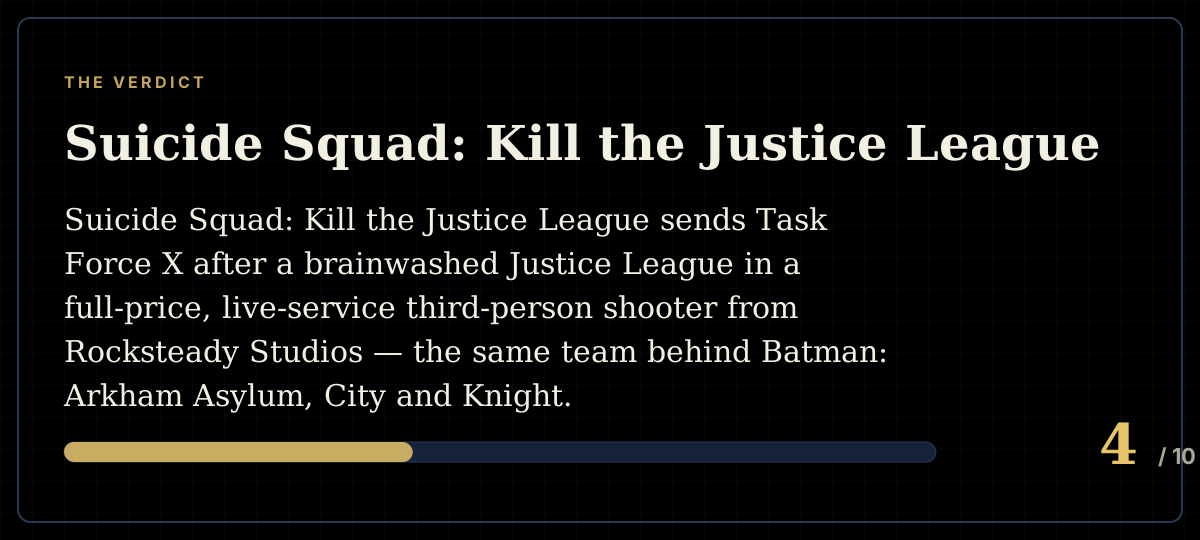
Suicide Squad: Kill the Justice League sends Task Force X after a brainwashed Justice League in a full-price, live-service third-person shooter from Rocksteady Studios — the same team behind Batman: Arkham Asylum, City and Knight. The gap between how critics and players received it is one of the starkest this library has recorded: 60 on Metacritic from critics, against a user score of just 3.8 out of 10. Warner Bros. withheld review codes until after servers went live, a deliberate choice widely reported at the time and one that meant no outlet could publish a review before players themselves started posting theirs. Steam's own review page saw some of the highest vote counts this library has ever recorded — a single review sits at nearly 6,000 votes — and a genuinely widespread, though ultimately unconfirmed, allegation that negative reviews were being removed to inflate the visible score. The game's own subsequent history settled the argument about its commercial reception regardless of any score dispute: live content support ended with Season 4 in January 2025, eleven months after launch, and it now regularly appears on sale at 95% off.
Biggest strengths
- Core movement and traversal mechanics — flight, grappling and fast aerial combat — are credited by multiple reviewers as genuinely fun in short bursts, carrying over some of the kinetic feel Rocksteady built its reputation on
- Character writing and voice performances for the core Suicide Squad cast draw some specific praise even from otherwise critical reviews
- Visual presentation and cutscene production values are generally well-regarded, reflecting a genuinely large budget behind the production
Biggest weaknesses
- The gap between critic reception (60 Metacritic) and player reception (3.8 user score) is one of the starkest this library has recorded, and Warner Bros.' decision to withhold review codes until after servers went live meant no independent critical assessment existed before players had already begun posting their own
- A widespread, though ultimately unconfirmed and disputed, allegation across the game's review page claims negative reviews were being removed to inflate the visible positive percentage, a serious claim that never received a clear resolution
- The gameplay loop is repeatedly described as repetitive — go to a location, complete an escort/kill/protect objective, watch a cutscene, repeat with minor modifiers — a structure multiple reviewers say wears thin within the first several hours
Who it's for: Fans specifically curious about the combat feel — several reviewers do credit the movement and shooting as genuinely fun in isolation — may find something worth a heavily discounted purchase. Anyone hoping for a story-driven experience with the tone and craft of Rocksteady's Arkham games, or anyone considering paying full price for ongoing live-service content, should read the detailed reviews below; the game's own eleven-month content lifespan already answered whether that investment paid off for the people who made it.
Our recommendation: Not recommended at anything close to full price. If the combat specifically appeals to you after watching gameplay footage, it's arguably worth a look at the 95% discount it now regularly reaches — anything beyond that asks you to pay full live-service price for a service that stopped receiving new content less than a year after launch.
4 / 10
A beloved studio's follow-up to one of gaming's most respected trilogies
Rocksteady Studios built one of the most trusted reputations in the industry with the Batman: Arkham trilogy — Asylum, City and Knight are still regularly cited among the best superhero games ever made, praised for atmosphere, combat feel and genuine respect for their source material. Suicide Squad: Kill the Justice League was the studio's long-awaited follow-up, first announced at DC FanDome in 2020, and the gap between that pedigree and how the game actually landed is central to why its reception became one of 2024's defining gaming stories. One detailed review captures the specific heartbreak directly: a player with more than 1,300 hours across the Arkham trilogy writing that they "have a hard time believing this game is made by the same Rocksteady."
A critical and commercial gap too wide to ignore
The numbers alone tell an unusual story. Critics landed the game at 60 on Metacritic — mediocre, but not catastrophic. Players rated it 3.8 out of 10 on the same site, a genuinely severe score that reflects far more than ordinary disappointment. Part of that gap traces to a specific, widely reported decision: Warner Bros. withheld review codes from outlets until after the game's servers went live, meaning no independent critical assessment existed in the world before players themselves started posting their own reactions — a choice reported at the time as a deliberate attempt to control the initial narrative, whatever the game's actual quality turned out to be.
What followed was a genuinely widespread, though never conclusively resolved, controversy over the review numbers themselves. Multiple top-voted Steam reviews, several with vote counts in the thousands, allege that negative reviews were being actively removed to inflate the visible positive percentage — one citing a specific 84% figure they call impossible to square with the game's own visibly declining player counts. Steam's own systems make mass review deletion at that scale a technically disputed claim, and no independent investigation conclusively confirmed it either way. What isn't in dispute is how loudly and specifically players were making the accusation, in numbers large enough that Steam's review page for this game carries some of the highest individual vote counts this library has recorded anywhere — a single review sits at just under 6,000 votes, another close behind it.
What the game actually asks you to do
Set the numbers dispute aside, and the specific gameplay complaints are consistent and concrete. The core loop — travel to a location, complete an escort, kill, protect or destroy objective, sit through a cutscene, repeat with the occasional modifier — is described by reviewer after reviewer as wearing thin well before the campaign's midpoint, a structure that reads as a generic live-service shooter template applied to characters and a studio capable of much more. Boss encounters draw particularly sharp criticism, with multiple reviews calling major fights against Justice League members disappointing rather than the dramatic confrontations the premise promises. Movement and traversal are the one area where genuine praise survives consistently — flying and grappling across Metropolis has real kinetic appeal, several reviewers say, even as they criticise almost everything built around it.
Monetisation compounded the frustration for a full-price release. A seasonal battle pass and separately sold cosmetics sitting inside a NZ$119.95 game struck many reviewers as a mismatch on principle, live-service monetisation layered onto a purchase price that already matched or exceeded most premium single-player releases. The game's own subsequent history settled that argument in practice rather than just opinion: live content support concluded with Season 4 in January 2025, eleven months after launch — a strikingly short run for a game built around ongoing seasonal content — and Suicide Squad now regularly appears on storefronts at a 95% discount, a concrete, verifiable marker of how the commercial bet actually played out.
A concession that arrived after the argument was already lost
Season 4's offline mode deserves acknowledgment on its own terms, since it's a genuine, concrete response to one of the launch's specific complaints — the always-online requirement that made the game unplayable during connectivity issues or server maintenance, a real point of friction for players who'd expected a substantially single-player-capable experience given the source material and the studio's history. Letting the full campaign and seasonal content run offline is exactly the kind of change a live-service game should make when a persistent-connection requirement stops making practical sense. The timing undercuts how much credit it can reasonably claim, though: it arrived in the same season announced as the game's last, meaning the fix for one of the launch's loudest complaints doubled as an admission that ongoing live support wasn't continuing regardless. It's a genuinely useful change for anyone picking the game up today, but it reads less like course-correction than like a studio converting a dying live-service game into the offline experience it perhaps should have been from the start.
Verdict
Suicide Squad: Kill the Justice League is, by nearly every available measure, one of 2024's most significant disappointments — not simply a mediocre game, but a specific, well-documented collapse of trust between a beloved studio and the audience that followed it here from the Arkham trilogy. The movement and combat retain flashes of what made Rocksteady's reputation, but the repetitive structure, tonally mismatched writing, aggressive full-price monetisation and a critic-versus-player reception gap serious enough to fuel unresolved manipulation allegations all point the same direction. The game's own eleven-month content lifespan and current 95% discount have already delivered the verdict the review scores argued about at launch. Approach it, if at all, purely for the movement feel at a steep discount, and treat any full-price purchase as a bet against evidence the market itself has already settled.
Pros and cons
Pros
- Core movement and traversal mechanics — flight, grappling and fast aerial combat — are credited by multiple reviewers as genuinely fun in short bursts, carrying over some of the kinetic feel Rocksteady built its reputation on
- Character writing and voice performances for the core Suicide Squad cast draw some specific praise even from otherwise critical reviews
- Visual presentation and cutscene production values are generally well-regarded, reflecting a genuinely large budget behind the production
- An offline mode, added in Season 4, lets the full story campaign and seasonal content be played without an internet connection, addressing at least one persistent complaint about the always-online requirement
- Co-op with friends softens some of the repetition complaints for players willing to treat it as a background game to play alongside other things
Cons
- The gap between critic reception (60 Metacritic) and player reception (3.8 user score) is one of the starkest this library has recorded, and Warner Bros.' decision to withhold review codes until after servers went live meant no independent critical assessment existed before players had already begun posting their own
- A widespread, though ultimately unconfirmed and disputed, allegation across the game's review page claims negative reviews were being removed to inflate the visible positive percentage, a serious claim that never received a clear resolution
- The gameplay loop is repeatedly described as repetitive — go to a location, complete an escort/kill/protect objective, watch a cutscene, repeat with minor modifiers — a structure multiple reviewers say wears thin within the first several hours
- Story and writing are described as tonally disrespectful to the source material by several longtime Batman: Arkham fans, a particularly painful contrast for players who specifically came in trusting Rocksteady's track record with these characters
- A full-price game built around a battle pass and separately sold cosmetics drew consistent monetisation criticism, and the game's own history settled the argument about value regardless: live content ended after Season 4 in January 2025, and it now regularly sells at a 95% discount less than two years after launch
Screenshots
-

Suicide Squad: Kill the Justice LeagueImage: Warner Bros. Games via Steam -

Suicide Squad: Kill the Justice LeagueImage: Warner Bros. Games via Steam -

Suicide Squad: Kill the Justice LeagueImage: Warner Bros. Games via Steam -
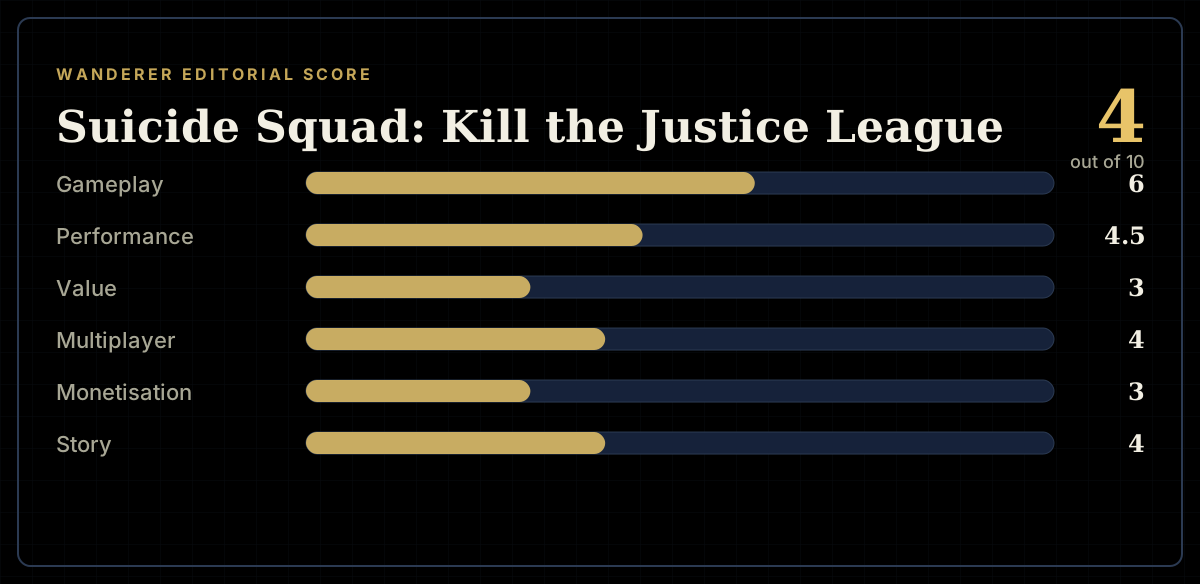
How the review scores each part of the gameWanderer Editorial -
The short versionWanderer Editorial