
Game review
Simultree
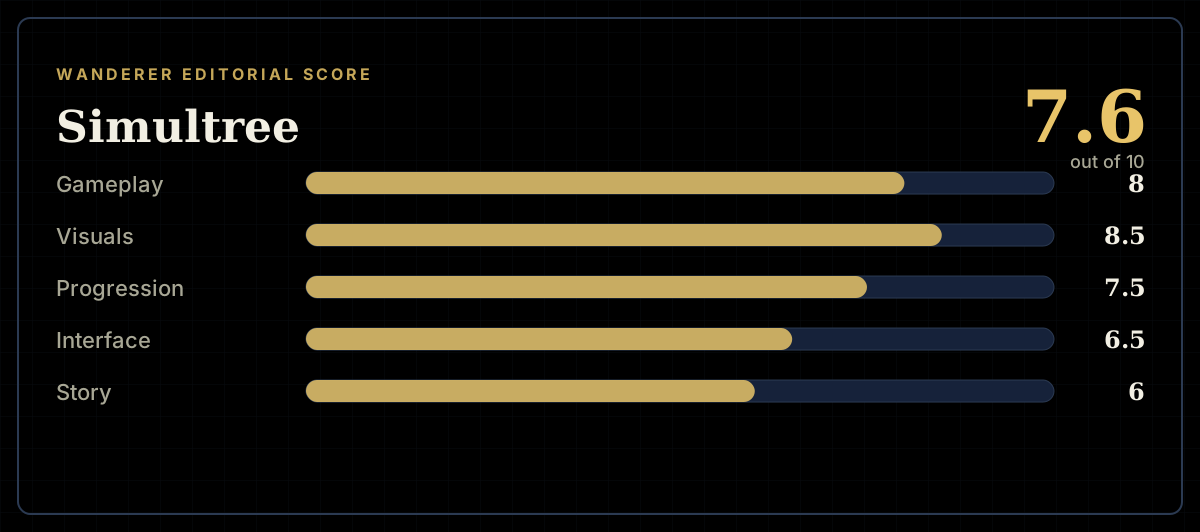
7.6 / 10
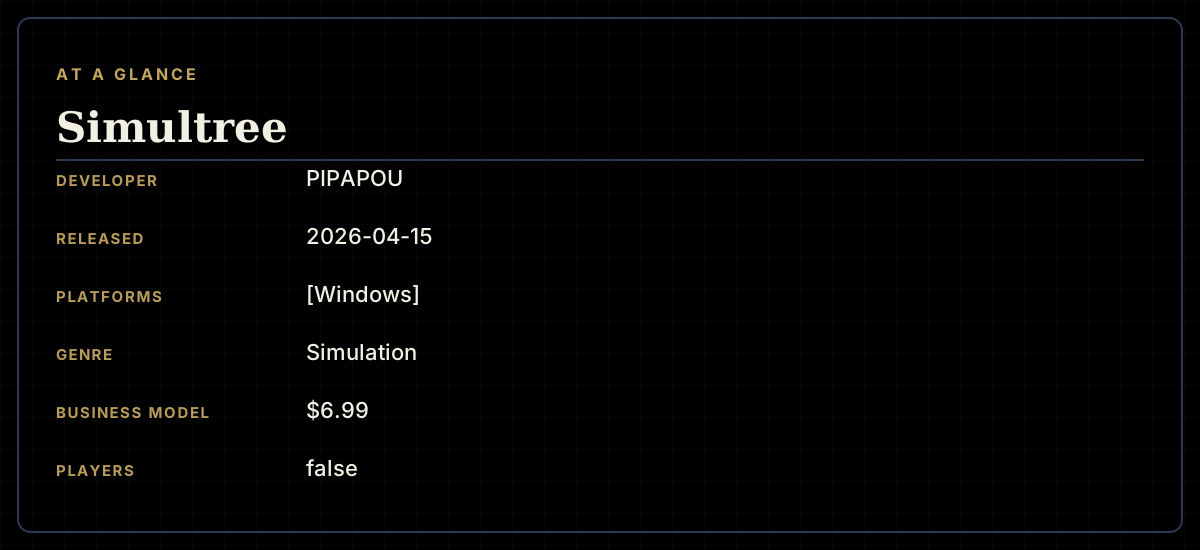
- Developer
- PIPAPOU
- Publisher
- Coduck Studio
- Released
- 15 April 2026
- Platforms
- [Windows]
- Genre
- Simulation
- Monetisation
- $6.99
- Players
- false
The short version
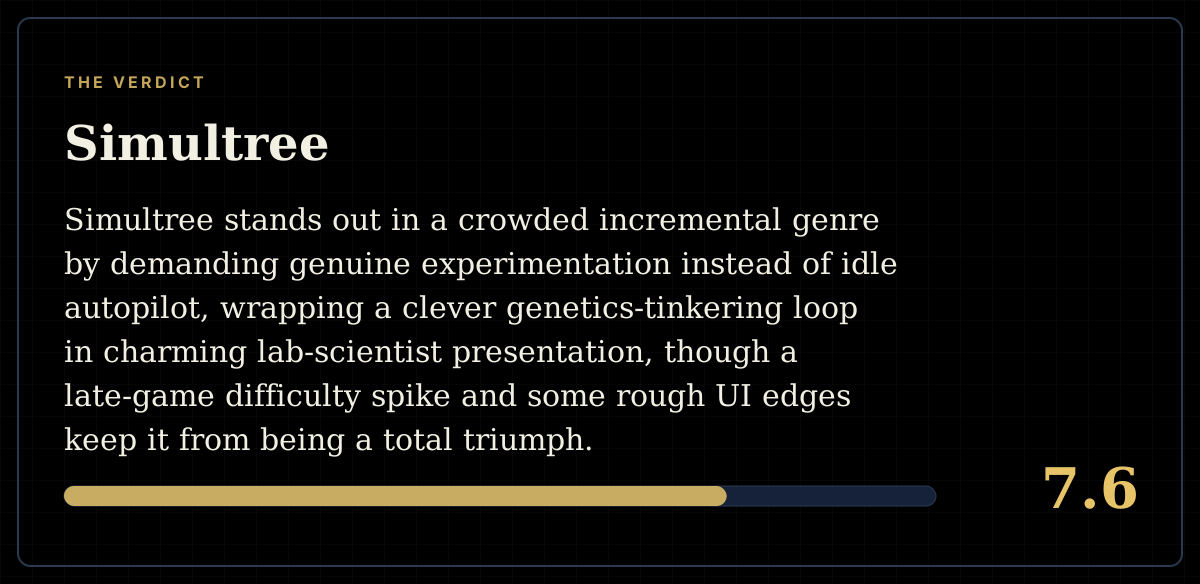
Simultree stands out in a crowded incremental genre by demanding genuine experimentation instead of idle autopilot, wrapping a clever genetics-tinkering loop in charming lab-scientist presentation, though a late-game difficulty spike and some rough UI edges keep it from being a total triumph.
Biggest strengths
- A genuinely strategic incremental loop that requires actively tuning genetic traits and simulation settings rather than passively watching numbers climb, a rarity reviewers say sets it apart from most of the genre
- Charming, tactile presentation built around a first-person scientist's hand, magnifying glass, and lab equipment, with sound design and small interactive flourishes reviewers repeatedly single out as memorable
- A tight roughly three-hour runtime to full completion that most reviewers treat as appropriately sized rather than padded, with an endless mode afterward for players who want more
Biggest weaknesses
- A notable difficulty and clarity spike around the fourth experiment tier, where several reviewers report getting stuck without clear guidance on which traits to use
- Camera and cursor navigation that a handful of reviewers describe as awkward, including UI elements getting obscured by the in-game hand and poor behavior on ultrawide monitors
- The cursor hijacking system-wide while the game runs in the background, preventing players from tabbing out during idle simulation stretches, according to one detailed complaint
Who it's for: Fans of short, thoughtful incremental games who want an actual puzzle to solve rather than a game that plays itself, and who don't mind a roughly three-hour runtime.
Our recommendation: Buy it
7.6 / 10
For science, sort of
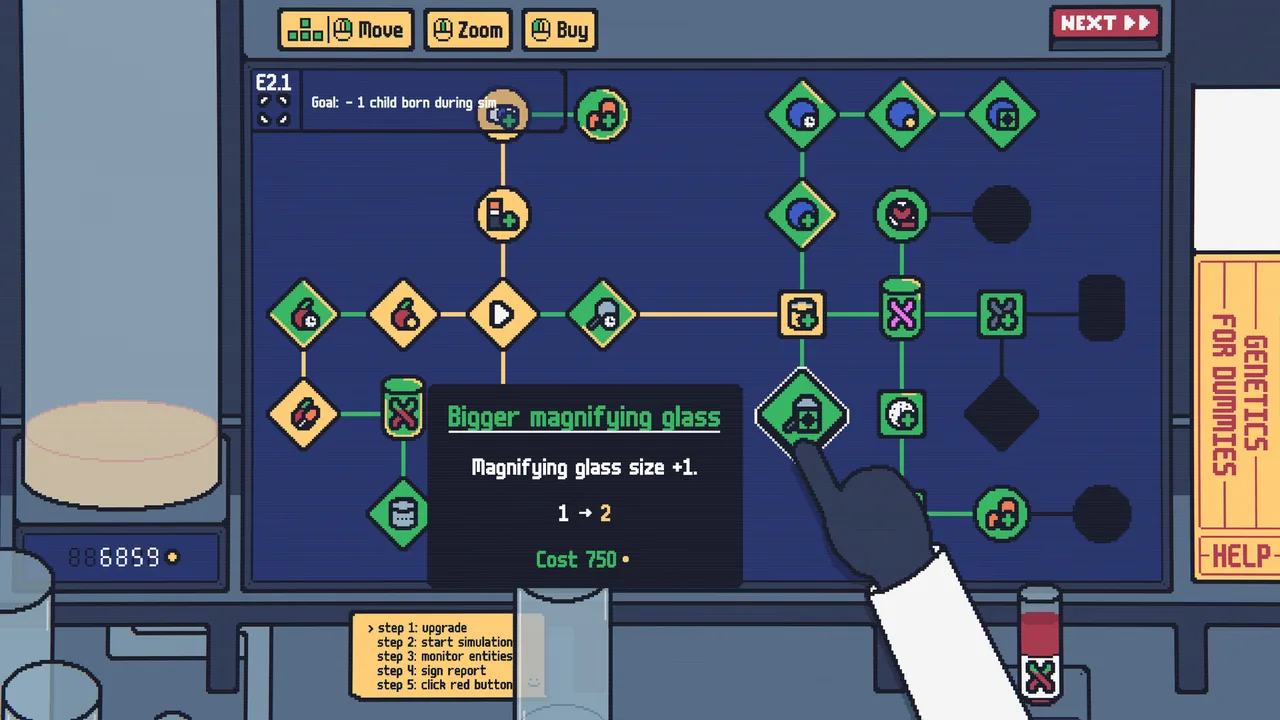
Simultree, released April 15, 2026 by developer PIPAPOU and publisher Coduck Studio, casts you as a scientist monitoring life simulations, tiny Pac-Man-shaped organisms that earn you points by eating fruit before they inevitably starve. Those points fund a skill tree of genetic traits, tools, and upgrades that reshape how future simulations play out. It's a short incremental game, most reviewers finish everything in around three hours, but it launched to a Very Positive reception, 145 reviews, roughly 87%, largely on the strength of a loop that asks more of the player than the genre usually does.
Thinking, not just clicking
The single most common praise across the review sample is that Simultree actually requires strategy rather than the passive number-watching typical of incremental games. Reviewers describe genuinely experimenting with trait combinations and simulation parameters to hit specific goals, rather than simply letting numbers tick upward on autopilot. Several reviewers who normally find the genre mindless specifically credit this game with breaking that mold, citing moments where they had to stop, think, and deliberately reconfigure their approach to clear a goal rather than just waiting for stat growth to catch up.
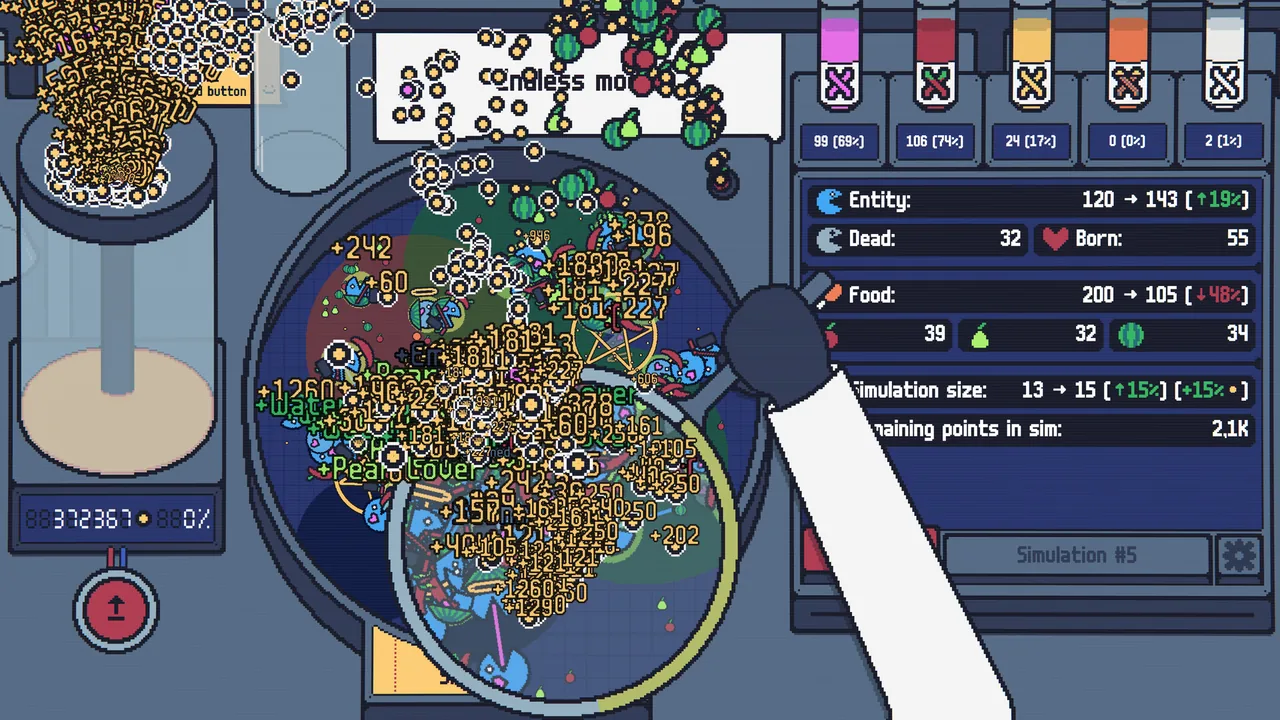
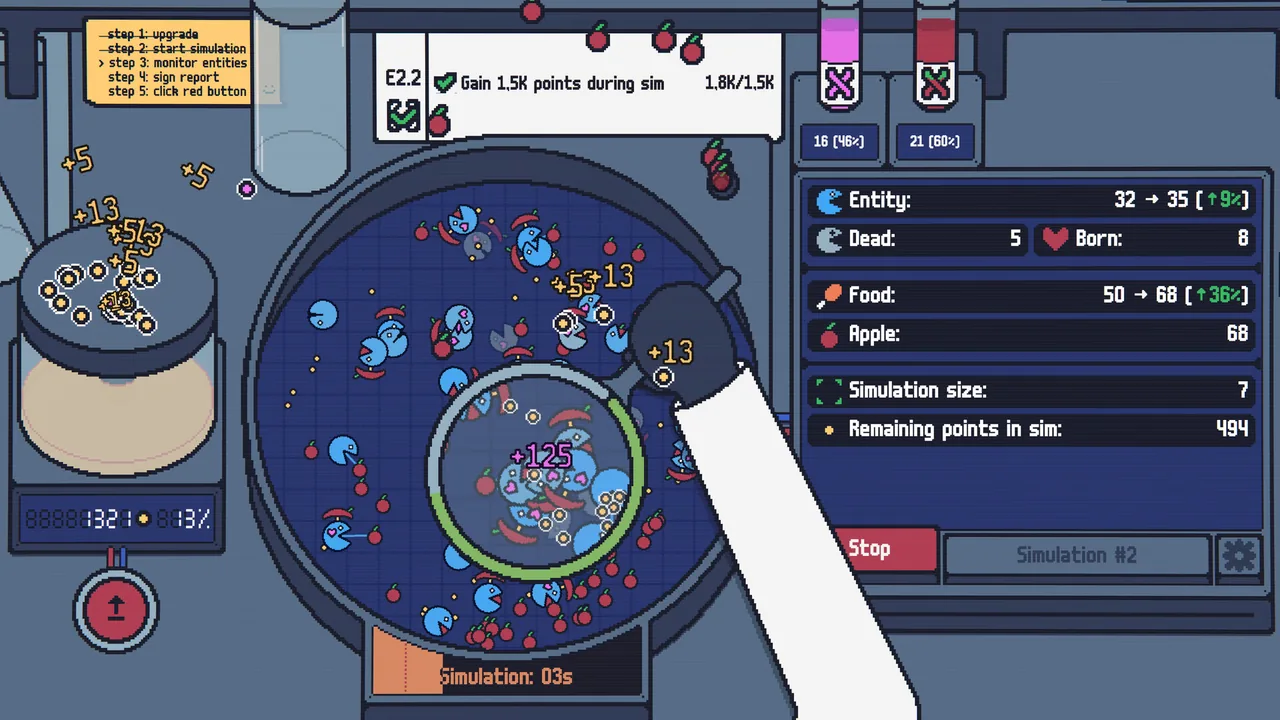
Each simulation run plays out as a short, watchable event: the little organisms wander their enclosure, hunt for fruit, and eventually die off, and every run generates data that feeds back into the skill tree. That feedback loop is what most reviewers point to as the game's real hook, since improving a run means understanding why the previous one failed rather than just spending accumulated currency on the next tier of upgrades. It's a small structural choice, but it's the one that reviewers say elevates Simultree above the dozens of other incremental games competing for attention on Steam.
A lab you can feel
Simultree's presentation draws consistent, specific praise. The game is framed entirely through the eyes of a scientist, complete with an animated hand and magnifying glass cursor, a whiteboard players can doodle on, a stamp for saving results, and other small interactive flourishes that reviewers repeatedly call out by name as evidence of genuine craft. The sound design earns similar praise, particularly the tactile click and stamp noises tied to core actions, and the soundtrack is described as pleasant enough not to wear out its welcome over a playthrough.
A wall around the fourth experiment
The clearest recurring complaint concerns a difficulty and clarity spike around the game's fourth experiment tier, where multiple reviewers report getting stuck without a clear sense of which genetic traits or settings would let them progress. Most describe eventually working it out through trial and error and coming away satisfied once it clicked, framing the challenge as fair once understood rather than broken, but the jump is sharp enough that it's worth knowing about going in, particularly for players used to the genre's usual gentle curves.
Rough edges in navigation
A smaller but consistent thread of complaints concerns interface friction: the in-game hand can obscure important graphs and UI elements, the game's camera and cursor movement feel awkward to some players even after adjusting settings, and ultrawide monitor support is reportedly inconsistent. One detailed negative review also flags that the cursor gets hijacked system-wide while a simulation runs, preventing players from tabbing out to do something else during idle stretches, a real friction point given how much of the loop involves waiting on simulations to resolve. On a more positive note, the developer has already patched at least one accessibility complaint, an unlock that initially required a tablet to complete, after players raised it.
Short by design, and mostly fine with it
Reviewers are split on whether roughly three hours to full completion, plus an open-ended endless mode afterward, represents good value at $6.99. The majority treat the length as appropriately tight for the concept, several explicitly praising the developer for not padding the experience out, and single out the endless mode as a welcome bonus rather than a requirement. A minority argue the asking price is steep relative to the runtime, particularly players who found the core loop repetitive once its systems clicked into place, and a few wish for DLC or a sequel to extend the concept further.
One developer, a tight scope
Simultree comes from PIPAPOU, a solo developer whose earlier prototype of the concept circulated in a smaller, rougher form well before this Steam release, with a public demo arriving roughly two months ahead of the April 15 launch to let players test the loop before committing. Coduck Studio published the finished game, but the reviews make clear the design voice throughout, down to the specific genetic traits and the lab-scientist framing, is a single creator's vision rather than a committee's, and reviewers who followed the demo describe the final release as a meaningfully more polished and complete version of that earlier idea rather than a reskin or a rushed sequel.
Who should run these experiments
Simultree suits fans of incremental and idle games who are tired of experiences that play themselves, and who want a short, well-crafted puzzle wrapped in charming presentation rather than a long-term time sink. Players expecting a deep, hours-spanning incremental grind, or who are sensitive to interface friction, should temper expectations, but for the audience it's aimed at, this is an easy few hours well spent.
The verdict
Simultree earns its Very Positive reception by doing something genuinely different within a crowded, often mindless genre: it asks you to actually think. A rough patch around its fourth experiment tier and some interface quirks keep it from being flawless, but its charm, craft, and respect for the player's time make it a clear recommendation for anyone tired of incrementals that play themselves.
Pros and cons
Pros
- A genuinely strategic incremental loop that requires actively tuning genetic traits and simulation settings rather than passively watching numbers climb, a rarity reviewers say sets it apart from most of the genre
- Charming, tactile presentation built around a first-person scientist's hand, magnifying glass, and lab equipment, with sound design and small interactive flourishes reviewers repeatedly single out as memorable
- A tight roughly three-hour runtime to full completion that most reviewers treat as appropriately sized rather than padded, with an endless mode afterward for players who want more
- A responsive solo developer who has already patched at least one accessibility complaint (a tablet requirement for full completion) after players flagged it
Cons
- A notable difficulty and clarity spike around the fourth experiment tier, where several reviewers report getting stuck without clear guidance on which traits to use
- Camera and cursor navigation that a handful of reviewers describe as awkward, including UI elements getting obscured by the in-game hand and poor behavior on ultrawide monitors
- The cursor hijacking system-wide while the game runs in the background, preventing players from tabbing out during idle simulation stretches, according to one detailed complaint
- A small but vocal minority who found the core loop too linear and repetitive to justify the price, particularly once the novelty of the concept wears off
Screenshots
-
SimultreeImage: Coduck Studio via Steam -
SimultreeImage: Coduck Studio via Steam -
SimultreeImage: Coduck Studio via Steam -
How the review scores each part of the gameWanderer Editorial -
Key facts at a glanceWanderer Editorial -
The short versionWanderer Editorial