
Game review
Siegeturtle
6.5 / 10
- Developer
- YYZ Studio
- Publisher
- Pretty Soon
- Released
- 10 November 2025
- Platforms
- Windows
- Genre
- Idle, Roguelite, Auto Battler
- Monetisation
- One-time purchase, no in-game purchases
- Players
- Single-player
The short version
Siegeturtle sends a turtle swimming automatically through hostile seas, recruiting companions like unicorns, dolphins and giant squids, leveling attributes, and periodically resetting for permanent power through an ascension system, all wrapped in a cute, cozy presentation. It costs a few dollars, carries zero microtransactions, and reviewers on both sides of the recommendation line back that up with an unusual data point: extraordinarily high playtimes, several in the hundreds or even thousands of hours, appearing in both glowing and harshly critical reviews alike. What separates the two camps isn't how much time people spent with it, but what they found once the early game's momentum runs out — a cluster of specific, independently-reported complaints about prestige costs that outpace currency gain, offline progress capped harshly enough to require running the game for extremely long unattended stretches, and unusually high GPU usage on higher-refresh-rate monitors.
Biggest strengths
- Complete absence of microtransactions draws specific, repeated praise, with one reviewer summarising it as "all of the dopamine of a number go up idle mobile game but without any of the predatory microtransactions" for a few dollars total
- Extraordinarily high logged playtimes appear across both positive and critical reviews — several players in the hundreds of hours and at least two past the 1,000-hour mark — indicating the core loop genuinely sustains long-term engagement even among its harshest critics
- The companion-recruitment system and overall presentation draw consistent praise for charm, with reviewers specifically calling the animations adorable and the game "deeper and deeper the longer you play"
Biggest weaknesses
- A specific, independently-reported structural complaint describes prestige ("ascension") costs scaling faster than the currency needed to afford them, turning what should be a voluntary reset-for-power system into what multiple reviewers call a "timewall" — a wall of required waiting rather than active progress
- Offline progress is reported as harshly capped, with one detailed reviewer noting bonuses only fully apply after reaching a specific late-game milestone, meaning the practical way to progress becomes leaving the game running continuously for extremely long stretches rather than playing in normal sessions
- Multiple independent reviewers report unusually high GPU usage, with one specifically measuring close to 50% GPU load and noting that the game's own render-disable option only reduced it by a small fraction; another reports the game struggling specifically on higher-refresh-rate monitors
Who it's for: Idle-roguelite fans who specifically want a monetisation-free alternative to mobile incrementals and don't mind treating early progress walls as something to grind or wait through. Less of a fit for anyone who wants smooth, ever-improving pacing all the way through, since even some of the game's most invested players report the mid-game slowing to a genuine crawl.
Our recommendation: Worth its heavily discounted price for idle-genre fans specifically drawn to the no-monetisation pitch, but go in aware that multiple deeply invested players — including some with hundreds of hours logged — independently report a specific point where prestige costs stop scaling reasonably against how fast you can earn currency, turning voluntary grinding into something closer to a requirement.
6.5 / 10
An honest idle-mobile alternative, minus the mobile part
Siegeturtle's clearest selling point isn't its swimming turtle or its recruitable menagerie of companions, charming as reviewers consistently find both — it's the complete absence of any monetisation beyond the purchase price. One reviewer's framing captures the appeal precisely: "all of the dopamine of a number go up idle mobile game but without any of the predatory microtransactions," delivered for a few dollars total. That pitch is backed up by unusually strong behavioural evidence rather than just reviewer sentiment — playtimes in this corpus run remarkably high, with multiple reviewers on the positive side logging in the hundreds of hours and at least two past 1,000 and even 2,000 hours. That's the kind of engagement mobile idle games typically only achieve through constant re-engagement mechanics and paid boosts; Siegeturtle appears to earn it through its core loop alone.
When the same playtime produces opposite verdicts
What makes Siegeturtle's review corpus unusually informative is that extreme playtime shows up on both sides of the recommendation line. A detailed critical review comes from a player with roughly 705 hours logged, describing the early-to-mid game as genuinely fun before "the classic 'let's prestige over and over to break this timewall' design issues" set in — and specifically calling the game's touted "hidden power" late-game reveal anticlimactic, since it turns out to be more of the same prestige-and-timewall structure rather than a genuine escalation. That's a materially different account from a casual player bouncing off the concept early; this is someone who invested real time and still landed on a negative verdict once the structural problems became unavoidable.
The timewall, specifically
The core mechanical complaint recurs with unusual precision across independent reviews: ascension, Siegeturtle's prestige system, is reported to require currency (described by reviewers as "coral") that becomes progressively harder to earn at exactly the rate needed to keep affording each next ascension tier. One reviewer describes needing to reach a specific late milestone before earning any of this currency at all, then needing to spend more of it just to unlock further upgrade paths while still only earning it slowly — a structure several reviewers independently label a "timewall" rather than ordinary difficulty scaling. Layered on top of that, offline progress is reported as harshly capped: one reviewer notes that meaningful offline bonuses only fully apply once a player crosses a specific late-game distance milestone, meaning the practical strategy for progressing becomes leaving the game running continuously for very long unattended stretches rather than playing in normal sessions.
Technical and community friction
A smaller but concrete technical complaint concerns performance: multiple reviewers independently report unusually high GPU usage for an idle game, with one measuring close to 50% GPU load and noting the developer's own render-disable toggle only reduced that by a small fraction, and another specifically flagging problems on higher-refresh-rate monitors. On the community side, more than one reviewer describes needing to consult the game's Discord server to understand confusing progression walls the game itself doesn't explain well, with mixed results — one reviewer specifically reports being timed out by a moderator over what they characterise as an innocuous comment, though this is a single account rather than a pattern repeated widely across the sample.
Systems beyond the core swim
Siegeturtle layers a fair amount onto its basic auto-battler loop. Between battles, the turtle can be sent fishing, trading catches for gold or holding onto them for passive stat bonuses, with an upgradeable fishing rod improving the odds of rarer finds — a secondary resource loop that gives players something to manage beyond simply watching combat resolve. Attribute points split across Strength, Agility, Intelligence and Vitality let players lean into a preferred playstyle, while skill points spent on the turtle and its companions add a further layer of build customisation. Legendary loot from boss encounters, plus a system for breaking down unwanted gear into upgrade materials, gives dedicated players a gear-optimisation loop layered on top of the character-building one. None of these individual systems draws much specific criticism on their own — the complaints in this corpus are almost entirely about pacing and the ascension economy, not about any single system being poorly designed in isolation.
On the platform side, one Linux player's account is worth noting even as an outlier: after successfully playing the demo through Proton and importing that save into the full release, they report being the first game where Proton compatibility genuinely wasn't sufficient, eventually giving up after troubleshooting. That's a single data point rather than a broad pattern in this sample, but it's specific enough — including a clear before-and-after comparison against the working demo — to flag for any prospective Linux buyer rather than assume Proton support is a given.
The verdict
Siegeturtle earns real, well-documented affection from a large and clearly invested player base, and its complete rejection of the monetisation tricks common to the genre it's drawing from is a genuine, checkable point in its favour. But the same corpus that produces its highest praise also produces some of its most detailed criticism, from players who put in hundreds of hours before concluding the prestige economy stops scaling fairly. At its steeply discounted price, that's a reasonable trade for genre fans willing to treat the late-game timewalls as a known cost of entry — just don't expect the smooth, ever-improving pacing the early hours promise to hold all the way through.
Pros and cons
Pros
- Complete absence of microtransactions draws specific, repeated praise, with one reviewer summarising it as "all of the dopamine of a number go up idle mobile game but without any of the predatory microtransactions" for a few dollars total
- Extraordinarily high logged playtimes appear across both positive and critical reviews — several players in the hundreds of hours and at least two past the 1,000-hour mark — indicating the core loop genuinely sustains long-term engagement even among its harshest critics
- The companion-recruitment system and overall presentation draw consistent praise for charm, with reviewers specifically calling the animations adorable and the game "deeper and deeper the longer you play"
- The developer is credited by at least one reviewer for shipping frequent, if individually small, updates, suggesting active post-launch support rather than an abandoned release
- At its heavily discounted price, several reviewers who otherwise raise serious complaints about pacing still describe feeling like they "got away with something" given how much content and playtime the game offers for the cost
Cons
- A specific, independently-reported structural complaint describes prestige ("ascension") costs scaling faster than the currency needed to afford them, turning what should be a voluntary reset-for-power system into what multiple reviewers call a "timewall" — a wall of required waiting rather than active progress
- Offline progress is reported as harshly capped, with one detailed reviewer noting bonuses only fully apply after reaching a specific late-game milestone, meaning the practical way to progress becomes leaving the game running continuously for extremely long stretches rather than playing in normal sessions
- Multiple independent reviewers report unusually high GPU usage, with one specifically measuring close to 50% GPU load and noting that the game's own render-disable option only reduced it by a small fraction; another reports the game struggling specifically on higher-refresh-rate monitors
- Several reviewers describe needing to consult the game's Discord server to understand confusing progression walls, with at least one describing that experience as frustrating and another reporting being timed out by a moderator over what they felt was an innocuous comment
- Global achievement data shows a steep late-game drop-off consistent with the reported grind walls: many early achievements clear above 80%, while several of the deepest achievements fall to under 10%, and the rarest sit at 3.5-3.8%
Screenshots
-

SiegeturtleImage: Pretty Soon via Steam -

SiegeturtleImage: Pretty Soon via Steam -

SiegeturtleImage: Pretty Soon via Steam -
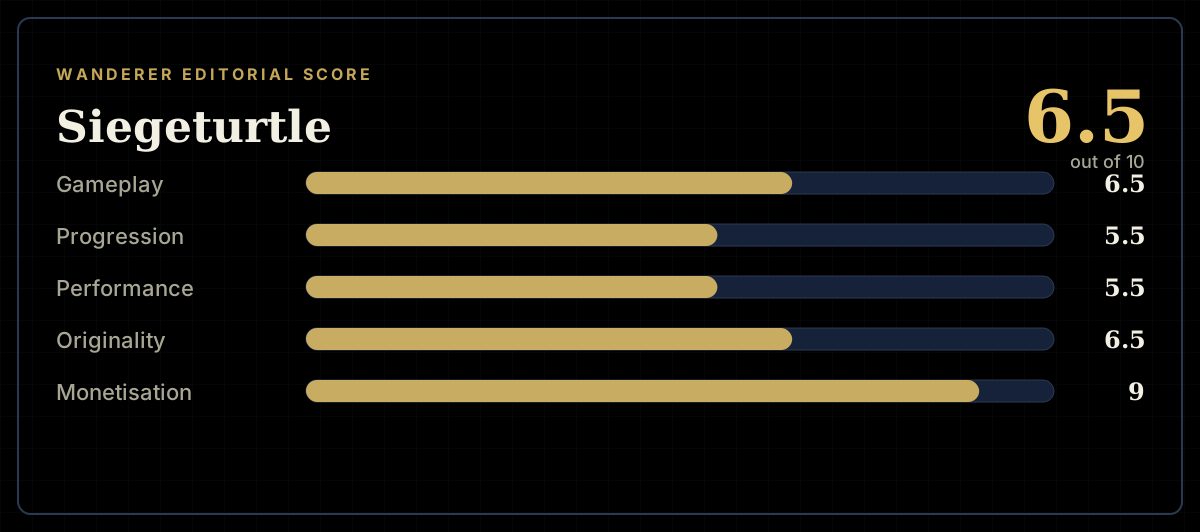
How the review scores each part of the gameWanderer Editorial -
The short versionWanderer Editorial