Game review
Rustic Defense Review: A Hexagonal Roguelike Tower Defense That Rewards Patience
7.6 / 10
- Developer
- Lasot Interactive
- Publisher
- Lasot Interactive
- Released
- 24 November 2025
- Platforms
- ["PC"]
- Genre
- Strategy / Tower Defense
- Monetisation
- Paid
- Players
- false
The short version
Rustic Defense blends hexagonal tower defense with roguelike procedural generation and a genuinely deep meta-progression tree, and reviewers describe an unusually addictive core loop that overcomes a modest visual presentation, with all but one voice in the sample recommending it without reservation.
Biggest strengths
- Reviewers repeatedly describe the core loop as unusually addictive, with one writing that a two-hour session 'felt like 10 minutes' and several others calling it 'a hidden gem'
- A detailed review praises the meta-progression tree as 'the most amazing' the reviewer has seen in a tower defense game, alongside 15 tower types, 5 heroes, and 10 chapters worth of content
- Terrain-based tactics stand out as a genuine mechanical hook, with tower firing range increasing on higher ground, adding a spatial layer most genre entries skip
Biggest weaknesses
- One reviewer admits being initially put off by the graphics before the gameplay won them over, suggesting the visual presentation is a real hurdle for some players even if most get past it
- Small bugs are mentioned in at least one review, though the same reviewer credits the developer with fixing issues quickly
- The sample's single dissenting review offers almost no detail, simply warning it 'takes a special kind of someone' to enjoy the game, leaving newcomers little concrete sense of who might bounce off it
Who it's for: Tower defense and roguelike fans looking for a strategy-heavy, content-dense game, rather than players who prioritize slick visual presentation above gameplay depth.
Our recommendation: Strongly worth trying for tower defense fans, with an almost unanimously positive sample praising its depth, variety, and value for a genre-typical price.
7.6 / 10
Rustic Defense sets its tower defense loop on procedurally generated hexagonal maps, wrapping fog of war, four enemy biomes, and a hero system around the genre's usual build-and-upgrade fundamentals. It sits at 96% positive across 28 Steam reviews, an unusually strong score even by indie tower defense standards, and a sample of 16 English-language reviews spanning its November 2025 launch through this year shows why: reviewer after reviewer describes the game as quietly, almost surprisingly addictive.
A Roguelike Spin on Familiar Fundamentals
Each run starts with the player's base visible and the rest of the map hidden behind fog of war, concealing four distinct enemy biomes that reveal themselves as waves are cleared. One detailed review lays out the structure precisely: ten chapters vary the number of roads adjacent to the player's base, directly changing how difficult a given map is to defend and forcing careful tower placement rather than a single repeatable strategy. Reviewers consistently credit this map variation with keeping the game from growing stale, with one writing that "each battle feels distinct... [it] forces you to rethink your approach instead of relying on the same strategy every time."
Fifteen Towers, Five Heroes, and a Deep Progression Tree
The content on offer draws specific, repeated praise. The sample lists 15 tower types, 5 unlockable heroes who attack from the player's base, a skill tree, and an upgrade deck of randomly dropped cards that let players boost damage, extend range, or unlock new tower types after each wave. One reviewer with over 67 hours logged calls the meta-progression tree "the most amazing... I've ever seen in a TD game," while another highlights the sheer volume of systems as reason enough to keep returning, describing the game as "a real hidden gem" for how well it blends tower defense with roguelike structure.
Terrain Actually Matters
A specific mechanical detail stands out in the more detailed reviews: a tower's firing range depends on the height of the terrain it's placed on, with towers on higher ground firing farther than those on flat fields. Combined with mines that can only be built on tiles containing the right resources, and crystals that power hero attacks, this gives map reading genuine tactical weight beyond simply filling every available tile with the strongest available tower, a layer of spatial planning several reviewers cite as a meaningful differentiator from more generic genre entries.
Modest Graphics That Grow on You
Not every account is unreservedly glowing on presentation. One reviewer admits being "hesitant to buy this game because of the graphics," before the gameplay itself won them over: "I got used to the graphics quickly, can see everything clearly, know what is going on and everything runs smoothly." That's a useful data point for prospective buyers judging purely by screenshots — the sample suggests the visual style reads as plain rather than broken, and that most reviewers who push past an initial hesitation come away satisfied with how functional it proves in practice.
Small Bugs, an Active Developer
The same reviewer who flagged the graphics also notes "some small bugs here and there," but adds that "the dev is fixing them as soon as he can," a sentiment echoed by another reviewer who simply calls it "quality game from active dev's." For a solo or small-team indie release, that kind of responsiveness matters, and nothing else in the sample suggests bugs serious enough to disrupt the core loop for most players.
One Thin Dissent
Only one review in the sample recommends against the game, and it offers little to work with: "Going to take a special kind of someone to enjoy this game," logged after just eighteen minutes of play. Without more detail, it's hard to weigh against the far more substantial positive accounts, several of which come from reviewers who explicitly say they aren't dedicated tower defense fans yet still found themselves hooked. It's worth noting as the sample's sole outlier rather than dismissing outright, but it carries far less evidentiary weight than the detailed reviews surrounding it.
Who the Sample Says This Is For
A recurring thread across the sample is how many reviewers describe themselves as lapsed or casual tower defense players rather than genre die-hards, and still found the game pulled them in regardless. One writes plainly that they "wouldn't consider myself a hardcore tower defense fan," but that the game's emphasis on strategic thinking won them over anyway; another, describing themselves as "a big fan of tower defense games," calls it simply "a nice twist on the genre." That range, from curious newcomers to committed genre fans, suggests Rustic Defense's appeal isn't narrowly limited to players who already know exactly what they want from a tower defense game.
Price and Value
At NZ$14.75 with no discount at the time of writing, Rustic Defense sits at a standard indie tower defense price point, and reviewers who dug into its chapters, heroes, and progression systems repeatedly call it "a bargain for the price" and "worth the price tag." Several reviewers logged well over ten hours, with two surpassing 20 and one reaching 67.7 hours, suggesting the ten chapters and meta-progression tree hold attention far beyond a quick playthrough, which matters more for a genre where replayability often makes or breaks the value proposition.
Final Verdict
Between the procedural map generation, terrain-based tactics, deep meta-progression, and a developer reviewers describe as actively engaged, the sample makes a genuinely strong case for Rustic Defense as one of the better roguelike tower defense releases of its year. The 96% positive score isn't an outlier or a fluke of a small sample skewing rosy; it's backed by detailed, specific praise across nearly every review that engages with the game at length, with only one thin, underexplained dissent to weigh against it. The presentation is the one place buyers should calibrate expectations, since at least one reviewer needed time to adjust to it, but nothing in the sample suggests that hurdle outweighs what reviewers consistently describe as an unusually addictive, content-rich tower defense experience.
Pros and cons
Pros
- Reviewers repeatedly describe the core loop as unusually addictive, with one writing that a two-hour session 'felt like 10 minutes' and several others calling it 'a hidden gem'
- A detailed review praises the meta-progression tree as 'the most amazing' the reviewer has seen in a tower defense game, alongside 15 tower types, 5 heroes, and 10 chapters worth of content
- Terrain-based tactics stand out as a genuine mechanical hook, with tower firing range increasing on higher ground, adding a spatial layer most genre entries skip
Cons
- One reviewer admits being initially put off by the graphics before the gameplay won them over, suggesting the visual presentation is a real hurdle for some players even if most get past it
- Small bugs are mentioned in at least one review, though the same reviewer credits the developer with fixing issues quickly
- The sample's single dissenting review offers almost no detail, simply warning it 'takes a special kind of someone' to enjoy the game, leaving newcomers little concrete sense of who might bounce off it
Screenshots
-
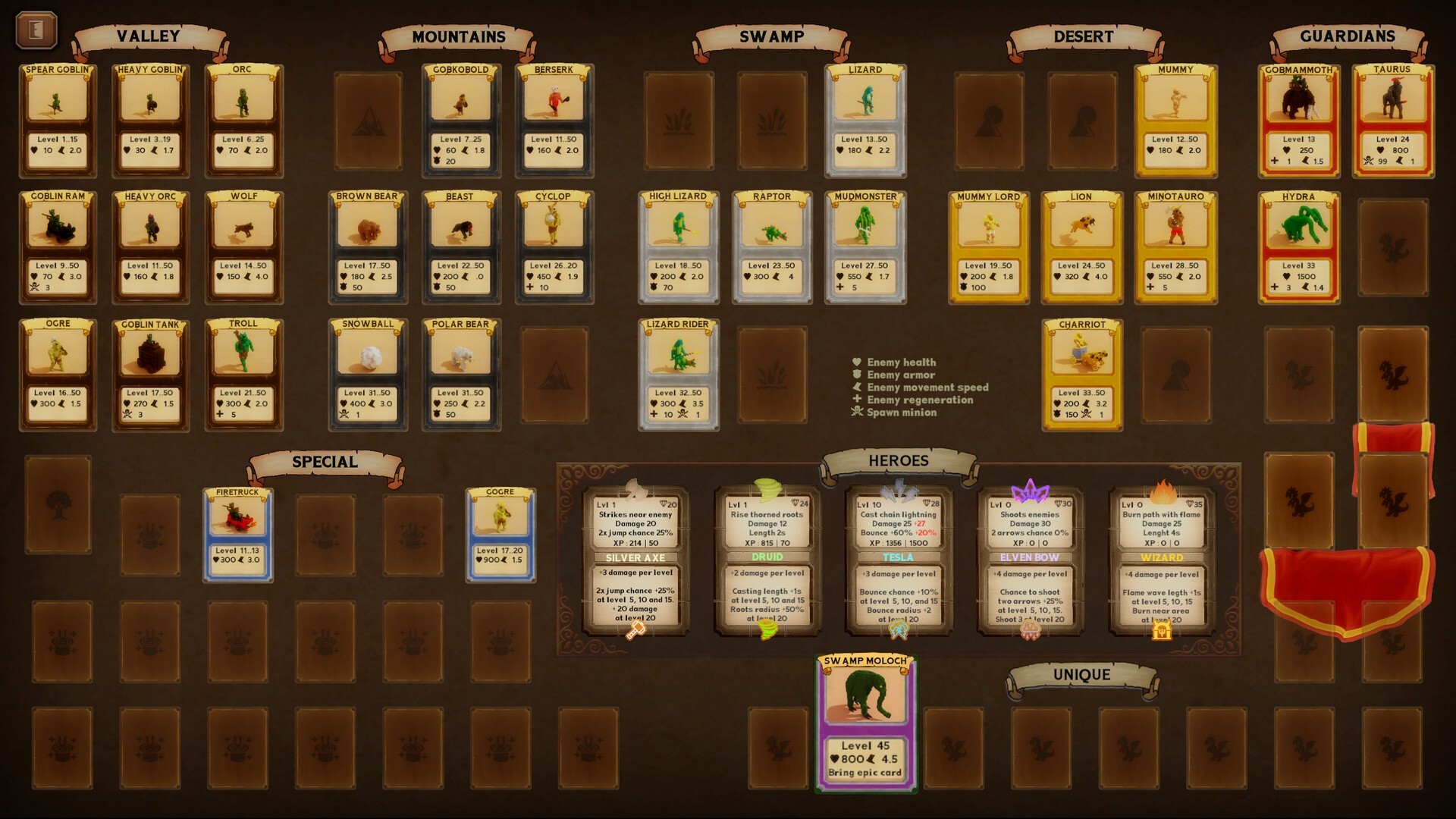
The game's enemy and hero card collection, grouped by biomeLasot Interactive -
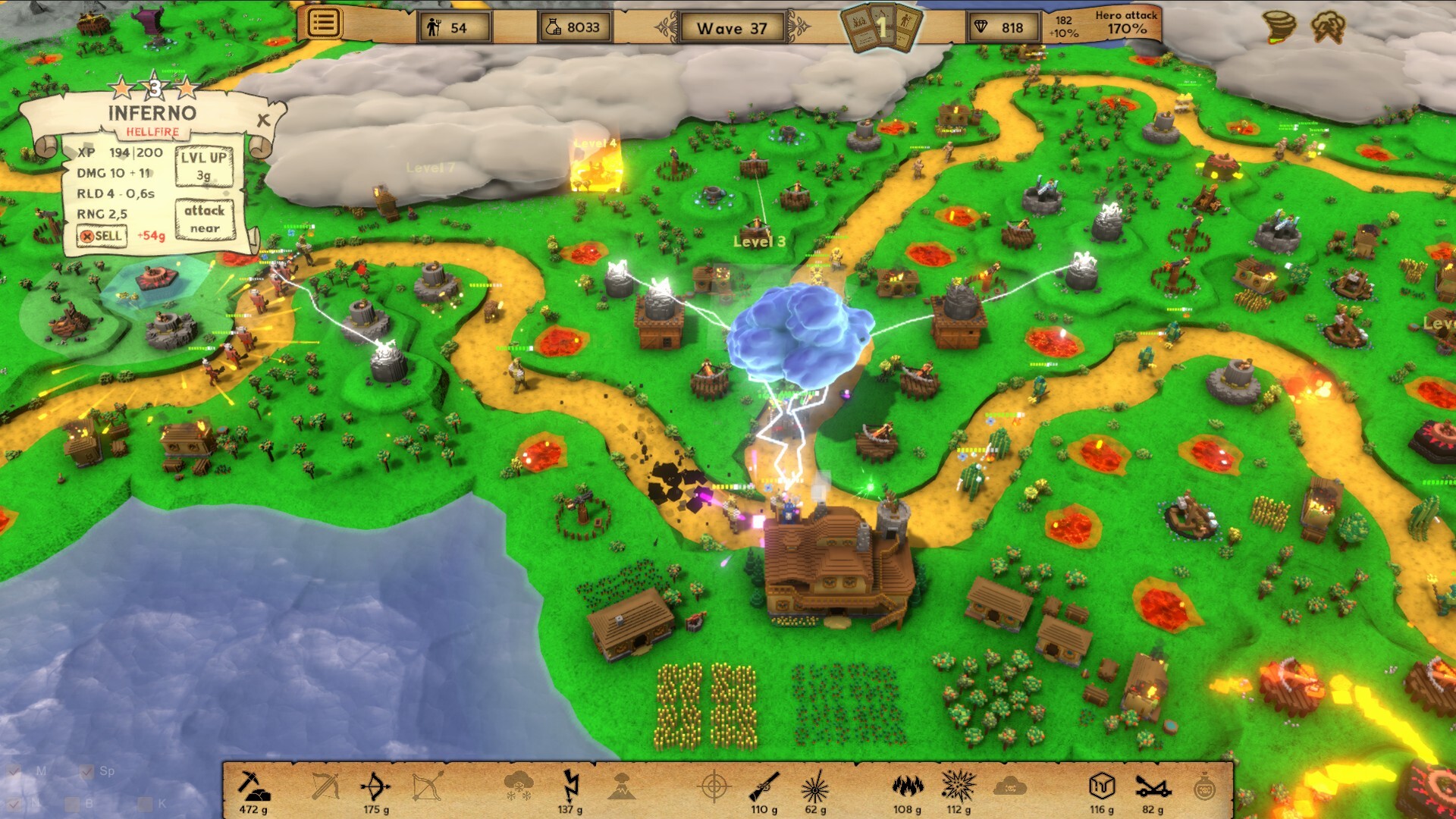
Towers unleash lightning and fire on an advancing waveLasot Interactive -
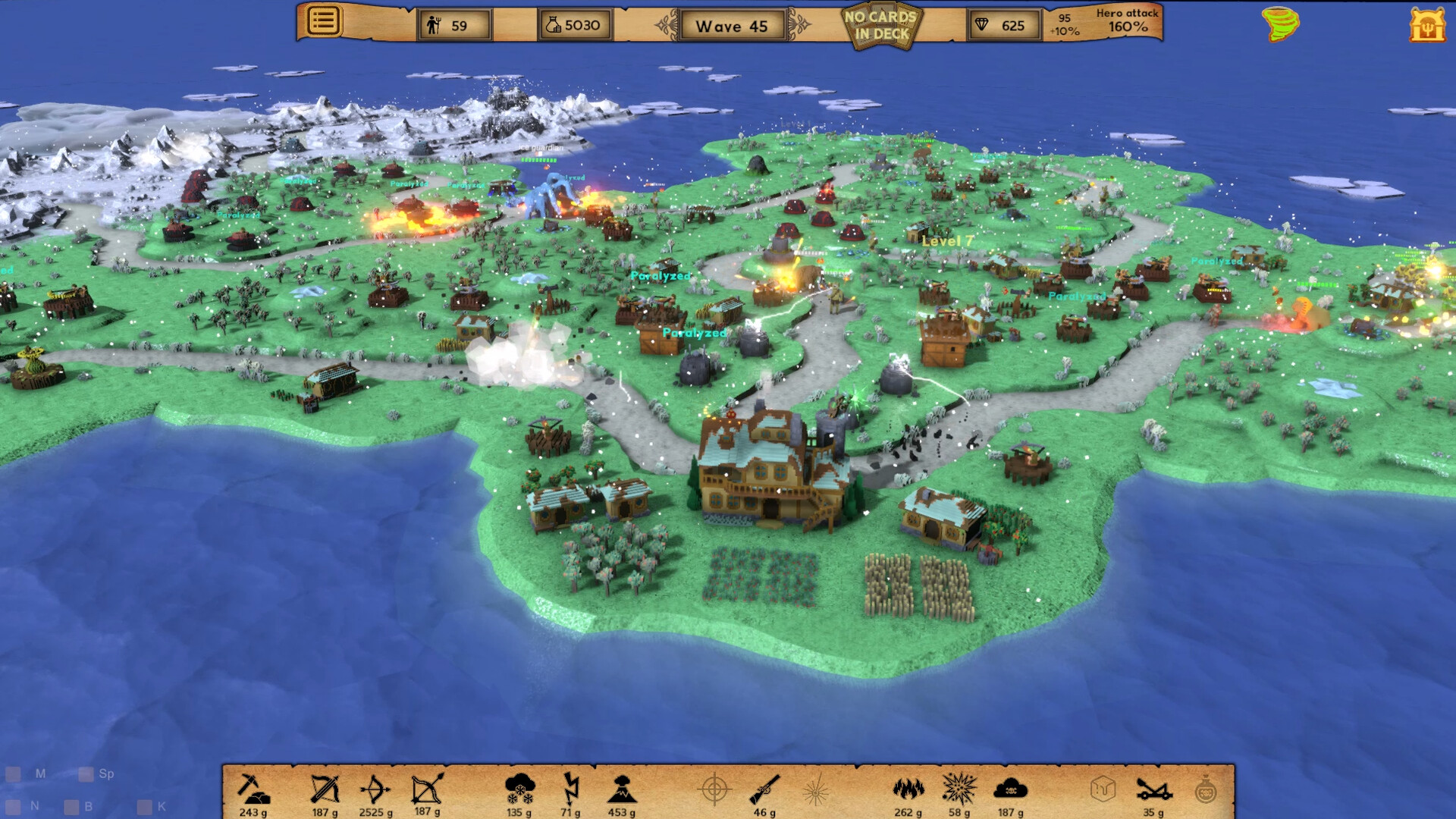
A snow-biome map deep into a run, at wave 45Lasot Interactive -
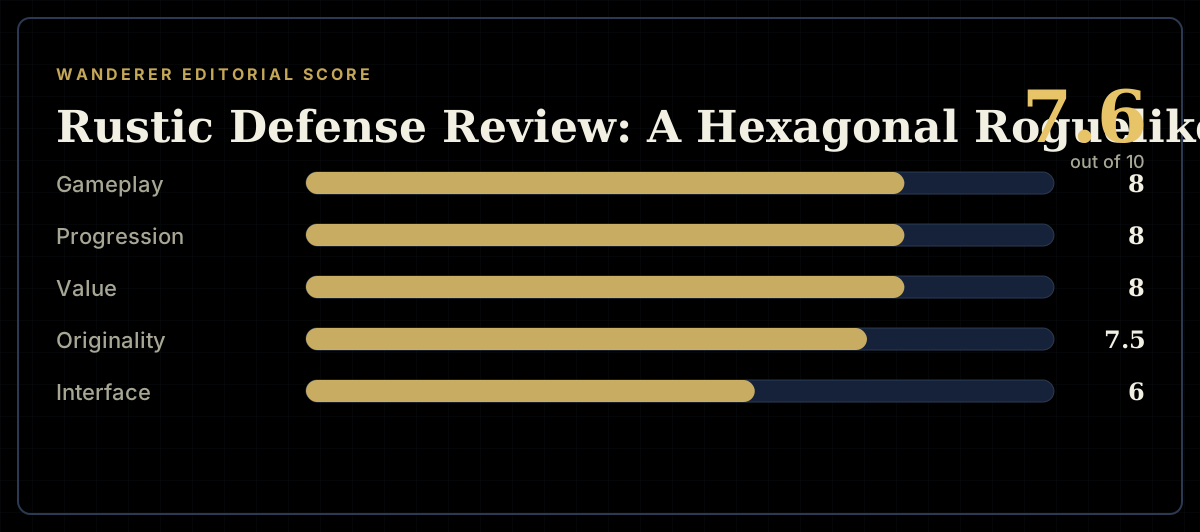
How the review scores each part of the gameWanderer Editorial -
The short versionWanderer Editorial