Game review
Into the Restless Ruins Review: A Brilliant Dungeon-Builder Undone by Weak Combat
6.8 / 10
- Developer
- Ant Workshop Ltd
- Publisher
- Wales Interactive
- Released
- 15 May 2025
- Platforms
- ["PC"]
- Genre
- Roguelike Deckbuilder
- Monetisation
- Paid
- Players
- false
The short version
Into the Restless Ruins takes a genuinely fresh idea -- build your own dungeon out of a deck of room cards, then explore the maze you made yourself before your torch burns out -- and executes the building half of that loop brilliantly. Reviewers are remarkably consistent on where the game falls short: the combat is thin, and the card economy undercuts its own deckbuilder identity. Neither is a dealbreaker for the dungeon-architecture fans it's aimed at.
Biggest strengths
- The core loop of building your own dungeon out of room cards, then physically navigating the maze you made, is repeatedly described as genuinely inventive and satisfying
- Scottish and Welsh folklore theming, including in-game Gaelic and Welsh dialogue, is called out by multiple reviewers as a distinctive and appreciated touch
- A generous card pool (over a hundred rooms, dozens of cantrips and charms) gives long-term players plenty to unlock
Biggest weaknesses
- Combat is repeatedly described as simplistic, unbalanced between weapon types, or an afterthought compared to the building mechanic
- Multiple reviewers independently note that unused cards reshuffle back into the deck rather than being consumed, meaning rare card rewards can pollute the deck instead of improving it
- The torch/light mechanic that limits visibility and exploration time is divisive -- some reviewers call it a well-designed risk-reward system, at least one found it simply frustrating
Who it's for: Deckbuilder and roguelike fans who want a genuinely new spin on the genre, and don't mind combat that takes a back seat to construction and planning.
Our recommendation: Recommended, especially for fans of dungeon-construction or Blue Prince-style room-placement games, with the caveat that the combat and card-reward systems are the sample's most consistent weak points.
6.8 / 10
Into the Restless Ruins, from UK studio Ant Workshop and publisher Wales Interactive, sits at 83% positive across 109 Steam reviews. That's a solid, comfortably-positive score, and a detailed sample of 20 English-language reviews spanning launch week through more than a year later shows exactly why: a genuinely novel central idea that reviewers keep praising in almost identical terms, paired with a combat system that keeps drawing the same specific criticisms.
Building Your Own Maze
The premise reviewers return to again and again is the game's central twist on the deckbuilder formula: you don't just play cards to attack or defend, you play cards to physically construct the dungeon you're about to explore. One reviewer calls it "brilliant concept, well executed," describing the loop as building "a deck of rooms, use the rooms to buff yourself and create a path to shrouded areas," then jumping in "with no map and try to find the path you've laid out." Another, in a lengthy and thoughtful review that ultimately leans negative overall, still concedes that "building your own path forward is truly novel" and that the obstacles baked into the room shapes -- forcing paths to curve, split, and complicate navigation -- are "genius, and beautifully crafted." A third describes the appeal succinctly: "managing to make a straight line from your starting point to your goal feels divine to play, but I always want to start up another run even when I walk through a labyrinth of death." That's an unusually consistent read across reviewers who otherwise disagree on plenty else.
The Torch Mechanic: Tension by Design, or Just Annoying
Layered on top of the building puzzle is a torch that burns down as you explore, limiting both visibility and time before it starts draining your health. Most of the sample treats this as the game's key tension mechanic, working as intended: one reviewer specifically calls "the risk reward mechanic of losing health once your torch dims" well thought out, and another describes the satisfaction of "planning and building a dungeon that lets you get to your goals and stack buffs perfectly," only for the torch to run low and turn a carefully planned route into "an inescapable labyrinth in which you have no idea what the right way is." Not everyone agrees, though -- one shorter, negative review calls the torch mechanic "insanely annoying," specifically objecting to only being able to "see three feet in front of you half the time." That's a genuine, minority dissent worth noting rather than papering over, but it's an outlier against a much larger chorus treating the torch as the system that makes the building phase matter.
Combat: The Sample's Clearest, Most Consistent Complaint
If there's one thing nearly every critical review in the sample agrees on, it's that combat is the game's weakest link. One reviewer who ultimately recommends the game still states plainly that "boss fights (and combat in general) feels uninspiring." Another, who does not recommend it, writes that "the combat side of things is where the game is a let down," noting bosses "don't really have much to them, never feeling at risk in the encounters." A third, more detailed critique digs into weapon balance specifically: "the weapons you pick up are not necessarily an upgrade from the default starting weapon... I felt like the game was punishing me for picking them up." A fourth, in an otherwise-positive and unusually thorough review, runs through nearly every weapon type and concludes most of them are simply worse than the starting sword. This isn't a single disgruntled account -- it's the same specific complaint, independently reached, by reviewers who land on opposite sides of their overall recommendation, which is exactly the kind of corroboration that's hard to explain away as one person's bad luck with a build.
The Deckbuilder That Undercuts Its Own Economy
A more technical but equally well-corroborated criticism concerns the card economy itself. One reviewer lays it out in detail: cards you earn "are -supposed- to act as a reward. But these cards are never consumed. Once you go through your deck, it gets reshuffled and dealt to you fresh, with every card intact," meaning "every rare addition or niche shape you work for only serves to pollute your deck." A separate, unconnected review reaches the same conclusion independently: "unlocking more cards can be disadvantageous because it pollutes the card pool, making it harder to draw the cards that you find to be most useful," adding that most competing deckbuilders let players ban or trim unwanted cards, but "there is no such remedy here." Two reviewers, writing months apart with no apparent connection, arriving at the identical structural critique is a strong signal that this is a real design issue rather than a one-off misunderstanding of the systems.
Theming and Presentation: A Genuine Point of Distinction
Several reviewers single out the game's Scottish and Welsh folklore theming as a standout, and specifically praise the inclusion of minority-language dialogue. One reviewer, who says they "primarily bought this game to support developers who are willing to put in the extra effort to include minority languages like Scottish Gaelic and Welsh," reports being pleasantly surprised by how much they enjoyed the game itself. Another calls out "the Welsh theming/inspiration, particularly in its few NPC's" as worth a specific shout-out. This kind of theming isn't just window dressing to these reviewers -- it's cited as a genuine reason they picked the game up, and one that paid off.
Value and Longevity
Playtimes across the sample run wide, from reviewers who bounced off within a couple of hours to one who logged over 33 hours and produced a detailed tier-list comparison against a dozen other roguelike deckbuilders, placing this one comfortably in the "Good" tier. A handful of shorter, negative reviews specifically cite a lack of content relative to the asking price -- one reviewer who beat the game "in one day" felt there wasn't enough there to justify a full-price purchase. But that critique sits against a larger number of much longer, positive playthroughs (13, 24, 26, even 30-plus hours), several of which note ongoing content updates from the developer since launch. For a genre-savvy player who buys in for the building mechanic specifically, this reads as reasonable value; for someone expecting deep, evolving combat to carry a long campaign, it may disappoint.
Final Verdict
Into the Restless Ruins earns its strong Steam reception honestly: its central idea, building your own dungeon and then having to survive the maze you made, is praised in remarkably consistent terms across a wide and detailed review sample. But the sample is just as consistent about where it falls short, with independent reviewers repeatedly flagging thin combat, weapon imbalance, and a card economy that undermines its own deckbuilding identity. For players drawn to the construction puzzle at its heart, those weaknesses are worth tolerating; for players expecting the combat to carry equal weight, this is a game whose best ideas are let down by its least-developed system.
Pros and cons
Pros
- The core loop of building your own dungeon out of room cards, then physically navigating the maze you made, is repeatedly described as genuinely inventive and satisfying
- Scottish and Welsh folklore theming, including in-game Gaelic and Welsh dialogue, is called out by multiple reviewers as a distinctive and appreciated touch
- A generous card pool (over a hundred rooms, dozens of cantrips and charms) gives long-term players plenty to unlock
Cons
- Combat is repeatedly described as simplistic, unbalanced between weapon types, or an afterthought compared to the building mechanic
- Multiple reviewers independently note that unused cards reshuffle back into the deck rather than being consumed, meaning rare card rewards can pollute the deck instead of improving it
- The torch/light mechanic that limits visibility and exploration time is divisive -- some reviewers call it a well-designed risk-reward system, at least one found it simply frustrating
Screenshots
-
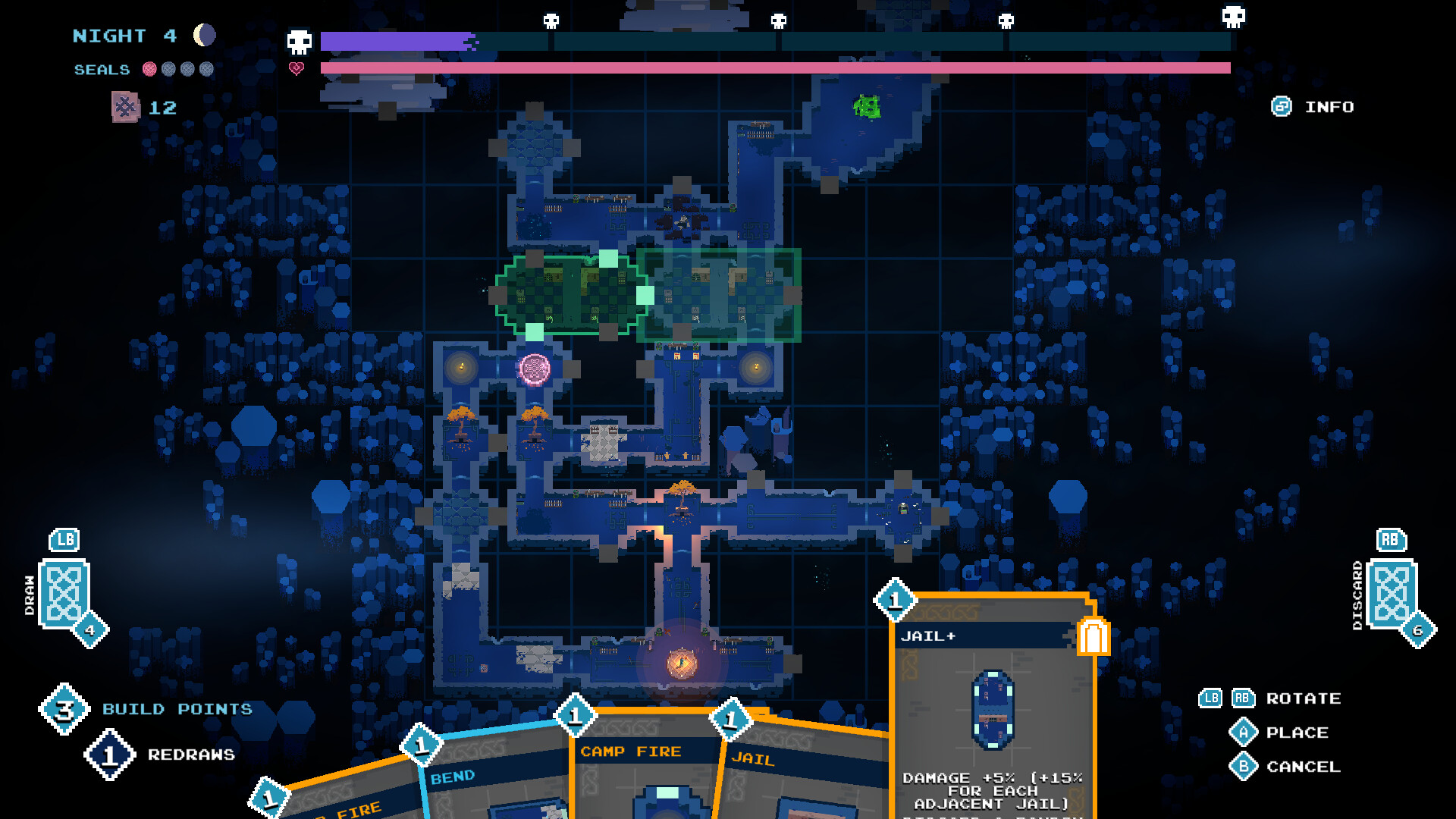
Planning a run means piecing rooms together from a hand of cards before ever setting foot insideWales Interactive -

A horde closing in -- the moment-to-moment combat reviewers describe as the game's weakest linkWales Interactive -
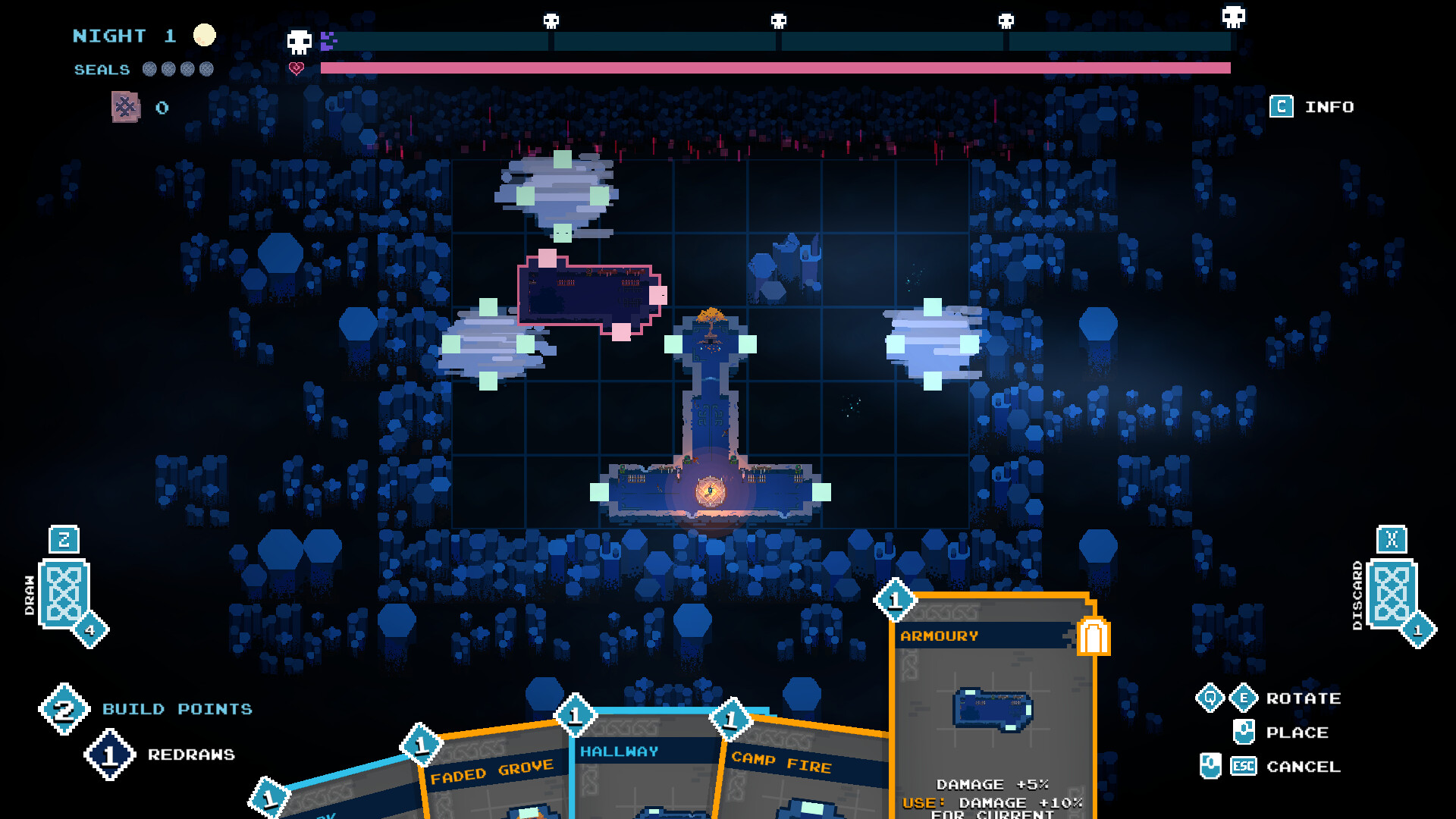
A dungeon in its early stages, still mostly shrouded in mist waiting to be built outWales Interactive -
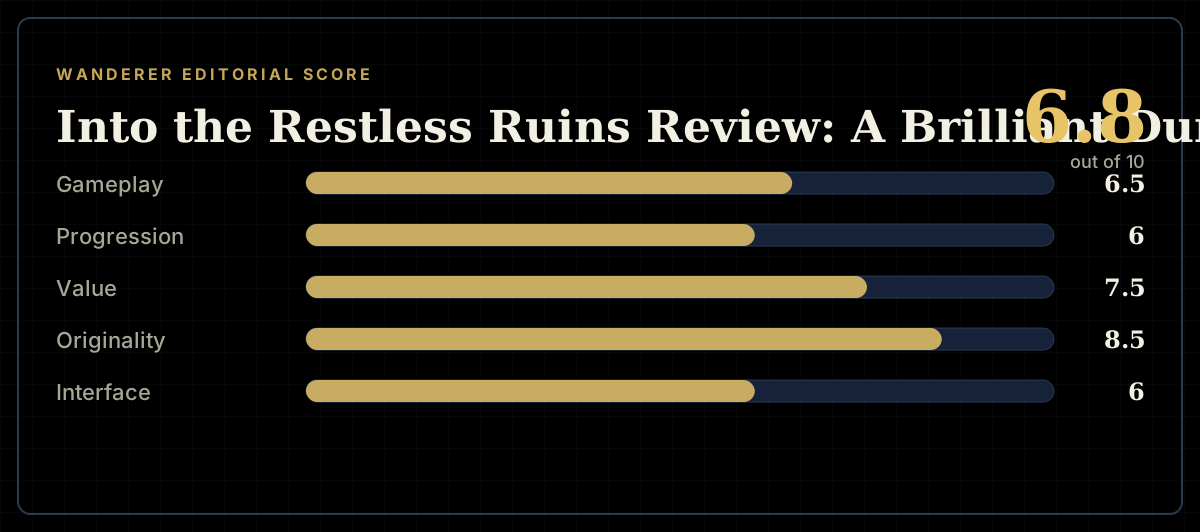
How the review scores each part of the gameWanderer Editorial -
The short versionWanderer Editorial