
Game review
Robocraft
4 / 10
- Developer
- Freejam
- Publisher
- Freejam
- Released
- 24 August 2017
- Platforms
- Windows
- Genre
- Vehicular Combat
- Monetisation
- Free-to-play with in-app purchases, including loot boxes reported to withhold a meaningful share of their contents behind a premium currency.
- Players
- Online PvP combat between player-built robots was the entire premise of the game; the servers enabling it no longer run.
The short version
Robocraft let players build genuinely inventive robot vehicles — drones, walkers, hover tanks, flying warships — out of simple blocks and take them into free-to-play online combat, and for several years after its 2013-14 debut it was exactly the kind of creative, community-driven success story this genre rarely produces. Then, in a single update reviewers still refer to by name nearly a decade later ("Unleashed"), the developer stripped out the tier system, tech tree and vehicle classes that structured that creativity, and the overwhelming majority of this game's public review history is the six-week firestorm of backlash that followed. The story ends definitively: developer Freejam closed the studio entirely in January 2025, shutting down both Robocraft and its planned sequel's servers in the same week and delisting the game for good.
Biggest strengths
- A genuinely creative core idea — building functional, wildly varied combat vehicles from simple blocks — that reviewers from its best years describe with real enthusiasm and thousands of logged hours.
- Supported a real diversity of vehicle types: drones, walkers, hover platforms, tanks and flying craft, all built from the same shared block system.
- Attracted and held a large, dedicated community for several years before the game's defining controversy, per multiple long-tenured reviewers.
Biggest weaknesses
- A single 2017 update, referred to by name across dozens of reviews ("Unleashed"), removed the tier system, tech tree, megabots and vehicle-class structure that reviewers say gave progression and build diversity meaning.
- The overwhelming majority of the game's public review history — dozens of detailed, specific reviews in English, Russian, German, Polish, Korean and Chinese — is concentrated in the six weeks immediately following that update, describing broken matchmaking, ruined balance and a gutted progression system.
- At least one review describes loot-box monetisation that withholds a meaningful share of contents unless a premium currency is spent, a common free-to-play friction point layered on top of the balance controversy.
Who it's for: Nobody currently — the game cannot be purchased and its servers are confirmed shut down. Relevant now only as a case study in how one contested balance update can permanently define a game's public reputation, even years before the actual end.
Our recommendation: Cannot be purchased or played online. Worth remembering as a specific, well-documented example of a beloved sandbox undone by a single overreaching update.
4 / 10
A creative sandbox that briefly got everything right
Robocraft's pitch was simple and, for a period, genuinely well executed: combine blocks in an editor to build a battle vehicle — the store page lists "jet cars, tanks, flying warships, helicopters, drones; almost any vehicle is possible" — then drive it into online combat against other players' equally varied creations. Reviews written from the game's earlier years back this up with real specificity rather than vague nostalgia. "It had everything you could ask for: balancing, a good community, active and attentive devs," reads one, describing the game's peak around 2014-15. Another recalls reaching "the height when megabots" — a specific, larger vehicle class — were introduced, treating it as a genuine content highlight rather than filler. A Korean-language review similarly marks "the megabot update" as the game's creative peak before things changed. Multiple reviewers logged extraordinary time in the game during this period — one review comes from an account with over 68,900 minutes (nearly 1,150 hours) played — which is hard to read as anything but real, sustained enthusiasm for what the game once was.
One update, and the community turned decisively
What makes Robocraft's Steam review history unusual is how concentrated the backlash against a specific, named change actually is. Checking a broad sample of the public review corpus, the overwhelming majority — in English, Russian, German, Polish, Korean and Chinese, independently and without any apparent coordination — cluster within a single six-week window in January and February 2017, all describing the same update. "Old robocraft was so much better, it had a technology tree, weapons that worked and you had to have at least some skill to win," reads one. "Then FreeJam removed all of the things that made the game good," reads another, going on to list them. A German- language review makes the same specific complaint about the tech tree and level system being stripped out. A review from an account with 133,632 minutes (over 2,200 hours) logged is blunt: "Was a really good game until the 'Unleashed' update... completely unbalanced, broken leagues, broken matchmaking." That volume, consistency and specificity across languages and playtimes is a stronger signal than a handful of angry posts — it reads as a genuine, community-wide rupture over one decision, not an isolated grievance.
The end, confirmed and complete
Unlike several other ageing free-to-play titles this outlet has covered, Robocraft's story doesn't end in ambiguous silence. The developer's own January 2025 announcement is direct: "Freejam has ceased production on Robocraft 2 and the studio is closing down. Robocraft 1 and Cardlife are currently being delisted from the Steam store and the servers for both of these games will be shutting down over the course of this week." That confirms what the Steam store page itself now shows — a formal notice that the game is no longer available — and closes out a story that had included a genuine attempt at recovery: news posts from early-to-mid 2024 document real work on a "Robocraft 2" rebuild, including new laser weapons, wheels and a cube-manipulation tool, before that project was cancelled alongside the studio's closure. One small, telling detail from the final store listing: its last promotional screenshots are watermarked "Development Build" and clearly depict this unreleased Robocraft 2 project — snowy mountain arenas and vehicle designs quite different from the blockier original game most reviews describe — rather than the game actually being sold, suggesting the developer's own marketing attention had shifted to the sequel well before the end came.
The monetisation layer that compounded the trust problem
Buried within the wave of 2017 backlash reviews is a separate, more specific financial complaint worth pulling out on its own. One review, in Russian, states that the game's main revenue source was loot crates of varying quality, and that "half of the loot from them you don't get until you buy PREMIUM" — describing a structure where opening a crate reveals rewards a player then has to pay separately to actually claim in full. Whether or not that exact mechanic was universal across every crate type, its presence in the review sample matters because of timing: it surfaces in the same window as the balance and progression complaints, meaning players who felt the core systems had been gutted were simultaneously encountering monetisation friction on top of it. A community already souring on a game's direction is far less forgiving of aggressive monetisation than one that still trusts the developer's judgment, and the clustering of both complaint types in the same six-week period likely reinforced each other rather than existing as two unrelated grievances.
Final verdict
Robocraft's core idea — genuinely open, block-based vehicle combat with real strategic variety — was good enough to earn years of dedicated play from a real community, and this review doesn't want to understate that. But its public reputation was permanently reshaped by a single 2017 update that an unusually broad, specific and multilingual slice of its own players say gutted the systems that made it worth building around, and the game never fully recovered from that rupture in the eyes of the people who reviewed it. The story is over now in every practical sense: no purchase, no servers, no sequel, and a developer that closed its doors for good in January 2025. What's left is a clear, well-documented lesson in how much damage one contested design decision can do to a live game's community, regardless of what comes after it.
Pros and cons
Pros
- A genuinely creative core idea — building functional, wildly varied combat vehicles from simple blocks — that reviewers from its best years describe with real enthusiasm and thousands of logged hours.
- Supported a real diversity of vehicle types: drones, walkers, hover platforms, tanks and flying craft, all built from the same shared block system.
- Attracted and held a large, dedicated community for several years before the game's defining controversy, per multiple long-tenured reviewers.
Cons
- A single 2017 update, referred to by name across dozens of reviews ("Unleashed"), removed the tier system, tech tree, megabots and vehicle-class structure that reviewers say gave progression and build diversity meaning.
- The overwhelming majority of the game's public review history — dozens of detailed, specific reviews in English, Russian, German, Polish, Korean and Chinese — is concentrated in the six weeks immediately following that update, describing broken matchmaking, ruined balance and a gutted progression system.
- At least one review describes loot-box monetisation that withholds a meaningful share of contents unless a premium currency is spent, a common free-to-play friction point layered on top of the balance controversy.
- Freejam, the developer, closed permanently in January 2025, shutting down Robocraft's servers (and its in-development sequel's) for good, with the game delisted from Steam entirely.
Screenshots
-

RobocraftImage: Freejam via Steam -

RobocraftImage: Freejam via Steam -

RobocraftImage: Freejam via Steam -
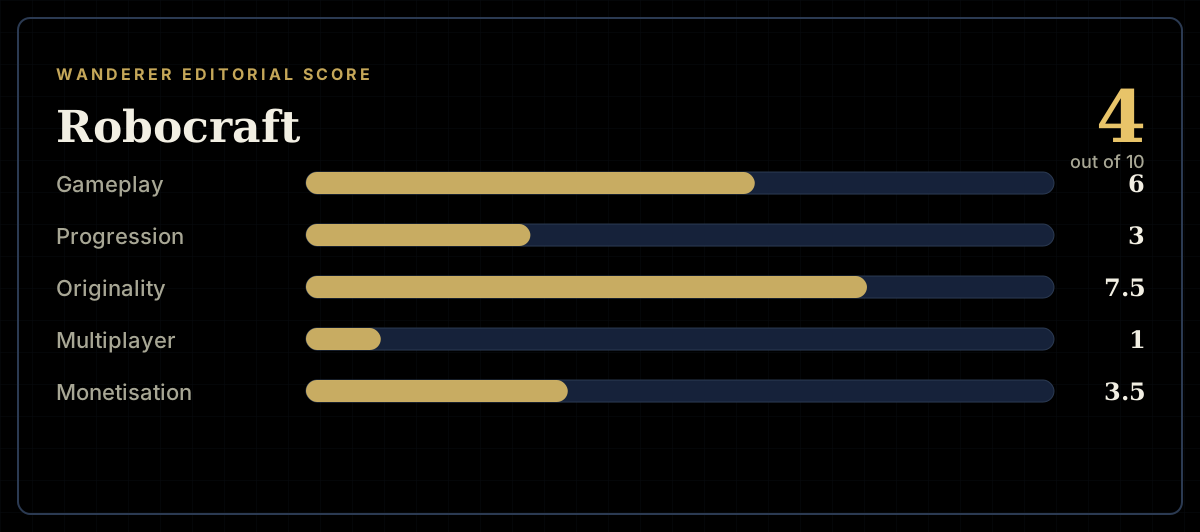
How the review scores each part of the gameWanderer Editorial -
The short versionWanderer Editorial