
Game review
REMATCH
6 / 10
- Developer
- Sloclap
- Publisher
- Sloclap, Kepler Interactive
- Released
- 19 June 2025
- Platforms
- Windows
- Genre
- Sports, Multiplayer
- Monetisation
- One-time purchase, plus a paid season pass and cosmetic microtransactions
- Players
- Online 5v5 team-based multiplayer
The short version
REMATCH puts you in direct, third-person control of a single footballer in fast, physical 5v5 matches, from Sloclap — the studio behind the acclaimed martial-arts games Sifu and Absolver. The core sensation of controlling the ball and your body in real time draws exactly the kind of specific, technical praise you'd expect from a developer with Sloclap's pedigree in tactile movement. That praise sits inside a genuinely Mixed reception across more than 53,000 reviews, driven by two large, independently well-documented problems: a netcode reviewers describe as badly broken, with players and the ball reported to visibly teleport mid-match, and a monetisation structure — a full box price on top of a time-limited season pass and separately-sold cosmetics — that a large share of buyers say is aggressive for a game already asking full price. A third, lighter but near-universal complaint has become the game's own community meme: teammates who refuse to pass, dubbed "Blue Lock brainrot" by reviewers referencing the anime's ball-hogging ethos.
Biggest strengths
- The core ball-and-player-control feel draws specific, technical praise consistent with Sloclap's reputation from Sifu and Absolver — reviewers describe genuinely satisfying physicality in passing, shooting and one-on-one duels that stands apart from more arcade-style football games
- The third-person, single-player-controlled perspective is repeatedly credited as a genuinely fresh angle on multiplayer football, distinct from both traditional top-down sports sims and other stylised sports titles
- Playing with a coordinated full team of friends is described as transforming the experience, with organised communication turning the same systems that frustrate solo players into the game's biggest strength
Biggest weaknesses
- A large and consistent share of the review corpus reports broken netcode, describing players and the ball visibly teleporting mid-match, goalkeepers making saves that still count as goals conceded, and inputs registering in the opposite direction from what was pressed — a fundamental problem for a game built entirely around precise, real-time ball control
- The monetisation structure draws sustained, detailed criticism: a full box price of NZ$46.95 is layered with a season pass reviewers describe as FOMO-structured — unlockable content becomes permanently inaccessible once a season ends unless a new pass is purchased — plus separately-sold cosmetics, a combination multiple reviewers argue is standard free-to-play practice applied to a paid release
- Multiple reviewers report declining player counts and long ranked-queue times as a direct consequence of the above two problems, with one describing a 30-minute wait for a full 5v5 ranked queue and explicitly calling for the game to go free-to-play to address it
Who it's for: Football and sports-game fans specifically drawn to Sloclap's tactile, physical take on player control, who are prepared to tolerate real netcode instability and a monetisation model several reviewers call predatory for a paid release. Best played with a coordinated group of friends rather than solo queue, given how consistently reviewers report randoms refusing to pass.
Our recommendation: Worth it for the core gameplay feel specifically, and much more enjoyable with an organised group of friends than solo — but go in aware of widely-reported connection issues and a monetisation structure that a large share of the game's own paying audience considers unfair for a full-price release, and check current server and matchmaking conditions before buying given reports of declining player counts.
6 / 10
Sifu's studio, on the pitch
REMATCH puts a single player directly under your control in fast, physical 5v5 football matches, built by Sloclap — the French studio whose martial-arts games Sifu and Absolver earned a reputation for tactile, weighty, skill-expressive combat. That pedigree translates directly onto the pitch: reviewers who know the studio's earlier work describe the same careful attention to how movement and contact feel, applied here to passing weight, shot placement and one-on-one ball duels. The third-person, single-player perspective is a genuinely distinctive angle for a multiplayer football game, and it's the part of REMATCH that draws the most consistent, specific praise across an otherwise deeply divided review corpus.
A netcode problem too widespread to dismiss
The single most damaging and most widely reported issue is technical. A large share of the review corpus — spanning both explicitly negative reviews and complaints buried inside otherwise positive ones — describes broken netcode: players and the ball visibly teleporting mid-match, goalkeeper saves that still register as conceded goals, and inputs occasionally resolving in the opposite direction from what was actually pressed. For a game whose entire design rests on precise, real-time control of a ball and a body, that's not a cosmetic annoyance — it undermines the exact thing reviewers praise most about the game. One detailed reviewer with more than 50 hours logged and full achievement completion states plainly that they still have to leave a negative review because of bugs and connectivity issues, despite genuinely liking the core concept — a specific, credible case of technical execution failing to match design ambition rather than a player simply disliking the genre.
A monetisation model built for a different kind of game
The second major, equally well-documented complaint concerns money. REMATCH launched at a full NZ$46.95 box price, and layered on top of that is a season pass reviewers describe as structured around fear of missing out — content becomes permanently locked once a season rotates unless a new pass is bought — plus separately-sold cosmetic items. Multiple reviewers make the same specific argument: this is standard free-to-play monetisation architecture, transplanted wholesale onto a premium-priced release, without the free-to-play pricing that would normally justify it. One reviewer puts it bluntly: "if you want to include battle passes and cosmetics from the start I would suggest F2P." Several connect this directly to a second consequence — declining player counts and lengthening matchmaking queues, with one reviewer reporting a 30-minute wait for a full ranked 5v5 lobby and explicitly calling for the game to drop its price point or business model to address the drop-off.
"Blue Lock brainrot"
A lighter, almost affectionately exasperated complaint runs through the corpus regardless of overall verdict: randomly-matched teammates who refuse to pass, chasing solo runs and shots from unrealistic distances regardless of team position. Reviewers have given this phenomenon its own name, "Blue Lock brainrot," referencing the popular anime's ego-driven, ball-hogging philosophy of play, and the joke recurs almost as often in positive reviews as critical ones — several reviewers who otherwise recommend the game plead, half-seriously, for random teammates to simply pass the ball. The practical upshot, reported consistently, is that REMATCH is a substantially better experience with an organised group of friends than in solo queue, where coordination problems compound the technical ones already described above.
What Sloclap actually built
Beyond the headline complaints, it's worth being specific about what the game gets right structurally. Matches are genuinely fast-paced, with the third-person perspective putting real weight behind every touch, tackle and shot rather than abstracting player interaction the way top-down sports sims typically do. Customisation systems let players personalise their footballer's appearance, and reviewers who engage with that layer describe it as a reasonable, if secondary, hook alongside the core 5v5 competitive loop. The skill ceiling around passing weight and shot placement is real enough that reviewers who play with coordinated, communicating teams describe genuinely high-level exchanges that wouldn't be possible if the underlying ball physics were shallow — which makes the netcode problems described above more frustrating rather than less, since the mechanical depth those problems undermine is clearly there when the connection holds up.
Sloclap's own history is a relevant data point for judging the game's trajectory rather than just its launch state. The studio's earlier release, Sifu, also launched to a mixed initial reception before sustained post-launch patches and content additions meaningfully improved its standing over time. Several reviewers explicitly invoke that precedent as a reason for cautious optimism here, treating REMATCH's current problems as more likely to be addressed than abandoned — though that's a bet on future support rather than a review of the game as it exists today.
The verdict
REMATCH has real, specific mechanical strengths that a large share of its 53,000-plus reviewers credit honestly — Sloclap's reputation for tactile, skill-expressive movement carries over convincingly onto the football pitch. What holds the game back from a stronger overall reception is almost entirely execution and business-model choices layered on top of that foundation: netcode reviewers describe as fundamentally broken for a game built on precise ball control, and a monetisation structure a large share of paying customers consider unfair stacked on an already full-price release. Sloclap's track record with Sifu's post-launch support offers some reason for optimism that these problems are being actively worked on rather than left to fester — but as of this review, buyers should go in with clear expectations about both the netcode and the community's own running joke about who's actually willing to pass the ball.
Pros and cons
Pros
- The core ball-and-player-control feel draws specific, technical praise consistent with Sloclap's reputation from Sifu and Absolver — reviewers describe genuinely satisfying physicality in passing, shooting and one-on-one duels that stands apart from more arcade-style football games
- The third-person, single-player-controlled perspective is repeatedly credited as a genuinely fresh angle on multiplayer football, distinct from both traditional top-down sports sims and other stylised sports titles
- Playing with a coordinated full team of friends is described as transforming the experience, with organised communication turning the same systems that frustrate solo players into the game's biggest strength
- Sloclap has a track record, per reviewers referencing the studio's post-launch support of Sifu, of meaningfully patching and expanding games after release, which several reviewers cite as reason for optimism about the game's trajectory despite its rough launch state
- The pure mechanical skill ceiling — dribbling, passing weight, shot placement — draws praise from reviewers who specifically enjoy the depth once teammates are coordinated enough to let it show
Cons
- A large and consistent share of the review corpus reports broken netcode, describing players and the ball visibly teleporting mid-match, goalkeepers making saves that still count as goals conceded, and inputs registering in the opposite direction from what was pressed — a fundamental problem for a game built entirely around precise, real-time ball control
- The monetisation structure draws sustained, detailed criticism: a full box price of NZ$46.95 is layered with a season pass reviewers describe as FOMO-structured — unlockable content becomes permanently inaccessible once a season ends unless a new pass is purchased — plus separately-sold cosmetics, a combination multiple reviewers argue is standard free-to-play practice applied to a paid release
- Multiple reviewers report declining player counts and long ranked-queue times as a direct consequence of the above two problems, with one describing a 30-minute wait for a full 5v5 ranked queue and explicitly calling for the game to go free-to-play to address it
- A community-wide complaint, referenced almost as often in positive reviews as negative ones, describes randomly-matched teammates refusing to pass and attempting solo runs regardless of team position — reviewers have coined the phrase "Blue Lock brainrot," after the anime's ball-hogging ethos, to describe the phenomenon
- At least one detailed, 100%-completion reviewer with more than 50 hours logged states they still had to give a negative review specifically because of bugs and connectivity issues, despite genuinely liking the underlying game concept — a notable case of mechanical goodwill losing out to technical execution
Screenshots
-

REMATCHImage: Sloclap via Steam -

REMATCHImage: Sloclap via Steam -

REMATCHImage: Sloclap via Steam -
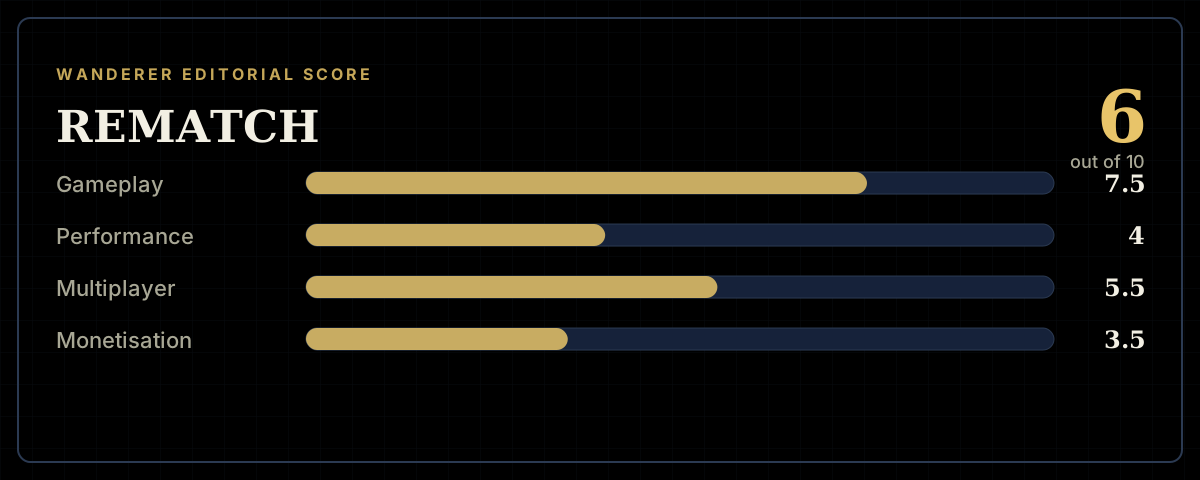
How the review scores each part of the gameWanderer Editorial -
The short versionWanderer Editorial