
Game review
Rebel Cops
6 / 10
- Developer
- Weappy Studio
- Publisher
- THQ Nordic
- Released
- 17 September 2019
- Platforms
- Windows
- Genre
- Strategy
- Monetisation
- Paid, no in-app purchases found
- Players
- false
The short version
Rebel Cops puts players in charge of a small, undermanned, poorly equipped police squad fighting to reclaim their town from a criminal takeover, in turn-based tactical missions where a single unlucky shot can permanently cost a cop their life. Spun off from Weappy Studio's This Is the Police 2, it keeps that series' striking neo-noir art style and adds genuine stealth and non-lethal tactical options. But a large share of its own review corpus argues it strips away everything else that made the parent games distinctive — story, dialogue, and management — leaving a shorter, more repetitive tactical layer undercut by a notoriously punishing early mission and painfully slow, un-skippable animations.
Biggest strengths
- A genuinely distinctive premise — leading an undersupplied, embattled police force against organized crime — that reviewers consistently call refreshing within the tactics genre
- Real, meaningful stealth and non-lethal options, including opening windows for flanking, stunning and quietly carrying away suspects, coordinating team-wide alerts, and using silencers, giving each mission multiple legitimate approaches
- A faithful continuation of This Is the Police's striking, minimal, stylized neo-noir art direction, with specific tie-ins to the second game that reviewers say land well
Biggest weaknesses
- A dominant, repeated complaint that the game strips away everything distinctive about its parent series — no story, no dialogue, no cutscenes, no management layer — leaving what multiple reviewers call a half-baked or unfinished-feeling spin-off by comparison
- A specific, widely-cited early "mansion mission" with an unusually large map, heavy secondary-objective load, and scripted enemy placement that can take hours to clear without triggering an alarm, cited repeatedly as a punishing, poorly-paced difficulty spike
- Slow, un-skippable arrest and movement animations that reviewers say make simply watching the game take as long as playing it — one detailed account estimates roughly two minutes of animation to process a single 12-suspect stealth takedown
Who it's for: XCOM and Commandos fans drawn to a stealth-first tactical layer and a distinctive neo-noir setting, who can tolerate slow pacing and real permadeath stakes.
Our recommendation: Worth it at its low price for the distinctive premise and genuine stealth tactics, but go in expecting a much smaller, story-free experience than This Is the Police fans might assume, and brace for a genuinely brutal early mission.
6 / 10
What it is
Rebel Cops casts players as the leader of a small, badly outnumbered and poorly equipped police force, fighting through turn-based tactical missions to reclaim a town from a criminal takeover, with permanent consequences for any officer felled in the field. Developed by Weappy Studio as a spin-off of This Is the Police 2 and published by THQ Nordic, it released on 17 September 2019 at a modest NZD 15.95, trading the parent series' management-sim and narrative layers for a tighter, XCOM- adjacent focus on stealth and squad-based combat.
Its review corpus, 450 in English, sits at a genuine Mostly Positive 72.9% (328 to 122), and reading through both camps reveals a game whose core tactical ideas are well-liked even by many of its critics — the disagreement here centers on specific, repeated complaints about scope, pacing, and one particularly notorious mission, rather than a fundamental dispute about the underlying design.
A distinctive premise with real tactical substance
Reviewers consistently credit Rebel Cops with a genuinely fresh spin on the tactics genre. "It's X-com with a cops, and instead of aliens, you're beating some civie pushed into working for some mob boss with a baton," writes one detailed reviewer, praising the option to go fully non-lethal and stealthy or simply "ask every suspect if they want to make your day." Another situates it more specifically within the genre's stealth lineage: "the comparisons with XCOM are inevitable, but I think this is more like a turn-based Commandos," highlighting how the game "rewards stealth, not only because everyone is a one-shot kill." A separate, detailed pros-and-cons review lists the specific tactical toolkit approvingly: "cool combat options include opening windows, team alerts, stunning suspects, carrying suspects (or bodies) so as not to attract attention, silencers" — a genuinely varied approach-planning toolkit for a modestly priced spin-off.
A spin-off that strips too much away, according to a large share of reviewers
The most consistent critical thread in this corpus concerns what's missing rather than what's present. "Basically this game is 'This is the Police 2' without story, movies, dialogues, and the strategy part," writes one detailed reviewer, calling it "a set of tactical missions, back to back, predefined maps" with little replayability as a result. A separate reviewer states the same complaint more bluntly: "this has the same gameplay like 'This is the police' but looks abandoned half way and unfinished. There are no dialogs or story scenes." A third, more measured account frames the disappointment carefully: "functionally this is supposed to be a side story for This is the Police, but it really has very little to do with it other than being in the same art style. The gameplay is a stripped down version of the tactical layer." That's a specific, repeated expectation gap worth naming directly — buyers approaching this as a proper narrative-driven successor rather than a focused, standalone tactics puzzle box are the ones most likely to come away disappointed.
The mansion mission problem
One specific mission recurs across reviews as a genuine pacing failure rather than fair difficulty. "One of the first missions has a giant map, takes several hours to complete, has an absurd amount of secondary objectives... and at various points drops enemies onto the map at prescripted places you can't know in advance," writes one detailed reviewer who calls it "a fascinating case study in awful game design." Another corroborates the same specific mission independently: "the big mansion boss mission early in the game is damn hard, like hours upon hours hard... if you raise the alarm in this mission its game, so you have to do the whole thing perfectly." A third reviewer states plainly that this mission was where they quit entirely, while explicitly clarifying "this review is by no means a 'don't buy'" — a fair, specific distinction between a genuine design misstep and an overall condemnation of the game.
Animation speed as a real, repeated friction point
A separate, more mechanical complaint concerns pacing at the animation level rather than mission design. "You can't speed up animations," writes one detailed reviewer, calculating that a single 12-suspect stealth takedown involves "about 120 seconds of watching the same animation" repeated for each stun-and-arrest sequence. That's a specific, fixable-in-principle complaint distinct from the broader "missing content" critique — even reviewers who enjoy the tactical substance underneath describe genuine frustration with how long it takes to execute straightforward, already-decided actions.
What the achievement data confirms
Rebel Cops's achievement curve shows a notably low ceiling even at the top: the single most-earned achievement sits at just 51.5%, a comparatively low figure for a "first meaningful milestone" compared to other tactics games this lane has covered, before falling steadily through the 20s and teens and bottoming out below 4% for the hardest completionist achievements. That's consistent with the mansion- mission complaints above — a meaningful share of buyers appear to bounce off relatively early, which lines up with a notoriously difficult, poorly-paced obstacle sitting near the start of the campaign rather than at its climax.
Verdict
Rebel Cops offers a genuinely distinctive tactical premise with real, well-designed stealth options and a striking neo-noir presentation carried over faithfully from its parent series. But a large, consistent share of its own reviewers argue it sacrifices too much of what made This Is the Police distinctive in the process, and a specific, badly-paced early mission combined with slow, un-skippable animations creates real, avoidable friction on top of that scope reduction. Worth its low asking price for tactics fans willing to treat it as its own small, focused thing rather than a true successor to its source material.
Pros and cons
Pros
- A genuinely distinctive premise — leading an undersupplied, embattled police force against organized crime — that reviewers consistently call refreshing within the tactics genre
- Real, meaningful stealth and non-lethal options, including opening windows for flanking, stunning and quietly carrying away suspects, coordinating team-wide alerts, and using silencers, giving each mission multiple legitimate approaches
- A faithful continuation of This Is the Police's striking, minimal, stylized neo-noir art direction, with specific tie-ins to the second game that reviewers say land well
- Genuine permadeath stakes with the possibility of unlimited in-mission saves as an optional unlock, letting players choose their own risk tolerance between hardcore tension and forgiving save-scumming
Cons
- A dominant, repeated complaint that the game strips away everything distinctive about its parent series — no story, no dialogue, no cutscenes, no management layer — leaving what multiple reviewers call a half-baked or unfinished-feeling spin-off by comparison
- A specific, widely-cited early "mansion mission" with an unusually large map, heavy secondary-objective load, and scripted enemy placement that can take hours to clear without triggering an alarm, cited repeatedly as a punishing, poorly-paced difficulty spike
- Slow, un-skippable arrest and movement animations that reviewers say make simply watching the game take as long as playing it — one detailed account estimates roughly two minutes of animation to process a single 12-suspect stealth takedown
- Real balance inconsistency, with some missions described as too easy and others punishingly difficult, alongside reports of minor bugs and frequent misclicks
- A restrictive unit movement range that several reviewers say struggles to keep pace with the game's larger maps, compounding the pacing problems from slow animations
Screenshots
-

Rebel CopsImage: THQ Nordic via Steam -

Rebel CopsImage: THQ Nordic via Steam -

Rebel CopsImage: THQ Nordic via Steam -
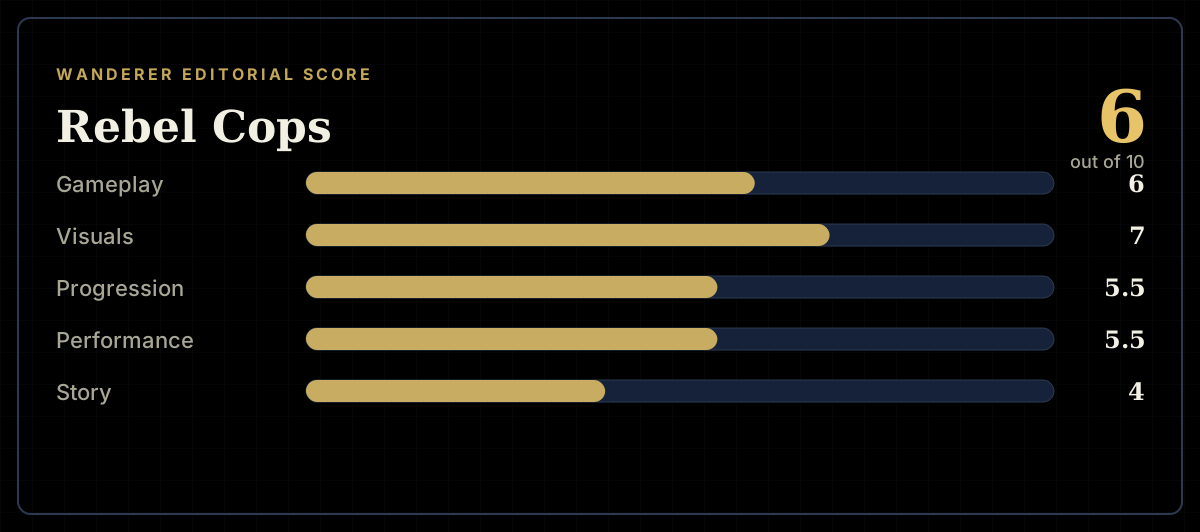
How the review scores each part of the gameWanderer Editorial -
The short versionWanderer Editorial