
Game review
RAD
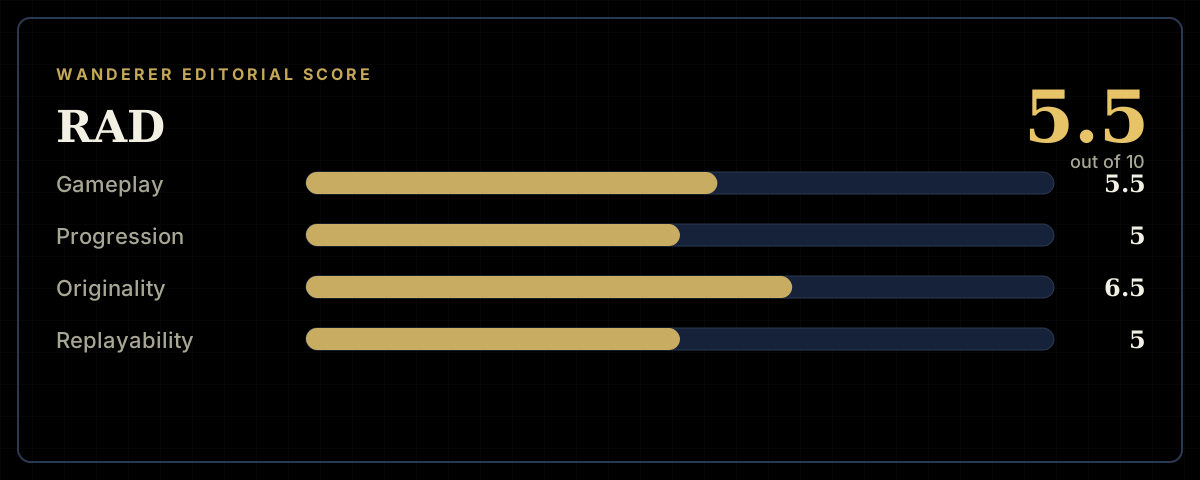
5.5 / 10
- Developer
- Double Fine Productions
- Publisher
- BANDAI NAMCO Entertainment America Inc.
- Released
- 19 August 2019
- Platforms
- Windows
- Genre
- Action
- Monetisation
- Paid, no in-app purchases found
- Players
- false
The short version
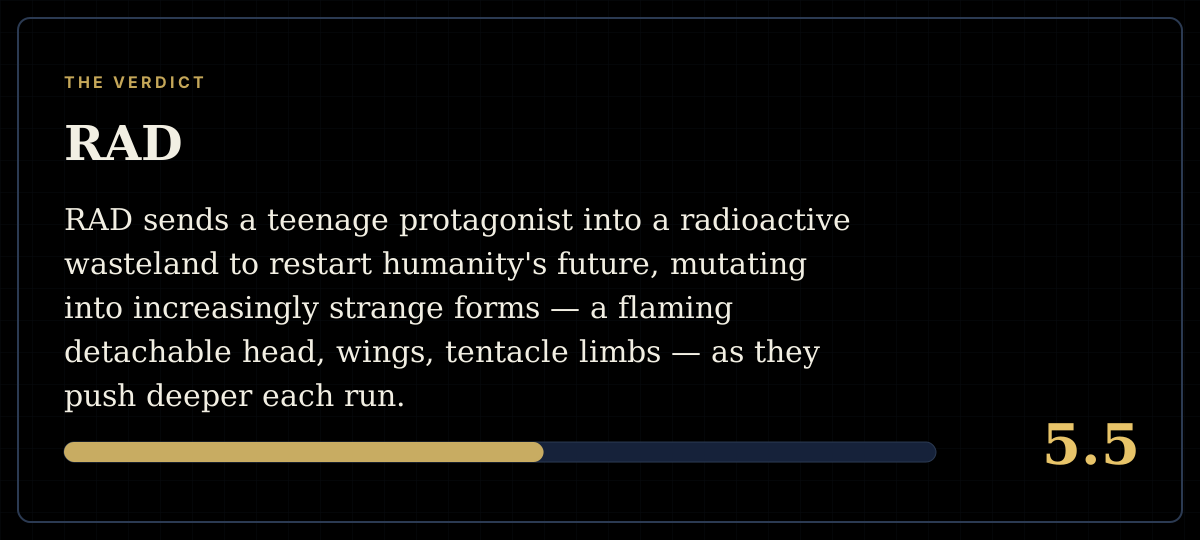
RAD sends a teenage protagonist into a radioactive wasteland to restart humanity's future, mutating into increasingly strange forms — a flaming detachable head, wings, tentacle limbs — as they push deeper each run. Its presentation, mutation variety and soundtrack draw real, detailed praise, including a viral corrective review written specifically to counter quick, dismissive negative reviews. But an equally detailed contingent argues the runs are unusually long and slow for the genre, the RNG frustratingly uneven, and the overall depth thinner than the Isaac/Gungeon/Hades comparisons it invites.
Biggest strengths
- A genuinely varied mutation system, with specific standout examples like a detachable, throwable flaming head mutation and traversal mutations (wings, double jump) that open up secret areas
- Strong, specific praise for the soundtrack, described by multiple reviewers as full of memorable tracks fitting the 80s/90s post-apocalyptic aesthetic
- Randomized boss encounters per floor visit keep repeat runs from feeling identical, according to a detailed defender of the game
Biggest weaknesses
- A widely repeated complaint that runs are unusually long (up to roughly an hour) with comparatively little variation in world structure between attempts, an atypical pacing choice for the genre
- Multiple detailed reviewers argue the game is fundamentally "shallow" compared to genre benchmarks like The Binding of Isaac, Enter the Gungeon and Hades, citing fewer meaningful choices and clunkier melee combat that makes avoiding damage difficult
- A specific RNG complaint that perk and mutation pools are effectively pre-determined at the start of a run rather than freshly randomized, compounding already swingy luck around healing items and key drops
Who it's for: Roguelite fans specifically drawn to a mutation-based build system and strong 80s/90s-inflected presentation, prepared for longer, slower-paced runs than genre norms.
Our recommendation: Worth trying on a discount, ideally via a longer session than the refund window allows — several reviewers argue the game needs real time to reveal its actual depth.
5.5 / 10
What it is
RAD casts a teenage survivor as one of the last hopes for a humanity trying to reboot itself after societal collapse, sending them into a shifting, radioactive wasteland where death causes lasting mutations that carry across future runs. The core hook is that mutation system: rather than a fixed character build, players' abilities transform as they take radiation damage and unlock new forms, ranging from combat-altering changes to traversal options like wings or a double jump that open up secret paths through the environment. Developed by Double Fine Productions and published by Bandai Namco, it released on 19 August 2019 at NZD 29.95.
Its 425-review English corpus sits at a genuine Mostly Positive (323 to 102), and reading through it in depth reveals a corpus locked into essentially one central question: does RAD earn its inevitable comparison to the genre's most acclaimed names, or does it fall short of them in ways that matter?
A detailed, viral defence
The single most influential review in the corpus — by a wide margin, with over 700 upvotes — is explicitly framed as a corrective. "I'm writing my 2nd review on Steam in order to get the record straight about RAD," it opens, from a reviewer describing over 1,040 hours in Enter the Gungeon specifically to establish genre credibility before making a detailed case for the game. The specifics are genuinely compelling: a mutation "that turns your head into a flaming skull which you can then throw and detonate," later upgradable with homing capability; environments where gaining wings or a double jump "allows you to reach secret areas" hidden behind cracks in walls and floors; a moveset the reviewer compares to "Link's movesets in the Zelda series," including a charge-up spin attack and a three-hit combo; and randomized per-visit boss encounters that keep repeat floor visits from feeling identical. That review closes by directly addressing the negative reviews it's trying to counter, arguing many come from players who "only played for little over a half an hour" before refunding — a pointed, specific rebuttal to reviews formed on brief first impressions rather than sustained play.
The detailed case that it doesn't hold up
Set against that defence, an equally substantial contingent makes the opposite case in comparable detail. "RAD is shallow. Compared to its contemporaries there are fewer options," writes one reviewer, adding that "the combat system makes it nearly impossible to avoid taking damage" and that "your moves feel klunky." Another states plainly that "RAD doesn't work as a rogue-like. Or rogue-lite," arguing it lacks "all that much replay value" once its systems are learned, since "there's very little depth" beneath an initially exciting learning curve. A specific, structural complaint several reviewers converge on independently concerns pacing: runs average close to an hour, a notably long commitment for the genre, with "the world" not changing "that fundamentally between runs" — a combination that leaves some reviewers describing extended stretches as, in one reviewer's phrasing, "time wasting" rather than tense roguelike pressure.
A specific RNG complaint worth taking seriously
Beyond the broader depth debate, one detailed reviewer raises a more precise structural criticism: "the RNG perks are pre-determined from the start," rather than freshly randomized as a run progresses, compounding frustration when combined with genuinely swingy luck elsewhere — another review separately describes "going entire levels without a single healing item" or, on other runs, "getting nothing but healing items" after specifically choosing a perk meant to increase their drop rate. That's a real, specific critique of the game's randomization systems working against player agency rather than a general complaint about difficulty, and it's corroborated independently by more than one account.
What the achievement data shows about the run-length complaint
RAD's 37 achievements show a notably steep drop-off even relative to other roguelites this lane has documented. Early achievements sit around 24-50%, but full-completion and late-game achievements — including several tied to specific challenge conditions — sit under 1%. That's a genuinely severe cliff, and it's worth connecting directly to the pacing complaint above: if a typical run genuinely takes close to an hour, as multiple reviewers independently report, then reaching the game's harder late-game content requires a much larger single-sitting time investment than a genre where runs typically last 20-30 minutes. A steep achievement drop-off in that context may reflect players simply not having the patience for repeated hour-long attempts as much as it reflects raw difficulty — a distinction that matters for judging whether the low completion numbers indicate a genuinely brutal challenge or a pacing structure that discourages the repeated attempts a roguelike depends on for both.
Weighing two credible, opposed accounts
It's worth stating plainly why this review doesn't resolve the central dispute in RAD's corpus one way or the other: both sides are argued by reviewers with real, demonstrated genre expertise rather than a knowledgeable defender against uninformed critics. The 700-plus-vote defence explicitly establishes its author's credentials with over a thousand hours in a genre-defining title before making its case. The detailed critical reviews are similarly specific and mechanically literate, naming exact genre benchmarks and precise combat complaints rather than vague dissatisfaction. When a genre's own experienced fans land on opposite conclusions with comparable rigor, the fairest reading is that RAD occupies real middle ground — genuinely well-crafted in its presentation and mutation variety, genuinely divisive in whether its underlying systems reward the extended commitment the genre usually demands.
Verdict
RAD is a genuinely well-presented roguelite with real, specific creative highlights in its mutation system and soundtrack, defended in detail by players who gave it the sustained time its most enthusiastic reviewer argues it needs. But an equally detailed critical contingent makes a fair, specific case that its combat, pacing and randomization don't match the genre's best, and the split in this corpus doesn't resolve cleanly either way. Worth a real, patient try rather than a quick half-hour judgment, ideally at a discount given how divided even engaged, experienced roguelite fans are on whether the depth is actually there.
Pros and cons
Pros
- A genuinely varied mutation system, with specific standout examples like a detachable, throwable flaming head mutation and traversal mutations (wings, double jump) that open up secret areas
- Strong, specific praise for the soundtrack, described by multiple reviewers as full of memorable tracks fitting the 80s/90s post-apocalyptic aesthetic
- Randomized boss encounters per floor visit keep repeat runs from feeling identical, according to a detailed defender of the game
- A banked currency system between runs gives a real sense of accumulating progression without removing the challenge of individual attempts
Cons
- A widely repeated complaint that runs are unusually long (up to roughly an hour) with comparatively little variation in world structure between attempts, an atypical pacing choice for the genre
- Multiple detailed reviewers argue the game is fundamentally "shallow" compared to genre benchmarks like The Binding of Isaac, Enter the Gungeon and Hades, citing fewer meaningful choices and clunkier melee combat that makes avoiding damage difficult
- A specific RNG complaint that perk and mutation pools are effectively pre-determined at the start of a run rather than freshly randomized, compounding already swingy luck around healing items and key drops
- At least one detailed reviewer reports genuine crash bugs ("Fatal Errors") interrupting runs
- Achievement completion drops off extremely steeply past the early game, with several late-game and full-completion achievements sitting below 1%
Screenshots
-

RADImage: BANDAI NAMCO Entertainment America Inc. via Steam -

RADImage: BANDAI NAMCO Entertainment America Inc. via Steam -

RADImage: BANDAI NAMCO Entertainment America Inc. via Steam -
How the review scores each part of the gameWanderer Editorial -
The short versionWanderer Editorial