
Game review
Kiou (棋桜)
6.5 / 10
- Developer
- 株式会社ネコノメ (Nekonome Inc.)
- Publisher
- 株式会社ネコノメ (Nekonome Inc.)
- Released
- 13 June 2026
- Platforms
- Windows
- Genre
- Casual, Free To Play, Strategy
- Monetisation
- free-to-play with gacha/cosmetic microtransactions
- Players
- true
The short version
Biggest strengths
- By a wide margin the fastest matchmaking of any current online shogi platform, according to a player who directly compared it against Lishogi, 81dojo, and Shogi Wars
- A genuinely faithful, serious implementation of real shogi rules underneath its flashy presentation
- Eye-catching production values, with animated special effects tied to specific shogi techniques and formations
Biggest weaknesses
- An aggressive gacha and monetization system gating characters and customization, described by one reviewer as feeling like "quite an afterthought" with no clear way to earn free pulls
- Very limited teaching resources for newcomers, with only a basic tutorial and no shogi theory content beyond that
- The casual mode's AI move-suggestion feature has been flagged by multiple reviewers as prone to recommending genuinely bad or even losing moves without explaining its reasoning
Who it's for: Existing shogi players looking for the fastest matchmaking currently available on any platform, and anime-strategy-game fans curious about a low-commitment free entry point; not aimed at total beginners hoping to learn the rules from scratch
Our recommendation: recommended with caveats
6.5 / 10
Shogi finally gets its Mahjong Soul moment
Kiou (styled 棋桜, read "Kiou") arrives with a clear pitch: take shogi, Japan's centuries-old chess variant, and wrap it in the fast, flashy, character-driven presentation that turned games like Mahjong Soul into unlikely hits for their respective tabletop pastimes. One detailed reviewer, evidently a longtime shogi player, opened their review with genuine excitement: "it's finally here! This is the Shogi equivalent of Mahjong Soul, and to be honest Shogi definitely needs games like these to get a chance to grow in popularity." That's a meaningful endorsement from someone who clearly already loves the underlying game and has been waiting for exactly this kind of accessible entry point.
A real strategy game underneath the sparkle
It's worth being clear about what Kiou actually is: a faithful, serious implementation of shogi's real rules, not a simplified or gimmicked-up variant. The same reviewer explained the appeal of the underlying game itself for newcomers considering the jump from Western chess, describing shogi as feeling "much more committal while being a much more 'freeform' type of game" thanks to its drop rule, where captured pieces can be reintroduced to the board by either player. That structural difference from chess is real and well worth knowing about before diving in, and Kiou's various modes — ranked, casual, CPU practice, and puzzle modes offering mate-in-one and mate-in-three challenges — all sit on top of that same authentic ruleset rather than a watered-down approximation.
The fastest matchmaking on the platform, by direct comparison
The single strongest, most specific praise in the review pool comes from a player who benchmarked Kiou directly against its established rivals. They singled out three existing platforms — Lishogi, 81dojo, and Shogi Wars — and found each wanting in a different way: Lishogi is feature-rich but has "completely no players," 81dojo has some players but slow matchmaking and an "extremely ancient" feel that even permits illegal moves resulting in an automatic loss, and Shogi Wars has fast matchmaking but no grace timer on the clock and a hard cap of three free matches per day. Against that backdrop, Kiou's combination of fast matchmaking and a genuinely better mobile companion app gives it a real, currently-unmatched niche, at least "at this time of release."
Gacha monetization that undercuts the goodwill
Where Kiou loses ground is its monetization structure. The same enthusiastic reviewer flagged upfront that "characters and customization are locked behind a very aggressive gacha and monetization system," adding the reassurance that it shouldn't matter much to players who are purely there for the shogi itself. A second reviewer was less charitable about the system's execution specifically, describing it as feeling "like quite an afterthought, as there doesn't seem to be any way of getting free pulls at the moment" — a notably half-hearted implementation of gacha mechanics compared to genre standards, offering the monetization friction without much of the compensating progression hook that usually justifies it.
An AI hint system reviewers say can't be trusted
A specific, corroborated technical complaint concerns the casual mode's built-in move-suggestion feature. One reviewer dismissed it outright, writing that "there is a non serious mode that have an AI telling you moves suggestion, in my opinion you should avoid playing that." A second, independent reviewer described the same feature in more detail and reached a similar conclusion: the suggested moves "can end up being quite fatal, especially when you don't understand why the move is being suggested" — a real problem for a feature explicitly aimed at helping less experienced players, who are the ones least equipped to recognize when the suggestion is bad. That's two independent accounts converging on the same specific weak point, and it's a meaningful gap for a mode presumably intended to ease newcomers into serious play.
Thin ground for actually learning the game
The flip side of Kiou's fast-matchmaking strength is that it offers little support for players who don't already know shogi theory. One reviewer noted plainly that beyond a "simple tutorial that gets the job done" and the puzzle mode's mate-in-one and mate-in-three challenges, "if you want to learn shogi theory, Kiou doesn't offer any way to do so," pointing new players instead toward external resources like Lishogi's own interactive tutorials and analysis tools before ever touching Kiou's ranked ladder. Match analysis within Kiou itself also appears gated behind a subscription layer distinct from the base gacha system, compounding the sense that deeper improvement tools are treated as a premium afterthought rather than a core feature.
A thin but useful review pool
It's worth flagging directly that Kiou's English-language review pool is small — just 11 reviews at the time of writing, against a much larger Japanese-language total reflecting its home-market audience. That's a narrow sample, but the two most detailed English reviews in it are unusually substantive and specific, converging independently on the same gacha and AI-hint concerns rather than offering surface-level takes, which gives this review meaningfully more to work with than the raw count alone would suggest.
Verdict
Kiou succeeds at exactly what it sets out to do: give shogi a fast, good-looking, free-to-play online home that currently beats its closest rivals on matchmaking speed and mobile support, without compromising the integrity of the game underneath. It's held back by a gacha system that reviewers describe as aggressive without being especially rewarding, an AI hint feature in casual mode that multiple players say actively misleads newer players, and a near-total absence of tools for teaching shogi theory to newcomers. Worth downloading for existing shogi players who want the quickest possible games against real opponents; total beginners should look elsewhere first to actually learn the rules before bringing them here to play.
Pros and cons
Pros
- By a wide margin the fastest matchmaking of any current online shogi platform, according to a player who directly compared it against Lishogi, 81dojo, and Shogi Wars
- A genuinely faithful, serious implementation of real shogi rules underneath its flashy presentation
- Eye-catching production values, with animated special effects tied to specific shogi techniques and formations
- A better mobile companion app than most of its direct competitors, per reviewer comparison
Cons
- An aggressive gacha and monetization system gating characters and customization, described by one reviewer as feeling like "quite an afterthought" with no clear way to earn free pulls
- Very limited teaching resources for newcomers, with only a basic tutorial and no shogi theory content beyond that
- The casual mode's AI move-suggestion feature has been flagged by multiple reviewers as prone to recommending genuinely bad or even losing moves without explaining its reasoning
- Match analysis tools appear to be locked behind a separate subscription layer on top of the base gacha system
Screenshots
-
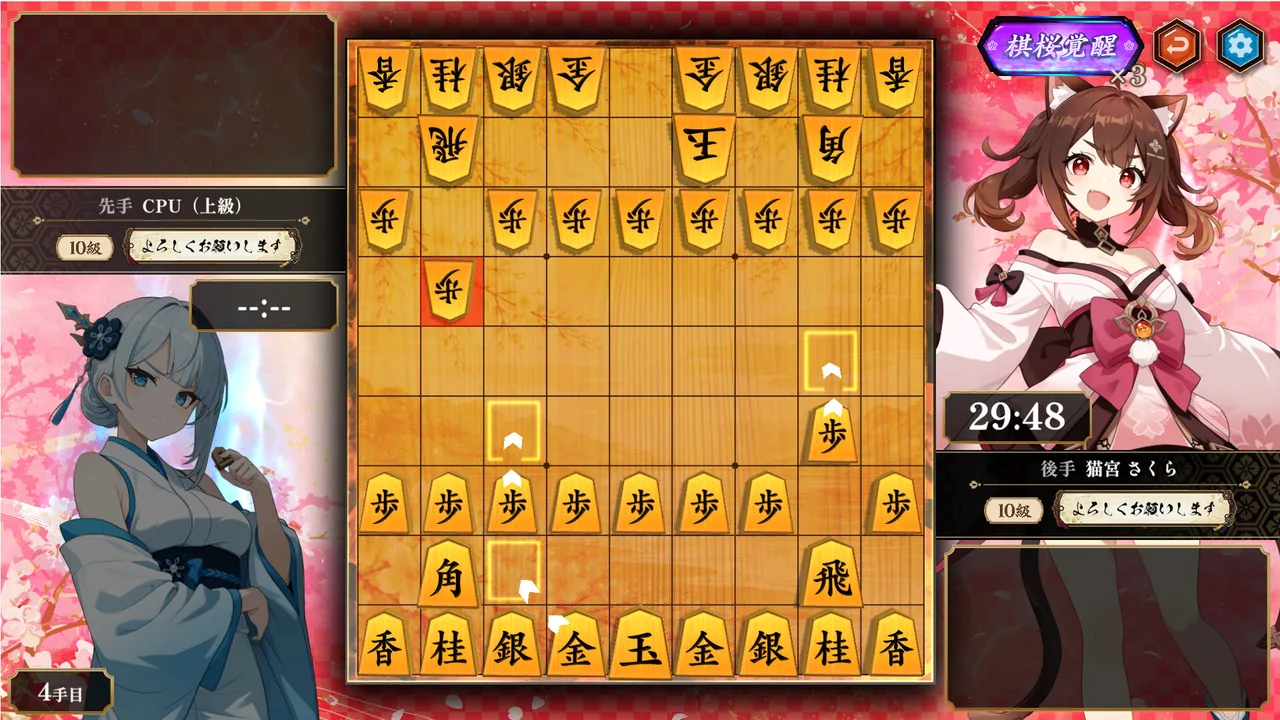
棋桜Image: 株式会社ネコノメ via Steam -
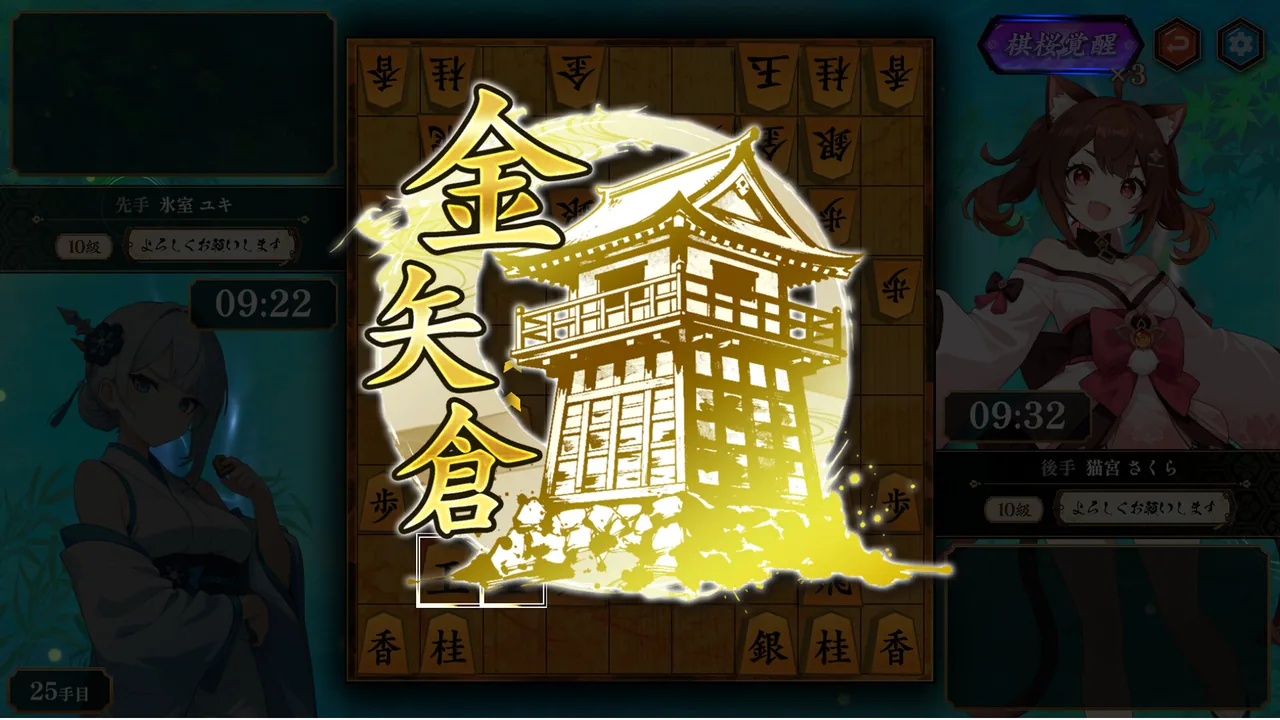
棋桜Image: 株式会社ネコノメ via Steam -
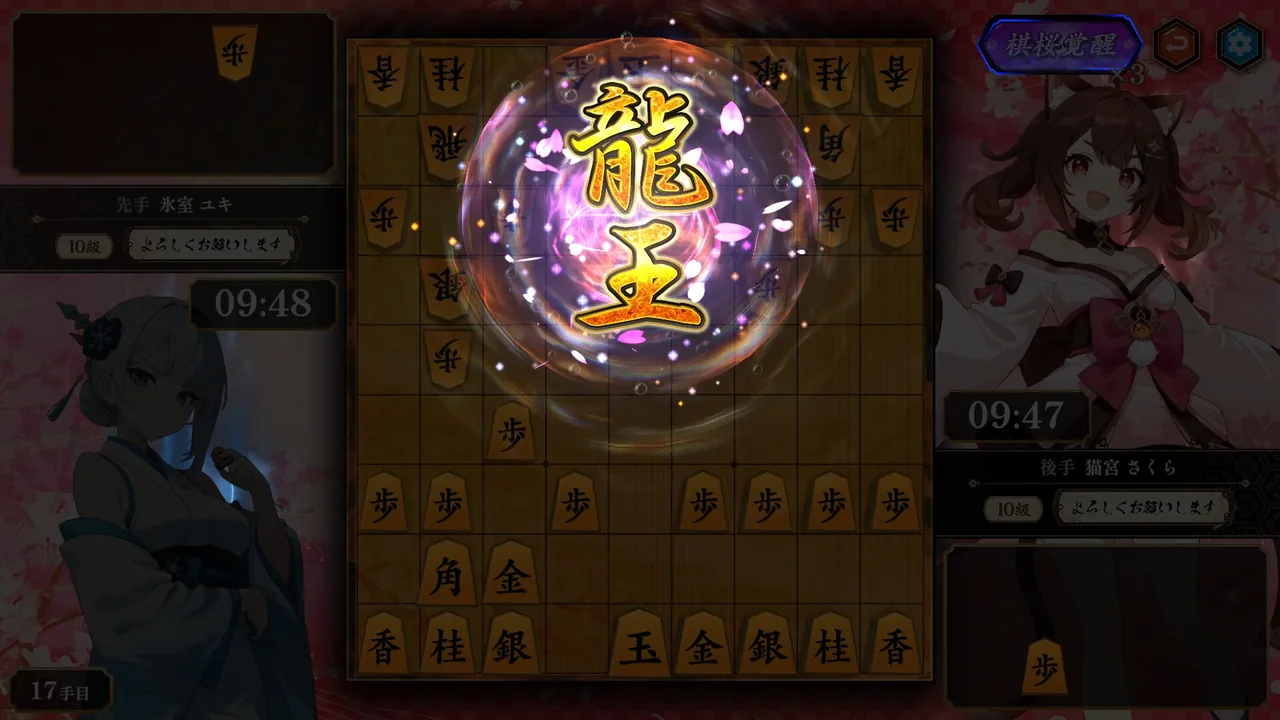
棋桜Image: 株式会社ネコノメ via Steam