Game review
Pragma Twice Review
7.5 / 10
- Developer
- Bryan Gillespie
- Publisher
- Bryan Gillespie
- Released
- 8 September 2026
- Platforms
- ["Windows"]
- Genre
- Simulation
You Wake Up as a Robot With Amnesia, and the Only Way Out Is to Write Real Code
Pragma Twice drops players into a dystopian research facility inside a newly awoken, programmable robot body, memories missing, a fresh hole where an old one used to be, and immediately hands them the one tool that matters: a real, working JavaScript editor. Every level is a puzzle solved by augmenting the robot's "kernel" with new functionality, registering a keyboard event to enable movement, writing a function to interact with a switch, automating a repetitive task the player has already solved by hand once. The game's defining choice is refusing to invent a simplified, game-specific scripting language: it's vanilla JavaScript, written in an in-game editor or an external one of the player's choosing, and virtually every object in the world, from blocks to switches to doors, exposes a real API that rewards actually reading its documentation. Levels are grouped into seven "corridors" of escalating complexity, and every one of them can theoretically be solved autonomously, with no keyboard input at all once the kernel is written, timing and code-golf-style solution length tracked as a form of bragging rights. Developed solo by Bryan Gillespie, it launched on September 8, 2026 at $9.99, alongside a free demo, with the game upfront that it teaches its own systems but not programming itself; players are expected to already know the language going in.
A Tiny, Unanimous Launch Among Players Who Already Speak the Language
Pragma Twice has drawn 7 reviews at the time of writing, every one of them positive, too small a sample for Steam to assign one of its usual descriptive tiers, but a clean, enthusiastic tally regardless. The pool is almost entirely English-language with a single Japanese-language review, and its reviewers skew heavily toward people who came in already comfortable writing code, several explicitly self-identifying as programmers evaluating the game on that basis.
Reviewers Say It's Genuinely Difficult, Genuinely Rewarding, and Built by Someone Who Understands Programmers
The praise across the pool centers on one thing above all: the game takes real programming seriously rather than gesturing at it. One reviewer calls it "rare to find a programming automation game that already expects you to know programming," framing that as a compliment rather than a barrier, while another, self-described as having their "brain thoroughly baked" by the fourth corridor, says they can't recommend it enough to anyone already comfortable in JavaScript. A recurring theme is the specific, cumulative satisfaction of the kernel system, one reviewer describes the robot growing more powerful "not just because the game gives you new tools but mostly because you've programmed it to be more powerful, it's your creation," singling out the built-in editor's multi-cursor support as a detail that matters to anyone who's been burned by clunkier in-game code editors before. The Japanese-language review, more technical in register, describes expecting a dumbed-down, game-ified version of JavaScript and instead finding an environment close to modern ES2025, calling it a comfortable space for actual web developers. More than one reviewer describes the "just one more level" pull as dangerously strong, with one joking that after finally putting the game down for the night, they wake up to go to work and do "the exact same things as in this game, except that Pragma Twice is much more fun." The reviewer furthest into the campaign, on the game's third of seven corridors, calls it "one of the more demanding programming games in terms of the required programming skills," specifically because there's no visual scripting layer to fall back on, and recommends the demo to anyone on the fence before buying.
A Real Barrier to Entry and an Editor With Room to Grow
Even inside a small, unanimously positive pool, the game's real limitations come through in the praise itself. Nearly every reviewer frames their recommendation with a caveat about prior programming knowledge, one self-described non-programmer, a dentist with only a small prior Arduino project to their name, says the game has been more approachable than expected once past an initial learning curve, but even that review frames the experience as unusually demanding relative to the reviewer's baseline. A separate reviewer, further along and clearly fluent in the language already, is blunter about who the game is and isn't for, writing they don't know "how doable it'd be for non-programmers" and stressing "it's definitely not a programming tutorial," a description that lines up with the store page's own upfront disclaimer. On the tooling side, the same reviewer who praised the editor's multi-cursor support flags that editor settings apparently can't be changed, a small but real friction point for anyone with strong preferences about their coding environment. Given how small and self-selecting the review pool still is this early, all seven positive and mostly from committed programmers, it remains genuinely untested how the game lands with players closer to the beginner end of the skill spectrum it politely warns them about.
Verdict
Pragma Twice succeeds at something few programming-puzzle games attempt: it hands players a real, unrestricted JavaScript environment and a genuine, documented API for the world around them, and trusts that the resulting challenge, not a simplified stand-in for one, is the appealing part. Its small early review pool is unanimous, and the praise it offers, a satisfying kernel-upgrade loop, a capable in-game editor, and puzzles that reward actually reading documentation, comes almost entirely from players who already knew how to code walking in. That's also its clearest limitation: this is explicitly not a programming tutorial, its editor has real rough edges like fixed settings, and how it plays for someone without existing JavaScript fluency remains genuinely unproven this early. At $9.99, with a free demo to test the water, this is an easy recommendation for anyone who already writes code and wants a puzzle game that respects that skill instead of diluting it; anyone hoping to learn to program by playing should look elsewhere first.
Screenshots
-
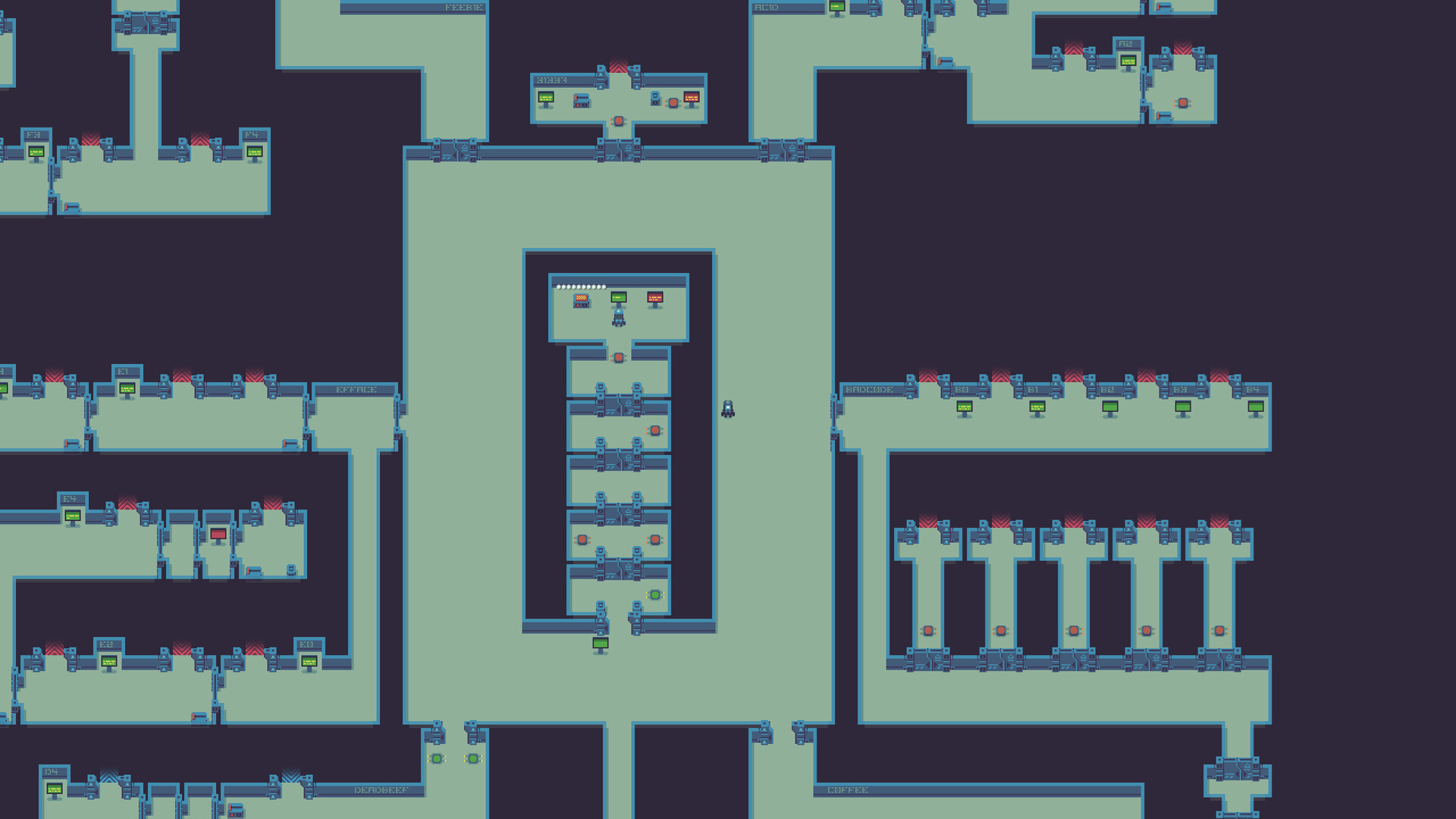
One of the facility's labeled corridor clusters, each room hiding its own terminal-and-switch puzzleImage: Bryan Gillespie via Steam -
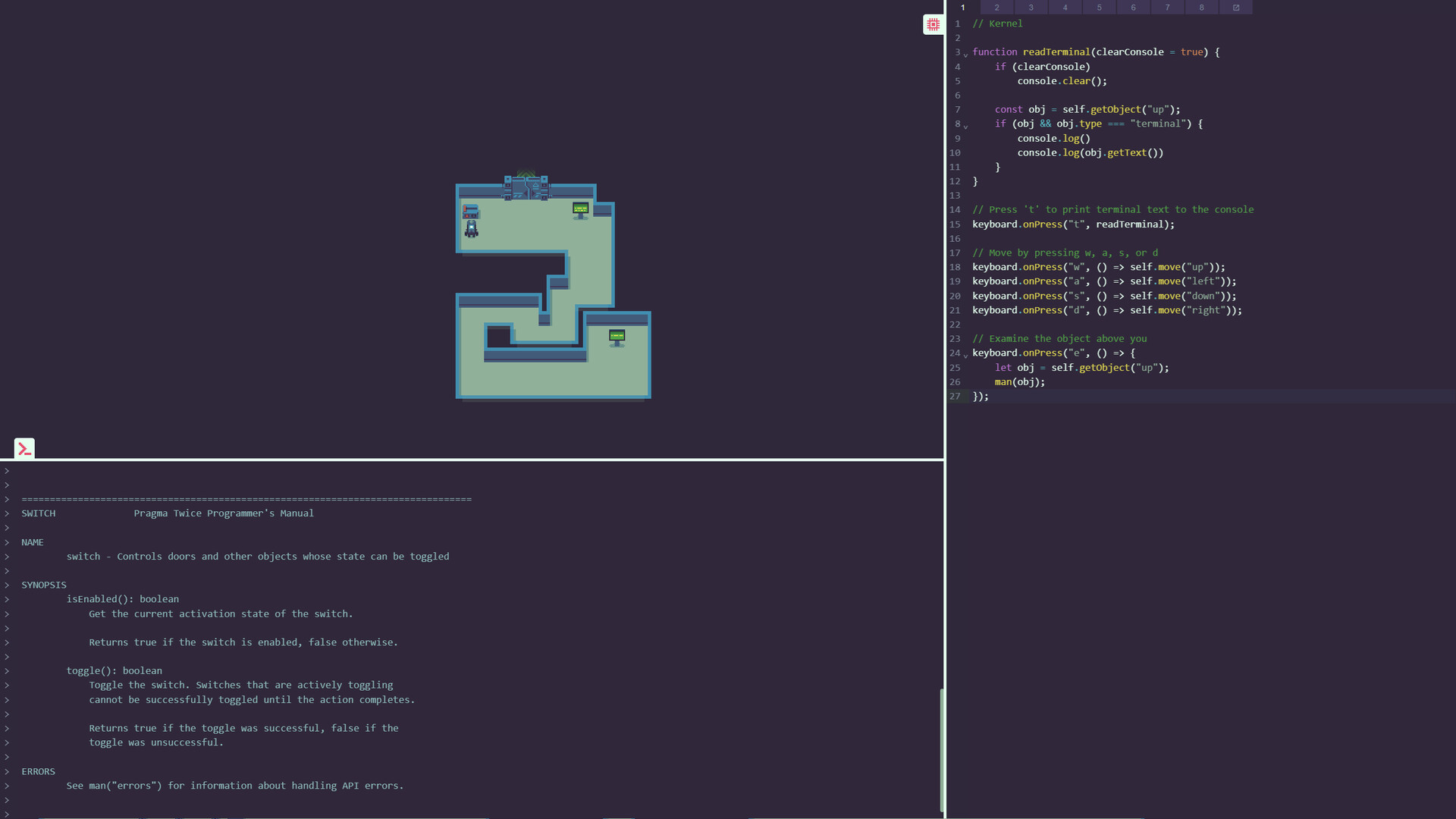
The in-game JavaScript editor and terminal, mid-way through registering movement and object-examination commandsImage: Bryan Gillespie via Steam -
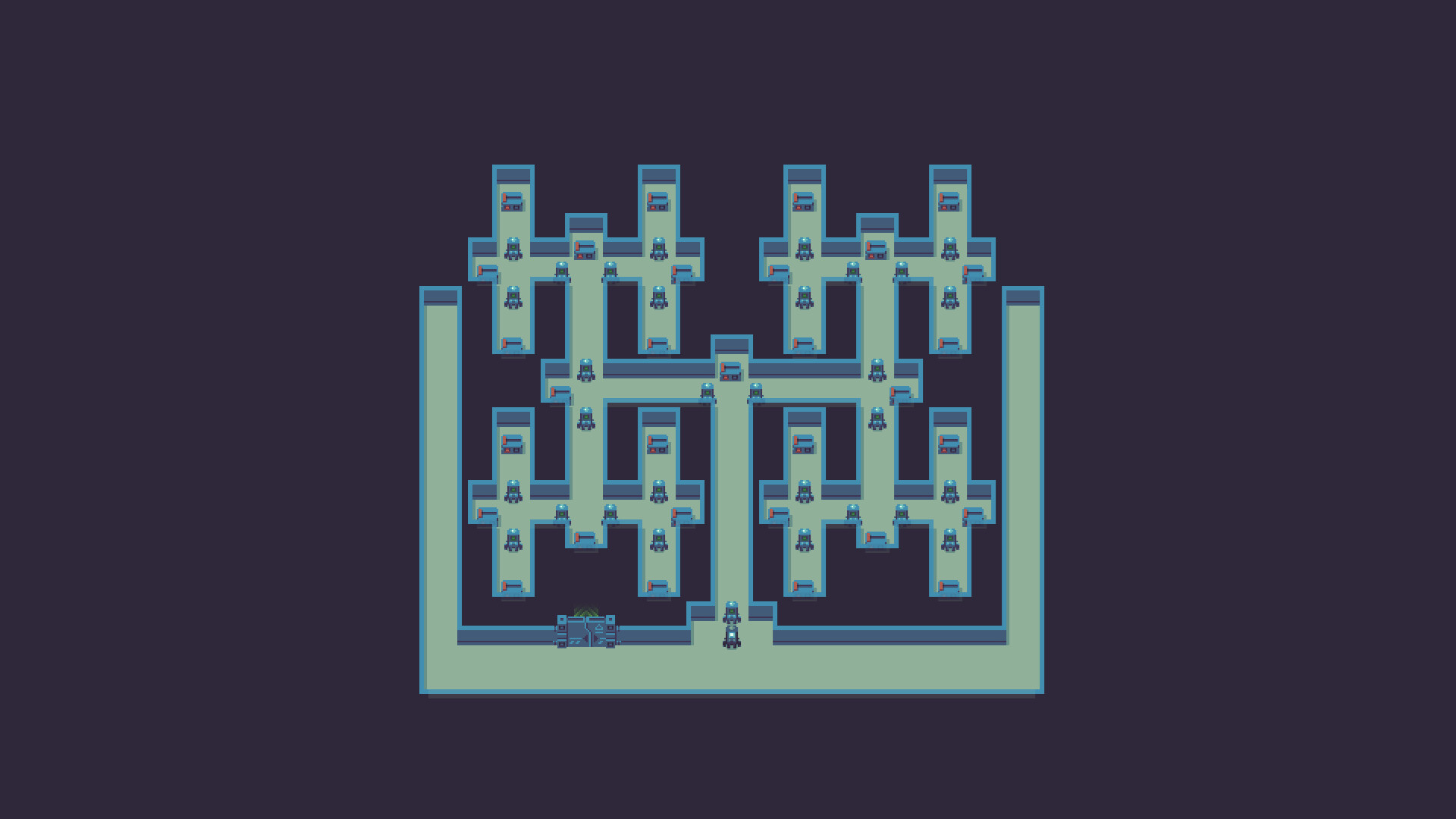
A later, more elaborate corridor layout, patrolled by multiple robots the player's kernel has to account forImage: Bryan Gillespie via Steam