Game review
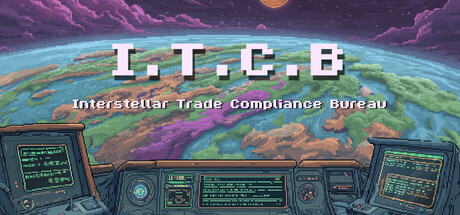
I.T.C.B - Interstellar Trade Compliance Bureau Review
4.7 / 10
- Developer
- Baseless Assumption Studio
- Publisher
- Baseless Assumption Studio
- Released
- 11 September 2026
- Platforms
- ["Windows"]
- Genre
- Simulation
Abducted, Handed a Spreadsheet, and Told to Cope
I.T.C.B - Interstellar Trade Compliance Bureau opens with a joke of a premise that the rest of the game plays remarkably straight: you've been abducted by aliens, picked essentially at random, and installed as the operator of their trade terminal. From there it's a resource-chain management sim in the Factorio-adjacent mold, minus the belts and the direct manual building placement, layered under a bureaucratic corporate ladder that reviewers describe as intentionally, amusingly opaque. You manage a growing population's happiness, convert raw resources into increasingly complex goods across escalating production tiers, and sell the surplus on a galactic market whose prices swing with in-game events. Developed and published by the small studio Baseless Assumption Studio, I.T.C.B launched on Steam on September 11, 2026, priced at $9.99, with a launch discount currently bringing it to $8.49. Multiple reviewers specifically note the developer shipping several balance patches within days of release, a level of post-launch attentiveness that shows up repeatedly across the review pool, for better and for worse.
A Genuinely Mixed, Actively Discussed Launch
I.T.C.B has drawn 29 reviews so far, splitting 14 positive to 15 negative for a "Mixed" rating right at the midpoint. That even split isn't a sign of an ignored or unremarkable release, it reflects a small but engaged audience arguing over specific, well-articulated disagreements about pacing, balance, and interface rather than drifting apart on vague vibes. Several reviewers explicitly reference watching the game change under them mid-playthrough, editing or softening their verdicts as patches landed, which speaks to a developer still actively tuning the game rather than one that shipped and walked away.
A Genuinely Novel Setting, With Real Systemic Depth Underneath
What keeps even critical reviewers engaged is the premise and the resource-chain systems built around it. One reviewer compares it favorably to Prun, describing it as the sci-fi trading sim they'd been waiting years for without a subscription-model price gouge attached, and another calls the alien-dashboard framing for the confusing UI a clever bit of theming even while wishing the execution were sharper. A reviewer with over 900 minutes logged compares the core loop to "Factorio without the belts, with unlimited storage," praising the lack of a real penalty for overbuilding once resource costs stop mattering at scale. Several others single out the "niche setting" as the game's strongest asset, one calling it a "zen clicker" with a unique flavor that simple clicker games don't usually offer, and a longtime player who reached cycle 30-40 describes the handful of basic mechanics combining into something simple in principle but genuinely hard to master. One reviewer frames the whole thing as a spreadsheet-lover's game in almost tongue-in-cheek terms, joking that satisfaction comes from watching rows fill up rather than understanding why the alien populace is happy, before adding, more seriously, that it could still use more graphs and trackable price history to fully lean into its trading-sim framing rather than settling for what one other reviewer calls "more of a production sim" that actively discourages buying resources at all.
Merciless Pacing, a Punishing UI, and Exponential Demand Against Linear Output
The negative half of the pool converges hard on three specific, recurring complaints. The most common is pacing: multiple reviewers say the game rushes decisions with no way to slow down, and ask, repeatedly and independently, for a pause button or a time-scale setting, since even reading a popup description can cost the player a critical window to react. One reviewer says they'd have enjoyed the game at a third of its current speed; another calls the early cycles unforgiving enough that they restarted four or five times before making it past the initial tier-three goods. The second recurring complaint is the interface itself, described by one reviewer as "90% UI" built from dense screens of "teeny little text" that require repeated clicking just to check prices, compounded by an overused CRT filter effect that several reviewers say actively hurts legibility rather than adding atmosphere. The third, and most structurally serious, complaint is a mismatch between linear production scaling and exponential demand growth: multiple reviewers independently describe building a stable, profitable operation only to watch it collapse once higher-tier goods unlock and demand outpaces what a linearly-scaling factory can produce, with one reviewer noting the game briefly became "impossible" after one patch before a follow-up patch swung it the other way into "far too easy." A couple of reviewers also raise a more pointed concern: that a noticeable share of the game's art and writing reads as AI-generated, with one reviewer bluntly opening their review with a mock prompt ("ChatGPT - Build a resource trading game, make no mistakes or interesting elements") and another separately stating outright that "a large number of assets are definitely AI-generated," while adding that this didn't necessarily ruin their experience of the underlying systems. Neither reviewer offers direct proof, but both raise the accusation independently and specifically enough that it's worth reporting as part of the game's reception rather than leaving out.
Verdict
I.T.C.B - Interstellar Trade Compliance Bureau has a premise worth the price of admission on its own, an abducted trade terminal operator serving an alien economy nobody bothers to fully explain, and it backs that premise with a resource-chain system that reviewers on both sides of the fence describe as genuinely absorbing once it clicks. The problem is that "once it clicks" is doing a lot of work in that sentence: an unforgiving pace with no pause option, a UI reviewers repeatedly call cluttered and hard to parse, and a production curve that swings between unbeatable and trivial depending on which week's balance patch you happen to load into add up to a launch that earned its even 14-to-15 review split honestly. The developer's visible, rapid post-launch patching is a genuine point in the game's favor, and a couple of reviewers who initially bounced off it describe coming back around once things settled, but right now I.T.C.B is a game with real ideas and real systemic depth that still asks a bit too much patience of the player before rewarding it, and the unresolved AI-generated-assets accusation from at least two independent reviewers is worth knowing about going in. For players drawn specifically to niche economic sims willing to ride out a rocky, still-being-tuned launch, there's a good game somewhere inside I.T.C.B; for anyone else, it's worth waiting for a few more patches first.
Screenshots
-
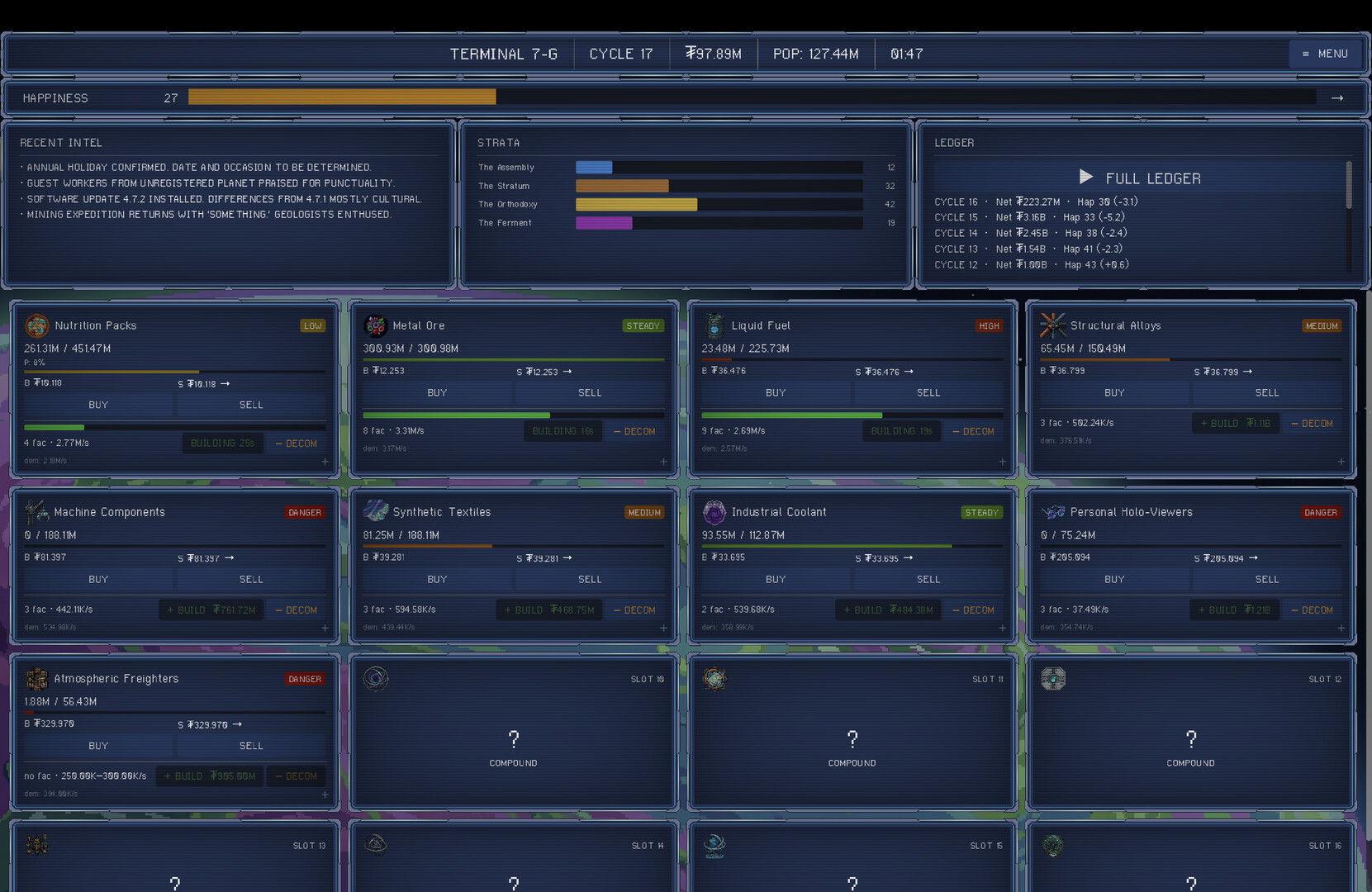
The dashboard packs happiness, faction standing, a full resource grid and buy/sell prices onto one dense screen, the density reviewers most often cited as the interface's biggest problemImage: Baseless Assumption Studio via Steam -
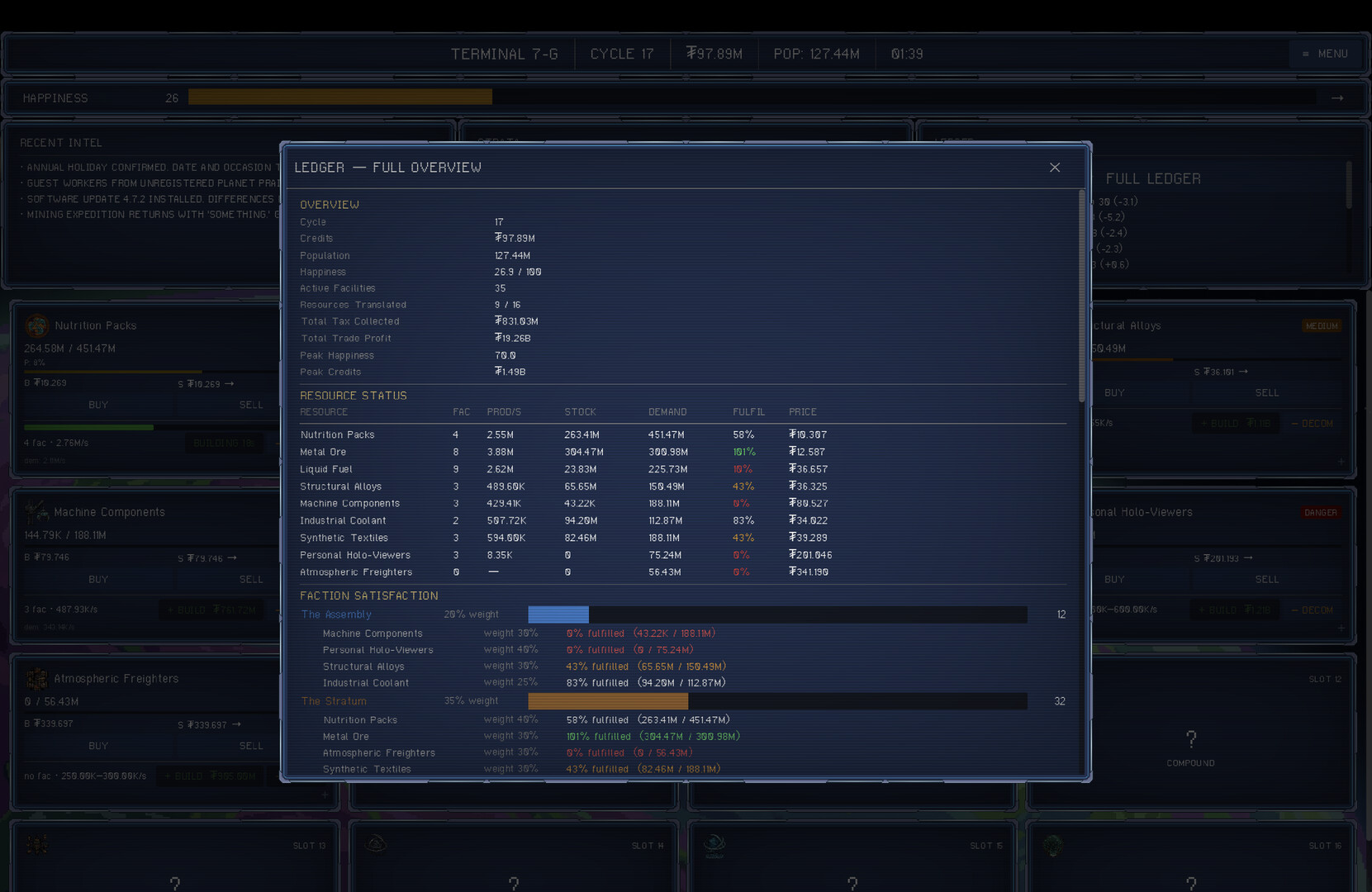
The full ledger view breaks down demand fulfillment resource by resource and faction by faction, the kind of granular detail spreadsheet-minded reviewers praised even as others found it overwhelmingImage: Baseless Assumption Studio via Steam -
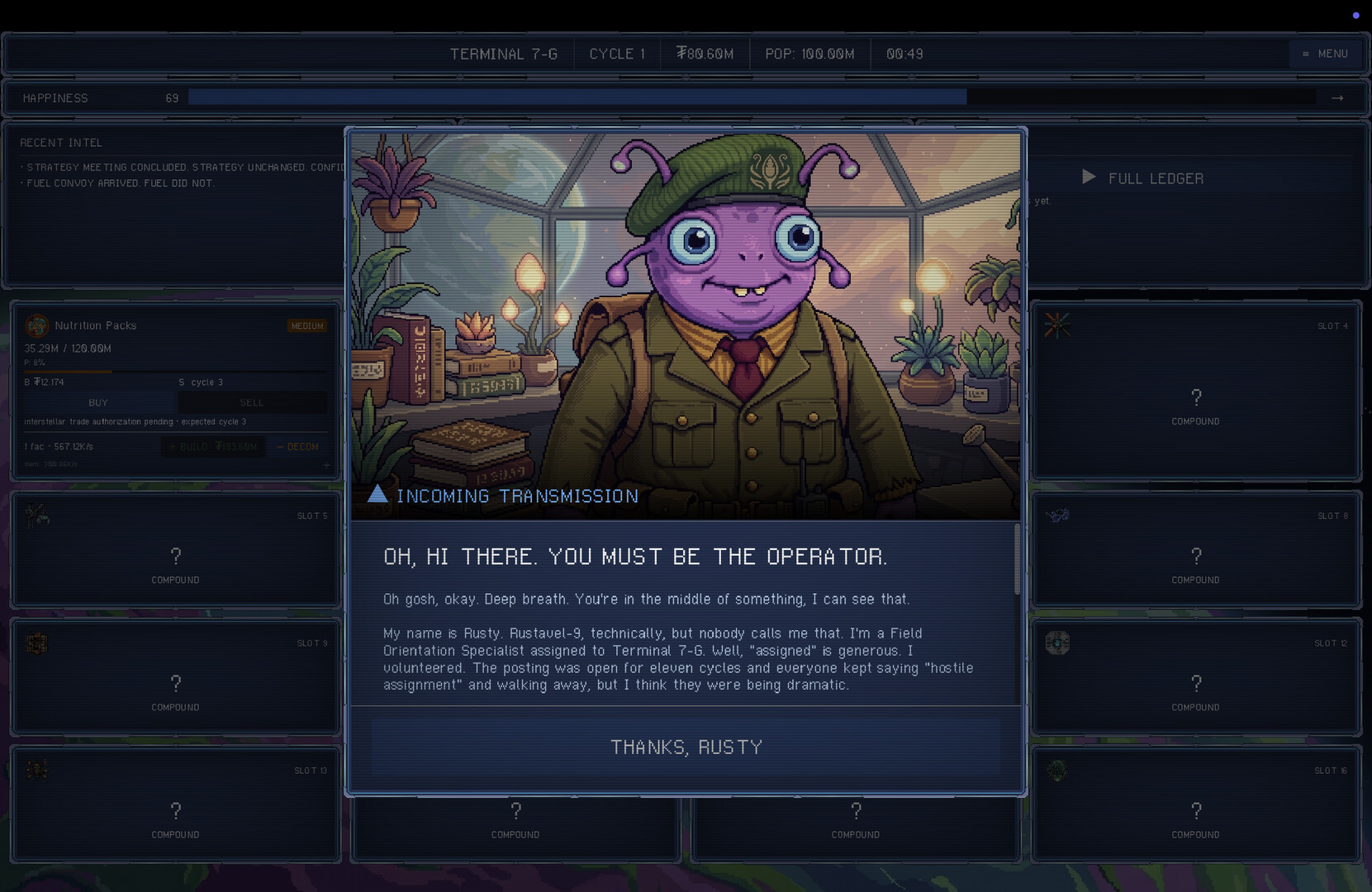
Rusty, a field orientation specialist, is one of the game's recurring comic voices, the kind of writing reviewers called genuinely charming even as they lost patience with the systems underneath itImage: Baseless Assumption Studio via Steam