
Game review
Police Officer Review
5.1 / 10
- Developer
- Turquoise Games
- Publisher
- TK Interactive
- Released
- 26 August 2026
- Platforms
- ["Windows"]
- Genre
- Simulation
Running the Station, Not Just Patrolling the Streets
Police Officer puts the player behind the front desk of a police station rather than behind the wheel of a patrol car, and that's the game's clearest point of differentiation from the crowded field of cop-themed sims. Instead of chases and shootouts, the bulk of play is procedural: checking suspects' identification against their physical description, running breathalyzer and drug tests, searching pockets and bags for contraband, and deciding whether a detainee gets a warning, a stint in a holding cell, or a trip to court. Reviewers who came in expecting an action game are consistently surprised, and mostly pleasantly, to find something closer to Papers, Please or Quarantine Zone: The Last Check, filtered through a police-station setting rather than a border checkpoint or medical facility.
Several reviewers single out the moment the game clicks into place: when several systems start competing for attention at once. A detainee needs processing, the holding cells are filling up, officers need dispatching to calls, and an investigation is sitting untouched. That layered pressure, more than any individual mechanic, is what reviewers repeatedly credit with making the "controlled chaos" of running a station feel genuinely engaging rather than just a checklist of chores. It's a simulation about administration and triage as much as it is about law enforcement, and the reviewers most receptive to that framing tend to be the ones most enthusiastic about the game overall.
A Progression System That Actually Rewards Attention
The station itself grows over the course of a playthrough, and that growth is one of the more consistently praised elements in the review pool. Hiring and assigning officers, upgrading interrogation rooms and security equipment, and expanding capacity all layer on top of the base identification-and-processing loop, and reviewers describe the difficulty curve as well-paced: calm and easy to parse in the opening hours, then busier and more demanding as the station scales up and more is asked of the player at once. Several reviewers explicitly call out losing track of time because the escalating workload kept pulling them back in for "one more day."
Not every addition lands as well. Periodic raid missions send the player into an on-rails shooting sequence, and reviewers are far less charitable here, describing the shootouts as simplistic, visually cheap, and tonally disconnected from the deliberate, procedural pace of the rest of the game — more than one reviewer asks for an option to disable them outright. A recurring side activity that has the player clubbing rats around the station for a small cash bonus draws a similar reaction: reviewers find it a strange, slightly jarring tonal mismatch for a game that otherwise plays things fairly straight, even when they find it funny in isolation. The core management loop is strong enough to carry the game regardless, but both additions read as filler bolted onto a more focused idea rather than genuine extensions of it.
When the Developers' Own AI Disclosure Undercuts the Verification Mechanic
Police Officer's store page discloses that the developers used AI-generated content for suspect ID photos and some background illustrations, and that disclosure becomes a significant point of friction once players actually start relying on those photos for the game's core identification mechanic. A large share of the negative reviews center specifically on this: the AI-generated ID portraits frequently don't resemble the in-engine character models closely enough to make an honest visual comparison, which several reviewers say turns what should be a skill-based verification check into a coin flip. Multiple reviewers extend the criticism beyond the disclosed scope, arguing the character voice lines, station art, and even some assets feel AI-generated throughout, and a few say that impression alone was enough to sour them on an otherwise interesting concept.
It's worth noting this is a genuinely split issue rather than a universal complaint — plenty of positive reviews don't mention it at all, and focus instead on the management loop working as intended. But for a game whose central mechanic is "does this photo match this person," a mismatch between the AI-generated reference image and the character it's meant to represent is a real, frequently cited problem rather than a cosmetic one, and it's the single most common thread running through the game's negative reviews.
Bugs, Ultrawide Support, and a Rough Launch
Beyond the AI-image complaints, the review pool paints a picture of a functional but rough launch. Ultrawide and widescreen monitor users report that some in-game menus, including the officer recruitment screen, place interactive buttons outside the visible play area, making parts of the game unusable without switching to a standard resolution and windowed mode. Other reviewers describe recurring bugs around holding-cell logic, where players are financially penalized for both holding intoxicated suspects too long and for releasing them too soon, a contradiction more than one reviewer flags as a genuine design bug rather than intended friction. Reports of stuck NPCs, achievements failing to register, and a tablet interface locking up mid-session also recur across the negative and mixed reviews, alongside general performance hitches during longer sessions.
None of this appears to be universally game-breaking — several reviewers with substantial playtime report a largely stable experience and simply note the rough edges in passing — but the frequency and specificity of the bug reports, combined with the resolution-support gap, is consistent enough across the review pool to treat as a real, current-state issue rather than a handful of isolated complaints.
Verdict
Police Officer has a genuinely interesting hook: a police procedural built around administrative pressure and station management rather than car chases, and when that loop is firing on all cylinders, reviewers describe real depth in balancing detainee processing, officer assignments, and station growth against each other. The problems are concentrated in a few specific places rather than spread evenly across the whole experience — AI-generated ID photos that undermine the core verification mechanic, tacked-on raid sequences that clash with the game's own tone, and a batch of technical issues including poor ultrawide support that shouldn't have shipped as-is. None of these are fatal on their own, and reviewers who look past them tend to walk away recommending the game anyway, but taken together they're enough to make this a "wait for patches" pick rather than a confident day-one buy at full price.
Pros:
- Distinctive station-management focus that stands apart from typical cop-chase games
- Genuinely engaging pressure once multiple systems compete for attention at once
- Well-paced difficulty curve tied to station growth and officer hiring
- Procedural verification mechanics (IDs, searches, tests) give decisions real weight
- Strong word of mouth from reviewers who look past its rough edges
Cons:
- AI-generated ID photos frequently don't match character models, undermining the core mechanic
- Raid shooting sequences feel cheap and tonally mismatched with the rest of the game
- Poor ultrawide/widescreen support blocks some menus from working correctly
- Contradictory holding-cell penalties and other logic bugs reported repeatedly
- Repetitive suspect and raid rotation once the early-game novelty wears off
Screenshots
-
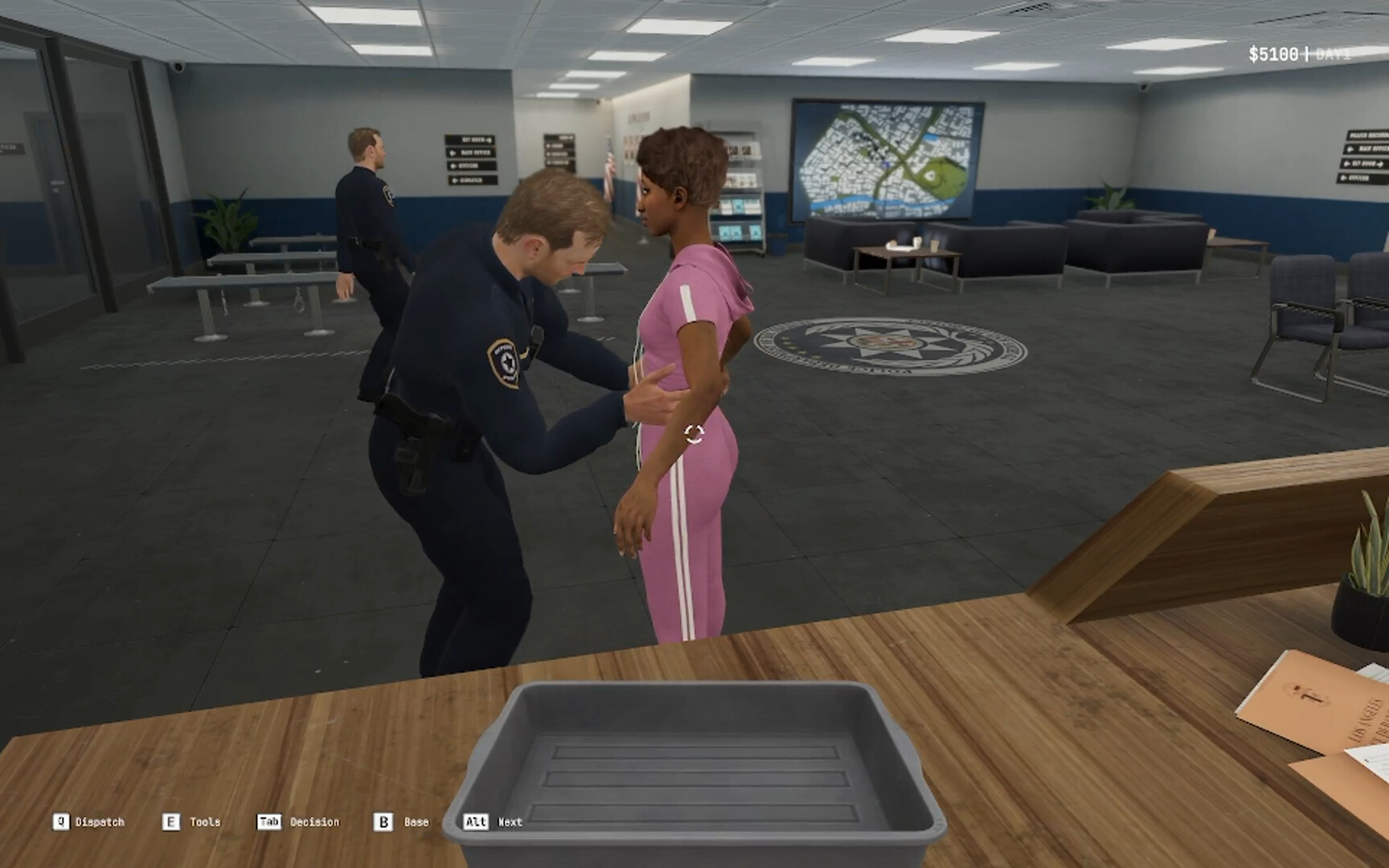
Processing a detainee at the station's front deskImage: Turquoise Games -
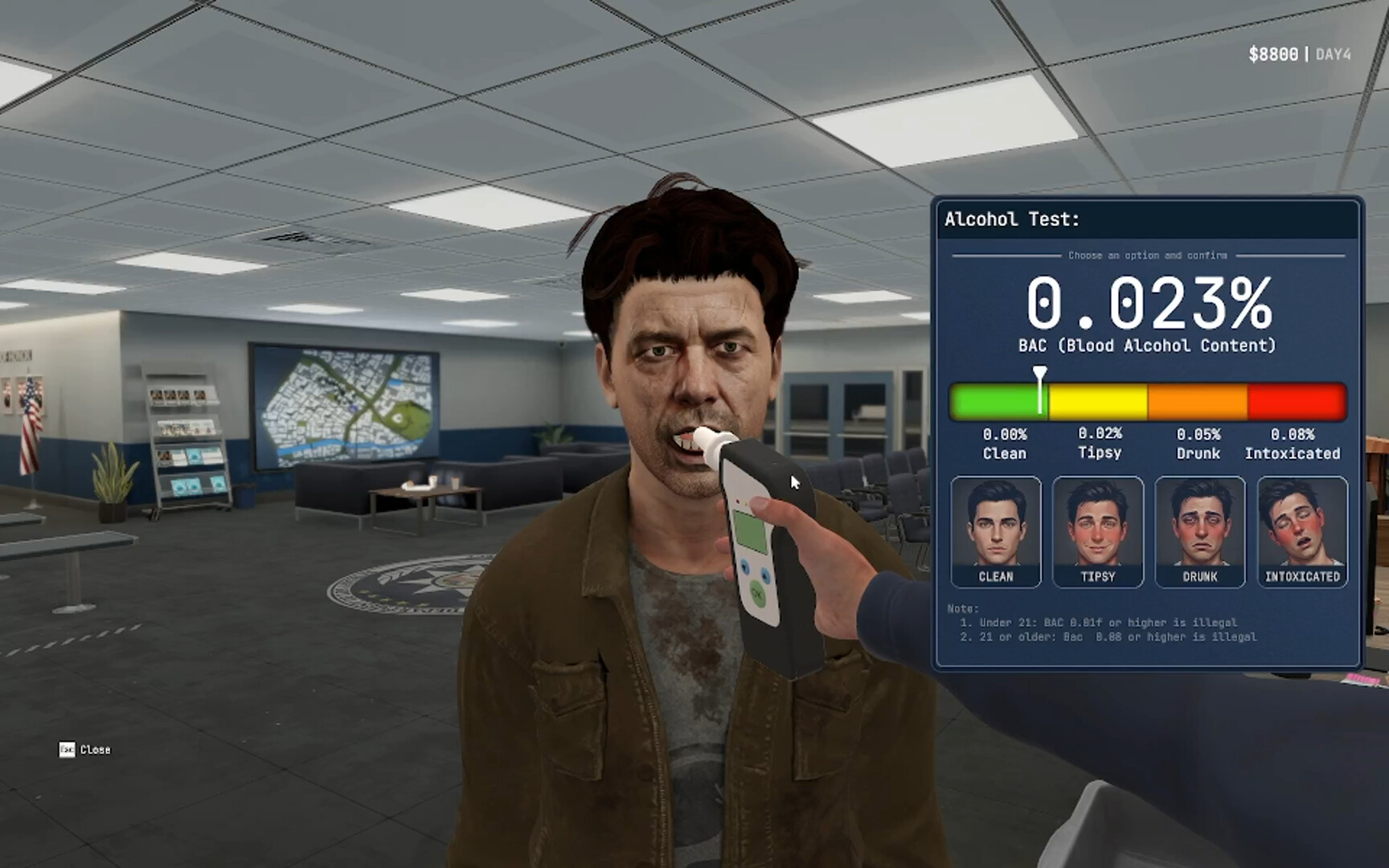
Running a breathalyzer test during a suspect intakeImage: Turquoise Games -
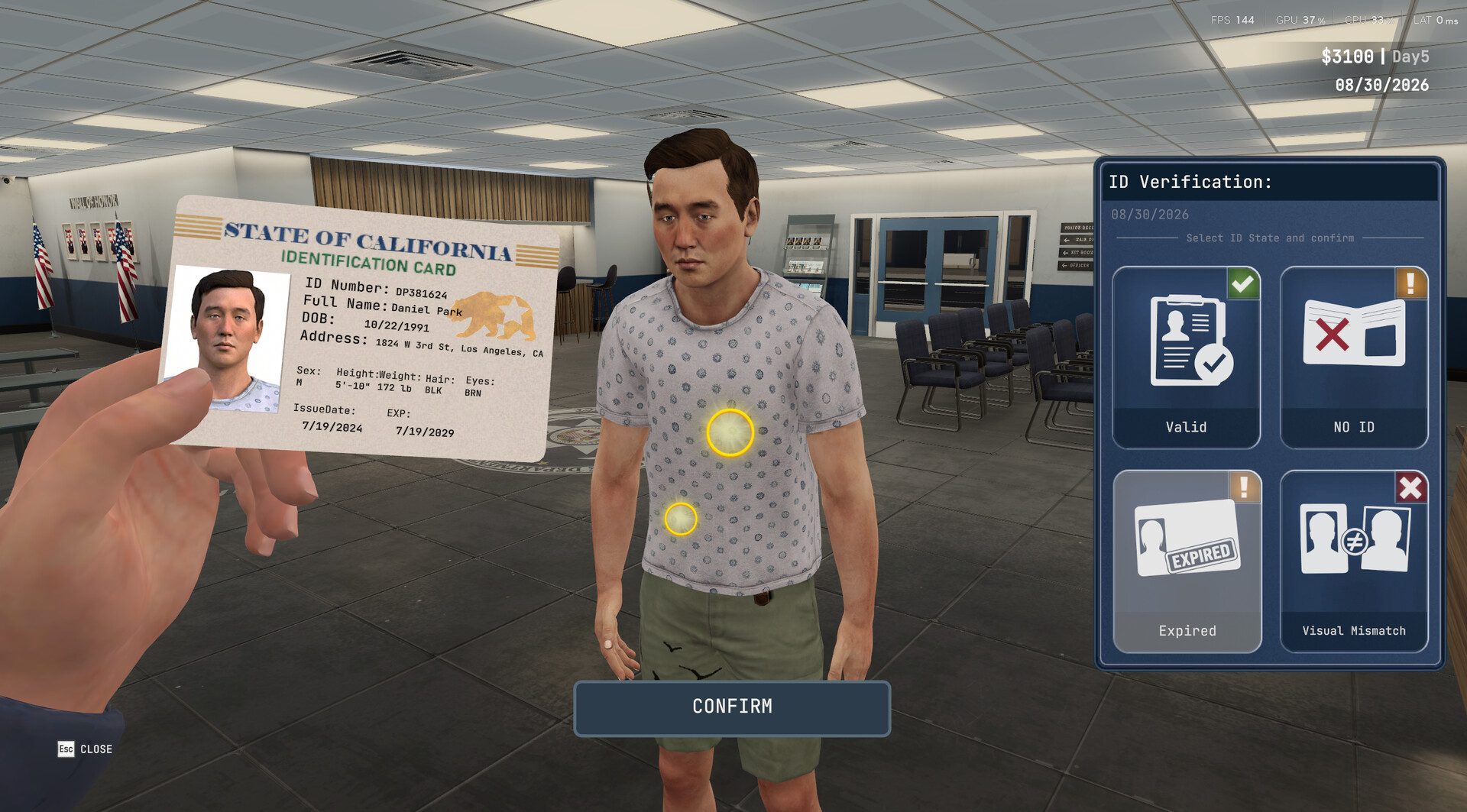
Comparing a suspect's ID photo against their appearanceImage: Turquoise Games -
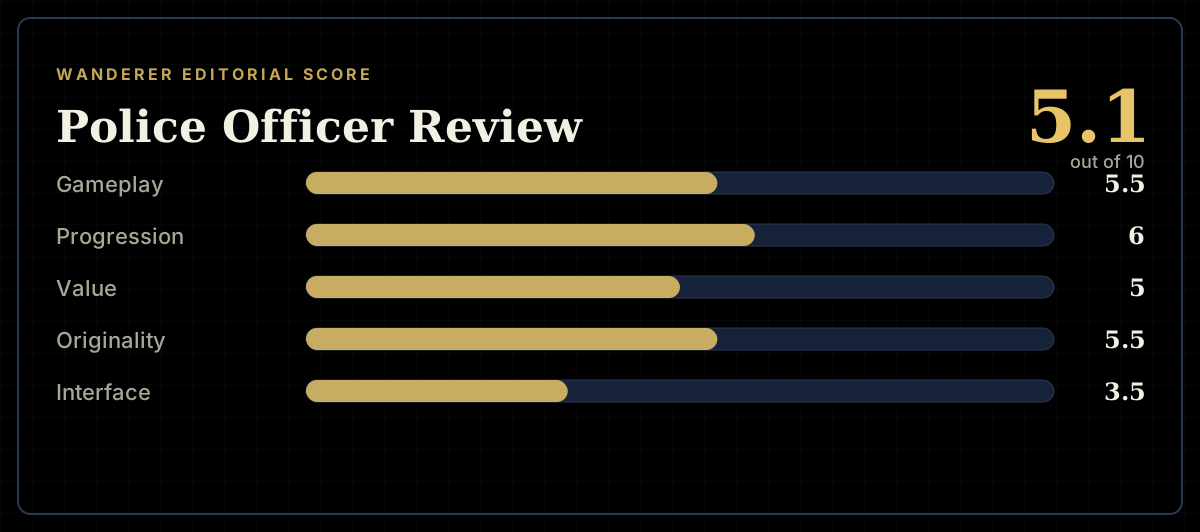
How the review scores each part of the gameWanderer Editorial -
The short versionWanderer Editorial