
Game review
YiJing 101 Review
6.6 / 10
- Developer
- Yi
- Publisher
- Yi's Studio
- Released
- 8 September 2026
- Platforms
- ["Windows"]
- Genre
- Casual
Learning the I Ching Through Lessons, Quizzes, and a Digital Divination Tool
YiJing 101 is exactly what its title promises: an educational piece of interactive software built around teaching the Yi Jing, the ancient Chinese classic of divination and philosophy known in English as the I Ching, to players with no prior background. The store page is upfront that this isn't a fortune-telling app dressed up as education, it frames the Yi Jing as "a way of observing the world" rather than a party trick, and structures its content as a progressive curriculum: lessons walk through the foundational concepts of yin and yang, the eight base trigrams, and eventually the sixty-four compound hexagrams built from pairing them, interspersed with short scenario-based mini-games and quiz questions meant to reinforce what was just taught. Once players have some grounding in the system, the game also includes a digital hexagram-casting tool for generating and interpreting a reading in the traditional divinatory sense. Developed and published by solo creator Yi under Yi's Studio, it launched on September 8, 2026 at a budget $2.99, with Chinese-language support and cloud saves, though no achievements at launch.
A Small, Mostly Positive Launch From a Niche, Culturally Specific Audience
YiJing 101 has drawn 22 reviews at the time of writing, 20 positive and 2 negative, landing comfortably in Steam's "Positive" tier. The review pool is almost entirely Simplified Chinese, unsurprising for a piece of educational software built around a specifically Chinese classical text, and reads like a genuinely engaged niche audience, several reviewers are longtime Yi Jing enthusiasts evaluating the game as a study aid rather than casual players stumbling onto it by accident.
Reviewers Praise an Accessible, Cheap Entry Point Into a Genuinely Dense Subject
The praise across the pool centers on accessibility. Multiple reviewers describe the game as breaking down famously dense, difficult-to-parse concepts into something a complete beginner can actually follow, with one calling it "very suitable for people with zero foundation to slowly understand" the subject, low barrier to entry paired with light practice exercises to reinforce what's learned. Several reviewers frame the software as a genuinely more convenient alternative to working through a dense physical book, and more than one says the experience left them wanting to go buy a real Yi Jing text to continue studying afterward, a strong signal that the game is succeeding as a gateway rather than a shallow gimmick. The price draws repeated, enthusiastic praise too, with reviewers calling $2.99 an easy, no-brainer purchase to "support Chinese classical culture," and more than one framing their purchase explicitly as support for an unusual, culturally specific project they were glad to see on Steam at all. A few reviewers describe using the built-in divination tool for its intended purpose after finishing the lessons, casting a hexagram for fun or reflection, and one suggests pairing the experience with calming music and incense for a more contemplative session.
A Notably Thin Practice Bank, No Dark Mode, and One Sharp Accusation of AI-Generated Content
The criticism in YiJing 101's pool is specific and points to a genuinely early, thin piece of software. The most common complaint by far is the shortage of practice material: multiple reviewers say the quiz question bank is too small to meaningfully reinforce the lesson content, with one saying they only felt they'd learned "the surface" of the subject despite finishing what's there, and several explicitly requesting more exercises in future updates. Interface complaints are consistent too: reviewers report no dark mode despite the subject matter's own yin-and-yang framing making that an obvious fit, no way to page backward through a lesson without exiting and re-entering it, and long stretches of unbroken text without supporting illustrations that several reviewers say make the material harder to retain. The digital divination tool draws its own specific complaints, one reviewer wanted the option to manually cast hexagram lines or use a time-based casting method rather than relying solely on the built-in randomizer, and noted there's no way to look back at past readings once they've been made. The pool's most pointed negative review goes further than content gaps, accusing the lesson text of reading like an AI-generated encyclopedia entry rather than carefully authored teaching material, arguing that key relationships between trigrams, such as why specific elements and family roles are assigned to specific hexagrams, are stated without explanation, leaving a motivated learner unable to actually understand the reasoning behind what they're memorizing.
Verdict
YiJing 101 fills a genuinely unusual niche well enough to earn its "Positive" standing: a cheap, low-friction way to get a real beginner's foothold in a genuinely difficult classical subject, delivered by someone who clearly cares about the material and at a price that makes the attempt basically risk-free. Its reviewers, largely people who already had some interest in the Yi Jing walking in, consistently credit it with making foundational concepts click and, in more than one case, sending them off to buy a real book to keep learning. But this is thin, early software: a quiz bank multiple reviewers call too small, an interface missing basic conveniences like a lesson back button and a dark mode, and at least one detailed, credible complaint that the teaching text explains what things are called without adequately explaining why, alongside a pointed accusation that some of that text reads as AI-generated rather than carefully composed. At $2.99, this is a reasonable low-stakes way to dip a toe into Yi Jing study, provided you go in expecting a promising first draft of an educational tool rather than a complete one.
Screenshots
-
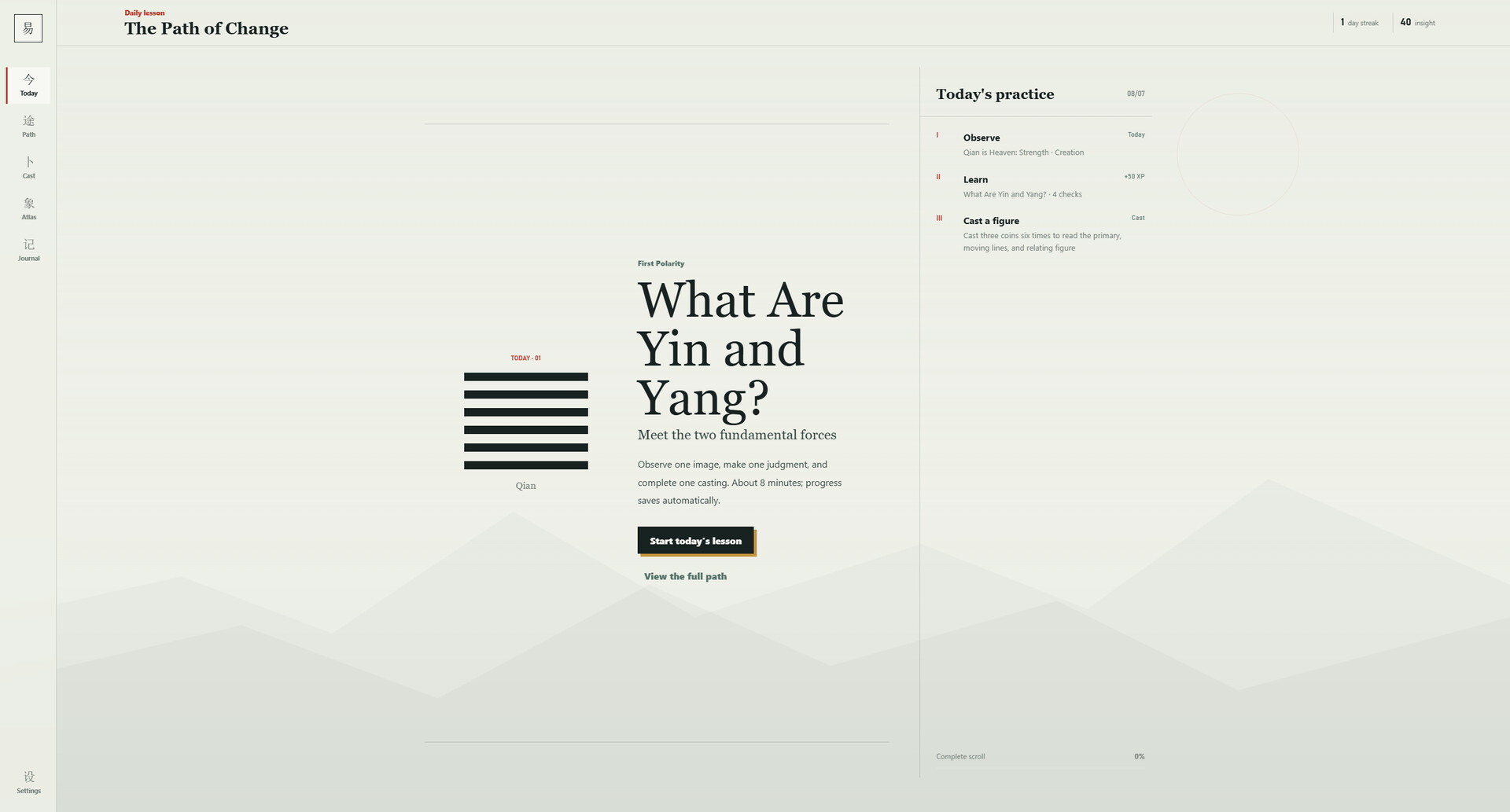
A daily lesson screen, introducing the Qian trigram and the day's observe-learn-cast practice stepsImage: Yi's Studio via Steam -

The coin-casting tool used to generate a hexagram reading, six throws building the figure from the bottom upImage: Yi's Studio via Steam -
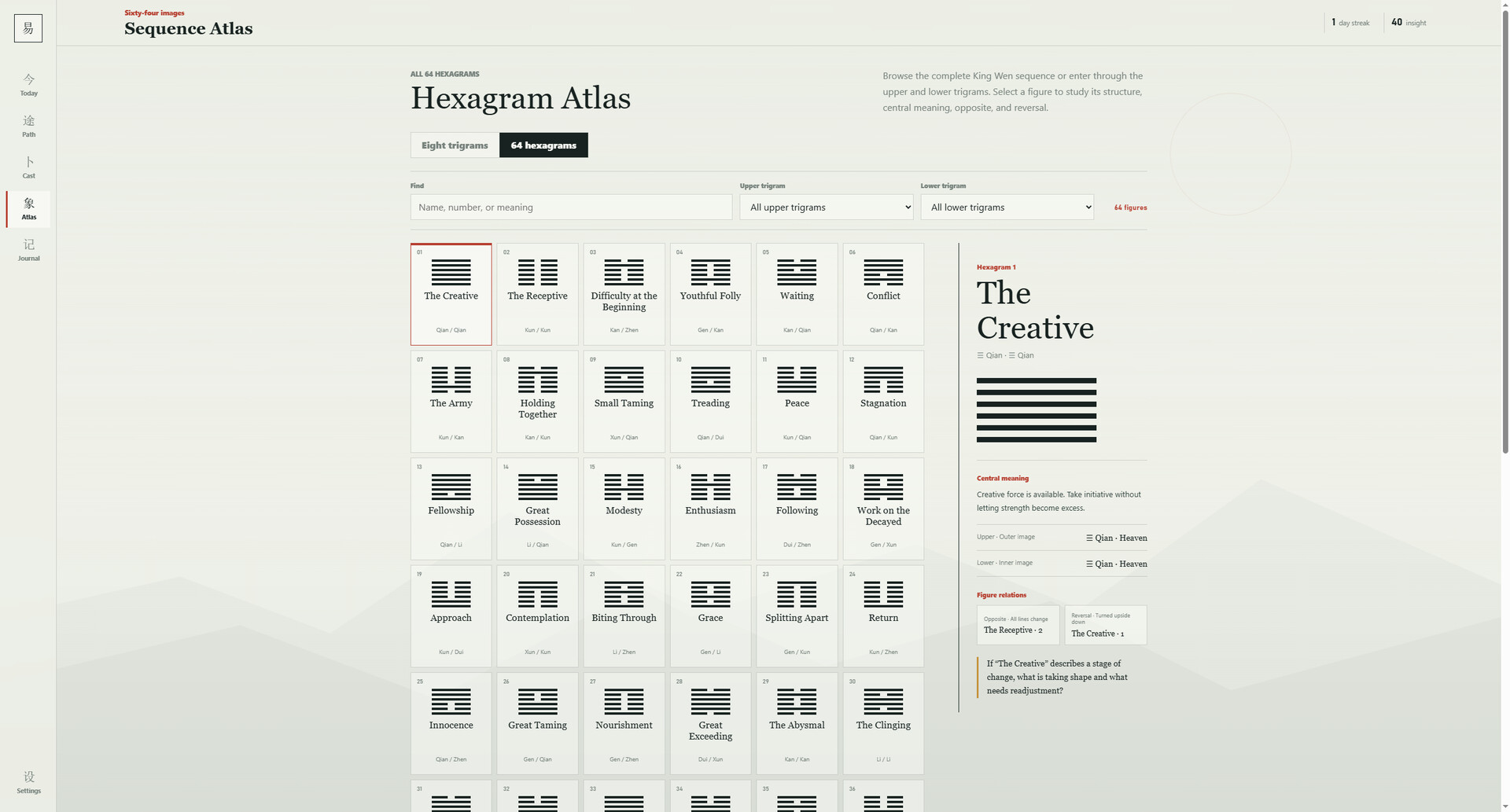
The Hexagram Atlas, letting players browse and look up the meaning of any of the 64 hexagramsImage: Yi's Studio via Steam