Game review
Put Back Stuff Review
6.6 / 10
- Developer
- Shellbunny
- Publisher
- Shellbunny
- Released
- 13 September 2026
- Platforms
- ["Windows"]
- Genre
- Casual
Restocking a Supermarket, One Legally Distinct Product at a Time
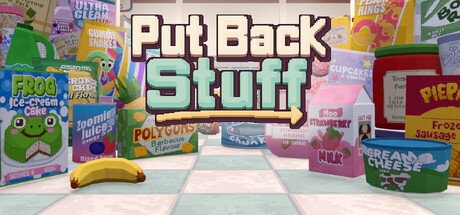
Put Back Stuff is a cozy, first-person organization simulator that drops players into the role of a new supermarket worker tasked with sorting thousands of scattered items back onto their correct shelves. It's an entry in the fast-growing "tidying" genre alongside games like Unpacking and A Little to the Left, but its hook is a distinctly Australian grocery store stocked with parody versions of real regional snacks and pantry staples, from Anzac biscuits and lamingtons to a suspiciously familiar cola and a clearly-not-Vegemite spread. Each shelf carries a category label, like dairy or bakery, and glows red when a player tries to place a mismatched item there; once an item claims a compartment, that slot is reserved for its type until manually cleared, and placing the first copy reveals how many total copies are needed to fill it. Players start out carrying only five items at a time, though a pushable shopping cart later expands that limit considerably, and the game backs its slow, meditative pace with a customizable in-game playlist, a wide slate of accessibility options including colorblind variants and motion-sickness settings, and Steam Achievements tied to specific completion styles. Developed and published solo by Australian developer Shellbunny, Put Back Stuff launched on Steam on September 13, 2026, priced at $5.99, with a public roadmap already promising additional store areas beyond the base supermarket.
A Small but Overwhelmingly Positive Launch
Put Back Stuff has drawn 38 reviews so far, 36 positive and 2 negative, for a 95% approval rating, landing it in "Very Positive" territory on Steam. Nearly every review, positive or negative, opens by acknowledging how crowded the tidying genre has become in a short span of time, and judges the game specifically on how it distinguishes itself within that crowd.
Handmade Assets, an Active Developer, and a Distinctly Australian Sense of Humor
The single most repeated praise across the review pool, by a wide margin, is that Put Back Stuff uses entirely custom, handmade art assets rather than the store-bought models several reviewers say have become common in cheaper entries in the genre, alongside frequent, explicit praise for the game containing no generative AI art or writing at all. Multiple reviewers call out this point by name, with one writing plainly, "It's so hard to find games like these that aren't lazy AI slop rip offs - this game is gorgeous," and others describing the handmade assets and confirmed absence of AI content as a deciding factor in their purchase and their star rating. Reviewers also consistently praise the developer's responsiveness, describing hotfixes and performance patches arriving within a day of reported issues, including full optimization for older hardware and proper ultrawide monitor support without distortion. The Australian grocery setting draws particular affection, with reviewers delighting in spotting parody versions of regional snack foods and calling the localization of the whole supermarket "immaculate," while the small narrative touches, employee break-room notes, hidden novelty items, and a roster of dog plushies tucked into lockers, get singled out repeatedly as evidence of a level of care uncommon in the genre. The pushable shopping cart, which expands on the traditional inventory-slot upgrades seen in other tidying games, and a customizable in-game music playlist both draw specific praise as thoughtful quality-of-life additions layered onto an otherwise familiar core loop.
A Cramped Reticle, Item-Shelf Mismatches, and Only One Map So Far
Both of the game's negative reviews, along with several otherwise-positive ones, zero in on the same practical friction points. One negative reviewer describes genuine difficulty telling items apart once they're piled high on top of each other, making it feel "impossible to fill any shelves" simply because locating the specific item needed becomes a chore in itself. The other detailed negative review lays out a more structural complaint: shelf compartments and item variety frequently don't line up cleanly, so a bakery section with three cake varieties might only have two shelf slots, or five pizza types might need to be split awkwardly across freezer compartments sized for three or four, creating what that reviewer calls a persistent, low-level "grating" irritation rather than the intended soothing experience. Separately, more than one positive review flags the aiming reticle as too small and hard to see against light-colored shelving, with one player reporting mild headaches from squinting at it during longer sessions, while others note stiff early-game movement that eases only after unlocking a sprint upgrade, and minor collision issues around freezer shelf corners. Content scope is the other recurring caveat: the base release ships with only a single supermarket area, and while the developer's public roadmap promises additional locations, some reviewers frame the current five-to-seven-hour experience as a solid foundation still waiting on the additional maps that would round it out. Starting carrying capacity of just five items also draws mild criticism as an unnecessarily slow ramp-up before the shopping cart unlock arrives to ease it.
Verdict
Put Back Stuff is a well-crafted, thoroughly Australian entry in the crowded cozy-organization genre, distinguishing itself from genre-mates through fully handmade, AI-free assets, an unusually responsive developer, and a supermarket setting stuffed with regional charm and small narrative touches that reward close attention. Its sorting loop is satisfying for genre fans, even if a handful of players find the item-to-shelf-space mismatches genuinely irritating rather than relaxing, and the small aiming reticle and stiff early movement are worth knowing about going in. With only one supermarket area at launch and a starting inventory that feels stingy before the shopping cart unlock, it's a game that leans on a promised roadmap to fully deliver on its ambitions, but at $5.99 for several hours of genuinely soothing, thoughtfully made content, it's an easy recommendation for anyone already invested in the tidying-game wave, and a strong pick specifically for players who've grown tired of interchangeable, asset-store-driven entries in the genre.
Screenshots
-
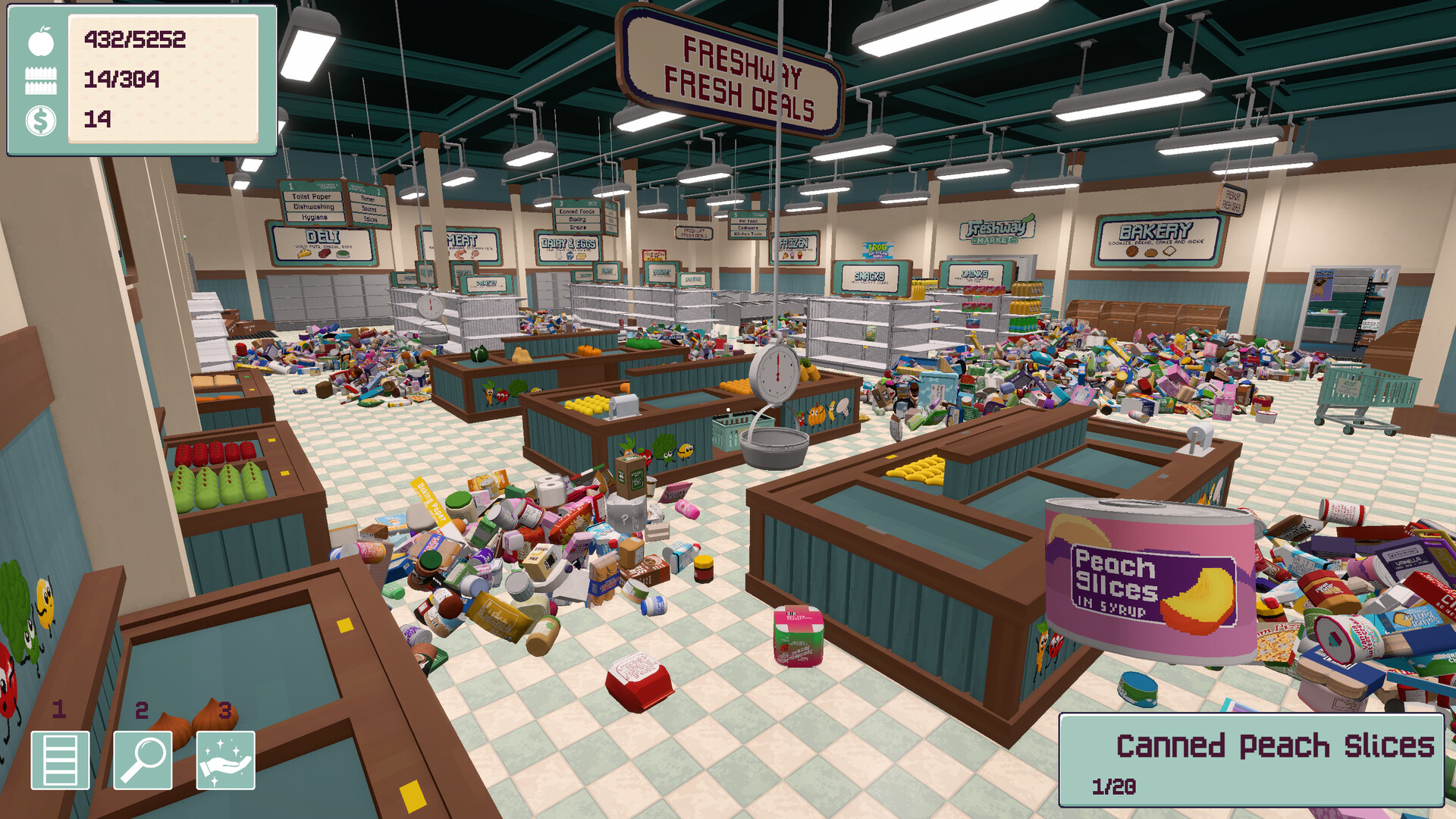
The Freshway Market starts buried under thousands of unsorted items across labeled departments like Bakery and Dairy & EggsImage: Shellbunny via Steam -
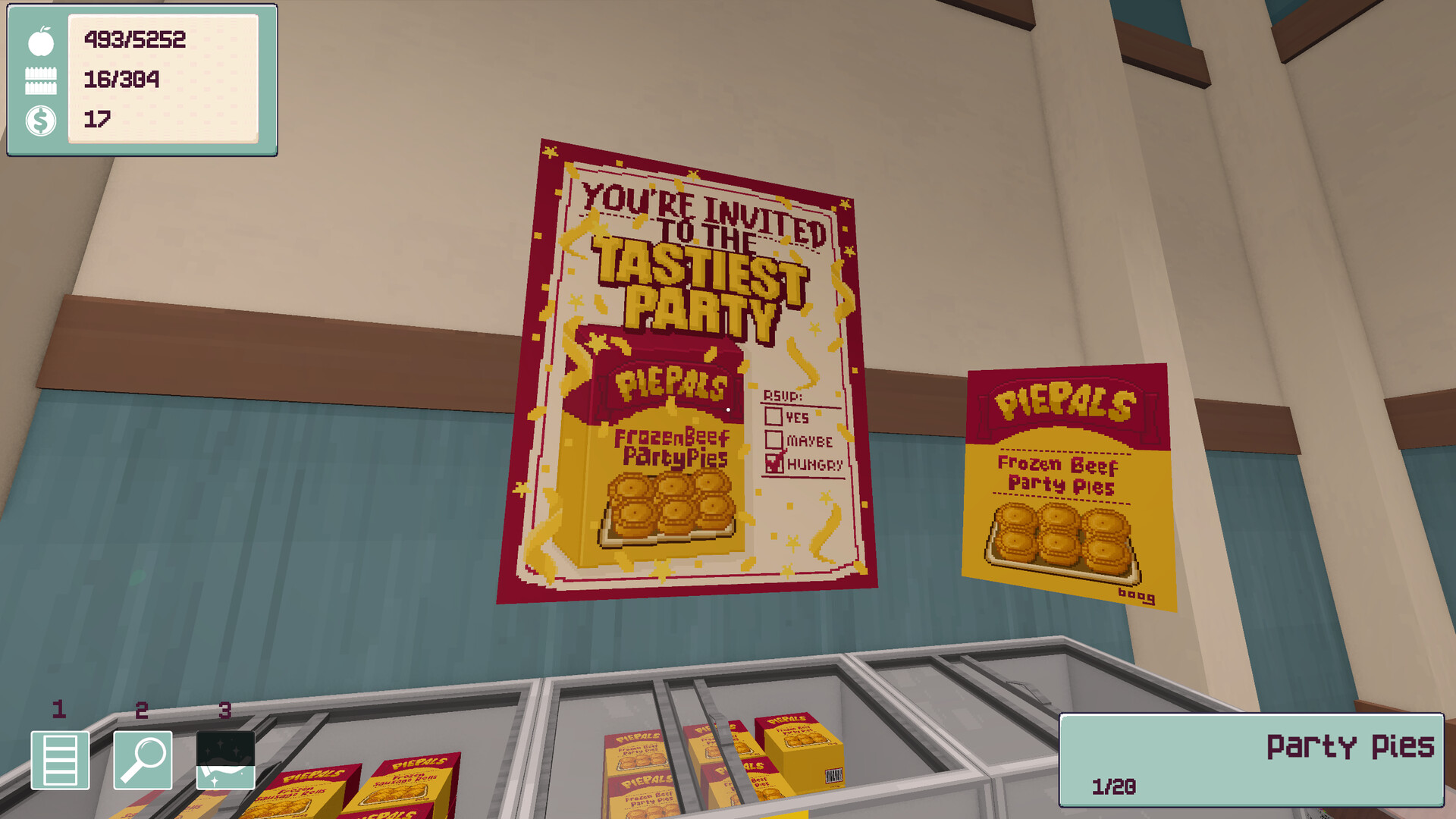
Parody grocery branding like PiePals Frozen Beef Party Pies fills the shelves with local, tongue-in-cheek humorImage: Shellbunny via Steam -
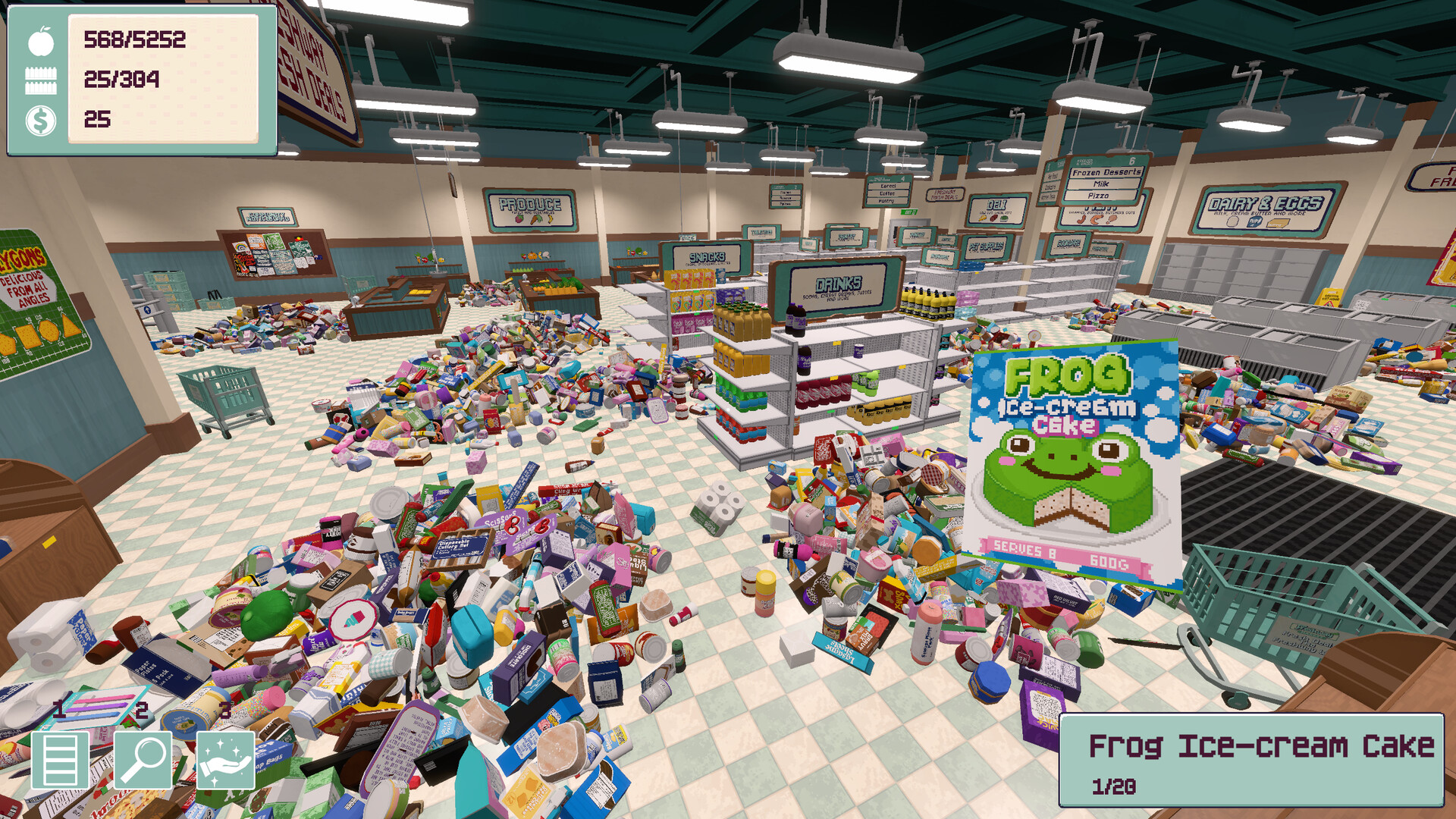
A pushable shopping cart, visible parked beside the produce section, expands the base five-item carrying limitImage: Shellbunny via Steam