
Game review
Pizza House Simulator
5.3 / 10
- Developer
- Broken Lyre Entertainment
- Publisher
- Devotion Interactive
- Released
- 19 August 2026
- Platforms
- Windows
- Genre
- Simulation / Cooking
- Monetisation
- Premium (one-time purchase)
- Players
- true
The short version
Pizza House Simulator is a solid, occasionally addictive co-op restaurant sim that leans hard on the winning formula established by the same developer's earlier Wrap House Simulator, right down to complaints that it's a reskin with the same bugs. It's genuinely fun with a group — chaotic, funny, and surprisingly deep once you find the gambling and investing side-systems — but solo players are left doing literally every task in the restaurant themselves, since nothing automates and the hireable staff are widely described as unhelpfully dumb.
Biggest strengths
- Genuinely chaotic, funny co-op experience that multiple reviewers specifically credit as the best way to play
- Attractive environments and scenery that several reviewers call a standout for the genre
- Surprisingly deep side-systems — gambling, stock investing, and loans — add an unexpected layer many reviewers enjoyed
Biggest weaknesses
- Solo play requires personally handling every single task in the kitchen — cooking, plating, garnishing, slicing, serving — with no automation to help
- Hireable staff are widely reported as unintelligent and unhelpful, undermining the appeal of playing without a full human group
- No save feature outside of completing a full in-game day, alongside several reported bugs
Who it's for: Groups of two to six friends looking for a chaotic, low-stakes co-op cooking sim, and fans of the developer's earlier Wrap House Simulator looking for more of the same with quality-of-life improvements.
Our recommendation: Recommended for co-op groups at its current price, but solo players should go in with clear expectations — you will be doing every single task in the restaurant personally, with no meaningful automation to lean on.
5.3 / 10
What Is Pizza House Simulator?
Pizza House Simulator puts you and up to five friends in charge of a pizzeria, handling everything from dough prep and topping assembly to oven timing, plating, and table service, while also managing the business side — staffing, upgrades, and a surprisingly deep set of side-systems including gambling on horse races, investing in stocks, and taking out loans to fund expansion. It's built by Broken Lyre Entertainment, the studio behind the similarly structured Wrap House Simulator, and the family resemblance is impossible to miss — several reviewers describe it explicitly as more of the same formula with quality-of-life improvements, for better and worse. At NZ$20.25, it's landed solidly with its player base so far, sitting at 87% positive across 411 reviews.
That comparison to Wrap House Simulator is the throughline of the entire review conversation: this is a developer iterating on a formula it already knows works, rather than reinventing anything, and reactions largely track how much goodwill players already had for that earlier game.
Co-op Chaos Is Where It Shines
The clearest, most consistent praise across the review sample is for the game's co-op experience. Reviewers repeatedly single out the chaos of splitting kitchen duties across a group of friends as the highlight — "such a good game to play with friends," "the game is awesome with friends!," and "I can see how this would be fun with friends" all appear independently across the sample, alongside praise for the game's humor and built-in emotes that lean into the chaos rather than fighting it. The environments and scenery draw specific praise too, with one reviewer calling out the crisp colours and detail as a standout compared to other games in the genre, and several others noting the game runs smoothly with minimal performance issues.
The side-systems add real texture beyond straightforward cooking-and-serving. A gambling minigame built around horse racing and a stock-investing system let players who get bored of straight kitchen duty gamble away their restaurant's profits instead — one reviewer recounts taking out the maximum loan on day one purely to bet it all on a favourite horse, calling the resulting zero-pizzas-sold day "10/10 would not sell a single pizza again." It's a small detail, but it's the kind of unexpected system depth that a few reviewers specifically credit with keeping the game interesting once the core cooking loop becomes familiar.
Solo Play Is a Genuinely Different, Harder Game
The single most detailed and specific criticism in the entire review sample concerns solo play, and it's worth quoting at length because of how precisely it's laid out: a reviewer with 27.5 hours on record explains that playing alone means personally handling every step of every order — putting the pizza in the oven, placing the ticket on the tray, retrieving fries and drinks, extracting and garnishing the pizza, slicing it, plating it, and calling the server — because "nothing will automate those steps." As they put it, "the difficulty isn't whether you can make the pizzas correctly or quickly enough... because if you try to make the pizzas, then nobody will cook, cut, or serve them." That's a structural problem specific to solo play rather than a matter of difficulty tuning, and it's echoed by another reviewer who otherwise loves the game but pleads for smarter staff: "please make my staff members smarter, especially because I also love playing alone. Right now they are not only dumb, but also don't behave like humans."
To be fair, not every solo player agrees this is a dealbreaker — one reviewer notes the game "plays almost exactly the same as Wrap House" but with QoL improvements that make it "even easier" to play solo, pointing to an easy difficulty and a dedicated singleplayer mode as real mitigations. The gap between these two perspectives likely comes down to how much a given player leans on hired staff versus embracing the reality that solo play means wearing every hat in the kitchen yourself.
Repetition, Bugs, and the "Reskin" Complaint
A second recurring thread of criticism concerns the gameplay loop's depth over time. One especially detailed negative review lays out the case clearly: "most of your time is spent repeating the same basic actions over and over again: prepare ingredients, make pizzas, serve customers, clean up, and repeat," arguing that progression "doesn't do enough to fundamentally change how you play" and that the game misses an opportunity to add real business decisions — staff management, ingredient shortages, competing restaurants — that could keep the loop fresh past the first few hours. Other reviewers push back on this characterization as unfairly harsh, but the underlying pattern — a strong opening few hours followed by a flattening curve once the systems are understood — shows up across multiple reviews regardless of overall recommendation.
Technical complaints round out the criticism: no save feature outside of completing a full in-game day, a reported stack-pickup bug affecting cart items, and at least one mention of incorrect number displays. One reviewer goes as far as calling the game "just a reskin of Wrap House, same issues, same bugs, still no save feature," specifically criticizing fixed furniture placement that leaves kitchens feeling cluttered with no way to rearrange the workspace to suit a group's preferred workflow.
Final Verdict
Pizza House Simulator delivers exactly what it sets out to — a chaotic, likeable co-op cooking sim with just enough extra systems (gambling, investing, restaurant upgrades) to keep things interesting beyond the core loop — and reviewers who play it the way it's clearly meant to be played, with a group of friends, are overwhelmingly satisfied. The picture is considerably rougher for solo players, who face a fundamentally harder, more tedious version of the same game with no meaningful automation to lean on, and for anyone hoping for a substantial evolution beyond what the developer's earlier Wrap House Simulator already offered. At its current price, it's an easy recommendation for a co-op group and a much more conditional one for solo players.
Pros and cons
Pros
- Genuinely chaotic, funny co-op experience that multiple reviewers specifically credit as the best way to play
- Attractive environments and scenery that several reviewers call a standout for the genre
- Surprisingly deep side-systems — gambling, stock investing, and loans — add an unexpected layer many reviewers enjoyed
- An easy difficulty and dedicated singleplayer mode exist for solo players who want a gentler pace
Cons
- Solo play requires personally handling every single task in the kitchen — cooking, plating, garnishing, slicing, serving — with no automation to help
- Hireable staff are widely reported as unintelligent and unhelpful, undermining the appeal of playing without a full human group
- No save feature outside of completing a full in-game day, alongside several reported bugs
- A vocal minority feel the core gameplay loop repeats without meaningfully evolving over time
Screenshots
-
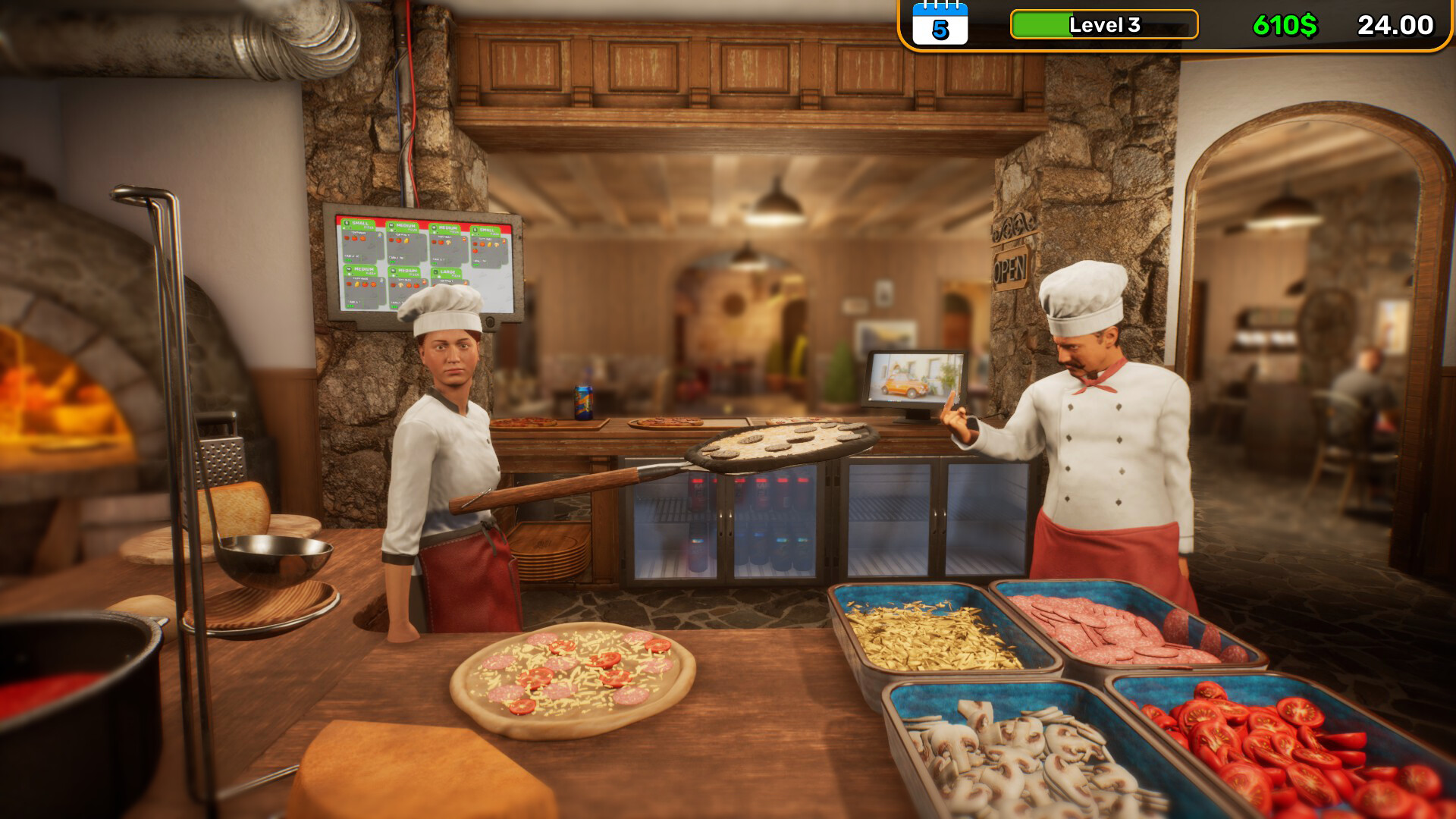
Co-op play splits kitchen duties like topping, plating and serving across the groupDevotion Interactive -
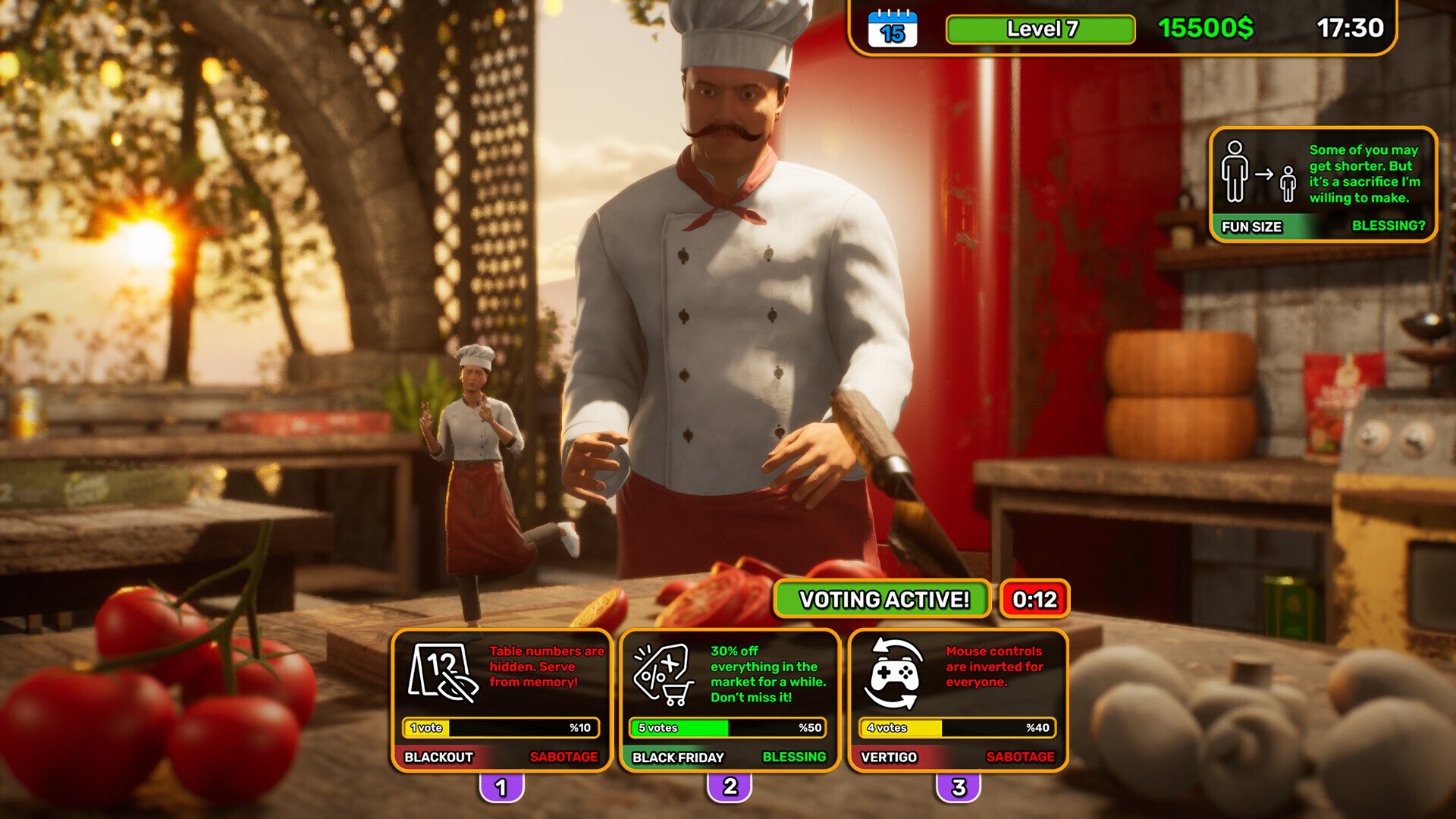
Random events force the group to vote on blessings and sabotages mid-shiftDevotion Interactive -
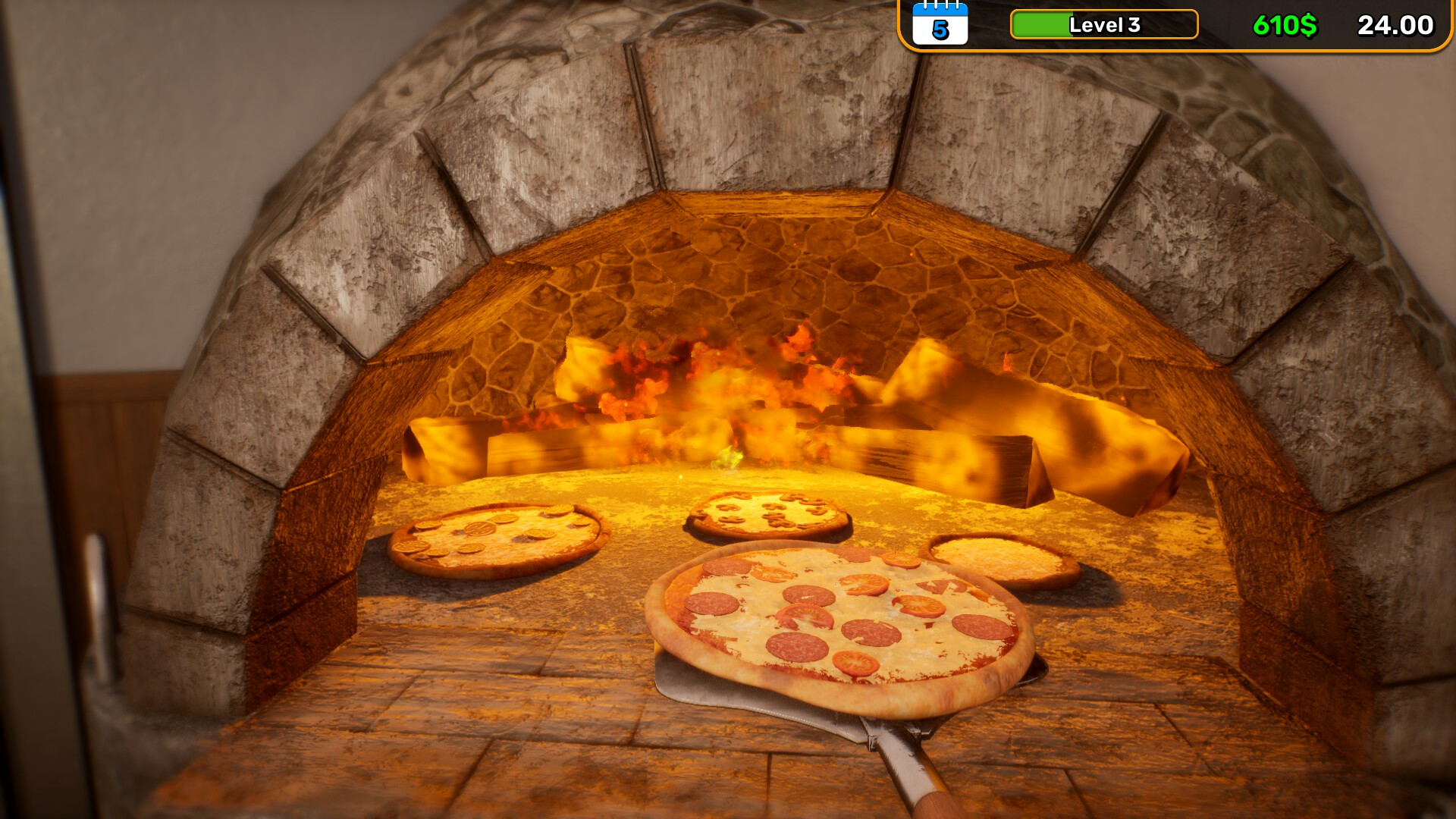
Timing the wood-fired oven correctly is central to the kitchen loopDevotion Interactive -
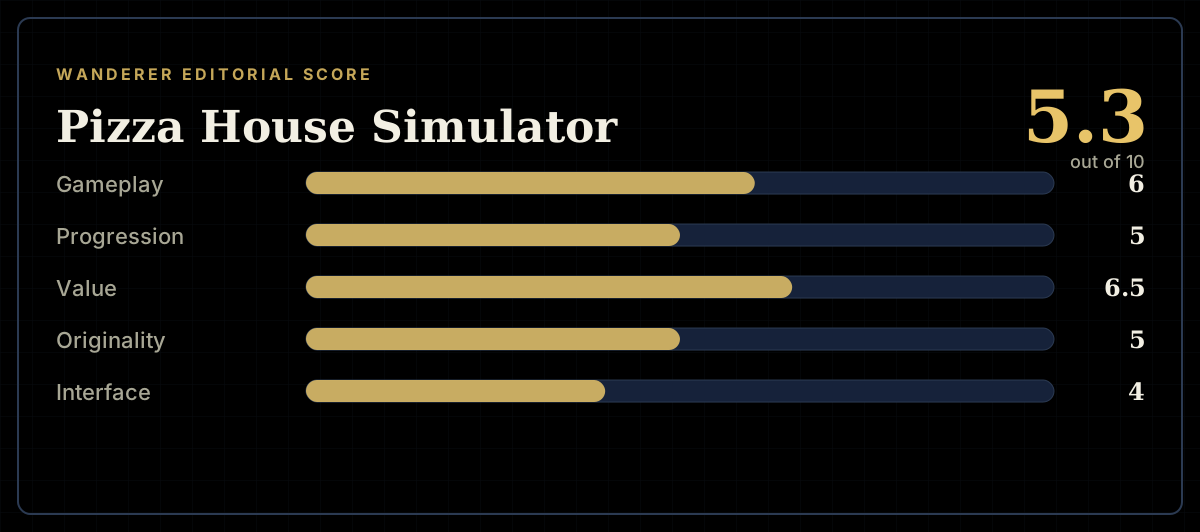
How the review scores each part of the gameWanderer Editorial -
The short versionWanderer Editorial