Game review
Once Upon A Card
7.5 / 10
- Developer
- ISART Digital
- Publisher
- ISART Digital
- Released
- 19 June 2026
- Platforms
- Windows
- Genre
- Indie, Strategy, Free To Play
- Monetisation
- free-to-play
- Players
- false
The short version
Biggest strengths
- Clever, distinctive path-building card mechanics that reviewers compared favorably to Slay the Spire, Blue Prince, and Balatro without feeling derivative of any of them
- Exceptionally polished art direction and sound design for a student project, repeatedly described by reviewers as running smoothly without bugs or softlocks
- Genuine strategic depth, with room-placement and combo mechanics reviewers said rewarded careful planning while leaving room for satisfying runs of luck
Biggest weaknesses
- Very limited content, a prologue plus one chapter, that multiple reviewers described as a demo or proof-of-concept rather than a full game
- A camera/zoom quirk during combat that doesn't reset to the player's previous zoom level once a fight ends
- At least one reported control issue, with a reviewer unable to progress because right-click card rotation didn't register
Who it's for: Deckbuilder and roguelite fans who enjoy strategic path- and combo-building, and who won't mind that the current release is closer to a polished proof-of-concept than a full campaign
Our recommendation: recommended
7.5 / 10
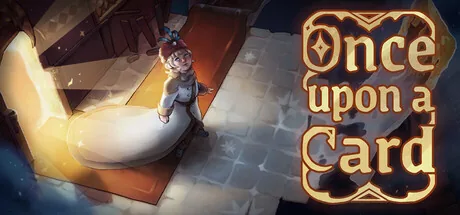
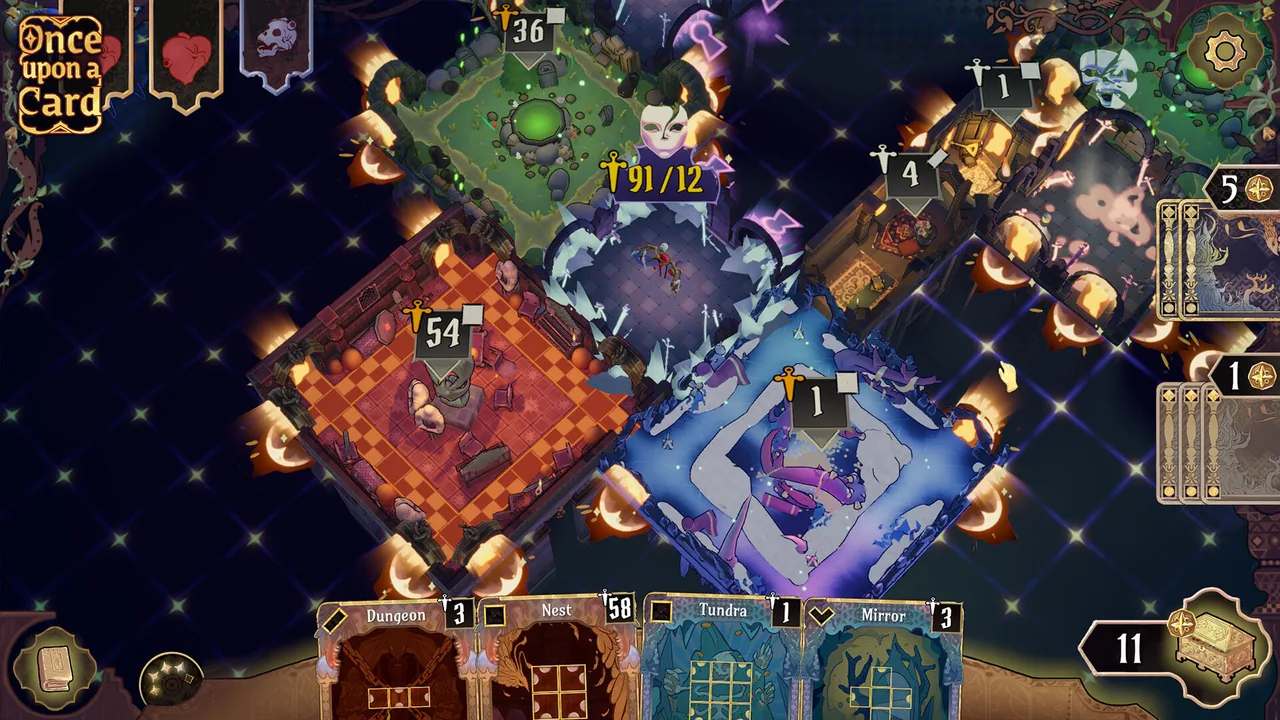
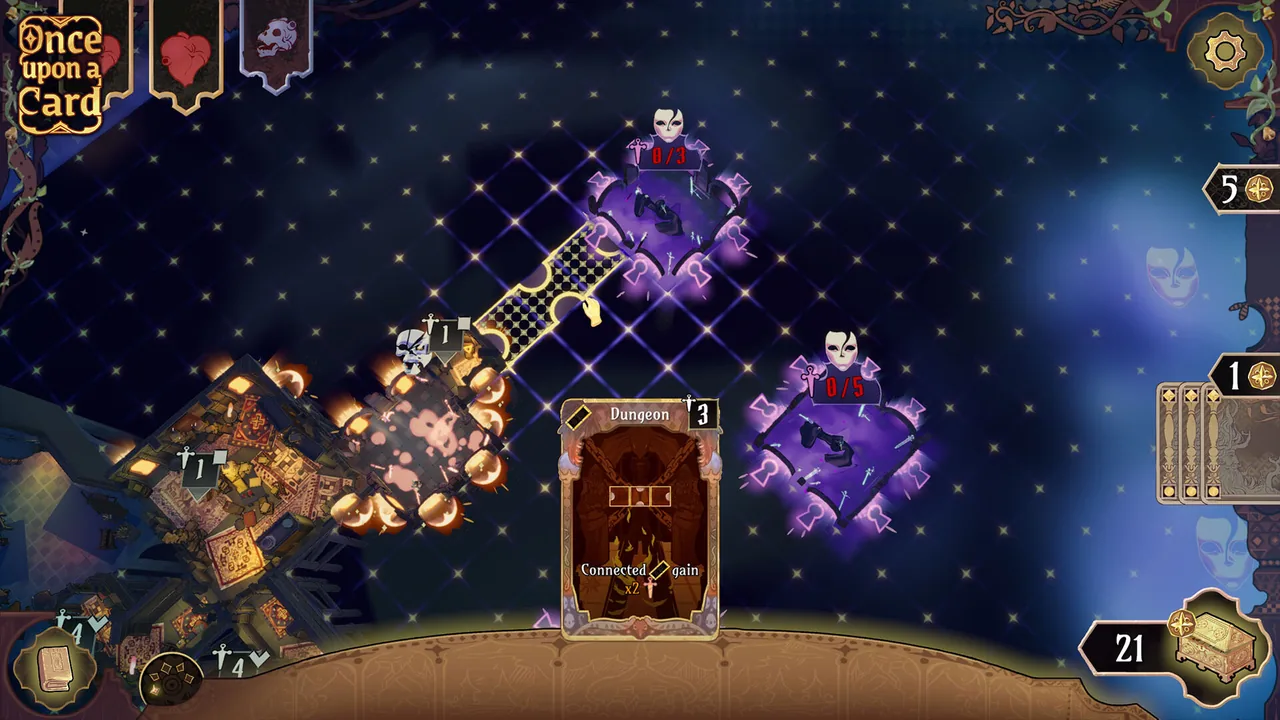
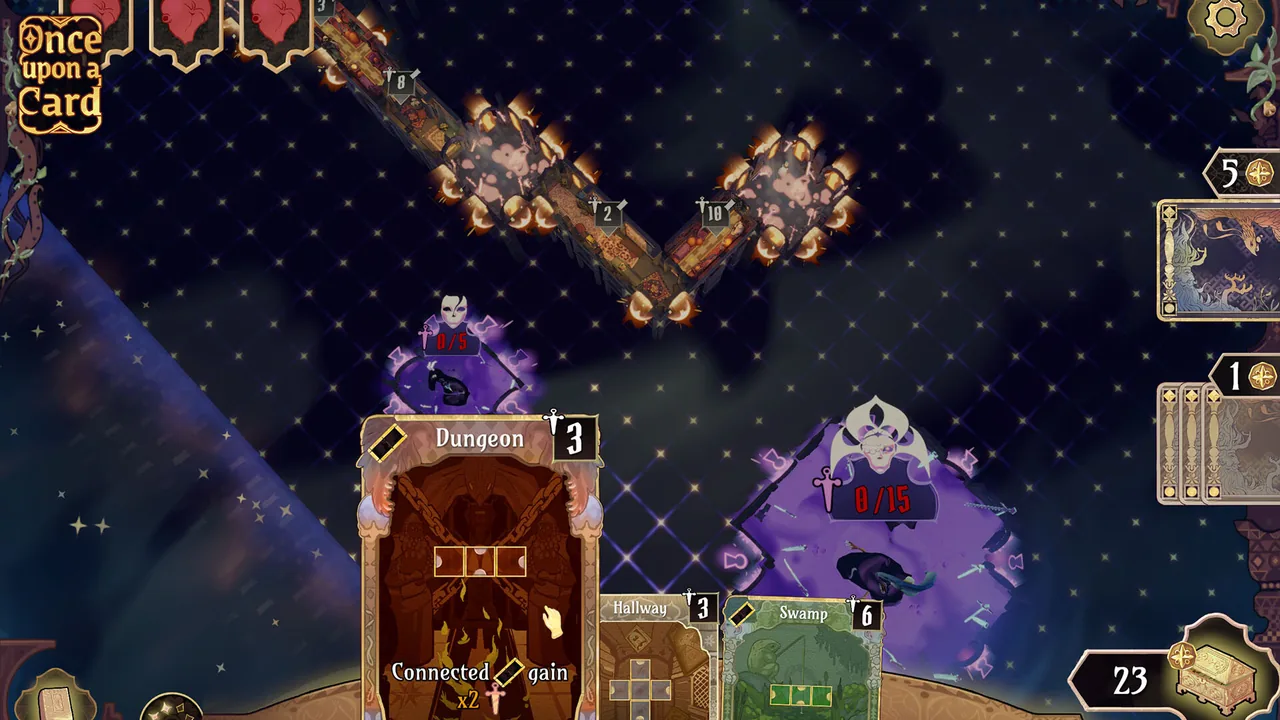
Once Upon A Card released free on Steam on June 19, 2026, a card-based roguelite built by students at the ISART Digital game school in which players guide a royal child through a series of nightmarish dream worlds, using cards to physically build paths, trigger combos, and adapt strategy as each run escalates toward tougher bosses. Its 22-review English pool skews strongly positive (20 up, 2 down), and the reviews are unusually detailed for a free student release, converging on a clear split between real enthusiasm for the mechanics and a consistent acknowledgment that what's here is a slice, not a complete game.
The strongest praise in the pool centers on how confidently the core mechanics are executed. One reviewer called it "a pure gem," an "innovative, well-made and fun gameplay, empowered by a rich art direction," and drew direct comparisons to three big genre touchstones: Slay the Spire for its infinite-scaling deck strategies, Blue Prince for its path-building and RNG control, and Balatro for its escalating numbers. That's high company for a student project to be mentioned alongside, and the same reviewer added that the game "runs smoothly, without bugs or softlocks," a claim echoed almost verbatim by a second reviewer who called it "a polished little roguelike deckbuilder" where "technically everything just works, no bugs, no jank in the prologue and chapter one." For a team of students rather than a funded studio, that level of technical polish drew real, specific praise rather than generic goodwill.
That said, nearly every substantial review makes a point of flagging how limited the current content actually is. One reviewer, who played prior to release and logged three to four hours, was direct about it: "As of now it lacks content for a complete game, but is a very solid proof of concept that shows a good understanding of what a good roguelite should be like," adding they'd "gladly take out the credit card" if it were ever expanded into a full commercial release. Another reviewer made a similar point using a board-game comparison, describing the current build as "a little barebones, kind of like playing a board game like Carcassonne without any of its expansions," while still calling the underlying gameplay loop "fun and interesting" and confirming they'd beaten the single available chapter three times by the time of their review update. A third reviewer summarized the tension neatly: "It's cool and unusual... only nitpick: combat zooms the board in, and the camera doesn't return to your previous zoom level when the fight ends," a review that otherwise reads as an enthusiastic, easy recommendation weighed down by one specific technical quirk.
The two negative reviews in the pool are worth reading carefully rather than dismissing, since together they represent the only real friction points reported alongside the near-universal content complaint. One reviewer reported a functional problem rather than a design disagreement: "my right click doesnt work and you need the right click to rotate cards," which stopped them from meaningfully engaging with more than a few cards during the tutorial before giving up, adding "im sure there is a game here but i didnt play it lol." That's a specific, actionable bug report buried inside an otherwise low-effort negative review, and it's corroborated indirectly by a separate positive reviewer who noted the tutorial "was simple and to the point, but miss discussing connection points," suggesting the onboarding experience has real gaps even for players who don't hit the control bug directly. The second negative review is shorter but points at the same underlying friction from a design angle: "Cool idea, frustrating as hell trying to find the right shape," a complaint about the spatial path-building puzzle that several positive reviewers otherwise praised as the game's cleverest idea.
Where the pool is most consistently positive is on presentation and the fairy-tale framing itself. Reviewers repeatedly called out the "charming art direction," a "good soundtrack," and narration reviewers wanted to hear more of, with one specifically requesting "more nightmare designs" to diversify the current selection and another wishing for "a full story being told by playing the same type of Fairy tale repeatedly." That wishlist tone, asking for more rather than criticizing what exists, runs through almost the entire positive side of the pool and reinforces the sense that reviewers see this less as a finished product to be judged on completeness and more as a strong foundation they're actively hoping the ISART Digital team, or a future commercial successor, builds further.
It's also worth noting how unusual this level of quality is for a student production specifically. Games built by school teams routinely ship with rougher edges than this: inconsistent art direction, unclear UI, mechanics that don't quite cohere. Reviewers here didn't extend charity on that basis so much as report genuine surprise at its absence, several explicitly contrasted it with typical "student game" expectations before praising how far short of that stereotype Once Upon A Card actually falls. That context matters for calibrating a score: judged purely as a finished commercial product, the thin content would be a harder mark against it; judged as what it actually is, a free, small-team release with real design ambition and unusually clean execution, the same shortfall reads as a natural consequence of scope rather than of carelessness.
Value here is about as straightforward as it gets: this is a genuinely well-made, free release, and even reviewers frustrated by its thin content rarely walked that frustration back into a negative rating, since there's no purchase price to feel shortchanged by. The clearest risk for a prospective player isn't wasted money but wasted expectations, this reads and plays like a highly competent vertical slice of a bigger game, complete with the connection-point tutorial gaps, camera quirks, and control bug that vertical slices tend to carry, rather than a fully shipped, bug-hardened commercial release. Anyone going in expecting a full campaign will likely finish disappointed by how quickly it ends; anyone going in expecting a well-crafted taste of a promising idea is very likely to come away, like most of this review pool, wanting the developers to keep going.
Pros and cons
Pros
- Clever, distinctive path-building card mechanics that reviewers compared favorably to Slay the Spire, Blue Prince, and Balatro without feeling derivative of any of them
- Exceptionally polished art direction and sound design for a student project, repeatedly described by reviewers as running smoothly without bugs or softlocks
- Genuine strategic depth, with room-placement and combo mechanics reviewers said rewarded careful planning while leaving room for satisfying runs of luck
- Completely free, making it an easy, low-risk recommendation for deckbuilder fans
Cons
- Very limited content, a prologue plus one chapter, that multiple reviewers described as a demo or proof-of-concept rather than a full game
- A camera/zoom quirk during combat that doesn't reset to the player's previous zoom level once a fight ends
- At least one reported control issue, with a reviewer unable to progress because right-click card rotation didn't register
- A tutorial some reviewers found simple but incomplete, particularly around explaining connection points between cards
Screenshots
-
Once Upon A CardImage: ISART DIGITAL via Steam -
Once Upon A CardImage: ISART DIGITAL via Steam -
Once Upon A CardImage: ISART DIGITAL via Steam