
Game review
Lazy Lord: War on the Desktop
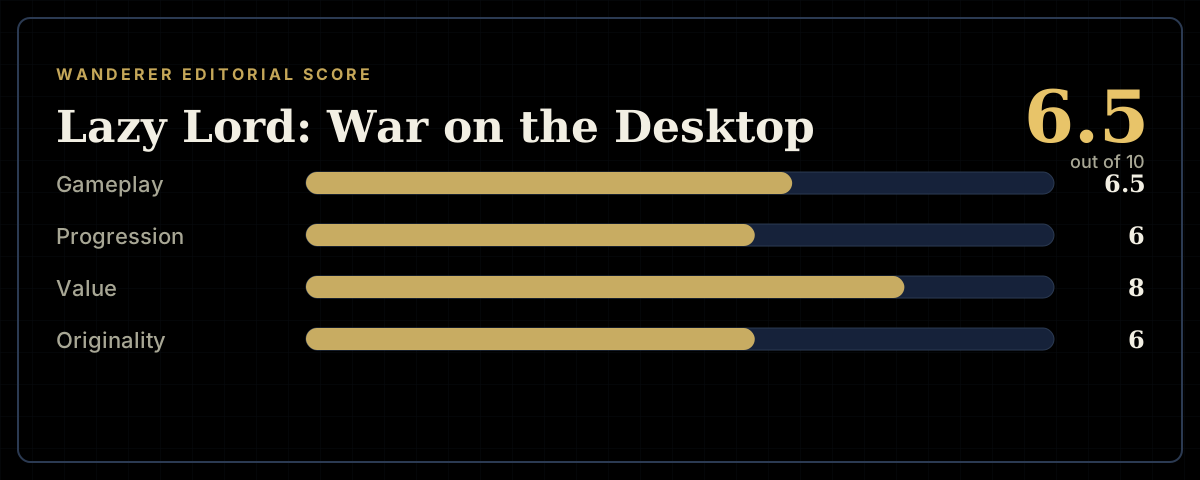
6.5 / 10
- Developer
- Restart Studio
- Publisher
- Restart Studio
- Released
- 21 October 2025
- Platforms
- Windows
- Genre
- Idle, Casual
- Monetisation
- One-time purchase, no DLC or in-game currency
- Players
- Single-player
The short version
Lazy Lord: War on the Desktop casts you as the laziest evil overlord in history — too tired to swing a sword, but perfectly content to send minions marching out automatically to conquer 1,000 areas one human settlement at a time, upgrading their strength with gold and ancient treasures while you do literally nothing else. It's a tiny, cheap desktop-widget idler that can sit at the corner of your screen or be hidden entirely, and the small review corpus available for it is unanimously positive, with more than one reviewer logging over a hundred hours. Reviewers specifically flag the minimalist art and interface as genuinely high quality, several saying the store page's own screenshots undersell how good the game looks and feels in actual motion. The honest caveat is that this review corpus is small — only a handful of English reviews exist at time of writing — so both the praise and the absence of any dissent should be read as early, promising signal rather than a large-scale verdict.
Biggest strengths
- Reviewers specifically single out the art style and interface as unexpectedly high quality for the price, with one stating plainly that the screenshots and trailers "don't do this game justice" and that it looks better in motion than in static marketing images
- The game supports genuinely low-commitment play, including an option to hide the desktop overlay entirely when you don't want to see it, letting the idle progression continue unobtrusively in the background
- Multiple reviewers report substantial, voluntary playtime well beyond what a NZ$2.99 purchase would typically demand, with two independently logging more than 100 hours each
Biggest weaknesses
- The available review corpus is genuinely small — only a handful of English-language reviews exist at time of writing, all positive, meaning there's no dissenting account yet to weigh the praise against, a real information gap this review states plainly rather than glossing over
- At least one reviewer requests basic quality-of-life additions, including better highlighting of available upgrades, suggesting some interface rough edges remain despite the overall praise for the art and UI
- The feature set is intentionally minimal by design — automatic minion-sending, gold-based upgrades, treasure bonuses — so players expecting meaningful strategic depth beyond a straightforward idle conquest loop should calibrate expectations accordingly
Who it's for: Fans of extremely low-commitment, cheap desktop idlers who want something charming to run in the background without any real time investment required, particularly anyone drawn to a comedic "evil but lazy" premise. Less of a fit for anyone wanting deep strategic systems, given the reviewed feature set is intentionally minimal.
Our recommendation: An easy, low-risk recommendation at NZ$2.99 given the consistently positive, if small, response — just go in aware that the sample size backing that recommendation is thinner than most reviews on this site, so treat it as a promising early signal rather than an exhaustively tested verdict.
6.5 / 10
Conquering the world without getting up
Not every idle game commits fully and consistently to its own comedic premise, but this one clearly does.
Lazy Lord: War on the Desktop leans fully into a specific, funny premise: you're an evil overlord so committed to laziness that you won't even swing a sword yourself, content instead to let minions march out automatically to destroy human settlements across 1,000 areas while you do nothing at all. Gold collected from every conquest funds upgrades to minion strength and unlocks new, increasingly chaotic unit types, and ancient Lord Treasures grant passive boosts that let your empire keep growing even while you're away entirely. It's a tiny, cheap, desktop-widget-style idler at heart — the kind of game built to sit unobtrusively at the edge of your screen, or be hidden from view entirely through a built-in toggle, while the conquest continues in the background regardless of whether you're watching.
Better than its own screenshots suggest
The clearest, most specific praise running through the small available review sample concerns presentation. More than one reviewer makes a point of saying the game looks noticeably better in actual motion than the store page's own screenshots and trailers convey, with one describing initial skepticism — expecting "old Flash game art" — replaced by genuine appreciation once they saw the clean, minimalist style in action. That's a specific, useful piece of consumer guidance: if the store page alone doesn't sell you on the visuals, reviewers suggest that's a marketing shortfall rather than an accurate reflection of what you'd actually be getting.
Playtime figures back up the underlying appeal beyond first impressions. Two reviewers independently report logging well over 100 hours each with the game — a remarkable figure relative to a NZ$2.99 purchase price, and a stronger signal of genuine long-term engagement than enthusiastic but brief praise would provide on its own. One reviewer specifically enjoys the incremental discovery of new enemy unit types as the conquest progresses, framing the simple core loop as having enough small surprises to sustain repeated short sessions rather than growing stale immediately, even joking that their one real complaint is that the enemy gets access to ninja units before the player's own side does.
A small sample, stated honestly
It would be dishonest to present this review with the same confidence as one backed by hundreds or thousands of reviews. At time of writing, only a handful of English-language reviews exist for Lazy Lord, and every one of them is positive — there's no dissenting account currently available to weigh against the praise, which means both the enthusiasm and the absence of criticism should be read as early, promising signal rather than an exhaustively tested verdict. The one piece of constructive feedback in the sample is modest: a request for better visual highlighting of available upgrades, suggesting some interface polish is still welcome even from a satisfied player.
A joke that carries through the whole package
The comedic framing isn't limited to the pitch — it extends into the game's own flavour text. The store page includes a running bit of quotes attributed to individual minions, like a goblin numbered 43 currently on fire declaring "my lord is so lazy, it's inspiring," or a skeleton bragging about conquering a castle while the player was "watching cat videos." That kind of small, consistent comedic voice running through even the marketing copy suggests a level of care in comedic tone and voice that goes well beyond the bare mechanical pitch of "idle conquest game," and it's consistent with reviewer descriptions of the game as "cute and fun" rather than a generic reskin of an existing idle template with a joke premise slapped on top.
Where it sits in a crowded niche
Desktop-widget idle games are an increasingly populated category on Steam, ranging from cozy creature-collectors to bird-feeding sims to, now, comedic conquest games like this one. Lazy Lord's particular angle — leaning into villainy rather than cosiness, and structuring progression around a fixed, countable goal of 1,000 areas rather than an open-ended number-go-up loop — gives it a distinct enough identity within that niche that reviewers don't describe it as interchangeable with its genre neighbours. Whether that distinct premise is enough to draw attention away from better-established desktop idlers competing for the same "something charming in the corner of my screen" use case is a question this review's small available sample can't fully answer — but the substantial playtimes logged by the handful of reviewers who have found it suggest the hook works at least as well as its established competitors for the players it reaches.
The verdict
Lazy Lord: War on the Desktop is a charming, extremely cheap idle conquest game that the small sample of players who've reviewed it clearly enjoy well beyond what its price would typically demand. The presentation earns specific, credible praise for exceeding its own marketing, and genuine hundred-hour-plus playtimes suggest real staying power behind the simple premise. Given how thin the review corpus currently is, this recommendation comes with an honest asterisk — but at NZ$2.99, the risk of trying it yourself is about as low as this review series ever encounters, and a free demo covering a tenth of the full game's content means you don't even need to take this review's word for it before deciding whether the core loop is worth the price of the full 1,000-area campaign.
Pros and cons
Pros
- Reviewers specifically single out the art style and interface as unexpectedly high quality for the price, with one stating plainly that the screenshots and trailers "don't do this game justice" and that it looks better in motion than in static marketing images
- The game supports genuinely low-commitment play, including an option to hide the desktop overlay entirely when you don't want to see it, letting the idle progression continue unobtrusively in the background
- Multiple reviewers report substantial, voluntary playtime well beyond what a NZ$2.99 purchase would typically demand, with two independently logging more than 100 hours each
- The 1,000-area conquest structure combined with a discoverable roster of enemy unit types (one reviewer specifically enjoys learning what new troop types the "enemy" fields) gives the simple premise enough incremental discovery to sustain repeated short check-ins
- A free demo with 100 of the full game's 1,000 areas lets prospective buyers try the core loop before committing, and the full version adds Steam Cloud save sync the demo lacks, a meaningful upgrade for anyone playing across multiple machines
Cons
- The available review corpus is genuinely small — only a handful of English-language reviews exist at time of writing, all positive, meaning there's no dissenting account yet to weigh the praise against, a real information gap this review states plainly rather than glossing over
- At least one reviewer requests basic quality-of-life additions, including better highlighting of available upgrades, suggesting some interface rough edges remain despite the overall praise for the art and UI
- The feature set is intentionally minimal by design — automatic minion-sending, gold-based upgrades, treasure bonuses — so players expecting meaningful strategic depth beyond a straightforward idle conquest loop should calibrate expectations accordingly
- As a very small-scale, likely solo or small-team release, there's limited independent evidence available yet about how well the developer supports the game post-launch compared to better-reviewed titles in this same idle-desktop-widget niche
Screenshots
-

Lazy Lord: War on the DesktopImage: Restart Studio via Steam -

Lazy Lord: War on the DesktopImage: Restart Studio via Steam -

Lazy Lord: War on the DesktopImage: Restart Studio via Steam -
How the review scores each part of the gameWanderer Editorial -
The short versionWanderer Editorial