
Game review
Ithya: Magic Studies
7.5 / 10
- Developer
- BlueTurtle
- Publisher
- BlueTurtle
- Released
- 7 May 2025
- Platforms
- Windows, macOS
- Genre
- Cozy, Productivity, Idle
- Monetisation
- One-time purchase, no DLC or in-game currency
- Players
- Single-player
The short version
Ithya: Magic Studies is a hybrid nobody quite has a clean name for: part cozy background game, part study-and-focus app, wrapped entirely in hand-drawn fantasy art from an artist called Blue Turtle, whose lofi and fantasy-soundtrack YouTube playlists already had an audience before this became a Steam listing. You sit in a customisable magic-school room, run a built-in pomodoro timer and task list against a backdrop of ten curated playlists and shifting day, night and rain ambience, and collect small creature "Elementals" as you go. It landed at Overwhelmingly Positive, 97.8% across 2,179 reviews, and reviewers who came in skeptical of "another productivity app on Steam" repeatedly describe being won over by the art and music specifically. Set against that acclaim is a tight, recurring list of feature complaints — an unwieldy task list, heavy GPU and battery draw for an app meant to run in the background, and the absence of a proper wallpaper mode — specific enough, and repeated by enough independent reviewers, to read as the real, addressable gap between what Ithya already is and what its own audience wants it to become.
Biggest strengths
- The hand-drawn art and curated soundtrack are the clear centre of the experience and draw the strongest, most specific praise in the corpus — multiple reviewers name-check developer Blue Turtle's pre-existing YouTube lofi and fantasy playlists as the reason they bought in, and say the game-ified version delivers on that reputation
- A real, checkable claim in the store listing — "All the Music & Art are 100% human made and without AI" — lands in a market where reviewers of other games in this session have specifically flagged AI-generated art and audio as a source of distrust, and no review in this corpus disputes it
- Multiple reviewers describe genuinely improved focus and output while using it — one specifically credits several hours with rewriting two chapters and drafting a character bio they'd been stuck on, treating the atmosphere as functionally productive rather than just pleasant
Biggest weaknesses
- The task list and daily-planning tools draw the most consistent specific criticism: reviewers report having to manually re-enter tasks every day with no way to set a recurring weekly plan, and that pressing Enter doesn't reliably create a new list entry
- Multiple independent reviewers report unexpectedly heavy GPU usage and battery drain for an app explicitly meant to sit in the background during other work, with one describing their battery halved in thirty minutes
- A direct, named comparison recurs in the corpus: at least one reviewer states plainly that "Spirit City Lofi Sessions is a much more polished version of this idea," specifically citing Ithya's single playable character (only ever female, with limited wardrobe options) against that competitor's greater customisation
Who it's for: Students, writers and anyone who works better with ambient music and a gentle sense of gamified structure, especially fans of Blue Turtle's existing lofi and fantasy playlists looking for an interactive version of the same mood. Less of a fit for anyone who wants a fully-featured task manager or planner first and atmosphere second — several reviewers say the organisational tools are the weakest part of the package.
Our recommendation: A strong, low-risk buy at NZ$16.99 for the atmosphere and soundtrack alone, which is what the vast majority of its audience is there for and happy with. Go in expecting a beautiful, relaxing companion rather than a serious productivity suite, since the task-management side is the part reviewers most consistently want reworked.
7.5 / 10
A study buddy built from a YouTube channel
Ithya: Magic Studies sits in an unusual, small but apparently hungry niche: cozy background apps that combine ambient fantasy or lofi music with light productivity tools, meant to run alongside whatever work you're actually doing. What sets this particular entry apart, according to its review corpus, is where it came from. Developer Blue Turtle had an existing audience for lofi and fantasy soundtrack playlists on YouTube before Ithya existed as a Steam listing, and multiple reviewers specifically say that reputation is what got them to buy in — and that the interactive version lives up to it. You inhabit a customisable room in a fantasy magic-school setting, choose from ten curated playlists spanning cozy lofi to more epic fantasy scoring, adjust the ambience between day, night, rain and sunset, and run a built-in pomodoro timer and task list while you work, study, write, or — as the store page specifically suggests — plan a D&D campaign.
The store listing makes one claim worth taking seriously on its own merits: "All the Music & Art are 100% human made and without AI." In a review session that has separately covered games where generative-AI asset accusations were a genuine, repeated source of player distrust, it's notable that no review in Ithya's corpus disputes this claim or raises the suspicion at all — for an art-and-music- first product, that's a real point in the developer's favour, not just marketing language.
The atmosphere earns its praise
The clearest, most repeated theme across the positive side of the corpus is that the hand-drawn environments and soundtrack aren't just pleasant set dressing — they're doing real work. One reviewer credits several hours in Ithya with rewriting two chapters of a project they'd been stuck on and finishing a character bio; another, who says they never leave Steam reviews, calls it their "work buddy for the foreseeable future" and reports it runs well even on Steam Deck. That kind of testimony — people crediting a specific, measurable chunk of finished work to the app rather than just praising its vibe — is stronger evidence for a productivity tool than atmosphere alone would be, and it recurs often enough in the sample to be a real pattern rather than a couple of enthusiastic outliers.
Collecting Elementals, and where that layer runs out
Beyond the timer and task list, Ithya layers in a lighter game-like structure: ten collectible "Elementals" scattered through the fantasy world's map, a room you can decorate as you unlock more of it, and a set of achievement tiers that track how deeply you've engaged with that collection layer rather than just how many focus sessions you've logged. Steam's own achievement data shows this half of the game holding far less of the audience than the core ambience-and-timer loop: entry achievements for finding an early Elemental or completing a first task sit at a healthy 62-77%, but the more involved Master and Grandmaster completion tiers fall to 39.1% and 16.2% respectively. That's a meaningfully steeper drop than a typical game's late-content curve, and it lines up with what the review corpus itself suggests — most buyers are here for the atmosphere and the productivity scaffolding around it, and treat the deeper collection game as a pleasant bonus rather than the main reason they keep coming back.
Where the productivity half falls short
Set against that is a tight, specific cluster of complaints about the tools meant to make Ithya more than just a pretty background. The task list draws the most consistent criticism: reviewers report having to manually re-enter their to-do list every single day with no option to set a recurring weekly plan, and that pressing Enter doesn't reliably create a new entry — small-sounding issues that matter a great deal in software whose entire job is staying out of your way. Alarm and timer sounds are separately called too harsh for a calm-focus app, with at least one reviewer noting they can't currently be disabled. And more than one reviewer independently reports the app drawing surprisingly heavy GPU resources and battery for something meant to idle in the background — one specifically says it drained their laptop battery by half in thirty minutes, a real practical problem for the "leave it running while you work" use case the whole product is built around.
The most pointed comparison in the corpus names a direct competitor: one reviewer states plainly that "Spirit City Lofi Sessions is a much more polished version of this idea," specifically citing Ithya's single playable character — always female, with a limited wardrobe — against that rival's greater customisation options. That's a useful, checkable data point for anyone comparing the two rather than buying on vibes alone, and it's consistent with the broader theme in Ithya's own negative reviews: the concept and atmosphere are ahead of the supporting tools around them.
The verdict
Ithya: Magic Studies earns its Overwhelmingly Positive rating honestly. The art and soundtrack are the product's real center of gravity, they're praised with specific, credible detail rather than vague enthusiasm, and the developer's prior audience for the same music gave it a running start most Steam debuts don't get. What holds it back from being an unqualified recommendation is a productivity layer — task management, alarms, resource efficiency — that its own fans consistently flag as the weakest part of an otherwise charming package, and a direct, named comparison to a more polished competitor that any prospective buyer should weigh. For NZ$16.99, most of its audience says the atmosphere alone is worth the price; whether the organisational tools catch up is the thing to watch before expecting Ithya to replace a dedicated task manager.
Pros and cons
Pros
- The hand-drawn art and curated soundtrack are the clear centre of the experience and draw the strongest, most specific praise in the corpus — multiple reviewers name-check developer Blue Turtle's pre-existing YouTube lofi and fantasy playlists as the reason they bought in, and say the game-ified version delivers on that reputation
- A real, checkable claim in the store listing — "All the Music & Art are 100% human made and without AI" — lands in a market where reviewers of other games in this session have specifically flagged AI-generated art and audio as a source of distrust, and no review in this corpus disputes it
- Multiple reviewers describe genuinely improved focus and output while using it — one specifically credits several hours with rewriting two chapters and drafting a character bio they'd been stuck on, treating the atmosphere as functionally productive rather than just pleasant
- Reported to run well even on Steam Deck, according to at least one reviewer, extending its use case beyond a desktop-only background companion
- The fantasy framing — a magic-school setting, a world map with lore, unlockable locations and collectible Elementals — gives the cozy-productivity-app genre a distinct identity, with reviewers directly comparing it favourably in tone (if not always polish) to genre peers like Spirit City: Lofi Sessions
Cons
- The task list and daily-planning tools draw the most consistent specific criticism: reviewers report having to manually re-enter tasks every day with no way to set a recurring weekly plan, and that pressing Enter doesn't reliably create a new list entry
- Multiple independent reviewers report unexpectedly heavy GPU usage and battery drain for an app explicitly meant to sit in the background during other work, with one describing their battery halved in thirty minutes
- A direct, named comparison recurs in the corpus: at least one reviewer states plainly that "Spirit City Lofi Sessions is a much more polished version of this idea," specifically citing Ithya's single playable character (only ever female, with limited wardrobe options) against that competitor's greater customisation
- Alarm and timer sounds are called too harsh and jarring by more than one reviewer, with at least one noting they cannot currently be disabled or replaced — a real usability problem for an app whose whole purpose is staying in a calm, focused state
- Steam's achievement data shows the more involved Elemental-collecting content drops off steeply: the entry-level achievements sit at 63-77%, but the harder completionist tiers (ACH_MASTER, ACH_GRANDMASTER) fall to 39.1% and 16.2%, suggesting the deeper collection layer holds far less of the audience than the core ambience-and-timer loop does
Screenshots
-

Ithya: Magic StudiesImage: BlueTurtle via Steam -

Ithya: Magic StudiesImage: BlueTurtle via Steam -

Ithya: Magic StudiesImage: BlueTurtle via Steam -
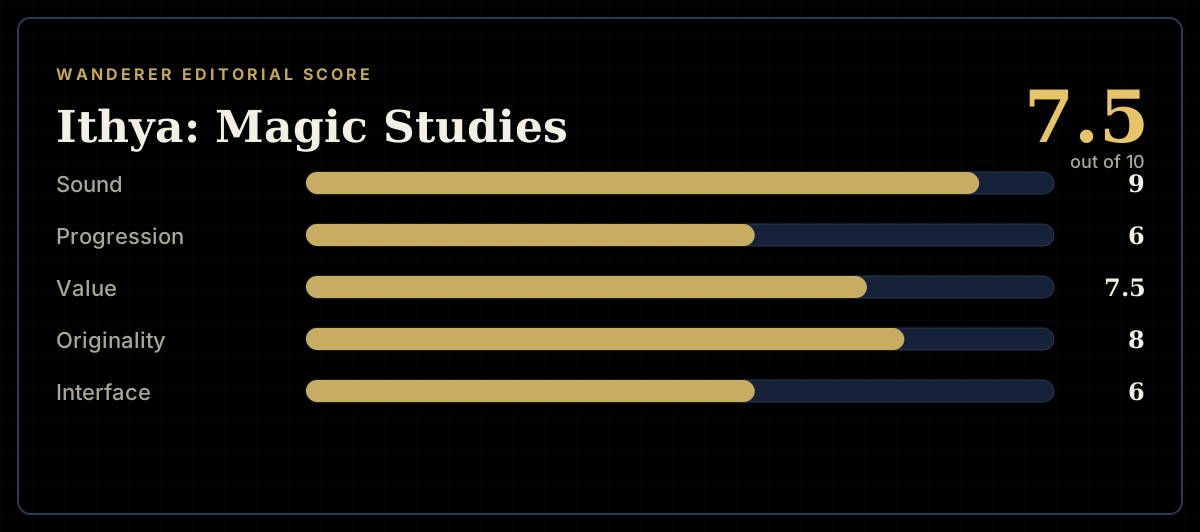
How the review scores each part of the gameWanderer Editorial -
The short versionWanderer Editorial