
Game review
Immortal IDLE
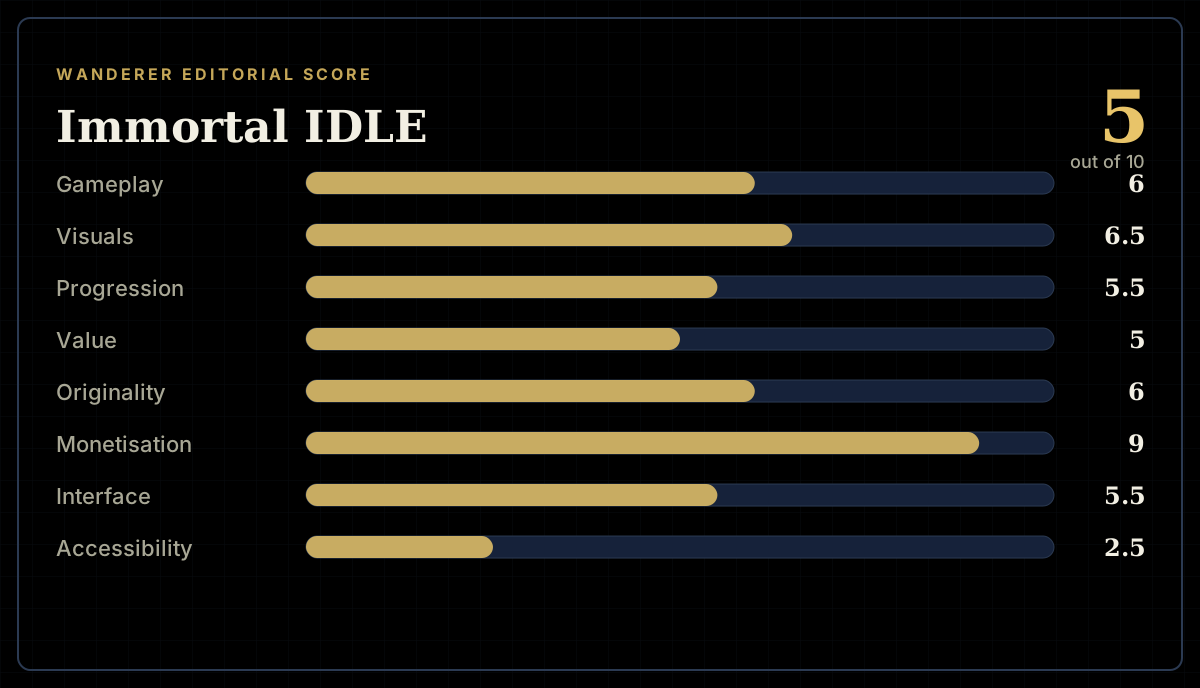
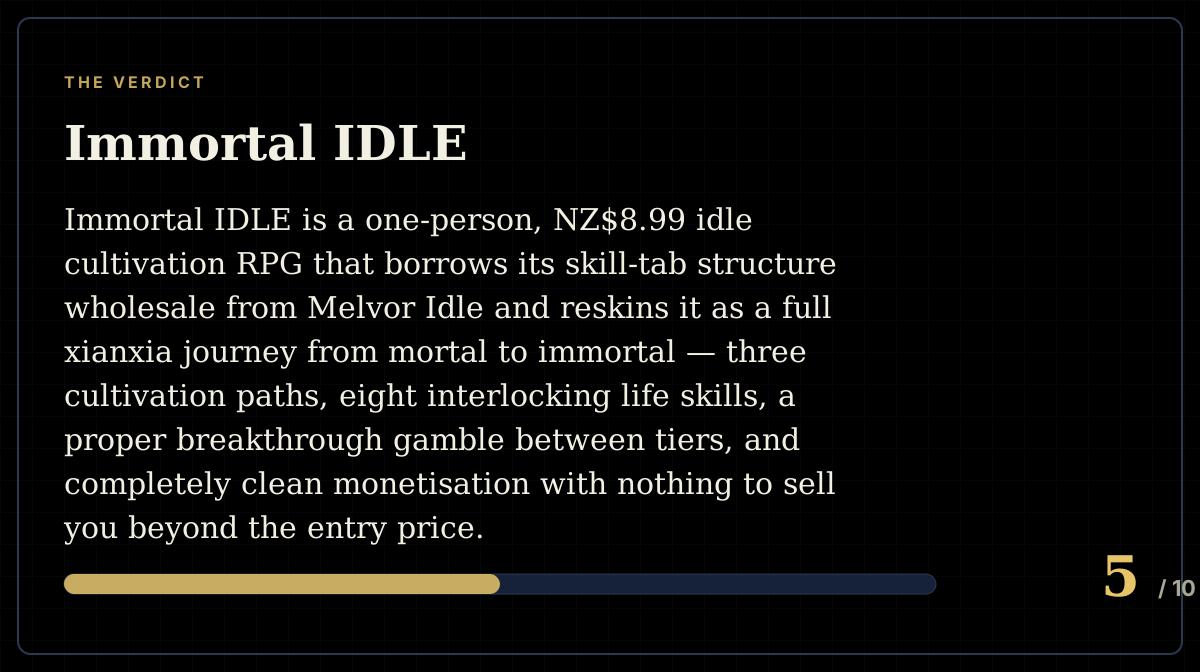
5 / 10
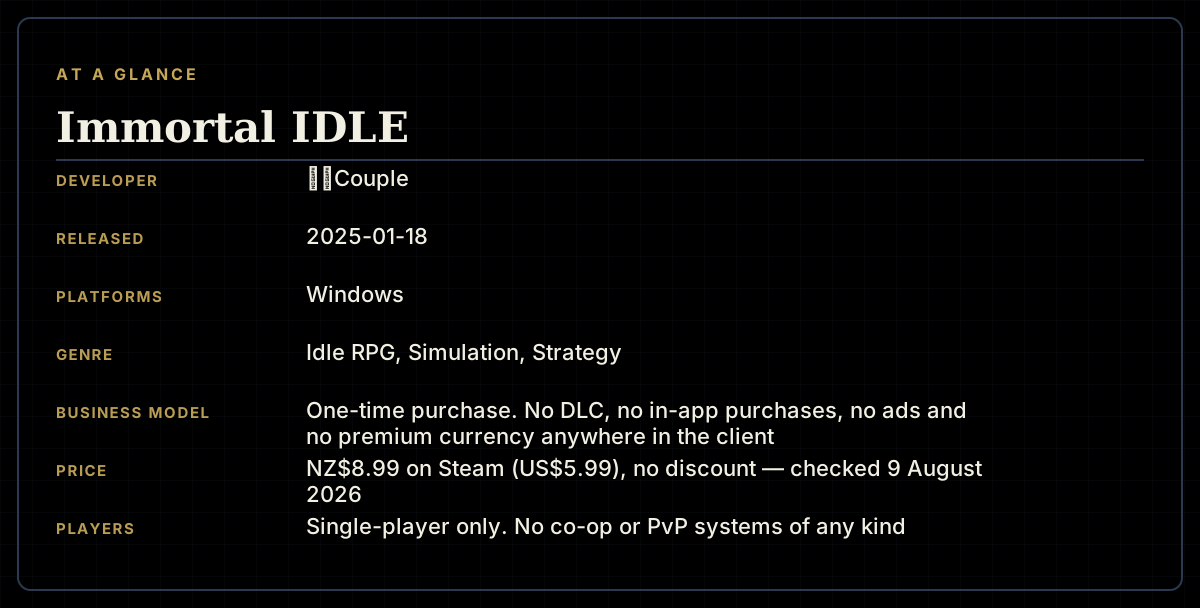
- Developer
- 伯乐Couple
- Publisher
- 伯乐Couple
- Released
- 18 January 2025
- Platforms
- Windows
- Genre
- Idle RPG, Simulation, Strategy
- Monetisation
- One-time purchase. No DLC, no in-app purchases, no ads and no premium currency anywhere in the client
- Players
- Single-player only. No co-op or PvP systems of any kind
The short version
Immortal IDLE is a one-person, NZ$8.99 idle cultivation RPG that borrows its skill-tab structure wholesale from Melvor Idle and reskins it as a full xianxia journey from mortal to immortal — three cultivation paths, eight interlocking life skills, a proper breakthrough gamble between tiers, and completely clean monetisation with nothing to sell you beyond the entry price. Steam's own achievement data shows most buyers get well into it, and its most dedicated critics have thousands of hours logged, not minutes. What keeps this out of a recommendation right now is twofold: the developer has not shipped an update since 11 June 2025, well past the "three to six months" the store page's own Early Access FAQ promised, and a growing cluster of reviews across 2025 and into 2026 describe the project as abandoned. Just as decisive for anyone reading this in English: the Steam page itself lists English interface support as "Not supported," and the entire 87-review corpus is written in Chinese as a direct result — not one review is in English, because the game currently cannot be played in it.
Biggest strengths
- A genuinely deep idle skilling structure for the price — three cultivation paths (Confucian, Buddhist, Taoist) plus eight separate life skills (gathering, woodcutting and mining, tea and wine brewing, spirit-plant farming, artifact forging, pill alchemy and talisman crafting), each with its own level curve and unlockable recipes
- Steam's global achievement data backs up real engagement rather than a quick bounce: 61.0% of owners clear the first tier milestone, tapering gradually to 11.5% at the ninetieth, a healthy shape for a grind-heavy idle game
- Completely clean monetisation, confirmed directly in the game's own screenshots as well as the storefront: one NZ$8.99 purchase, no DLC listed, no shop screen, no premium currency and no ads anywhere in the client
Biggest weaknesses
- No update recorded since 11 June 2025 — about fourteen months as of this review, against an Early Access FAQ that told buyers to expect three to six months. A cluster of reviews through 2025 and into 2026 flatly call the project abandoned, including one from June 2026 citing the exact same dead date this review found independently
- Steam's own language table lists English interface support as "Not supported." Every one of the 87 reviews on the game's page is written in Chinese; there is currently no way to play this game in English without bringing your own translation tools
- Long-time reviewers, some with well over a thousand hours logged, describe the eight life skills as barely interconnected in practice and the three cultivation paths as mutually exclusive rather than genuinely combinable, despite the store page's "why choose? You can master them all" pitch
Who it's for: Idle-RPG fans specifically curious about a cultivation-genre take on the Melvor Idle formula, who read or can machine-translate Simplified Chinese, and who are comfortable buying into a stalled Early Access project rather than an actively maintained one.
Our recommendation: Wait. The systems are real and the price is fair, but there is no English interface to play it in today, and the developer has gone quiet for well over a year on a game its own roadmap describes as 70% complete. Revisit only if an update actually ships.
5 / 10
A cultivation idler with real bones, and a developer who went quiet
Immortal IDLE opens with a promise a lot of idle games make and few actually build out: a full mortal-to-immortal cultivation journey, three doctrines to master, eight separate crafts to level, and a breakthrough gauntlet standing between every tier of power and the next. On the evidence of its own screenshots and its Steam achievement data, it mostly delivers on that promise. What it hasn't delivered on, for well over a year now, is an update — and for anyone reading this review in English, there's a second, more immediate problem: you currently cannot play it in English at all.
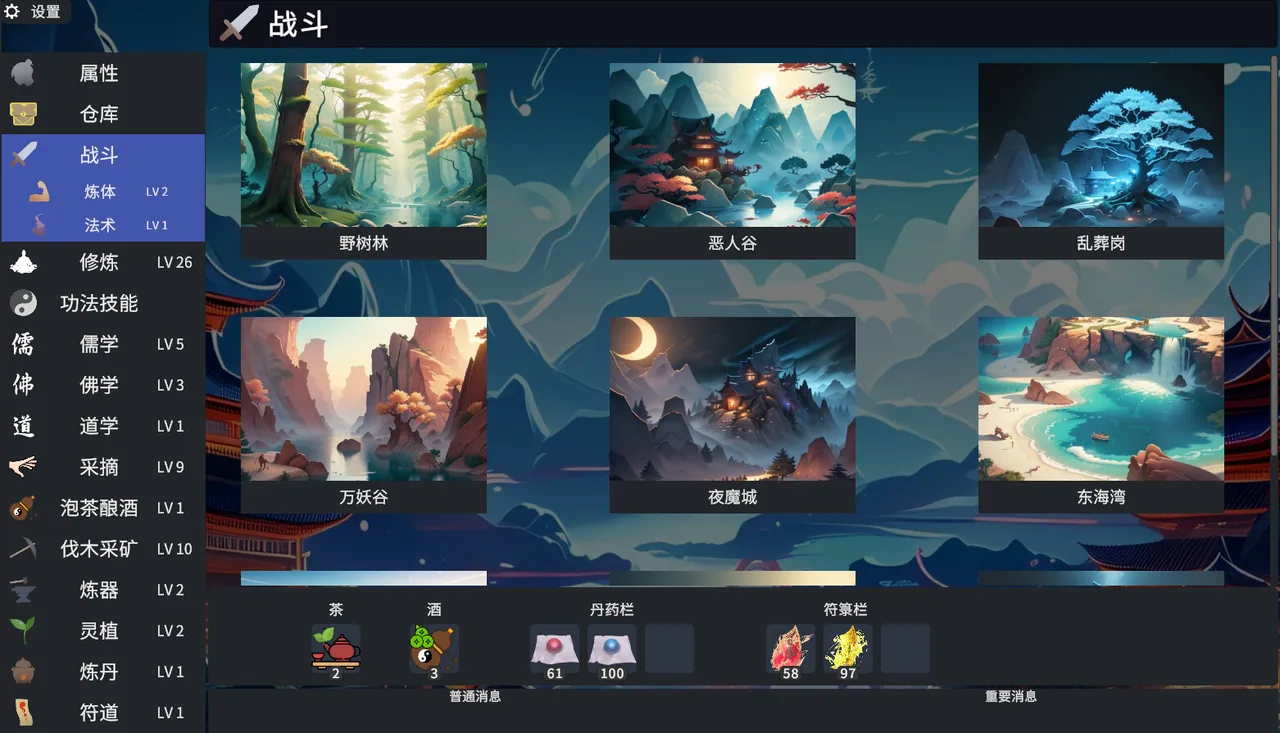
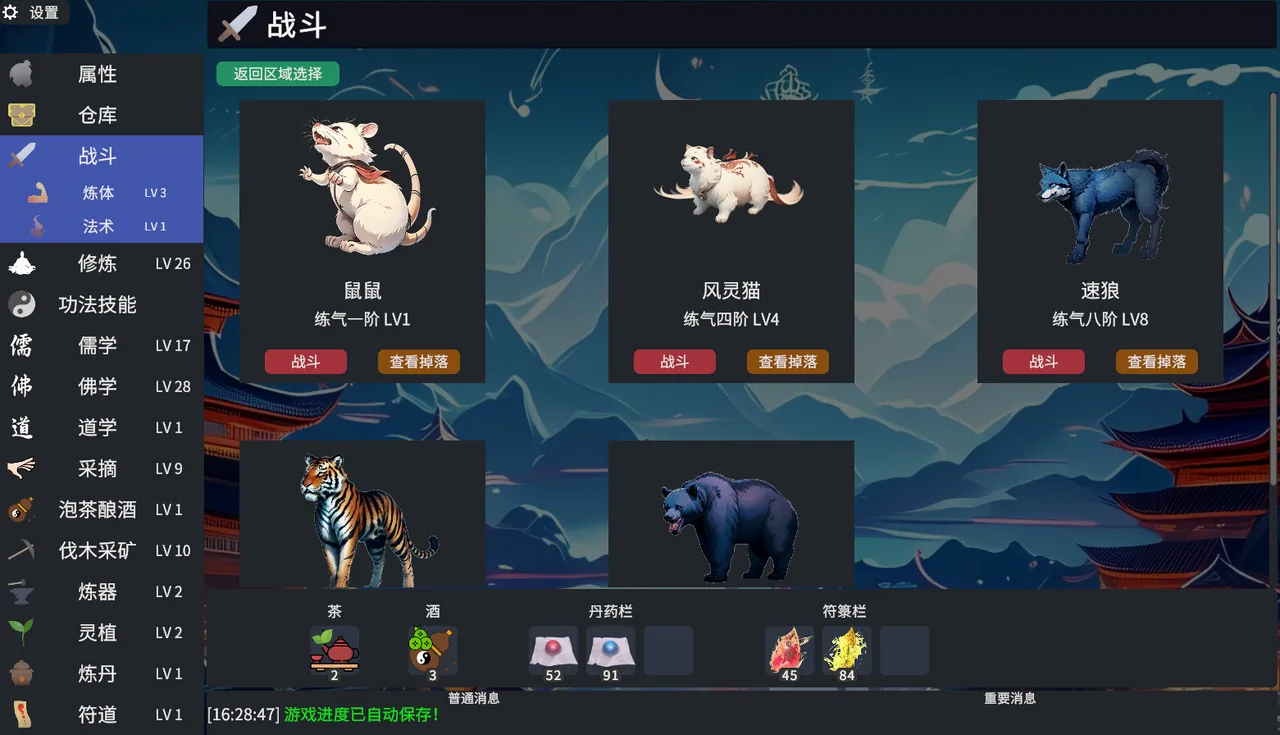
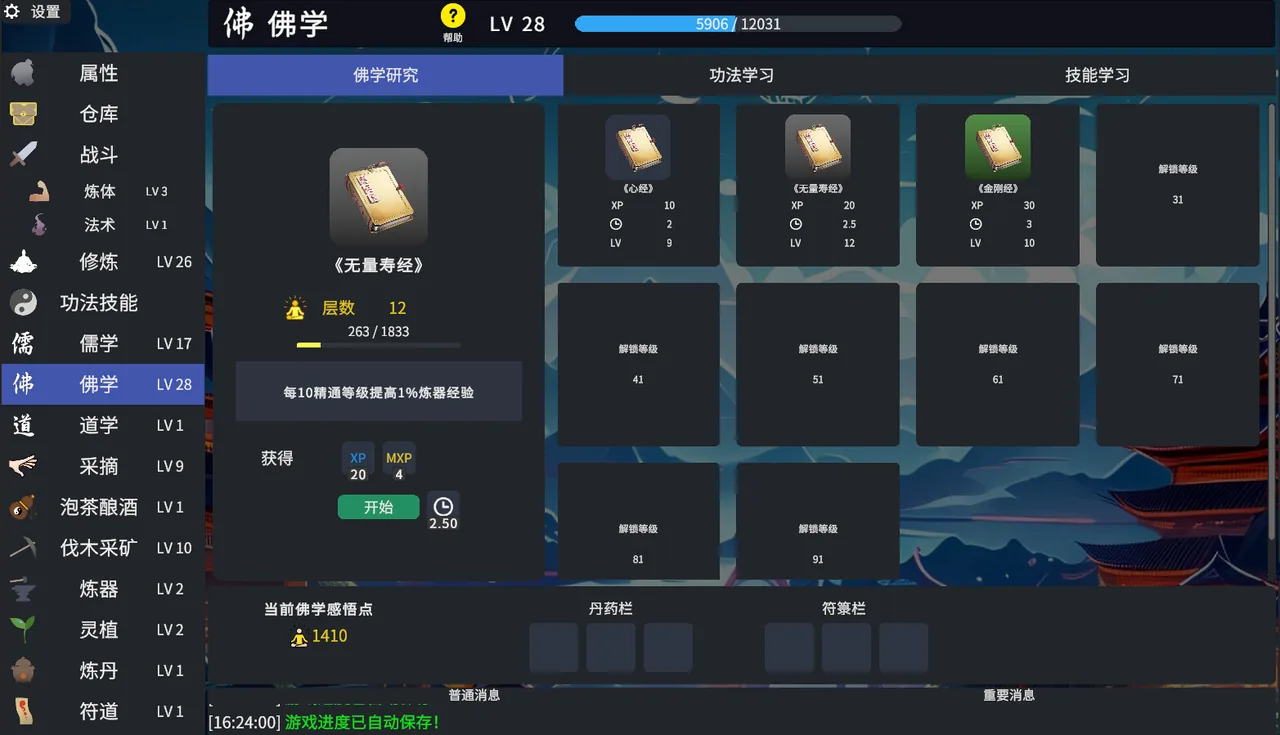
Start with what's there. The skill sidebar alone runs to fifteen entries: body refining and spellcraft feed into combat, three separate study tracks (Confucian, Buddhist, Taoist) unlock techniques and skills, and six production skills — gathering, woodcutting and mining, tea and wine brewing, spirit-plant farming, artifact forging, pill alchemy and talisman crafting — each run their own idle timer with tiered unlocks gated by level. It's a genuinely close cousin to Melvor Idle's skill-tab structure, right down to the layout, and the game's own review corpus knows it: thirteen of its 87 reviews name Melvor Idle directly, several using it as the reference point for what this game is trying to be. "低配修仙版梅尔沃放置" — "a low-budget cultivation version of Melvor Idle" — is how the most-upvoted review on the page puts it, going on to recommend Melvor itself to anyone who isn't specifically drawn to the cultivation setting. Another reviewer with 3,160 hours logged introduces themselves as "an old Melvor player who's idled it to completion," giving the new game the benefit of the doubt on the strength of that comparison alone.
Three paths, a breakthrough gamble, and a synergy that doesn't quite land
The store page pitches its three cultivation doctrines as complementary rather than exclusive — "why choose? You can master them all" — and the cultivation-breakthrough screen shown in the game's own promotional screenshots backs up that there's real mechanical weight behind progression: each tier transition displays a named technique manual and a stated success percentage, not a guaranteed pass, which lines up with a paired pair of Steam achievements for lucky and unlucky breakthroughs sitting at 9.5% and 29.8% respectively. Failure clearly happens often enough to matter.
Where the pitch runs into trouble is synergy. A detailed critical review from a player with roughly 348 hours logged (47 hours in at the time of writing) argues that although the three paths each grant a separate experience bonus, "the bonuses are currently pathetically small" and no real connective tissue between the three doctrines is visible in practice — pick one weapon type, pick one path, and the others sit mostly unused. Two shorter, more detailed reviews from launch week describe the same thing from the equipment side: quality tiers exist, but "no strong prefix or suffix variation," with stat differences small enough to ignore. It's a familiar shape for an Early Access idle game — the scaffolding for build variety is visibly there, but the numbers haven't been tuned to make choosing between the three paths feel meaningfully different yet.
The single-idle-activity ceiling, and a save-data complaint worth flagging
The most specific, recurring mechanical gripe in the review sample is that only one idle activity can run at a time — no gathering while fighting, no brewing tea while forging. One reviewer describes a patch that briefly allowed combat and gathering simultaneously, calls it "so satisfying," and reports it was quietly reverted the very next day as an unintended bug rather than kept as a feature, closing with a pointed jab that the developer shouldn't treat "the ancestors' rules" as unchangeable. A separate, shorter review from February 2025 complains that bulk-selling from the warehouse doesn't work and that all three cultivation paths can't be trained in parallel either. Both point at the same underlying friction: a game built from many small idle timers that currently forces you to babysit them one at a time.
One further complaint deserves a flag rather than a verdict, since it can't be verified from outside the game: a reviewer with roughly 143 hours logged describes losing a full day of idle progress and consumed items to a save failure — auto-save silently not triggering, manual save in the menu also failing, and only exiting via an "exit without saving" prompt actually preserving state, backwards from what that button should do. It's a single detailed report rather than a pattern across the sample, and the game's own screenshots show a green "progress auto-saved" confirmation message firing normally during ordinary play, so this reads as an isolated incident rather than a systemic issue — but a player considering a long idle session should know it's been reported at all.
What the achievement curve says about who actually plays this
Steam's achievement data gives the fairest outside read on how far people actually get. Twenty- seven achievements form two distinct groups. Ten track level-tier milestones and fall off gradually rather than cliff-diving: 61.0% of owners clear the first, dropping in roughly even steps to 45.5% at the eleventh, 28.9% at the fifty-first, and 11.5% at the ninety-first — a shape that says a solid majority engage seriously and a meaningful minority push a long way in. The other group, nine separate "master a single life skill to level 100" achievements covering everything from gathering to talisman crafting, all sit under 10%, most under 5%. Read together, that's a game most buyers get properly into on the main cultivation ladder, but one where fully maxing any individual side skill is a rare, dedicated-player achievement — which tracks with several reviews describing the side skills as nice-to-have rather than essential.
Playtime on the review sample backs the "properly into it" reading up further. The median positive reviewer has logged 220 hours; the median negative reviewer, 87 hours. The single highest playtime in the whole sample, 5,541 hours, belongs to a five-star review from a player asking for more content because they're about to hit the level cap — worth reading as evidence of an idle-window habit as much as raw enjoyment, since background-idle games routinely rack up clock time nobody is actively watching. Even discounting for that, a negative review with 3,613 hours logged, whose entire text reads simply "the updates are far, far, far too slow," is not a drive-by complaint. These are people who gave the game a genuinely long run before turning on it.
The pricing is clean; the project's pulse isn't
There's nothing to untangle on the money side, and this review checked it directly rather than taking the store's word for it: all seven of the game's own promotional screenshots show nothing resembling a shop, a currency-purchase prompt, a gacha pull or an ad — just skill tabs, timers and inventory bars. NZ$8.99 (US$5.99) is the entire transaction, no DLC is listed, and none of the 87 reviews in the corpus mention pay-to-win, microtransactions or IAP even in passing. For a genre where gacha pulls and currency shops are common even in Early Access, that counts for something, and it's the cleanest part of this review.
What isn't clean is the project's pace. Steam's Early Access FAQ, still live on the store page, told buyers at launch to expect "about three months, but it could extend to six" before a full release, and described the January 2025 build as "70% of the game systems" complete. The news feed backs up an initially active cadence — 27 posts between launch and 30 March 2025's "major version update" — before it stops entirely at "0.2.4.1 超小型更新" ["0.2.4.1 very small update"] on 11 June 2025. Nothing has followed in the fourteen months since. The review sample has caught up to that gap in real time: twelve of the 87 reviews use the specific Chinese term "跑路" — closer to "skipped town" than a neutral "discontinued" — to describe the project, dated across 2025 and rising into 2026, including one dated 26 June 2026 that states plainly, "last update was 11 June 2025, over a year with no news, the developer's disappearance should now be considered confirmed." That's the same conclusion this review reached independently from the news feed, arrived at by a player watching the same silence in real time. Every one of the small handful of 2026 reviews in the sample is negative; the only current player count this review could pull, checked the same day as everything else here, was one.
The fact that decides this review: there is no English version
Every finding above comes from a corpus of 87 reviews, and every single one of them is written in Chinese — 83 Simplified, 4 Traditional, zero English, confirmed by pulling the English-only filter directly and getting nothing back, then checking that against the all-languages total to rule out an API truncation quirk rather than a real result. The reason isn't obscure: Steam's own language-support table for this game lists English interface support as "Not supported," full stop, against Simplified Chinese for interface, full audio and subtitles. The short English description and "About This Game" text on the store page are marketing copy, not evidence the game itself is playable in English — and nothing in the client screenshots suggests otherwise; every menu, tooltip and item name shown in this game's own promotional art is Chinese only.
That's worth being direct about for Wanderer's readers specifically: everything documented above — the skill depth, the breakthrough gamble, the clean monetisation, the fourteen-month silence — describes a game that, as it stands today, you cannot play in English without bringing your own translation layer to it. That's not a knock on the game's quality so much as the single most important practical fact a buyer needs before spending the NZ$8.99, and it's the reason this review leans on Steam's own APIs and screenshots rather than a review corpus that, in this language, simply doesn't exist yet.
Final verdict
Immortal IDLE has the bones of a good idle RPG: a distinctive cultivation setting wrapped around a proven skill-tab structure, real stakes on its breakthrough system, an achievement curve that shows most buyers genuinely engage with it, and pricing so clean it doesn't need an asterisk. Set against that is a developer who has said nothing for fourteen months on a game its own roadmap called 70% finished, a review corpus that has started using the word "abandoned" with increasing frequency through 2025 and into 2026, and — decisively for this audience — a complete absence of English support that keeps the entire English-speaking player base, and this review corpus's zero English entries, out of the conversation entirely. Five out of ten reflects a game whose systems mostly work for the people who can currently play it, and a project that currently gives an English-speaking buyer no good reason to be one of them. If an update ever lands and an English interface arrives with it, this is worth another look.
Pros and cons
Pros
- A genuinely deep idle skilling structure for the price — three cultivation paths (Confucian, Buddhist, Taoist) plus eight separate life skills (gathering, woodcutting and mining, tea and wine brewing, spirit-plant farming, artifact forging, pill alchemy and talisman crafting), each with its own level curve and unlockable recipes
- Steam's global achievement data backs up real engagement rather than a quick bounce: 61.0% of owners clear the first tier milestone, tapering gradually to 11.5% at the ninetieth, a healthy shape for a grind-heavy idle game
- Completely clean monetisation, confirmed directly in the game's own screenshots as well as the storefront: one NZ$8.99 purchase, no DLC listed, no shop screen, no premium currency and no ads anywhere in the client
- Painterly, Chinese-landscape-inspired zone art and clearly organised skill-tab UI that reads well even in the store's own screenshots, despite an otherwise minimal presentation budget
Cons
- No update recorded since 11 June 2025 — about fourteen months as of this review, against an Early Access FAQ that told buyers to expect three to six months. A cluster of reviews through 2025 and into 2026 flatly call the project abandoned, including one from June 2026 citing the exact same dead date this review found independently
- Steam's own language table lists English interface support as "Not supported." Every one of the 87 reviews on the game's page is written in Chinese; there is currently no way to play this game in English without bringing your own translation tools
- Long-time reviewers, some with well over a thousand hours logged, describe the eight life skills as barely interconnected in practice and the three cultivation paths as mutually exclusive rather than genuinely combinable, despite the store page's "why choose? You can master them all" pitch
- No way to run more than one idle activity at a time. A brief patch let players fight and gather simultaneously; reviewers who enjoyed it say it was quietly patched back out as a bug the very next day, and bulk-selling from the warehouse reportedly still doesn't work
Screenshots
-
Immortal IDLEImage: 伯乐Couple via Steam -
Immortal IDLEImage: 伯乐Couple via Steam -
Immortal IDLEImage: 伯乐Couple via Steam -
How the review scores each part of the gameWanderer Editorial -
The game at a glanceWanderer Editorial -
The short versionWanderer Editorial