
Game review
Idle Kingdom
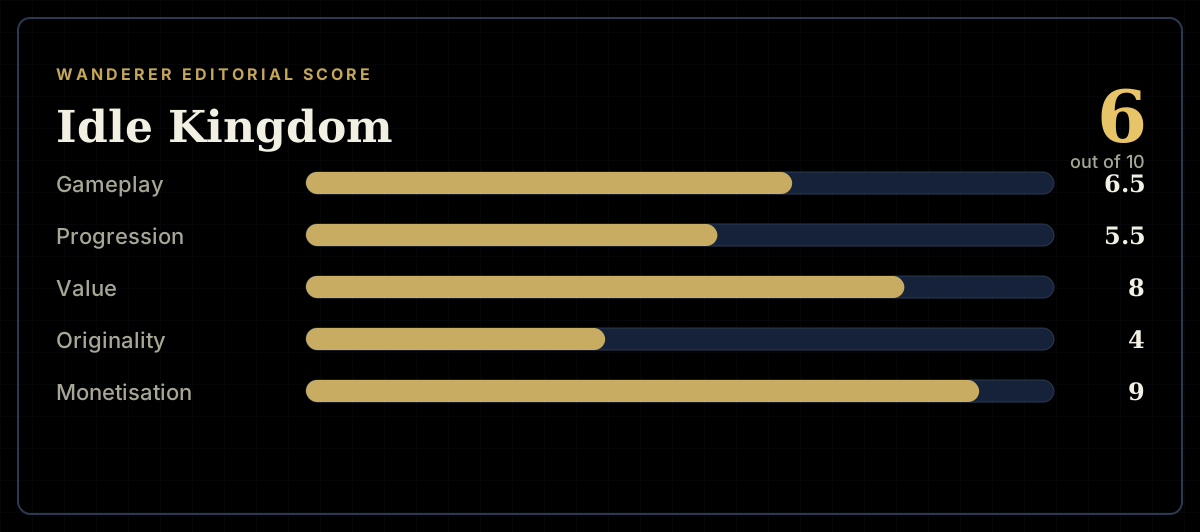
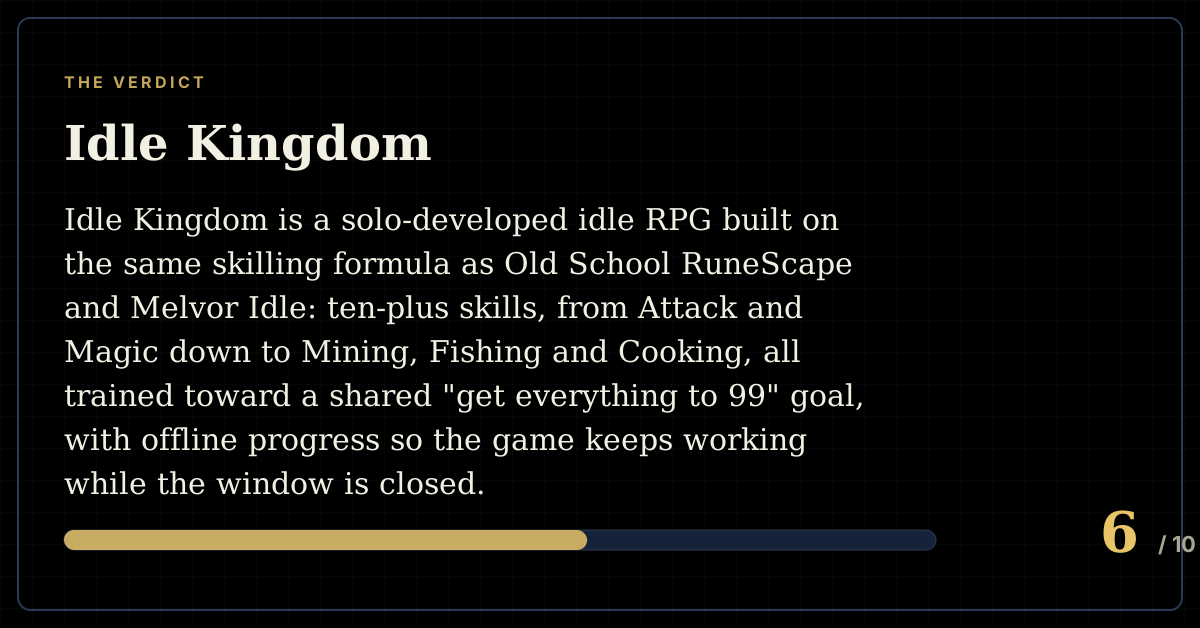
6 / 10
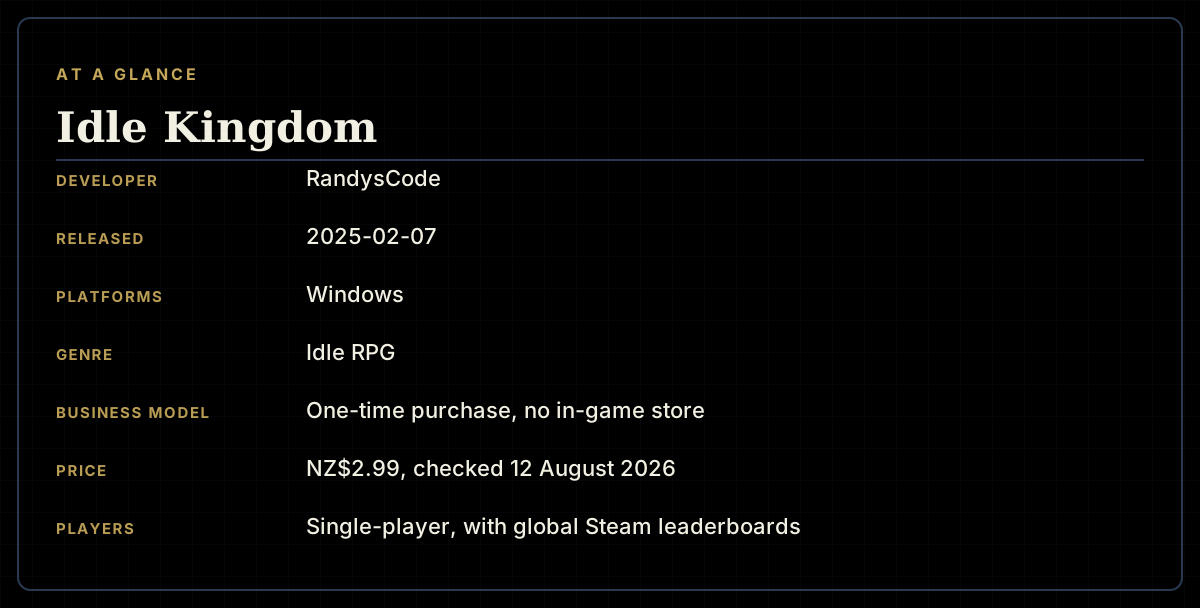
- Developer
- RandysCode
- Publisher
- RandysCode
- Released
- 7 February 2025
- Platforms
- Windows
- Genre
- Idle RPG
- Monetisation
- One-time purchase, no in-game store
- Players
- Single-player, with global Steam leaderboards
The short version
Idle Kingdom is a solo-developed idle RPG built on the same skilling formula as Old School RuneScape and Melvor Idle: ten-plus skills, from Attack and Magic down to Mining, Fishing and Cooking, all trained toward a shared "get everything to 99" goal, with offline progress so the game keeps working while the window is closed. Released 7 February 2025 by solo developer RandysCode for NZ$2.99, it carries a tiny but complete review base — 14 English-language Steam reviews, every one of them read for this review, 13 positive and one negative. The positive side leans hard on value and honesty: no premium currency, no timers sold as convenience, an active developer who patched steadily through February and March 2025 and reviewers who kept the game running for hundreds of hours. The one negative review calls it barebones and ugly, and directly unfavourably compares it to Melvor Idle. Both readings are fair for different reasons — the game is a faithful, cheap, honestly-monetised skilling idler that stopped visibly growing five weeks after it shipped.
Biggest strengths
- NZ$2.99 one-time price with no premium currency, no ads and no pay-to-win systems, which several reviewers specifically credit as the reason they're comfortable recommending it
- Offline progress genuinely functions, including a woodcutting-specific bug the developer patched within two weeks of release, so the core idle promise holds up
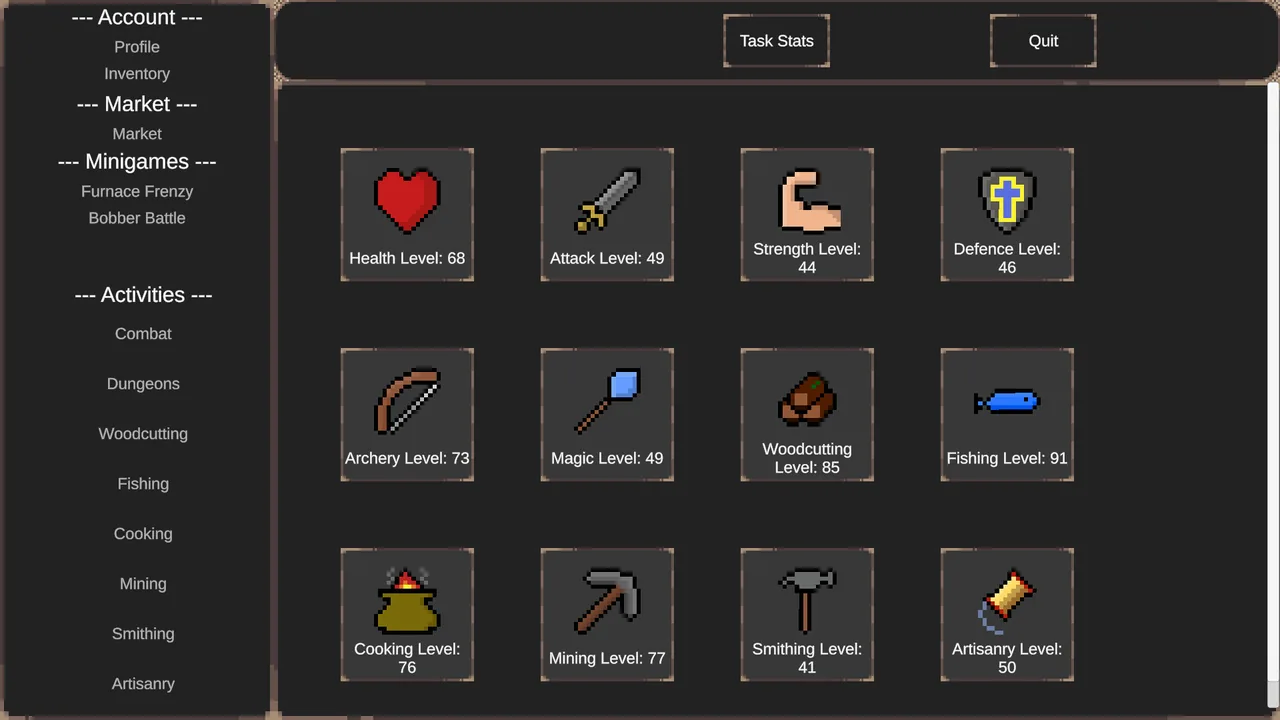
- Ten-plus skills split cleanly between combat (Attack, Strength, Defence, Archery, Magic, Health) and gathering/crafting (Mining, Woodcutting, Fishing, Cooking, Smithing, Farming, Artisanry), letting players lean into either loop
Biggest weaknesses
- Steam's news feed shows six patches between release and 4 March 2025, then nothing in the seventeen months since — the "active developer" reviewers praise is specifically dated to the game's first month
- The game's sole negative review, at 7.6 hours played, calls the visuals barebones and ugly and argues there isn't enough content to hold interest, a fair complaint against a February 2025 feature set this thin
- No Mac or Linux build, and no website beyond a Discord invite link, so even checking for a roadmap means joining a chat server
Who it's for: Idle-RPG fans who specifically want the RuneScape skilling loop at pocket-change price and don't need constant new content to stay interested; a poor fit for anyone hoping for the scale, polish or update cadence of Melvor Idle.
Our recommendation: Worth the NZ$2.99 for what it already is — an honest, functional skilling idler — but go in expecting the game you buy today to be close to the game you'll be playing next year.
6 / 10
Introduction
Idle Kingdom does not disguise its inspiration. It is a browser-idler-turned-Steam-release built on the same skilling chassis as Old School RuneScape and, more directly, Melvor Idle: a roster of combat and gathering skills that all funnel toward the same number-go-up goal, trained by clicking an activity and then leaving the game to tick along, online or off. It shipped 7 February 2025 from solo developer working under the name RandysCode, priced at NZ$2.99 with no follow-up purchases of any kind. Over seventeen months later, it carries one of the smallest review bases this library has covered — 14 English-language Steam reviews in total, every single one of them read for this piece. Thirteen are positive. The one negative review is short, specific, and not wrong about what it's describing.
That's an unusually clean situation for a review to work with. There's no need to sample a representative slice of opinion or worry about a vocal minority skewing the picture, because the whole conversation about this game, as far as Steam's public record goes, fits on one page. What it shows is a small, honest piece of software that did most of what it promised in its first month and then went quiet.
A familiar skilling loop, built cheap and built straight
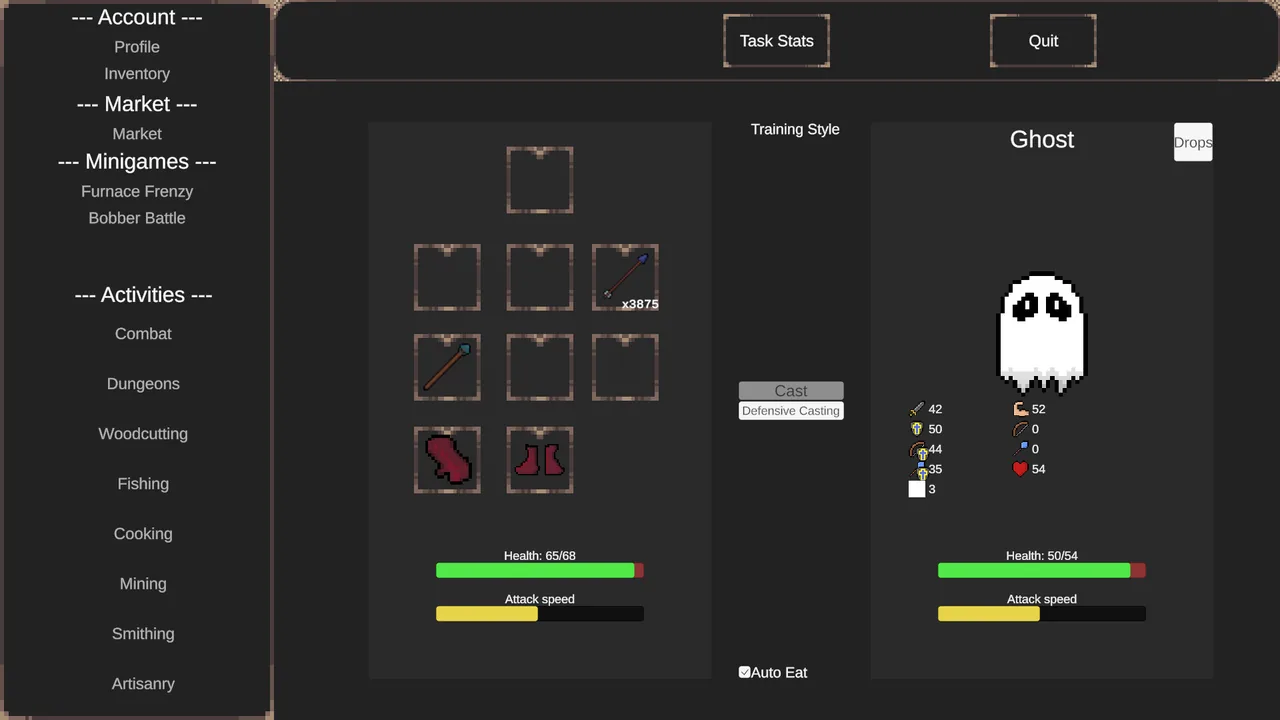
The pitch, lifted almost word for word from the store page, is "number-go-up" — and Idle Kingdom delivers exactly that without much decoration. Ten-plus skills split into two camps: combat (Attack, Strength, Defence, Archery, Magic, Health) and everything else (Mining, Woodcutting, Fishing, Cooking, Smithing, Farming, Artisanry). Training any of them is the genre's usual loop — pick an activity, watch a bar fill, collect the output, spend it on gear or consumables that make the next loop faster. A market handles the buying and selling. Multiple areas hold enemies to fight for loot. It's the shape every Melvor Idle player already knows by heart, and one reviewer said so directly and unfavourably: at 7.6 hours in, they called it "very similar to Melvor Idle. Barebones and ugly looking though. Not nearly enough content or fun to be had here." That's not an unfair description of a one-person, one-month-old idler sitting next to a game with years of updates behind it — it's just a description of scale, not of broken design.
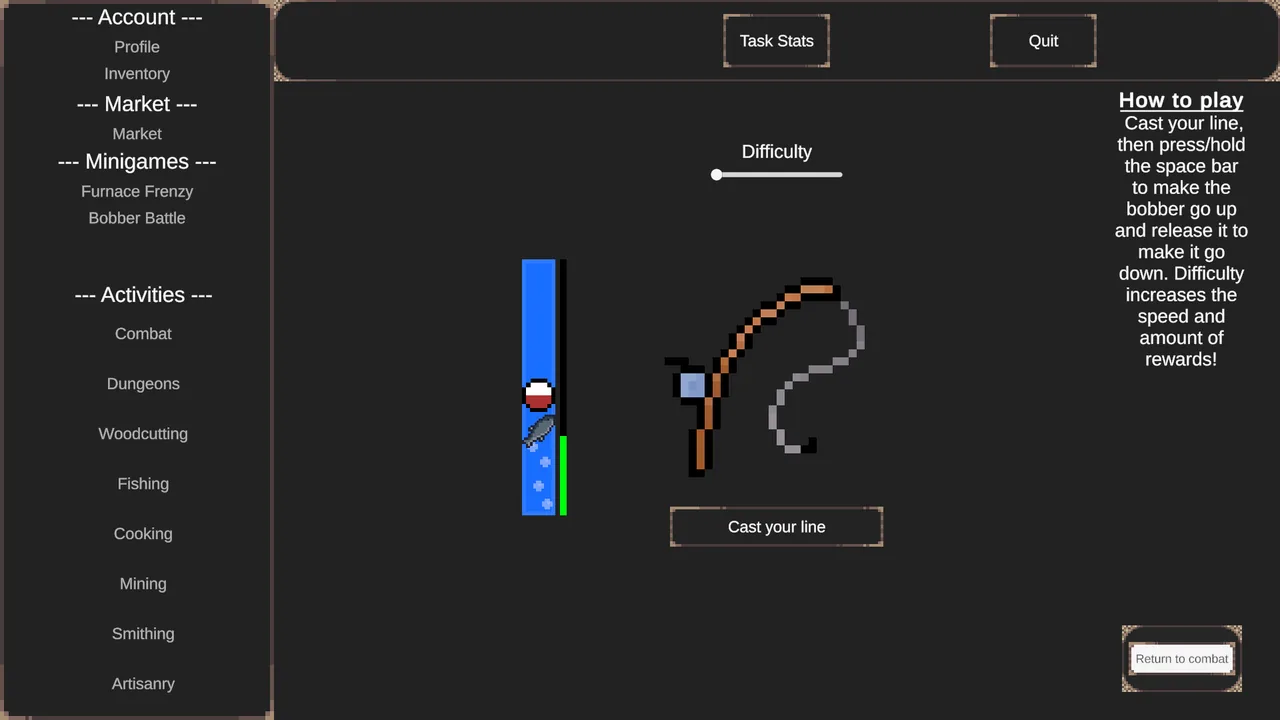
The other thirteen reviewers were looking at the same game and reaching for different comparisons. One, with 481 hours logged, called the drops and minigames things they'd "never seen in an idle game before" and rated it 8.5 out of 10 while praising a developer who was "very active on discord" and responsive to community suggestions. A shorter review with under an hour played still singled out the fishing minigame specifically — "something more active to do while waiting on your idle activities" — which is a real design point worth crediting: a lot of skilling idlers offer nothing to do with your hands at all, and Idle Kingdom at least tries.
The value case is the strongest thing about it
Set the content volume aside for a moment and look at the business model, because it's the part of this review with the least ambiguity. NZ$2.99, paid once, nothing else for sale. No premium currency sitting behind a storefront tab. No energy system gating how much you're allowed to play. No timers dressed up as a convenience purchase. Reviewers noticed and said so unprompted — "on the plus side there is no pay to win," wrote one, adding "I support indie devs doing a good job" even while admitting pricier, more feature-rich alternatives exist. That's a genuinely useful signal for this library's readers: a monetisation model this clean is rare enough in the idle genre that it's worth stating plainly rather than assuming every "idle RPG" on Steam comes with a shop attached. Offline progress — the actual load-bearing promise of the genre — also holds up in practice. One reviewer noted explicitly that Steam's playtime counter undersells how much the game has done for them because of it, and the developer's own patch notes from 22 February 2025 record a fix for an error specifically breaking offline woodcutting progress, which is the kind of unglamorous bug fix that suggests someone was actually testing the feature rather than shipping it and hoping.
Where the "active developer" praise runs out
Here's the finding that reframes the rest of this review. Steam's news feed for Idle Kingdom lists exactly six posts: a final pre-launch update on 6 February 2025, a launch-week patch two days later, three further patches through February, and a fourth on 4 March 2025 that added a leaderboard, Steam achievements, a new farming skill and an in-game planning tool. That March update is also the last one. As of this review, nothing further has been posted in the roughly seventeen months since.
That matters because "the dev is active and responsive" is the single most repeated phrase across the positive reviews — but every one of those reviews is dated between 7 February and 3 April 2025, which is to say, within the same five-week window the patch notes cover. None of it is dishonest; it's simply describing a real thing that was true at the time and has not been re-confirmed since by anyone posting publicly. A developer can absolutely keep working quietly in Discord — the support link on the store page points nowhere else — without touching Steam's news feed, and nothing here proves the game has been abandoned. But readers deciding whether to buy today should know they're buying the game as it stood in March 2025, not a game with an ongoing track record of growth behind it.
What the achievement data actually shows
Idle Kingdom ships fourteen Steam achievements, one for reaching level 99 in each skill, which gives a clean way to check how deep the playerbase has actually gone rather than trusting anecdotal playtime numbers. The results, pulled from Steam's global achievement statistics: Mining leads at 6.6%, with Fishing and Woodcutting just behind at 6.2% each and Foraging at 4.9%. Combat skills sit lower — Health and Attack both at 4.0% — and the newest additions trail the whole field: Farming and Defence at 3.1%, Smithing, Magic and Archery at 2.6%, and Artisanry, the rarest, at 2.2%.
Two things are worth saying about that spread rather than just reporting it. First, the ordering tracks with what the reviews already describe — gathering skills (Mining, Fishing, Woodcutting) are the ones players push furthest, which lines up with the genre's usual pattern of hands-off skills being easier to leave running unattended than combat, which needs the player to be present to survive fights. Second, the sample itself is tiny. A corpus with only 14 written reviews and a game this cheap almost certainly has a tracked population in the hundreds rather than the thousands, which means these percentages can shift meaningfully on a handful of new completions. They're evidence of where the current playerbase's effort has gone, not a statistically airtight verdict — and Farming's low placement in particular is likely inflated by the fact that it's the newest skill in the game, added in the final March patch, rather than a sign nobody wants to grow crops.
Final Verdict
Idle Kingdom does what it says on the tin: it's a RuneScape-shaped skilling idler, priced like a coffee, monetised with total honesty, and functional enough that reviewers have logged hundreds of hours in it without complaint about the offline systems that make an idle game worth owning. Where it falls short is content depth and, more importantly, the visible pace of its own growth — a feature set that stopped expanding in its fifth week, with no further public update in the year and a half since, sitting underneath praise for an "active" developer that was accurate once and hasn't been re-earned publicly since. Buy it for what it already is, not for what its reviews imply it's about to become. At NZ$2.99 that's still an easy recommendation for genre fans with modest expectations; it's a much harder one for anyone hoping this becomes their next long-term skilling game.
Pros and cons
Pros
- NZ$2.99 one-time price with no premium currency, no ads and no pay-to-win systems, which several reviewers specifically credit as the reason they're comfortable recommending it
- Offline progress genuinely functions, including a woodcutting-specific bug the developer patched within two weeks of release, so the core idle promise holds up
- Ten-plus skills split cleanly between combat (Attack, Strength, Defence, Archery, Magic, Health) and gathering/crafting (Mining, Woodcutting, Fishing, Cooking, Smithing, Farming, Artisanry), letting players lean into either loop
- A fishing minigame gives players something to actively do between idle ticks, which multiple reviewers single out as more engaging than passive waiting
Cons
- Steam's news feed shows six patches between release and 4 March 2025, then nothing in the seventeen months since — the "active developer" reviewers praise is specifically dated to the game's first month
- The game's sole negative review, at 7.6 hours played, calls the visuals barebones and ugly and argues there isn't enough content to hold interest, a fair complaint against a February 2025 feature set this thin
- No Mac or Linux build, and no website beyond a Discord invite link, so even checking for a roadmap means joining a chat server
- Achievement data suggests real thinness at the top end: even the most commonly maxed skill sits under 7% of the tracked population, on a corpus small enough that the numbers move on single-digit player counts
Screenshots
-
Idle KingdomImage: RandysCode via Steam -
Idle KingdomImage: RandysCode via Steam -
Idle KingdomImage: RandysCode via Steam -
How the review scores each part of the gameWanderer Editorial -
The essentials at a glanceWanderer Editorial -
The short versionWanderer Editorial