
Game review
Idle Cave Miner
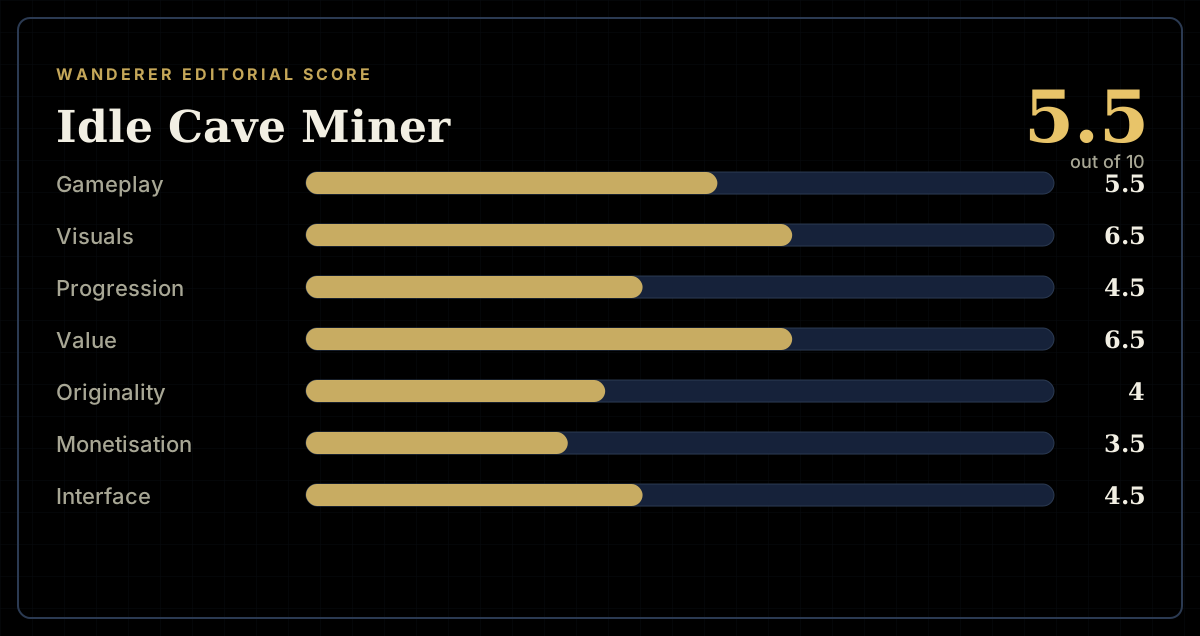
5.5 / 10
- Developer
- Cold Hours
- Publisher
- Cold Hours
- Released
- 7 December 2023
- Platforms
- Windows, Mac, Linux
- Genre
- Idle Game
- Monetisation
- Free to play, with an optional premium currency for extending offline time, buying auto-clicker functionality and speeding up crafting
- Players
- Single-player, with online leaderboards
The short version
Idle Cave Miner opens well: cute miners with their own small backstories, a pixel-art dig site that genuinely deepens as you go, and a prestige loop across four parallel mines that gives early hours real shape. The trouble starts once that shape has to hold for hundreds of hours instead of a handful, and the game's own systems start working against the "idle" part of its name — a capped offline timer, an economy where mashing the mine face beats the miners you're meant to be managing, and a premium currency standing between you and full completion.
None of that makes it a scam; it's free, it's honest about its shop, and plenty of players have gotten dozens of hours of genuine enjoyment before the wall hit. But a game whose entire pitch is letting you walk away shouldn't punish you for walking away, and Idle Cave Miner does exactly that.
Biggest strengths
- The opening hours are genuinely charming — distinct miners with their own small personalities, a mine that visibly changes character as you dig deeper, and clear, readable pixel art
- In-app purchases are switched off by default and several long-time players report finishing large amounts of content, achievements included, without spending a cent
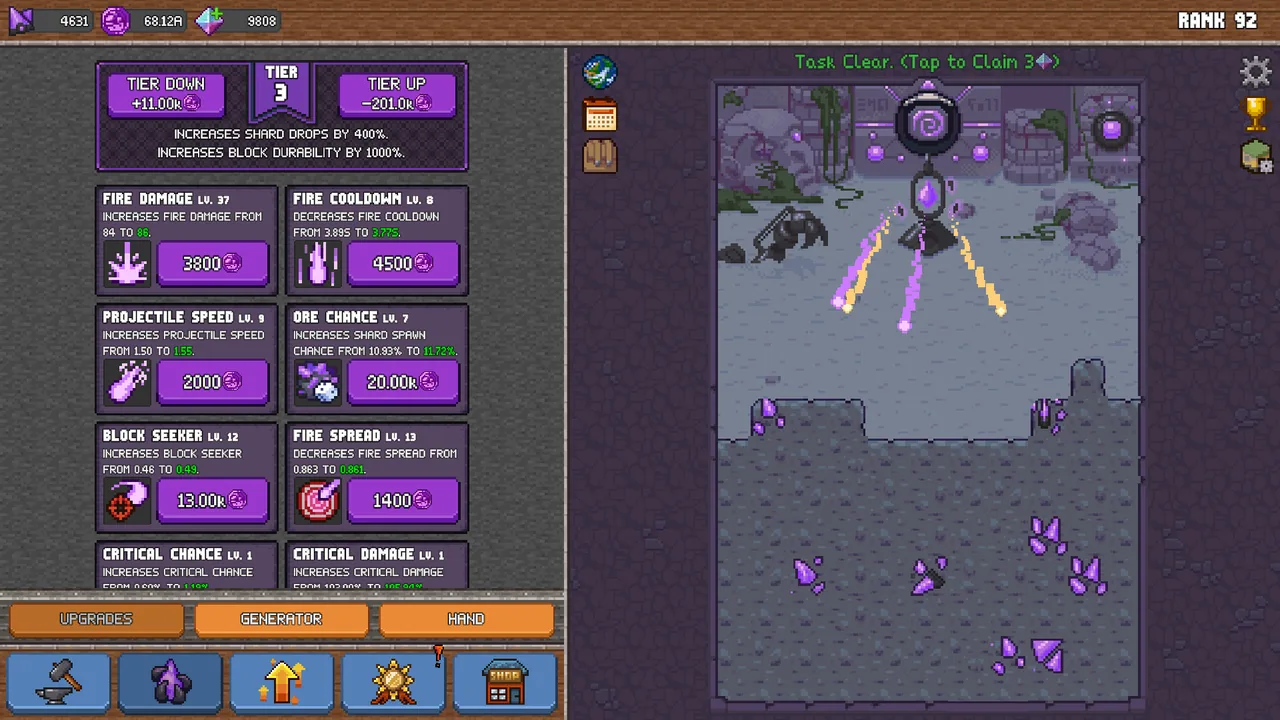
- Four parallel mines with their own resource sets give the mid-game some real structural variety instead of one long, single-track grind
Biggest weaknesses
- Progression collapses into an enormous late-game grind — reviewers who reached 100% completion report anywhere from several hundred to well over a thousand hours invested, with diminishing-return upgrades that flatten out hard past the midpoint
- Manual clicking, and third-party autoclickers, meaningfully outperform the hired miners the game is nominally built around, which undercuts its own core pitch
- Offline time is capped rather than unlimited, and extending it runs through the same premium currency as everything else — a direct contradiction of what "idle" is supposed to mean
Who it's for: Idle-genre newcomers who want a gentle, low-stakes entry point, and completionists who don't mind a very long tail. Not for anyone who specifically wants a game that respects being left alone.
Our recommendation: Worth the download since it costs nothing, but go in expecting the back half to slow to a crawl, and don't chase 100% unless you're prepared to either spend or wait it out over weeks.
5.5 / 10
Idle Cave Miner asks you to build a team of miners, send them into an ever-deepening cave, and let them work while you're not looking — which is the entire promise of the idle genre in one sentence. For a few hours, it delivers on that promise better than most of its free-to-play peers: a warm, readable pixel-art dig site, a small cast of miners who feel like more than reskinned stat sticks, and a prestige loop that gives early progress real momentum. Then the offline timer runs out, the upgrades stop scaling, and the game starts asking you to either sit at the mine face clicking or pay to make the waiting shorter. That's the whole review in miniature: a good opening act let down by a design that increasingly works against its own genre.
A likeable premise, well drawn
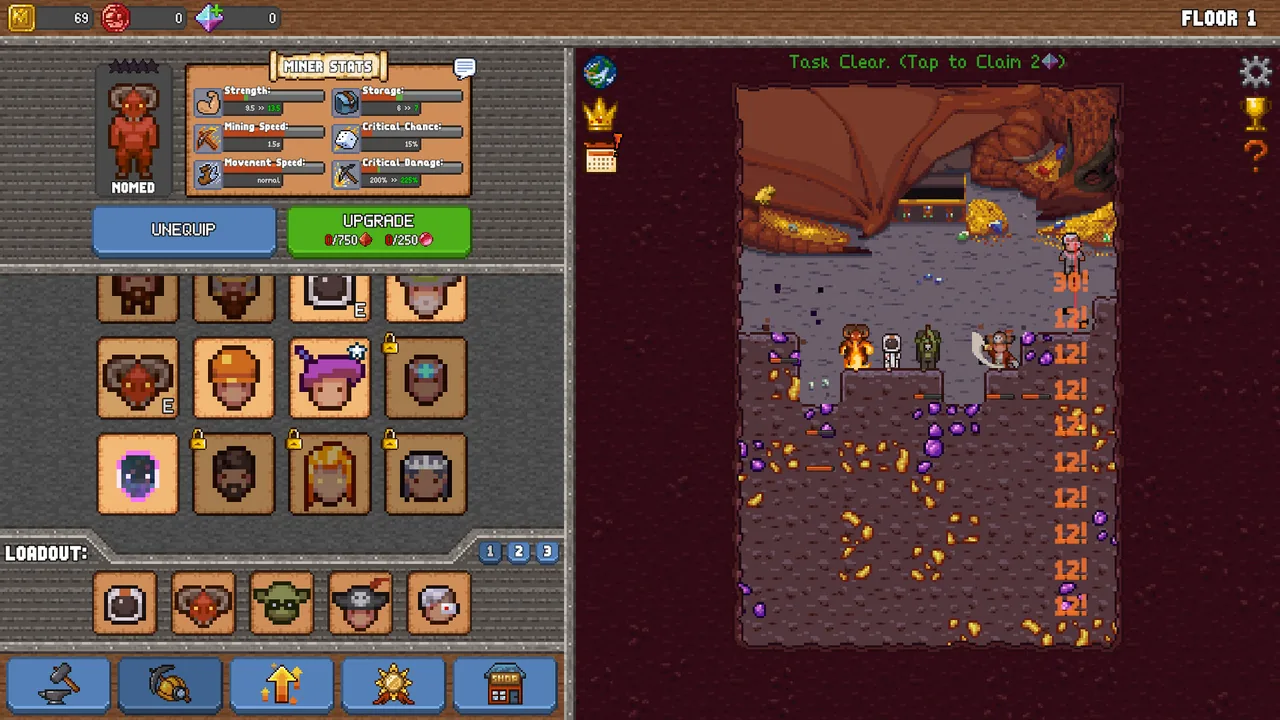
Cold Hours clearly put care into the presentation. The mine genuinely shifts in character as you descend — new biomes, new ore types, new visual identity rather than the same tileset recoloured — and the pixel art holds up well at a glance, which several long-time players single out as the thing that kept them opening the app after the novelty wore off. The miners themselves come with small written backstories and distinct looks, a detail that costs the developer little but does a lot of work in making a roster of hired hands feel like a roster of characters. Four separate mines run in parallel, each with its own resources and its own prestige currency, which means the mid-game has genuine structural variety instead of one linear grind with a different coat of paint — closer to running four small idle games side by side than padding one out.
The crafting-and-smelting layer sits on top of that: forge upgrades speed up refining rare ores and gems, and the items you craft permanently boost your miners rather than just sitting in a menu. On paper it's a reasonably complete idle-RPG skeleton — collection, crafting, prestige, missions, achievements, leaderboards — assembled with more polish than the genre's rock-bottom mobile ports usually manage.
The click beats the miner
The problem shows up as soon as you start comparing systems against each other rather than judging them in isolation. The entire pitch of Idle Cave Miner is a team of miners doing the work for you, but the game's own numbers don't back that pitch up: several players who tracked their output found manual clicking, and autoclicker tools running on top of it, outproducing a fully-staffed mining team by a wide margin once you're past the opening zone. One detailed player breakdown put autoclicker damage at roughly fifty times what the passive miners were contributing with no upgrades in play at all. That's not a minor balance quirk — it means the mechanically "correct" way to play a game called Idle Cave Miner is to sit there and click, which is close to the opposite of what an idle game is supposed to reward.
Progression that runs out of road
The early game moves at a comfortable clip: new miners, new gear, new mine tiers arrive often enough to keep a session feeling productive. That pace does not hold. Multiple players who pushed into the deeper floors describe forge upgrade costs and crafting times doubling with each new material tier while the returns on those upgrades shrink, to the point that some report the percentage bonus from gold upgrades bottoming out at single digits no matter how much further you push. The practical result, echoed across a wide spread of reviews, is a late game measured in hundreds of hours rather than tens — several players cite completion times between roughly 700 and 2,500 hours, much of it spent waiting on smelting timers rather than doing anything resembling "playing." A few describe reaching a genuine content wall around the 500-to-1,000-floor mark, where the game simply stops introducing anything new and the remaining stretch is pure number grinding toward achievements rather than fresh systems.
Steam's own achievement data backs up how steep that curve gets: of the 18 achievements, the easiest is earned by 96.6% of players, but completion drops off fast — under 8% have the mid-tier ones, and the hardest sit at 3.0% and 3.6%. That's a wide gap between "played casually" and "saw the whole thing," which tracks with the flood of reviews describing a strong start and a grind that eventually became the point of diminishing returns rather than a means to an end.
The offline cap, and what it costs to remove
The sharpest complaint across the negative reviews isn't the grind itself — idle-game players tend to have a high tolerance for that — it's that Idle Cave Miner puts a ceiling on the one thing the genre exists to deliver: unattended progress. Offline time is capped, several players describe it as landing somewhere around four to five hours even with upgrades, and extending it runs through the same premium currency ("Prismatic Orbs," by several accounts) used everywhere else in the shop. That currency trickles in slowly enough through free play that a number of reviewers describe the realistic way to remove the cap as spending real money, and describe purchase tiers running well past what a typical mobile gacha game asks for a single bundle. The game does not force any of this — in-app purchases are switched off by default, and multiple long-time players report reaching full or near-full completion without spending anything, at the cost of very long elapsed time. But "you technically don't have to pay" is a thinner defence here than in most free-to-play games, because the thing being rationed is the exact feature the game is named after. Achievement and full-completion progress specifically get cited as the sharpest edge of this — several players note that certain unlocks are realistically only reachable through premium currency they'd otherwise need to grind for an impractical length of time.
Interface and the mobile-port tells
The UI does its job without being pleasant to live in for hundreds of hours. Actions are still labelled "tap" in places rather than updated for a mouse-and-keyboard build, currencies pile up across several parallel systems the way mobile idle games tend to, and more than one reviewer flags a lack of any clean way to exit the application, forcing a manual force-quit. None of it is broken exactly — it's the specific, familiar friction of a game designed for a phone screen first and ported over with the fewest changes that would still let it run on Steam.
Where the game seems to be headed
A number of the more recent negative reviews raise the same point independently: Cold Hours appears to have shifted its attention to a sequel rather than continuing to build out this game's late-game systems, and the endgame reads accordingly — a set of upgrades and unlocks that don't lead anywhere, left in a state that suggests the loop simply stopped being iterated on rather than being deliberately designed to plateau. For a game that was clearly capable of more in its first few hours, that's a genuinely disappointing way for the tail end to land, and it colours how much benefit of the doubt the current late game deserves.
Final verdict
Idle Cave Miner earns real credit for its opening stretch — it's better-looking and better-written than the free-to-play idle-clicker average, and its four-mine structure is a legitimately good idea for keeping the mid-game varied. It loses that credit back over the following hundred-plus hours, where the numbers stop scaling sensibly, the game's own click-beats-miner economy undermines its central hook, and the offline cap turns "idle" into a word the store page uses rather than a promise the game keeps. None of that makes it predatory in the way the worst mobile ports are — it's honestly free, its shop is opt-in, and plenty of players clearly had a good time with it before the grind set in. But a very long tail of diminishing returns, a currency wall around full completion, and a developer who seems to have moved on to a sequel add up to a game that's easy to recommend for a free afternoon and much harder to recommend for the hundreds of hours it eventually asks for.
Players who'd rather their offline time stayed uncapped at every tier, with no currency menu standing between them and it, may find Wanderer a more relaxing version of the same idea.
Pros and cons
Pros
- The opening hours are genuinely charming — distinct miners with their own small personalities, a mine that visibly changes character as you dig deeper, and clear, readable pixel art
- In-app purchases are switched off by default and several long-time players report finishing large amounts of content, achievements included, without spending a cent
- Four parallel mines with their own resource sets give the mid-game some real structural variety instead of one long, single-track grind
- Cloud saves, online leaderboards and a genuine offline-progress system are all present and working as advertised, not just listed on the store page
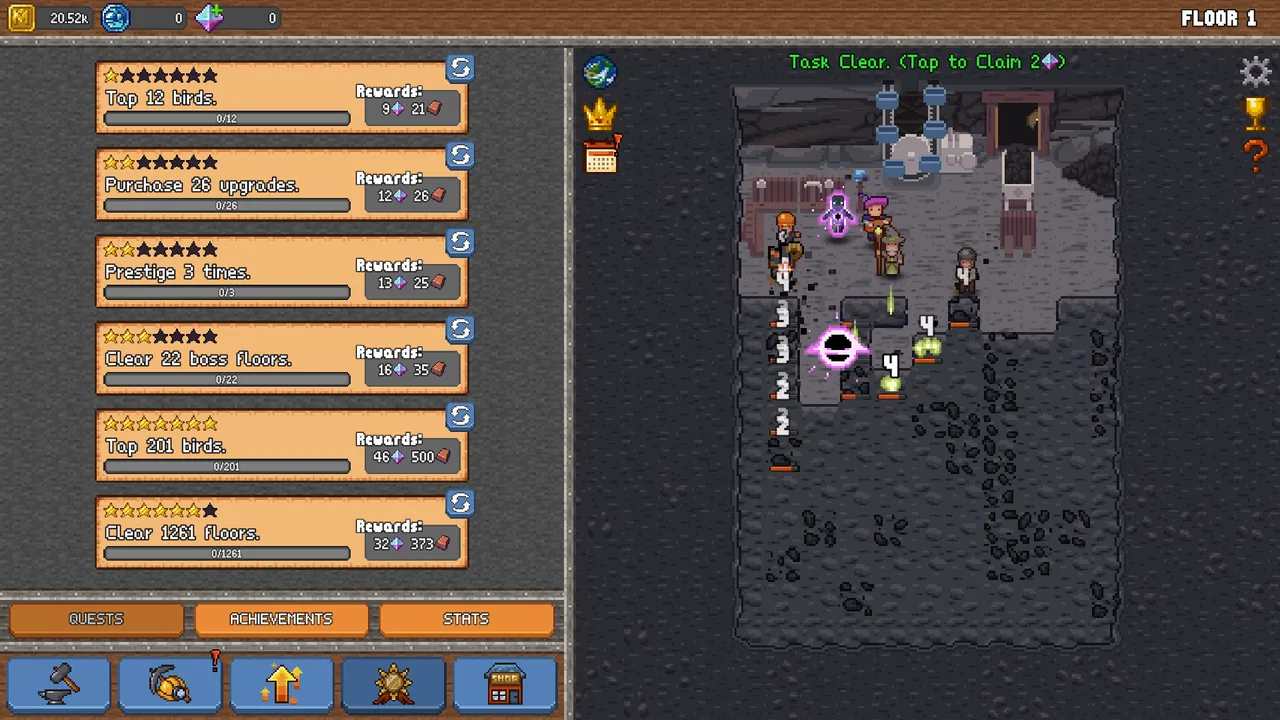
- Missions and achievements give idle-style players concrete short-term goals to chase between prestige resets
Cons
- Progression collapses into an enormous late-game grind — reviewers who reached 100% completion report anywhere from several hundred to well over a thousand hours invested, with diminishing-return upgrades that flatten out hard past the midpoint
- Manual clicking, and third-party autoclickers, meaningfully outperform the hired miners the game is nominally built around, which undercuts its own core pitch
- Offline time is capped rather than unlimited, and extending it runs through the same premium currency as everything else — a direct contradiction of what "idle" is supposed to mean
- Several achievements and deep completion sit behind premium currency that free play generates too slowly to reach without real spending, by multiple players' accounts
- The interface still calls actions "tap" rather than "click" in places and carries other unmistakable mobile-port fingerprints, down to a shutdown flow several players describe as unclear
- Development attention has visibly shifted to a sequel, and the base game's late-game systems read as left unfinished rather than deliberately paced
Screenshots
-
Idle Cave MinerImage: Cold Hours via Steam -
Idle Cave MinerImage: Cold Hours via Steam -
Idle Cave MinerImage: Cold Hours via Steam -
How the review scores each part of the gameWanderer Editorial -

The game at a glanceWanderer Editorial -
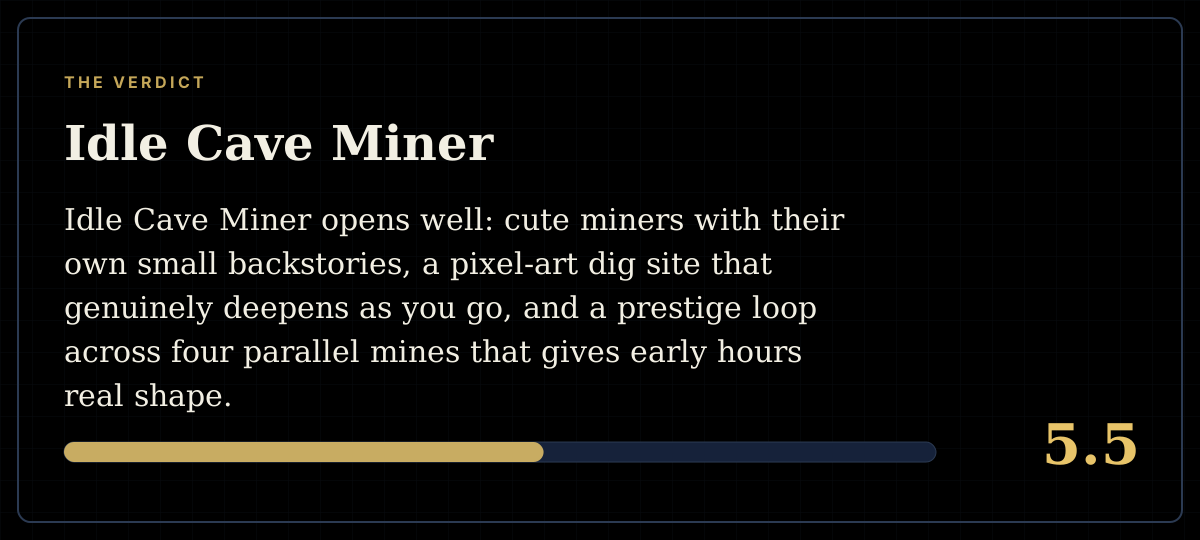
The short versionWanderer Editorial