
Game review
Hookah Haze
6 / 10
- Developer
- ACQUIRE Corp.
- Publisher
- Aniplex Inc.
- Released
- 10 July 2024
- Platforms
- Windows
- Genre
- Slice-of-life visual novel with simple mixing gameplay
- Monetisation
- One-time purchase, with an optional artbook DLC available
- Players
- Single-player only
The short version
Hookah Haze puts you behind the counter of a quiet Akihabara hookah lounge as Toru Sumiki, a manager recently diagnosed with a terminal illness, mixing shisha blends and slowly getting to know three regulars each working through their own private struggles. Reviewers consistently and specifically invoke VA-11 HALL-A and Coffee Talk as the clearest points of comparison, and the game's pixel art, music, and gentle emotional sincerity earn it real, warm affection on those terms. What tempers that affection across a large share of the same sample is a specific, repeated complaint that the actual content doesn't stretch far enough to justify its price: around ten hours across three short character routes, thin mixing gameplay that never develops beyond its opening hour, and — separately — a genuine, unresolved visual bug where character sprites render blurry and incorrectly scaled regardless of display settings.
Biggest strengths
- The pixel art, character designs, and overall atmosphere draw near-universal, specific praise, with reviewers consistently describing the lounge setting and cast as genuinely charming
- The soundtrack earns repeated, specific praise, and a customisable in-game jukebox lets players adjust background music to their liking, a small but appreciated feature several reviewers call out directly
- The central emotional premise — a protagonist confronting mortality by genuinely connecting with three people also carrying private burdens — is described by multiple reviewers as sincere and moving rather than manipulative, with at least one specifically praising a true, positive ending that resolves the terminal-illness setup without dishonest sentimentality
Biggest weaknesses
- The single most repeated complaint concerns value for length, with numerous reviewers independently describing a roughly ten-hour total runtime across three short routes as too little content for the asking price relative to genre peers
- The shisha-mixing gameplay is described by multiple reviewers as shallow and repetitive, offering little mechanical development beyond its first hour despite being a core recurring activity throughout the story
- A specific, unresolved visual bug is reported by multiple independent reviewers, in which character sprites render blurry and appear incorrectly scaled regardless of resolution or display settings adjustments
Who it's for: Fans of narrative-driven, low-stakes bartending sims like VA-11 HALL-A and Coffee Talk who want a gentle, melancholic story experience and don't need a long runtime or complex mechanics. Less suited to players expecting either deep gameplay systems or a full-price-length narrative.
Our recommendation: Worth playing at a discount for the atmosphere, music, and heartfelt if slight character stories. At full price, weigh the roughly ten-hour total runtime and thin mixing mechanic carefully against what you'd pay for comparable, more content-rich narrative sims in the same genre.
6 / 10
Hookah Haze sets up its stakes early and directly: Toru Sumiki, its protagonist, has just been diagnosed with a terminal illness and, on a doctor's suggestion to make the most of whatever time remains, takes a job managing a quiet hookah lounge on the edge of Akihabara. What follows is a gentle, low-stakes visual novel about mixing shisha blends and slowly getting to know three regulars, each carrying their own private weight. This review's sample reaches for the same reference point with striking consistency — VA-11 HALL-A, and to a lesser extent Coffee Talk — and that consistency is itself the most useful lens for judging what the game actually delivers.
An atmosphere reviewers fall for immediately
The praise for presentation is close to unanimous. "Really good pixel art aesthetics and atmosphere," one reviewer writes, echoing dozens of similar comments about the lounge's specific, lived-in visual charm. The soundtrack earns its own repeated praise, with a customisable in-game jukebox singled out as a small but genuinely appreciated touch. More substantively, the emotional core lands for a real share of reviewers: "what seems like a dating sim is in fact a reflexion about death, what we do with our life, how to deal with our traumas and grieves," one writes, and another specifically reassures prospective buyers that the game resolves its terminal-illness premise with "a true (good) ending," sparing players a manipulative tragedy for its own sake.
The comparison that both helps and hurts it
Reviewers who explicitly frame Hookah Haze against VA-11 HALL-A are almost uniformly honest that the comparison isn't entirely flattering. "Is it as good as VA-11 Hall-a? No, but few things are... this one is more a 7/10," one reviewer writes, going on to identify the specific shortfall: thinner writing and less distinct characters relative to its clear inspiration. Another puts it more bluntly: "Hookah Haze tried to copy VA-11 HALL-A's homework, but only got it right on the surface... nothing particularly interesting to say." That's a fair, specific critique rather than a dismissal — reviewers aren't saying the game fails on its own terms, they're saying it doesn't reach the specific bar its closest genre comparison set.
A length and price mismatch reviewers raise consistently
The most repeated concrete complaint concerns value: a total runtime around ten hours across three short character routes, priced at a level several reviewers feel doesn't match that scope. "If this game was a cute little game for 8-10 dollars base price I'd probably say it's worth experiencing, but at 18 dollars this game is HIGHWAY ROBBERY for the content on offer here," one reviewer writes bluntly. A separate, related complaint concerns the core mixing gameplay itself, which multiple reviewers describe as shallow and unchanging after its first hour, functioning more as a framing device between dialogue scenes than a system with real depth of its own.
A specific, unresolved technical bug
Beyond content concerns, several reviewers independently report a concrete visual bug: character sprites rendering blurry and incorrectly scaled, a problem that persists "no matter the resolution" according to one detailed account. This isn't a subjective art-style complaint — reviewers who otherwise love the pixel art specifically flag this as a technical rendering issue distinct from their aesthetic appreciation of the character designs themselves.
A localisation choice that reads differently to different readers
Worth naming directly and carefully: the English localisation characterises the protagonist in a specific way — several positive reviews explicitly praise a nonbinary characterisation as a sincere, well-handled touch, while at least one negative review raises a pointed objection to translation choices around the same character. This review treats this as a real difference in how readers respond to a specific, documented localisation decision rather than a factual dispute to adjudicate, and notes it here so prospective buyers with strong feelings either way can make an informed choice.
What the achievement data suggests about how far players actually go
Steam's own completion figures offer a useful independent check on the length and replayability complaints. An early story milestone sits above 92%, confirming most buyers do progress meaningfully into at least one character route, but full-completion achievements — requiring all three heroines' good endings plus the additional unlockable content that follows — settle around 13-15%. That's a real, if not severe, drop-off for a game most reviewers describe finishing a single route of in just a few hours, and it's broadly consistent with the value complaints raised throughout this review: many buyers engage with the game seriously, but a meaningfully smaller share go back to see every route through to its conclusion, whether due to the repetitive mixing mechanic or simply feeling they'd gotten what they wanted from a single playthrough.
A studio and publisher pedigree worth noting
It's worth placing this release in context of who made it. ACQUIRE Corp. has a long development history stretching back to titles like Tenchu and the Way of the Samurai series, and Aniplex is one of the more prominent anime-adjacent publishers bringing Japanese visual novels and narrative games to a global Steam audience. That pedigree shows up directly in the presentation quality this review's sample praises so consistently — the music, the character design, and the overall production polish read as the work of an experienced studio rather than a first-time indie effort, even where the actual writing and mechanical depth don't fully live up to that same level of craft.
A niche the game occupies comfortably, even if it doesn't lead it
It's worth stepping back from the direct VA-11 HALL-A comparisons to note that Hookah Haze still occupies a real, relatively under-served niche: slow, narrative-first bartending-adjacent visual novels with a specific melancholic register are not common, and reviewers drawn to that specific mood consistently report satisfaction even while acknowledging the game's shortcomings relative to its most obvious influence. For players who've already exhausted VA-11 HALL-A and Coffee Talk and are specifically hunting for more of that same feeling, Hookah Haze is a reasonable next stop, even if it isn't destined to become the genre's next landmark title itself.
Final verdict
Hookah Haze succeeds at creating a genuinely warm, melancholic atmosphere and tells a sincere, well-intentioned story about mortality and connection, backed by lovely pixel art and music that earn it fair comparisons to genre favourites like VA-11 HALL-A. It falls short of those same comparisons in writing depth and mechanical substance, and a real, specific mismatch between its roughly ten-hour length and its asking price is the single most repeated concern across its own review sample. Worth experiencing at a discount for the atmosphere and heart; think carefully about the price-to-content ratio before buying at full price.
Pros and cons
Pros
- The pixel art, character designs, and overall atmosphere draw near-universal, specific praise, with reviewers consistently describing the lounge setting and cast as genuinely charming
- The soundtrack earns repeated, specific praise, and a customisable in-game jukebox lets players adjust background music to their liking, a small but appreciated feature several reviewers call out directly
- The central emotional premise — a protagonist confronting mortality by genuinely connecting with three people also carrying private burdens — is described by multiple reviewers as sincere and moving rather than manipulative, with at least one specifically praising a true, positive ending that resolves the terminal-illness setup without dishonest sentimentality
- Multiple endings per character route, shaped by player choices, give some structural incentive to revisit favourite storylines
- The developer added a community items feature shortly after launch and has continued cross-promotional bundles and sales support well over a year after release, alongside a well-received optional artbook
Cons
- The single most repeated complaint concerns value for length, with numerous reviewers independently describing a roughly ten-hour total runtime across three short routes as too little content for the asking price relative to genre peers
- The shisha-mixing gameplay is described by multiple reviewers as shallow and repetitive, offering little mechanical development beyond its first hour despite being a core recurring activity throughout the story
- A specific, unresolved visual bug is reported by multiple independent reviewers, in which character sprites render blurry and appear incorrectly scaled regardless of resolution or display settings adjustments
- Several reviewers directly compare the writing unfavourably to VA-11 HALL-A specifically, describing the character stories and dialogue as comparatively surface-level and lacking a distinct thematic hook of its own
- At least one reviewer raises a specific complaint about the English localisation choices around the protagonist's characterisation, a point some other reviewers explicitly praise as a positive, sincere touch — this review treats it as a genuine difference in reader reaction to a real translation choice rather than a factual dispute
Screenshots
-

Hookah HazeImage: Aniplex Inc. via Steam -

Hookah HazeImage: Aniplex Inc. via Steam -

Hookah HazeImage: Aniplex Inc. via Steam -
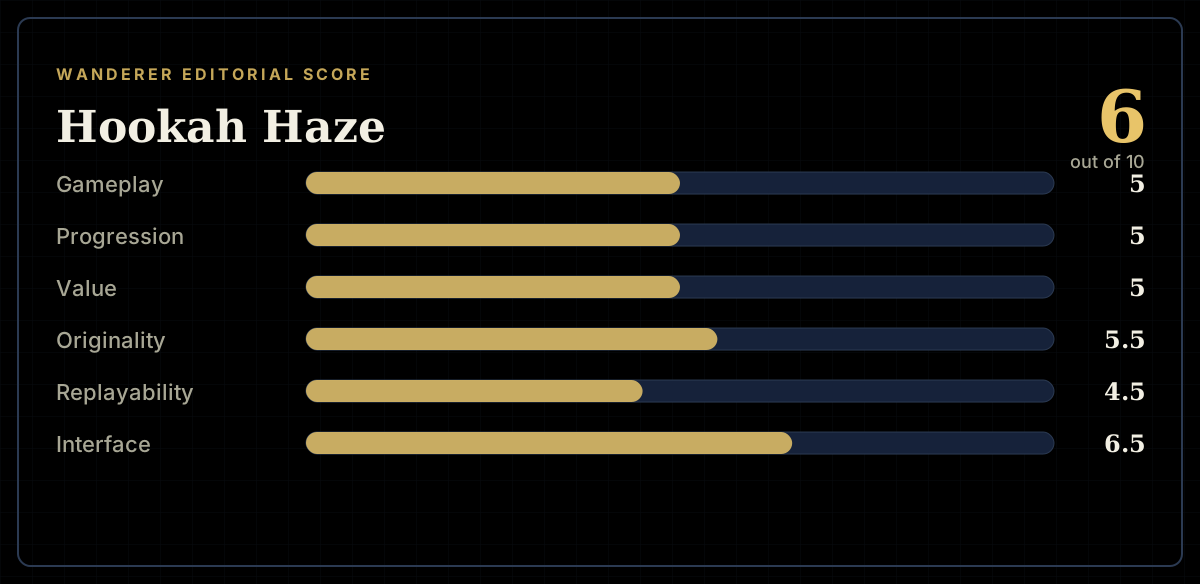
How the review scores each part of the gameWanderer Editorial -
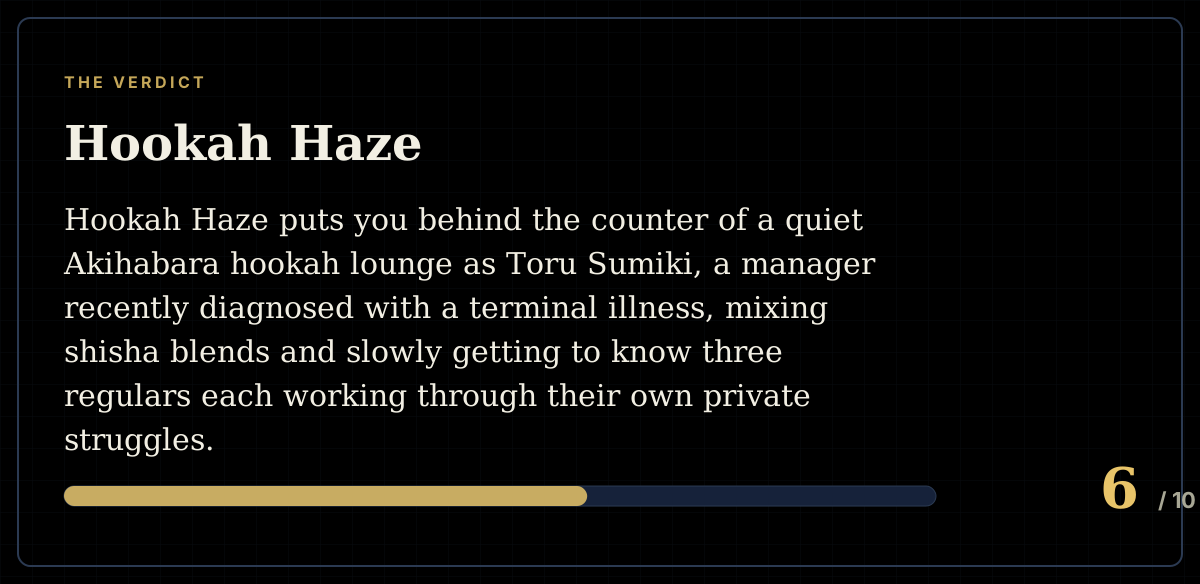
The short versionWanderer Editorial