Game review
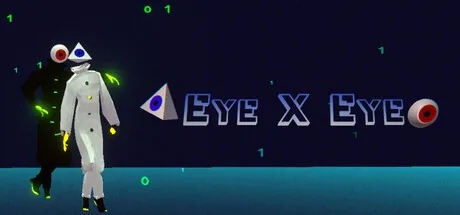
Eye X Eye
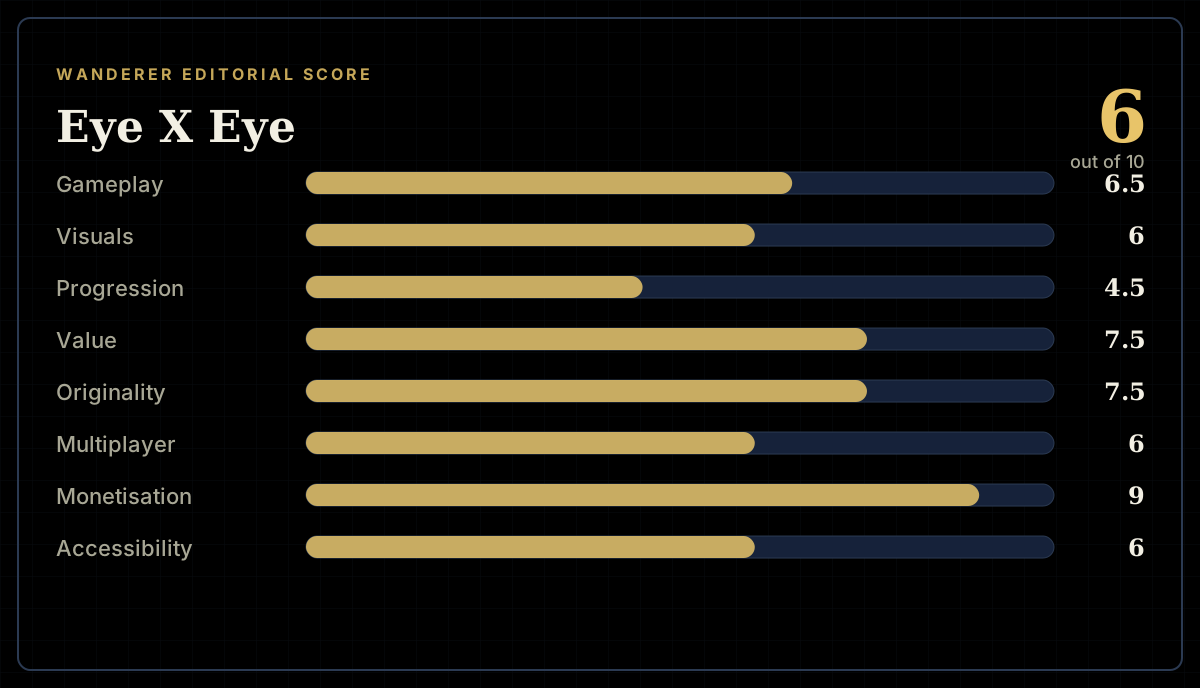
6 / 10
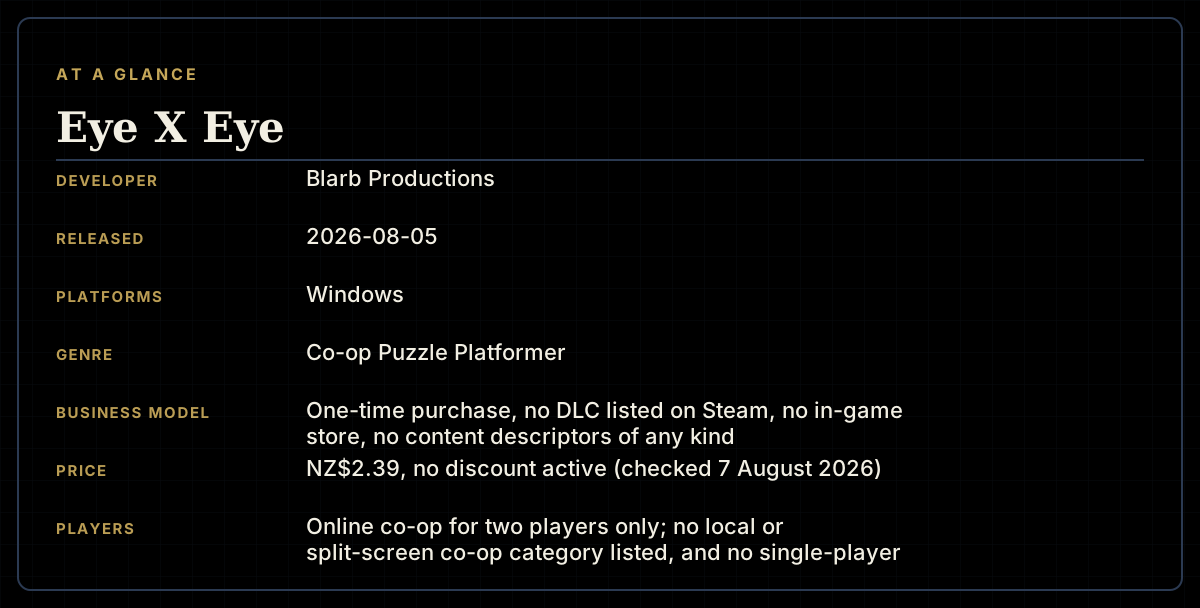
- Developer
- Blarb Productions
- Publisher
- Blarb Productions
- Released
- 5 August 2026
- Platforms
- Windows
- Genre
- Co-op Puzzle Platformer
- Monetisation
- One-time purchase, no DLC listed on Steam, no in-game store, no content descriptors of any kind
- Players
- Online co-op for two players only; no local or split-screen co-op category listed, and no single-player mode described
The short version
Eye X Eye is a two-player cooperative puzzle platformer with exactly one idea, and it's a genuinely good one: each player shoots a laser out of their own character's eye, and that beam physically pushes or pulls whoever it hits. Every obstacle in the game is built around the two of you using that beam on each other — one player anchoring the other through a gap, hauling them up a ledge, or shoving them somewhere neither of you could reach solo. Steam's own achievement list confirms the shape of the package precisely: five numbered levels plus a hidden achievement for finishing the game, nothing more and nothing hidden behind it. There is no demo, no press coverage, no Steam news post and — two days after launch — no user reviews of any kind and a current player count that read zero at the moment of checking. Blarb Productions has no other Steam listing under either its developer or publisher credit, which makes this a first release with literally no outside track record to weigh it against.
Biggest strengths
- The core mechanic — pushing or pulling your co-op partner with a beam fired from your own eye — is a genuinely distinct hook that isn't a reskin of existing push-pull or portal-style co-op puzzlers
- Steam's achievement list (Complete Level 1 through Complete Level 5, plus a hidden "Beat the game") matches the store page's claim of five levels exactly, so the advertised scope checks out against a verifiable source rather than marketing copy alone
- A one-time purchase of NZ$2.39 with no DLC, no in-game store and no content descriptors of any kind is about as low-risk a monetisation model as Steam offers
Biggest weaknesses
- No local or split-screen co-op category is listed on the store page, only "Online Co-op" — this appears to be a game you can only play with a remote partner, not on a shared couch, despite the design being built for two people physically hauling each other around
- Zero Steam user reviews and a live player-count check that returned zero exist two days after launch, so there is currently no independent account of how the puzzles, netcode or difficulty curve actually hold up
- The global achievement percentages show 16.6% of trackable players clearing Level 1 and a flat 0.0% on every level after it and on the hidden finishing achievement — too small and too fresh a sample to call a trend, but it's the only completion data that exists right now and it shows nobody yet recorded past the first level
Who it's for: Pairs who want a short, cheap, focused co-op session built around a single clever trick rather than a long campaign — the kind of thing you'd queue up for one evening with a specific friend rather than return to solo or with strangers.
Our recommendation: At NZ$2.39 for five levels built around one well-explained mechanic, the asking price matches the advertised scope honestly, and the monetisation is as clean as it gets. Nobody has reviewed it yet and nobody was recorded playing it at the time of checking, so there's no way to vouch for how the puzzles actually play in practice — buy it for the concept and the price, not on the strength of anyone else's word.
6 / 10
Most two-player puzzle platformers borrow their central trick from somewhere — a shared portal, a tethered rope, one player controlling gravity for both. Eye X Eye's trick is stranger and more direct than any of that: you fire a laser out of your own eye, and wherever it lands on your partner, it pushes or pulls them. There's no third tool, no separate ability button, no cooldown described anywhere on the store page. The beam is the entire toolkit, aimed at the other person in the level rather than at the environment, which turns every puzzle into a question of exactly where you point at your friend and for how long.
One mechanic, five levels, no padding
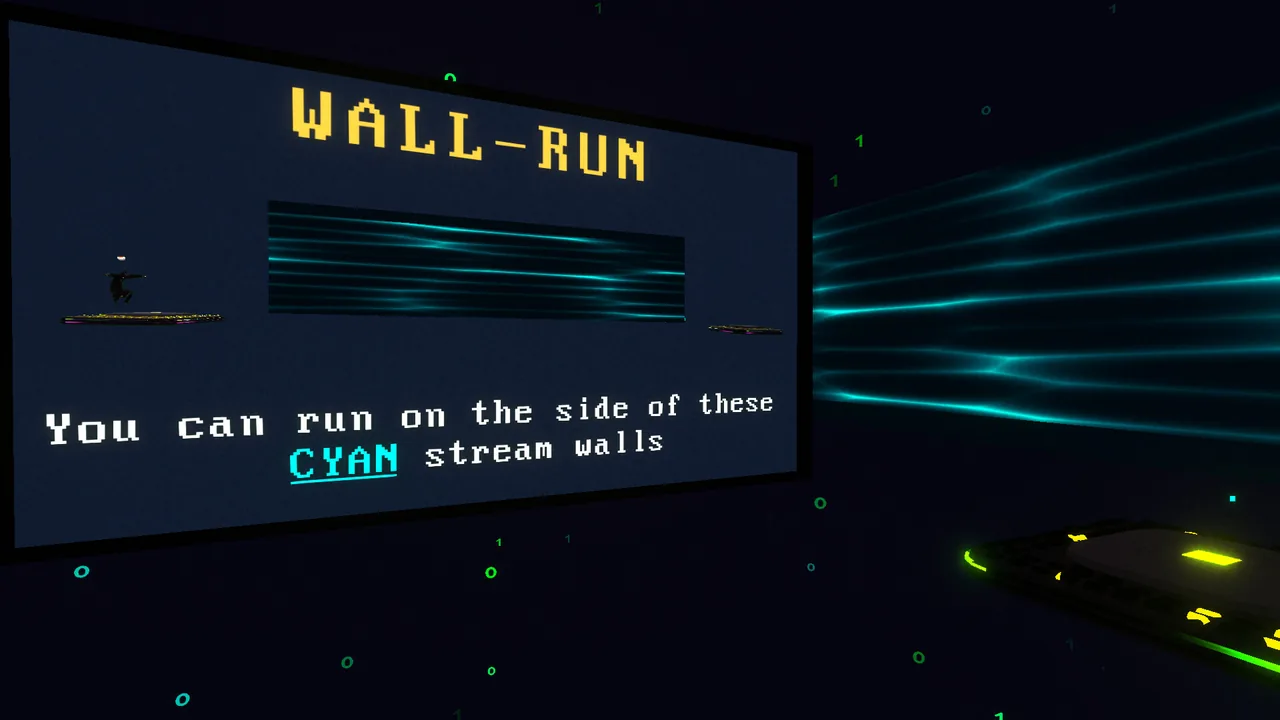
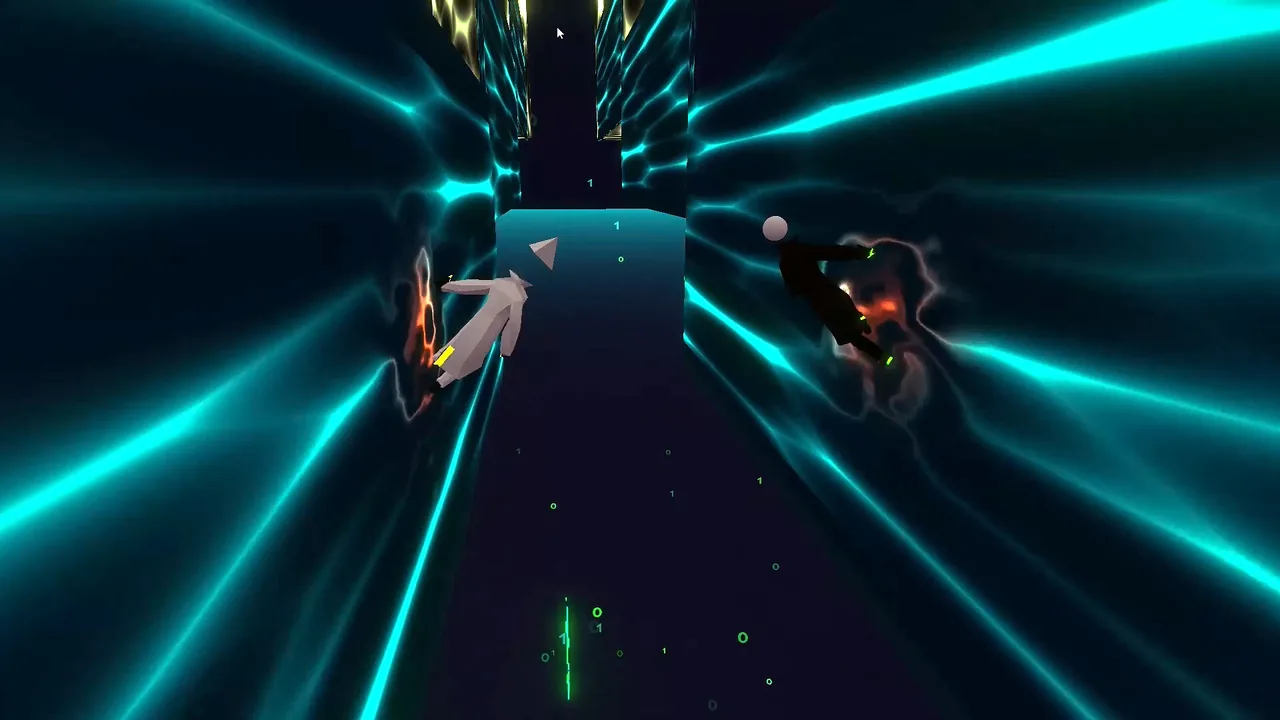
The store page's short description doesn't oversell what's here: "shoot lasers from your eye to push or pull your friend through challenges that alone would be impossible." Steam's own achievement list backs that framing up with something more concrete than marketing copy — six achievements total, one for completing each of five numbered levels and a sixth, hidden one for beating the game outright. That's useful because it's independently verifiable in a way a store page's word count isn't: whatever else is unknown about Eye X Eye, its length is not. Five levels, and the promotional video filenames captured alongside the store assets hint at what they cover — wall-running, a "choose the right path" branching section, a level built around trust and betrayal, and one that leans on pure geometry. The developer's own line about "stretching the boundaries of your friendship during tense situations" reads as a design statement as much as a joke: the beam that helps your partner across a gap is the same beam that can just as easily shove them off a ledge, and the five-level structure appears built to lean into that tension rather than avoid it.
There's a level-select lobby described as "interactive," which for a game this size is a reasonable way to give five discrete puzzle levels some sense of a shared space rather than a flat menu list. Beyond that, there's not much more structure to describe. This isn't a game with a skill tree, a currency, or optional side content — it's a short, focused delivery mechanism for one mechanic, and the achievement list is honest proof that five levels is the whole of it.
The mechanic is the pitch, and it's a good one
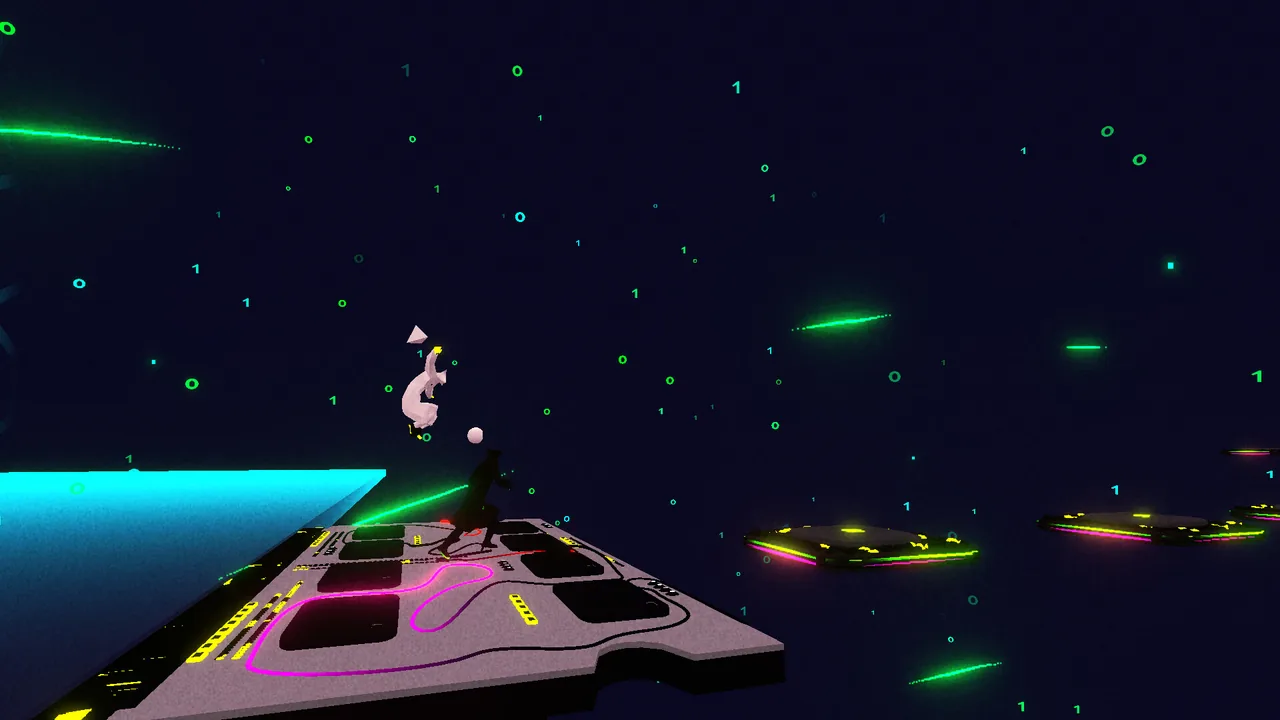
Judged purely as a design idea, aiming a push-or-pull beam at another human being — rather than at a crate, a switch or a wall, which is where most co-op puzzle games point their tools — is a genuinely distinct hook. It reframes the entire genre's usual "solve the room together" structure into something closer to "solve the room by doing things to each other," which is a sharper, more interpersonal premise than most two-player puzzlers commit to. The screenshots and captured video stills back up that this isn't just a one-note demo of the idea, either: named sections built around wall-running and multi-path choices suggest the five levels are meant to escalate the mechanic's uses rather than repeat the same puzzle shape five times.
What can't be verified yet is how well any of that actually plays — whether the beam's push and pull feel precise enough for platforming under time pressure, whether the netcode holds up over an online-only connection, or whether five levels is enough space to develop the idea before the credits roll. That's not a knock on the game specifically; it's simply the honest state of the evidence for anything released this recently.
No reviews, no players, no comparison
Two days after launch, Eye X Eye has exactly zero Steam user reviews — the query summary returns "No user reviews" outright, not a small or lopsided sample, but none at all. A direct check of Steam's GetNumberOfCurrentPlayers endpoint returned zero concurrent players at the moment of checking, which is a single dated snapshot on a brand-new online-only co-op game rather than any kind of verdict on its audience going forward — a two-player game needs two people online at the same moment to register a session at all, which naturally suppresses any count taken at a quiet hour. The global achievement percentages tell a similarly thin but not meaningless story: 16.6% of players with tracked stats have completed Level 1, and every achievement after that — Levels 2 through 5, plus the hidden finishing achievement — sits at a flat 0.0%. That's too small a sample this early to read as a real difficulty cliff, but it is the only completion data that exists right now, and at the moment of checking, nobody had been recorded finishing past the opening level.
There's also no wider context to lean on. Blarb Productions doesn't have a demo listed anywhere on Steam, no news posts have gone out through Steam's own feed, and a developer and publisher search turns up exactly one title under either credit: this game. The Steam legal notice on the store page reads "© 2024 Blarb Productions," two years ahead of the actual release date, which at least suggests the studio and its trademark predate this specific launch by some margin, even without any public record of what that time was spent on.
Two-player only, and only online
One structural point is worth being direct about: the store page lists "Online Co-op" as a category alongside general "Multi-player" and "Co-op" tags, but there's no local or split-screen co-op category anywhere. For a game whose entire premise is two people physically shoving each other around a level, that's a notable design choice — this reads as a game you play with a remote partner over the internet, not two people on the same couch. A broadband connection is also listed as a requirement in the system specs, consistent with an online-only build rather than an optional netcode layer. Controller support is similarly absent: Steam's own controller-support flags show no Xbox, PlayStation or generic gamepad support of any kind, which is a little unusual for a game built around precise directional aiming, a task many players would default to a pad for.
On the accessibility side, the picture is more generous for a two-person credited team: custom volume controls and a "Playable without Timed Input" option are both listed as store categories, meaning the game's puzzles are built to be solvable without requiring split-second reflexes even in a system that's fundamentally about aiming a beam at a moving target. Minimum system requirements are modest — an Intel Core i3 or AMD Ryzen 3, a GTX 750 Ti-class GPU, DirectX 11 and 3GB of storage — though the recommended specification jumps to 16GB of RAM and a GTX 1060, a bigger gap between minimum and recommended than a game of this visual scope would obviously suggest, and worth knowing if you're on older hardware. English and Italian are the only supported languages.
Final verdict
Eye X Eye earns a 6 for a genuinely distinct co-op idea — aiming a push-and-pull beam at your partner rather than at the environment — delivered with an honest, achievement-verified five-level scope and a monetisation model that couldn't be cleaner: NZ$2.39, one purchase, nothing else to evaluate. It doesn't score higher because there is currently no way to independently confirm how any of it actually plays: no user reviews exist at all, a player-count check returned zero, and the only completion data available shows nobody yet recorded finishing past the first level. Online-only two-player co-op with no controller support is also a real limitation for a game about physically wrangling a friend through a level. If the concept and the price are enough to get you and a specific co-op partner to try it, there's little financial risk in finding out for yourself; if you're looking for a game with an established audience or a proven difficulty curve to point to, that evidence doesn't exist yet.
Pros and cons
Pros
- The core mechanic — pushing or pulling your co-op partner with a beam fired from your own eye — is a genuinely distinct hook that isn't a reskin of existing push-pull or portal-style co-op puzzlers
- Steam's achievement list (Complete Level 1 through Complete Level 5, plus a hidden "Beat the game") matches the store page's claim of five levels exactly, so the advertised scope checks out against a verifiable source rather than marketing copy alone
- A one-time purchase of NZ$2.39 with no DLC, no in-game store and no content descriptors of any kind is about as low-risk a monetisation model as Steam offers
- Accessibility gets specific attention for a two-person debut team — custom volume controls and a "Playable without Timed Input" category are both listed, meaning reflex pressure isn't mandatory even in a game about split-second pushes and pulls
Cons
- No local or split-screen co-op category is listed on the store page, only "Online Co-op" — this appears to be a game you can only play with a remote partner, not on a shared couch, despite the design being built for two people physically hauling each other around
- Zero Steam user reviews and a live player-count check that returned zero exist two days after launch, so there is currently no independent account of how the puzzles, netcode or difficulty curve actually hold up
- The global achievement percentages show 16.6% of trackable players clearing Level 1 and a flat 0.0% on every level after it and on the hidden finishing achievement — too small and too fresh a sample to call a trend, but it's the only completion data that exists right now and it shows nobody yet recorded past the first level
- No controller support of any kind is flagged in Steam's controller-support data (no Xbox, PlayStation or generic gamepad support listed), unusual for a two-player physical-platforming game where a pad is often the natural input
- Five levels is a small package even against the very low price, and there's no meta-progression, unlockable content or replay hook described beyond finishing the campaign once
Screenshots
-
Eye X EyeImage: Blarb Productions via Steam -
Eye X EyeImage: Blarb Productions via Steam -
Eye X EyeImage: Blarb Productions via Steam -
How the review scores each part of the gameWanderer Editorial -
The game at a glanceWanderer Editorial -
The final verdictWanderer Editorial