Game review
Element TD 2 - Tower Defense
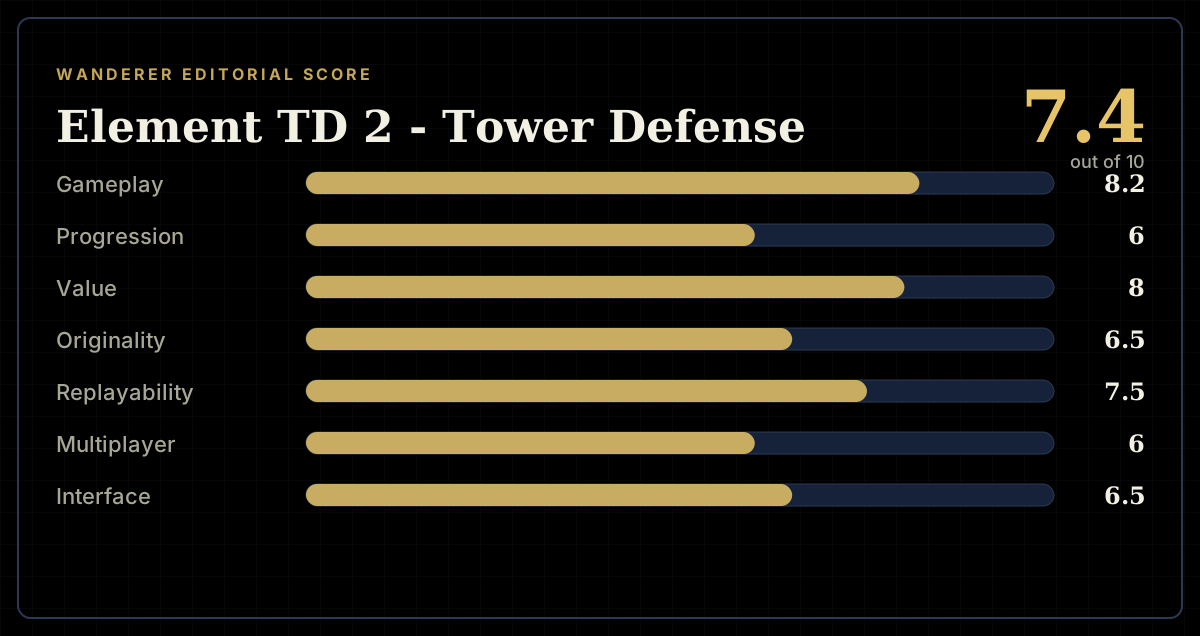
7.4 / 10
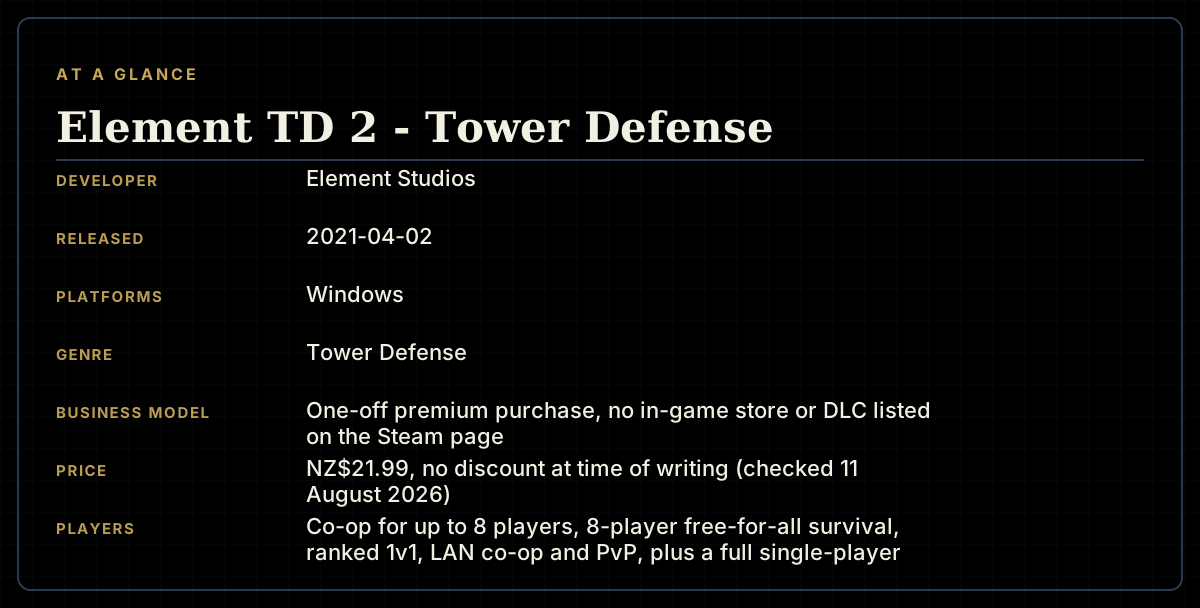
- Developer
- Element Studios
- Publisher
- Element Studios
- Released
- 2 April 2021
- Platforms
- Windows
- Genre
- Tower Defense
- Monetisation
- One-off premium purchase, no in-game store or DLC listed on the Steam page
- Players
- Co-op for up to 8 players, 8-player free-for-all survival, ranked 1v1, LAN co-op and PvP, plus a full single-player campaign and offline skirmish
The short version
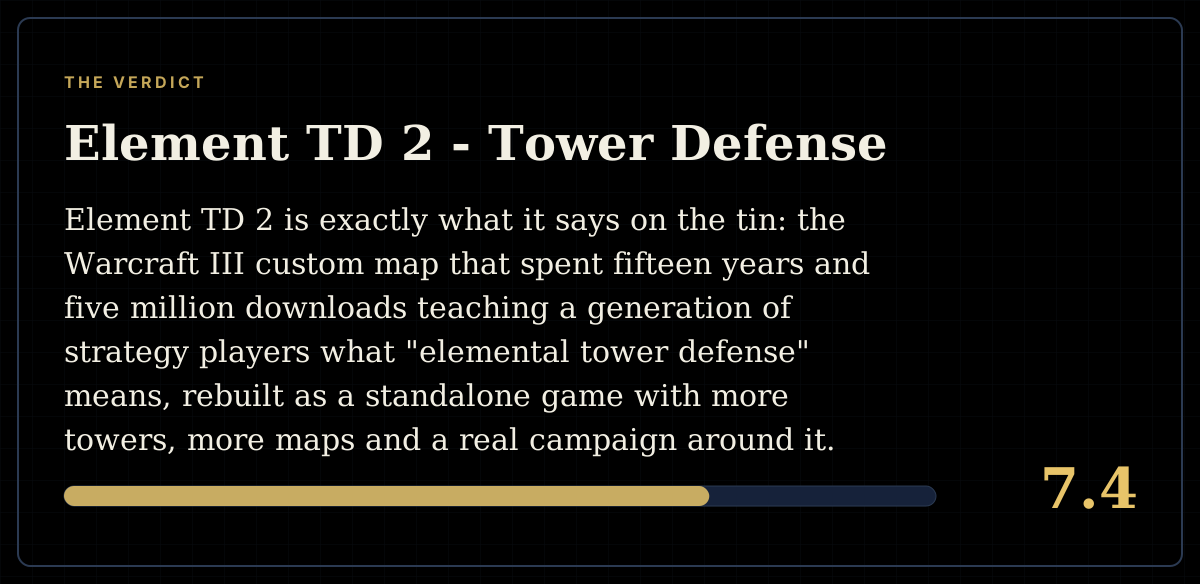
Element TD 2 is exactly what it says on the tin: the Warcraft III custom map that spent fifteen years and five million downloads teaching a generation of strategy players what "elemental tower defense" means, rebuilt as a standalone game with more towers, more maps and a real campaign around it. The core loop — mixing six elements into fifty-nine distinct towers, then mazing and re-mazing a lane against waves that punish a lazy build — is still as sharp as it was on Battle.net, and at 91% positive across 1,650 reviews the Steam audience largely agrees. What has aged less well is everything built around that loop: a campaign that makes you commit to towers before you can see the map they're defending, achievement completion that falls off a cliff after the first mission, and a population thin enough that ranked and free-for-all modes can be hard to fill outside peak hours. None of that undoes fifteen years of design work on the core system, but it does mean the parts Element TD 2 added on top of the mod are the parts most likely to frustrate a new player.
Biggest strengths
- Fifty-nine towers built from six combinable elements give genuinely deep, replayable build variety most tower defense games never attempt
- Direct lineage to a fifteen-year-old, five-million-download Warcraft III mod means the core mazing-and-elemental-matchup loop is proven, not a first draft
- Co-op for up to 8 players and a 28-mission campaign give solo and group players separate, substantial reasons to keep playing
Biggest weaknesses
- The campaign forces a tower build before you can see the map's layout or enemy composition, turning early strategy into guesswork rather than a real decision
- Concurrent player counts are low enough that ranked and free-for-all lobbies can be slow to fill outside peak hours, undercutting a game built around multiplayer modes
- Achievement data shows a steep drop-off after the first campaign mission, and negative reviews consistently cite difficulty spikes and unclear UI feedback on why a wave went wrong
Who it's for: Warcraft III mod veterans looking for the game their custom map became, and tower defense players who want genuine build-order depth rather than a simple lane-and-upgrade loop.
Our recommendation: Worth the asking price for the tower system alone, but go in expecting a thin live population outside peak hours and a campaign that front-loads its most annoying design choice — commit to a build before you've seen the map.
7.4 / 10
Introduction
Element TD is one of those Warcraft III custom maps whose influence outran the engine it was built on. Since 2005 it went through iteration after iteration across Warcraft III, StarCraft II and Dota 2, racking up more than five million downloads along the way, before Element Studios — founded specifically to carry it forward — took it out of other people's engines entirely. Element TD 2 entered Steam Early Access in February 2020 and left it for a full 1.0 release in April 2021, and what shipped is recognisably the same game a whole generation of custom-map players grew up on, just built from scratch as its own product: six elements, dozens of towers, maze-heavy maps and a mode list built around playing with other people rather than against a static AI.
Gameplay
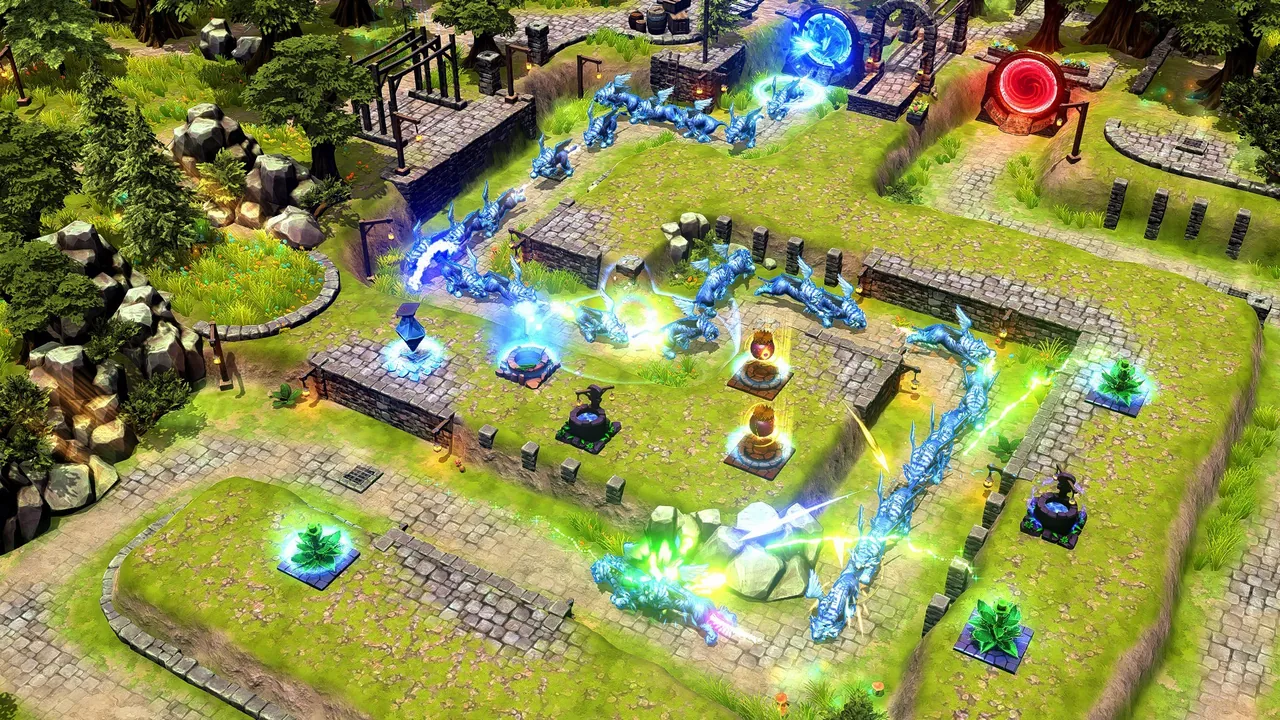
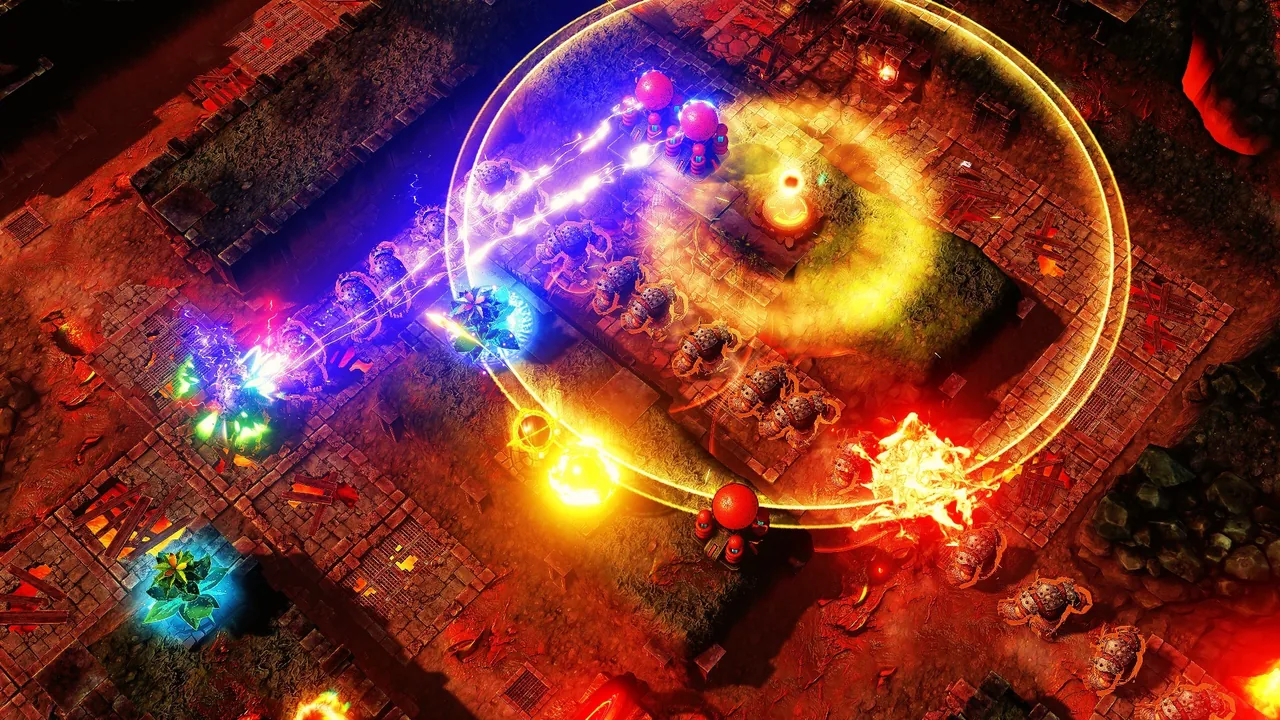
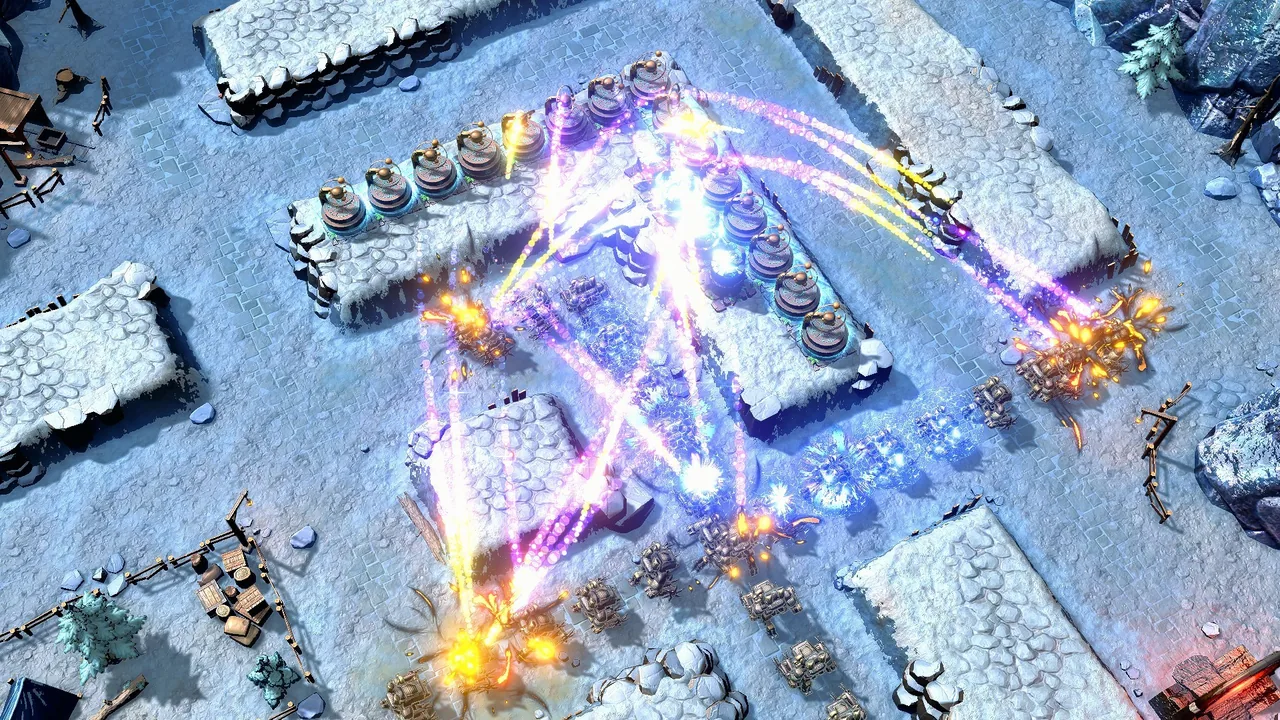
The pitch is short: combine towers from six elements — Earth, Fire, Water, Air, Light and Dark — to counter waves of creeps that each carry their own elemental strengths and weaknesses, and place them along a track you're usually allowed to reshape yourself. Fifty-nine towers exist once every dual- and tri-element combination is unlocked, and the game's real depth sits in choosing which combinations to commit gold to before you know exactly what a later wave will throw at you. That's the part the mod always got right and Element TD 2 hasn't lost: an elemental rock-paper- scissors layer sitting on top of standard tower defense fundamentals, deep enough that Steam reviewers with thousands of hours logged are still finding new builds worth trying. Maze-style maps where you build the creep's path out of your own towers add a second layer most straight lane-defense games skip entirely, rewarding players who think about geometry as much as elemental matchups.
Where the game works against itself is the campaign's pacing. Several of its 28 missions ask you to lock in a tower build before the map — and sometimes the enemy composition — is fully visible, turning what should be a strategic decision into an educated guess repeated on failure. One recurring complaint in user reviews is having to fully re-spec a loadout between missions with no real payoff beyond starting the next one from scratch; it reads as busywork layered onto a system that's more fun when you're reacting to what you can actually see. Difficulty spikes compound it — achievement data (more below) shows completion cratering after the first couple of campaign missions, which lines up with negative reviews describing a wall rather than a ramp.
Multiplayer
Co-op for up to eight players is the mode Element TD 2 is clearly built around, letting a group split elemental responsibilities across a shared maze the way the original mod's best matches always worked. Eight-player free-for-all survival and ranked 1v1 round out the competitive side, with LAN options for co-op and PvP alike. The mechanical design of all of it holds up. The problem is finding enough people to fill it: a live player-count check at the time of writing showed double digits online, and multiple recent reviews specifically call out ranked being gated behind level 15 while regular lobbies aren't reliably active enough to reach that level in the first place. A tower defense built this heavily around cooperative and competitive multiplayer needs a population to match, and outside whatever counts as this game's peak hours, that population is thin.
Progression
Outside the campaign, progression runs through unlocking the full tower roster, chasing an enormous achievement list — 456 tracked achievements spanning every map, difficulty and modifier combination — and leaderboards for players chasing optimal clears. That breadth is generous for anyone who wants hundreds of hours of goals, but the completion curve tells its own story: the single most-earned achievement, finishing the first campaign mission, sits a little above half of all players, and it falls away fast from there. That's consistent with a game whose core system rewards mastery more than it eases newcomers into it — good news for the players it retains, less good for the ones it doesn't.
Interface
The UI carries a lot of information — element matchups, upgrade paths, wave composition — and several long-time reviewers note it doesn't always surface the right piece of that information at the moment a decision needs it. A specific, repeated complaint is not being able to check the tower or matchup guide while a single-player match is paused, which matters more here than in most tower defense games because build decisions are the entire point. None of this is a broken interface, but for a game this dependent on legible matchup information, small friction adds up.
Value
NZ$21.99 for the full roster of towers, the campaign, co-op, ranked and free-for-all modes, no DLC split and no in-game store is a fair price for a game with this much system depth on offer, and it undercuts most tower defense titles trying to sell the same modes-and-maps breadth through smaller paid add-ons. Whether that value is fully realised depends on multiplayer population holding up, which is the one thing a purchase price can't fix.
Verdict
Element TD 2 does right by the mod it's descended from: the elemental tower system is deep, proven and still the reason people are logging thousands of hours on Steam a year and a half from its 1.0 release. What surrounds that system — a campaign that asks for commitment before information, a UI that doesn't always show the right thing at the right time, and a live population that can't always fill the multiplayer modes the game is built around — is where a new player is most likely to bounce off. Fans of the original mod already know what they're getting; tower defense players coming in fresh should expect a genuinely deep build system wrapped in a few rough edges its own community has been flagging for years.
Pros and cons
Pros
- Fifty-nine towers built from six combinable elements give genuinely deep, replayable build variety most tower defense games never attempt
- Direct lineage to a fifteen-year-old, five-million-download Warcraft III mod means the core mazing-and-elemental-matchup loop is proven, not a first draft
- Co-op for up to 8 players and a 28-mission campaign give solo and group players separate, substantial reasons to keep playing
- No in-game store, no DLC split — one purchase, everything included
Cons
- The campaign forces a tower build before you can see the map's layout or enemy composition, turning early strategy into guesswork rather than a real decision
- Concurrent player counts are low enough that ranked and free-for-all lobbies can be slow to fill outside peak hours, undercutting a game built around multiplayer modes
- Achievement data shows a steep drop-off after the first campaign mission, and negative reviews consistently cite difficulty spikes and unclear UI feedback on why a wave went wrong
- Several vocal reviews cite friction with the developers on the game's own Discord, separate from anything in the game itself but visible enough to colour recent reception
Screenshots
-
Element TD 2 - Tower DefenseImage: Element Studios via Steam -
Element TD 2 - Tower DefenseImage: Element Studios via Steam -
Element TD 2 - Tower DefenseImage: Element Studios via Steam -
How the review scores each part of the gameWanderer Editorial -
The specsWanderer Editorial -
The short versionWanderer Editorial