
Game review
Dota Underlords
5.5 / 10
- Developer
- Valve
- Publisher
- Valve
- Released
- 20 June 2019
- Platforms
- Windows
- Genre
- Strategy
- Monetisation
- Free-to-play with an optional, cosmetic-only battle pass
- Players
- true
The short version
Dota Underlords took the auto-battler formula that exploded out of a Dota 2 community mod and gave it Valve's own full production values: crossplay across PC and mobile, a City Crawl singleplayer campaign, ranked matchmaking, and a battle pass that never gates gameplay behind a paywall. It received real, substantive balance work for about eighteen months after launch, then Valve simply stopped — no closure announcement, no final update, just silence that has now lasted more than five years. A meaningful playerbase, in the low thousands concurrently, is still logging in regardless.
Biggest strengths
- A full-featured auto-battler built with real production values: a City Crawl singleplayer campaign, ranked matchmaking, private tournament lobbies, and genuine crossplay between PC and mobile with shared progression
- A battle pass monetisation model that explicitly does not gate any gameplay advantage behind payment, with the majority of its rewards earnable for free through normal play
- Real, substantive balance patches for roughly eighteen months after its Early Access launch, addressing specific hero and alliance interactions rather than shipping only superficial fixes
Biggest weaknesses
- No update of any kind since 19 November 2020, with no closure announcement, sunset notice, or public explanation from Valve for the silence
- The live Steam review system returns zero accessible reviews for this title despite historical third-party data suggesting a review corpus in the tens of thousands, a discrepancy this review could not resolve or explain
- No Steam achievement schema exists at all, removing one of the few remaining objective signals available for gauging how deeply the current playerbase engages with its systems
Who it's for: Auto-battler fans who want Valve's take on the format specifically, and who don't mind playing a game its own developer has visibly moved on from.
Our recommendation: Worth trying for free if the auto-battler hook appeals — just go in knowing nobody is actively balancing or expanding it anymore.
5.5 / 10
What it is
Dota Underlords is Valve's own auto-battler, built on the Dota 2 hero roster and set in White Spire, a fictional city thrown into a power vacuum after the death of its underworld matriarch, Momma Eeb. The genre itself — recruit units, position them on a board, and watch them fight automatically each round while you plan the next round's roster between fights — originated as a community-made Dota 2 mod, Dota Auto Chess, that became a genuine phenomenon in early 2019. Valve's response was to build its own official, polished version of the format rather than simply let the community mod stand alone, and Underlords entered Early Access on 20 June 2019 with the production values that implies: hero alliances that unlock bonuses when stacked together, four selectable "Underlord" units with their own abilities fighting alongside the player's recruited crew, full crossplay between PC and mobile with shared account progression, ranked matchmaking, and private lobbies for tournament-style spectated matches. A singleplayer "City Crawl" campaign structures progression through the same underworld-takeover narrative, and its monetisation is genuinely restrained by industry standards: a $4.99 battle pass exists, but Valve's own description states plainly it provides no gameplay advantage, and most of its rewards are earnable simply by playing.
The game left beta and exited Early Access into a full "Season One" release around March 2020, according to Valve's own dated post-mortem, "Wot I Think (now it's left beta)." Real, detailed balance patches continued after that point — the final documented update, dated 19 November 2020, adjusts specific hero abilities and alliance bonuses with the same granular care as earlier patches, addressing damage values, cooldowns and bug fixes rather than reading as a token final gesture. Nothing has followed since. Over five years of silence, with no announcement of cancellation, sunset, or reduced support — the game simply stopped receiving attention from its own developer at some point after that last patch, without comment.
A review built around an unusual gap
This review needs to state plainly, up front, an anomaly this lane hasn't encountered before even among its other zero-signal cases: Dota Underlords currently returns zero reviews through Steam's live review API, despite third-party historical data suggesting a corpus numbering in the tens of thousands accumulated during its active years. Repeated queries, with and without language filters, all return an empty result. This review cannot explain that discrepancy — there's no delisting notice, no indication the game was pulled from sale, and the store page loads normally as a live, free-to-play title. It's reported here as an honest limitation rather than papered over: whatever happened to make years of accumulated player testimony inaccessible, this review has no way to recover or account for it, and what follows leans entirely on Valve's own documentation and confirmed development history rather than any player's independent account.
A genre pioneer's product, quietly parked
What can be said with confidence is the shape of the story Valve's own patch history tells. Underlords had a real, active development period of roughly a year and a half — regular named updates through 2019 and 2020, addressing balance, adding content like the City Crawl campaign and Battle Pass seasons, and fixing bugs with specific technical detail in the patch notes themselves. Then, at a specific, identifiable point, that stopped entirely. No other 2019-era title checked in this lane has as complete and prominent a developer behind it as Valve, which makes the abruptness and duration of the silence more notable, not less — a genre Valve helped legitimise with its own official entry has since been left to run entirely on momentum, with real competitors like Teamfight Tactics receiving years of continued content that Underlords never got.
And yet the game hasn't gone empty. A live check of concurrent players recorded just over a thousand people actively in-game at the time of this review — a modest number by the standards of Valve's biggest titles, but a genuinely meaningful surviving audience for a multiplayer game whose own developer has been silent for half a decade. That combination — real abandonment, but real continued play — is its own small story about how a well-built core loop can retain a dedicated niche audience with zero ongoing investment required to sustain it, even without fresh content ever arriving.
What the design choices suggest about depth
Even without player testimony to draw on, Valve's own described feature set reveals real design ambition that goes beyond a quick cash-in on a trending genre. The four selectable Underlords each bringing distinct abilities and playstyles is a meaningfully deeper hook than a generic auto-battler needs to offer — it adds a strategic layer on top of the standard recruit-and-position loop, since choosing an Underlord shapes what kind of board a player is building toward from the very start of a match. The alliance system, where stacking specific combinations of recruited heroes unlocks bonus effects, is the genre's now-standard mechanism for rewarding planning over random luck, and Valve's patch notes show real, ongoing attention paid to keeping specific alliance combinations (Brute, Rogue, Scaled, Troll, and others named in the final documented patch) balanced against each other rather than left to calcify into a single dominant strategy.
The crossplay implementation is also worth noting as a genuinely forward-looking feature for 2019: shared progression between PC and mobile, letting a match started on one device continue on another, was an ambitious technical undertaking for the auto-battler genre at a time when most competitors were single-platform. That Valve built and shipped this rather than a more limited PC-only version suggests the game was conceived with real long-term ambitions for its audience, which makes the eventual, unexplained stop in development more of a genuine loss than it might be for a smaller, more modestly-scoped competitor.
Verdict
Dota Underlords is a well-built, free, full-featured take on the auto-battler genre with genuinely fair monetisation and real polish from its active development period. What it isn't, five years on, is a living game in any meaningful sense: no updates, no announced future, and — strangely for a release this size — no accessible player reviews to check against Valve's own account of what the game offers. Worth trying for free specifically because the core format holds up on its own merits, but go in understanding that whatever balance or content gaps exist today are permanent rather than pending a fix.
Pros and cons
Pros
- A full-featured auto-battler built with real production values: a City Crawl singleplayer campaign, ranked matchmaking, private tournament lobbies, and genuine crossplay between PC and mobile with shared progression
- A battle pass monetisation model that explicitly does not gate any gameplay advantage behind payment, with the majority of its rewards earnable for free through normal play
- Real, substantive balance patches for roughly eighteen months after its Early Access launch, addressing specific hero and alliance interactions rather than shipping only superficial fixes
- A meaningful surviving playerbase — over a thousand concurrent players recorded at the time of this review — despite years of total silence from the developer
Cons
- No update of any kind since 19 November 2020, with no closure announcement, sunset notice, or public explanation from Valve for the silence
- The live Steam review system returns zero accessible reviews for this title despite historical third-party data suggesting a review corpus in the tens of thousands, a discrepancy this review could not resolve or explain
- No Steam achievement schema exists at all, removing one of the few remaining objective signals available for gauging how deeply the current playerbase engages with its systems
- Development stopped at a moment when the auto-battler genre's biggest competitors (Teamfight Tactics chief among them) were still actively expanding, leaving Underlords increasingly outdated by comparison with no response from its own developer
Screenshots
-

Dota UnderlordsImage: Valve via Steam -

Dota UnderlordsImage: Valve via Steam -

Dota UnderlordsImage: Valve via Steam -
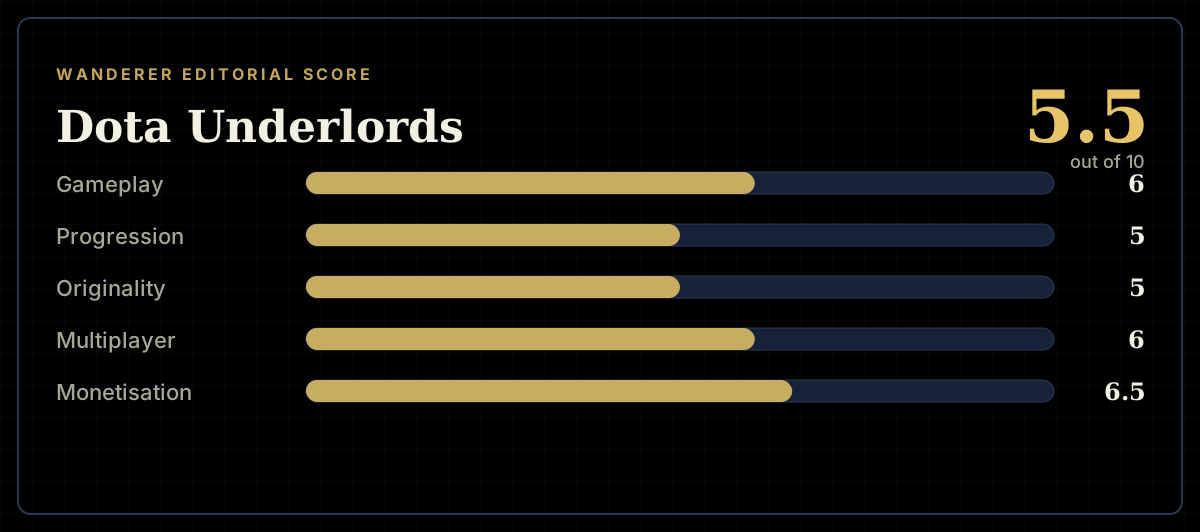
How the review scores each part of the gameWanderer Editorial -
The short versionWanderer Editorial