Game review
Dota 2
8 / 10
- Developer
- Valve
- Publisher
- Valve
- Released
- 9 July 2013
- Platforms
- Windows, macOS, Linux
- Genre
- MOBA / Competitive Strategy
- Monetisation
- Free, with every hero available from the first match. Revenue comes from cosmetics and event bundles; only two paid items appear on the Steam store page. Nothing sold affects match outcomes in any way. Checked 4 August 2026.
- Players
- Online PvP only — five-versus-five matches with ranked and unranked queues
The short version
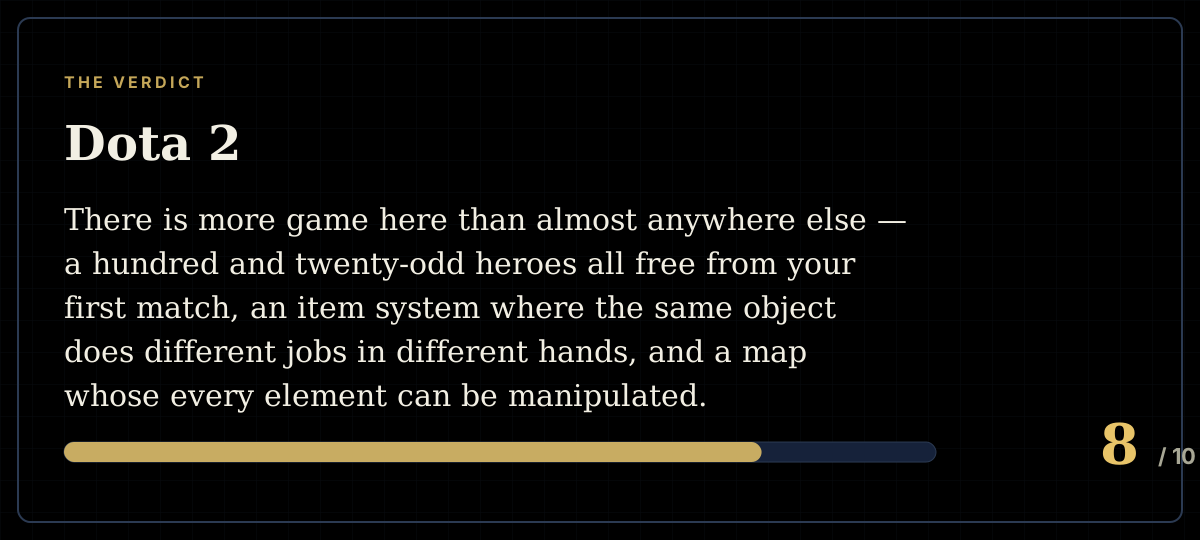
There is more game here than almost anywhere else — a hundred and twenty-odd heroes all free from your first match, an item system where the same object does different jobs in different hands, and a map whose every element can be manipulated. Valve have never sold a competitive advantage in thirteen years, which after the last few games I've priced is worth stopping to appreciate. What it asks in return is enormous: hundreds of hours before you understand what's happening, forty-minute matches you can lose through no fault of your own, and a community with a well-earned reputation for cruelty. The people who get through that stay for a decade. Most people don't get through it.
Biggest strengths
- Complete access from the first match — every hero free, forever, with no unlock grind and no hero purchases
- Nothing sold affects a match, in thirteen years, which almost nothing else at this scale can say
- Genuine strategic depth, where item choice, lane assignment and map control interact in ways that still produce new ideas after a decade of professional play
Biggest weaknesses
- The new-player experience is genuinely punishing, with an information load that takes hundreds of hours to parse
- Toxicity is the single most consistent complaint in the review corpus, spanning every year of the game's existence
- Matches run around forty minutes and can be decided by teammates rather than by your own play
Who it's for: Players who actively want a game they can study for years, ideally arriving with friends who already play. Not for anyone looking for a casual evening, not for solo newcomers, and not for players who need to feel competent quickly.
Our recommendation: If you're going to try it, bring friends who play and let them teach you — the single biggest predictor of whether someone stays is whether they arrived with a group. Play Turbo mode first; matches are half the length and the punishment for mistakes is far lower. And decide in advance that your first hundred hours are tuition, not entertainment. If that sounds unreasonable, it is, and there's no shame in choosing a different game.
8 / 10
The median person who reviewed Dota 2 recently has 1,078 hours in it. One of them has 22,927 — about two and a half years of continuous play, if you never slept.
I've been pricing storefronts all week. War Thunder's add-ons come to over two thousand New Zealand dollars; The Sims 4's to nearly sixteen hundred. Dota 2 has two paid items on its Steam page, gives you every one of its heroes from your first match, and has never in thirteen years sold anything that affects the outcome of a game.
Both of those facts are the same fact, and it's the most interesting thing about this game.
What you get for nothing
Complete access. That's genuinely rare and worth dwelling on, because the genre's other giant made its name on a hero-unlock treadmill. Here, the newest hero and the oldest are equally available to an account created five minutes ago, and the only thing money buys is how your character looks.
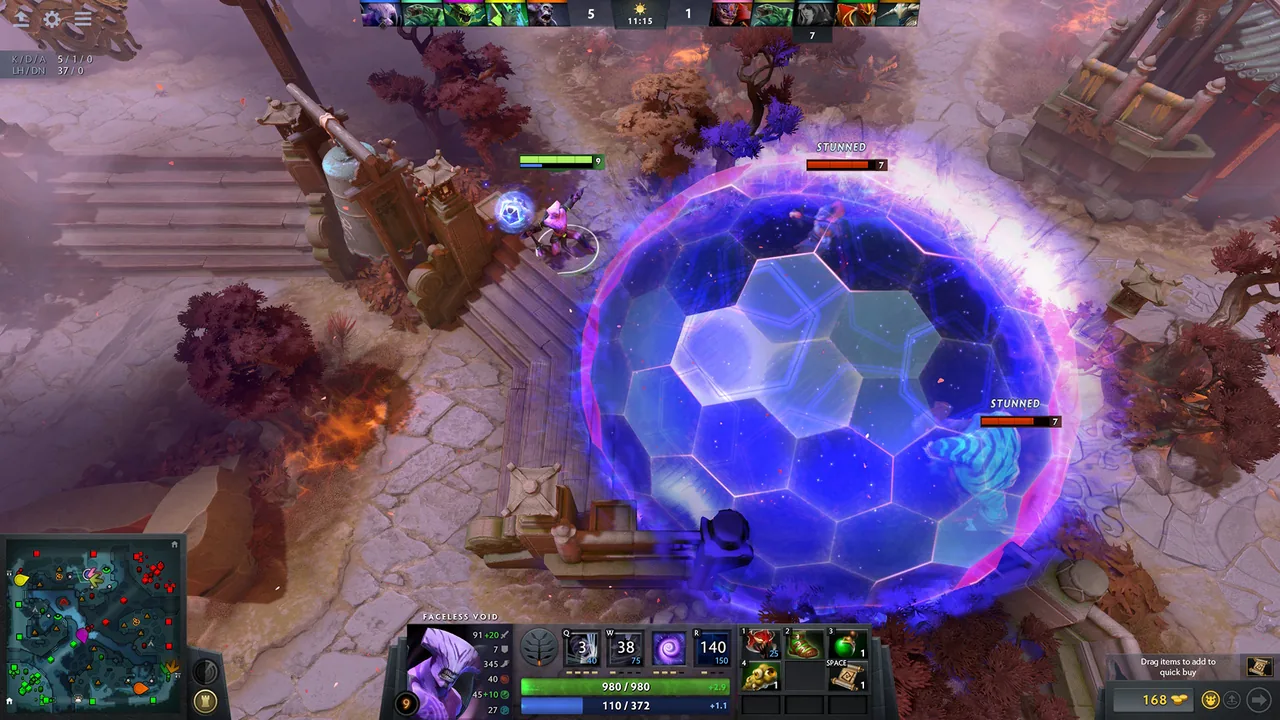
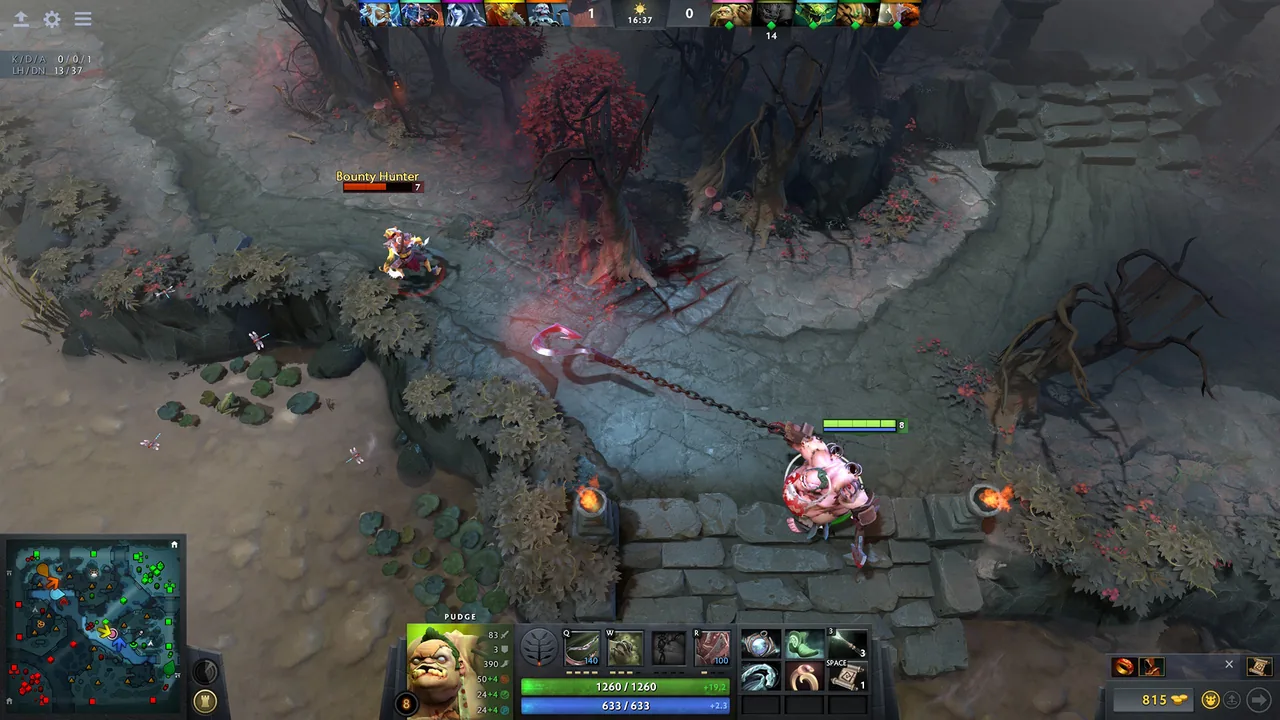
What that access opens onto is one of the deepest competitive systems ever built. Heroes have abilities that interact rather than merely stack. Items aren't a power ladder but a toolbox — the same item is a defensive purchase on one hero and an offensive one on another. The map itself is a resource: vision, terrain, creep equilibrium, the timing of a rune. Professional play still surfaces strategies nobody had thought of, thirteen years in, which is not something you can say about many games.
Valve keep working on it. A gameplay patch and a substantial story event both landed in mid-2026, and balance changes arrive regularly enough that the metagame genuinely moves. It runs on Windows, macOS and Linux, and it runs well.
For zero dollars, that's an extraordinary offer.
What it costs instead
Time, and quite a lot of dignity.
The new-player experience is the worst part of Dota 2 and always has been. A reviewer with 125 hours described it as an over-abundance of gimmicky abilities and crowd control, which is unfair as analysis and completely fair as a description of how it feels. There are over a hundred heroes, each with several abilities, any of which may be on the enemy team. Knowing what's about to happen to you requires knowing all of them. That knowledge is not optional — it's the difference between playing and being played with — and acquiring it takes hundreds of hours.
Then there's the shape of a match. Around forty minutes, five players a side, and the honest complaint that a player with 1,450 hours put plainly: even if you play exactly right, if your team is bad you lose. That's true of team games generally, but forty minutes is a long time to spend discovering it, and Dota offers almost no way to spend less.
And the community. This is the single most consistent thread in the review corpus, present in every year from 2013 to 2026 — verbal abuse, report-spam, newcomers driven out of games for not knowing what they couldn't yet know. A player returning in 2026 after a long absence summarised it in eight words: still the same old toxic community. Valve have built behaviour scores, mute systems and penalty queues, and reviewers with thousands of hours still describe the systems as inconsistent and the environment as hostile.
Why the complexity is load-bearing
It's easy to write off Dota's difficulty as bloat, and the criticism that recent maps are overloaded has some merit. But most of the complexity here is doing work, and it's worth explaining why, because it's the difference between a hard game and a badly-designed one.
Take the item system. In most games with equipment, items are a power curve — the later one is strictly better. In Dota an item is a verb. A Blink Dagger is an escape on a fragile hero and an initiation on a durable one. Force Staff can save an ally or push an enemy into your team. Buying the counter to the thing that's killing you is a legitimate strategy that shifts a losing game, and that only works because items answer each other rather than out-scaling each other.
The same logic runs through the map. Vision isn't a stat, it's terrain you contest with wards. Creep equilibrium — where the two waves meet — is something you actively manage, and pulling it toward your tower is a defensive act. Even your own gold is manipulable: dying costs it, and denying your own dying creeps stops the enemy earning it.
What that produces is a game where the interesting decisions aren't at the character-select screen, they're in the twenty-eighth minute when you notice the enemy carry has no answer to a specific item and you have ninety seconds of gold to spare.
That's why the hundred-hour tuition isn't arbitrary. You aren't memorising trivia — you're learning a vocabulary of interactions large enough that the strategic space stays open after a decade of professional scrutiny. Games that are easy to learn close that space quickly.
None of which obliges you to pay the tuition. It just means the wall is made of something, and the players on the other side of it aren't pretending.
What the review data actually shows
One thing worth noting for anyone reading the store page: no single negative review of Dota 2 has rallied meaningful support. On a corpus of 2.75 million, the most-upvoted criticisms have a handful of votes each.
That's unusual, and I think it's informative. Games with a specific broken thing produce a concentrated, heavily-upvoted complaint — the way War Thunder's economy or The Sims 4's DLC pricing do. Dota's dissatisfaction is diffuse: thousands of people individually finding it too hard, too long, too unkind, with nobody rallying around a single fixable grievance.
That's the profile of a game that isn't broken, just enormously demanding. Current sentiment sits at 66% of recent English reviews against 81% lifetime, which is a slow drift rather than a crisis.
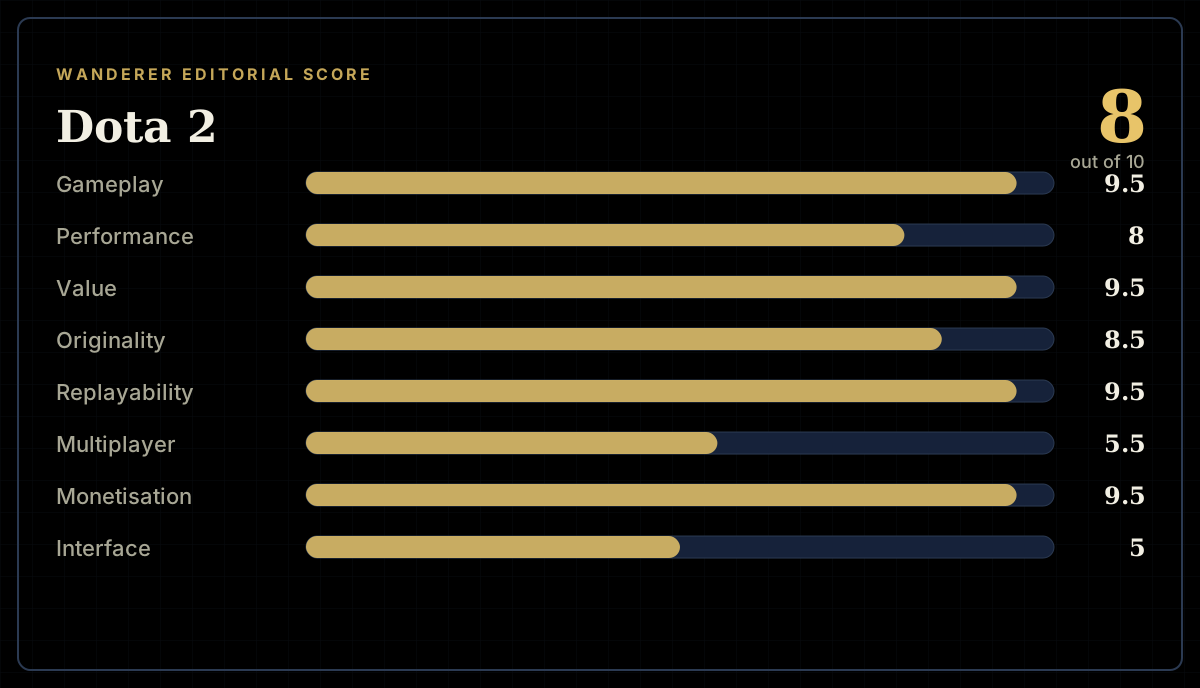
8.0 out of 10. Rated 8.0 out of 10.
As a piece of design, Dota 2 is close to unmatched, and as a business it's a rebuke to almost everything else I've reviewed this week — free, complete, unmonetised where it counts, and still being improved thirteen years on. If you want a game to be your hobby rather than your evening, there may be no better candidate anywhere.
Two points come off for the barriers, and they're real barriers rather than snobbery. A game that requires hundreds of hours before it makes sense, in matches you can't leave, surrounded by people who will tell you exactly what they think of your mistakes, has excluded most of the people who might have loved it. That's a design outcome, not bad luck, and Valve have never seriously prioritised fixing it.
If you have friends who play, install it tonight — you'll be fine, and you may not stop for a decade. If you don't, understand what you're signing up for. The thousand-hour median isn't a boast. It's the entry fee.
Pros and cons
Pros
- Complete access from the first match — every hero free, forever, with no unlock grind and no hero purchases
- Nothing sold affects a match, in thirteen years, which almost nothing else at this scale can say
- Genuine strategic depth, where item choice, lane assignment and map control interact in ways that still produce new ideas after a decade of professional play
- Still actively developed by Valve, with balance patches and substantial story events shipping through 2026
- Free, cross-platform, and native on Linux and macOS
- Engagement figures unlike anything else — the median recent reviewer has over a thousand hours
Cons
- The new-player experience is genuinely punishing, with an information load that takes hundreds of hours to parse
- Toxicity is the single most consistent complaint in the review corpus, spanning every year of the game's existence
- Matches run around forty minutes and can be decided by teammates rather than by your own play
- Matchmaking and behaviour-penalty systems draw persistent criticism, including from players with thousands of hours
- Complexity has continued to increase, and even veterans describe recent maps as overloaded
- Effectively impossible to play casually — there is no short-session version of this game outside Turbo mode
Screenshots
-
Dota 2Image: Valve via Steam -
Dota 2Image: Valve via Steam -
Dota 2Image: Valve via Steam -
How the review scores each part of the gameWanderer Editorial -
The short versionWanderer Editorial